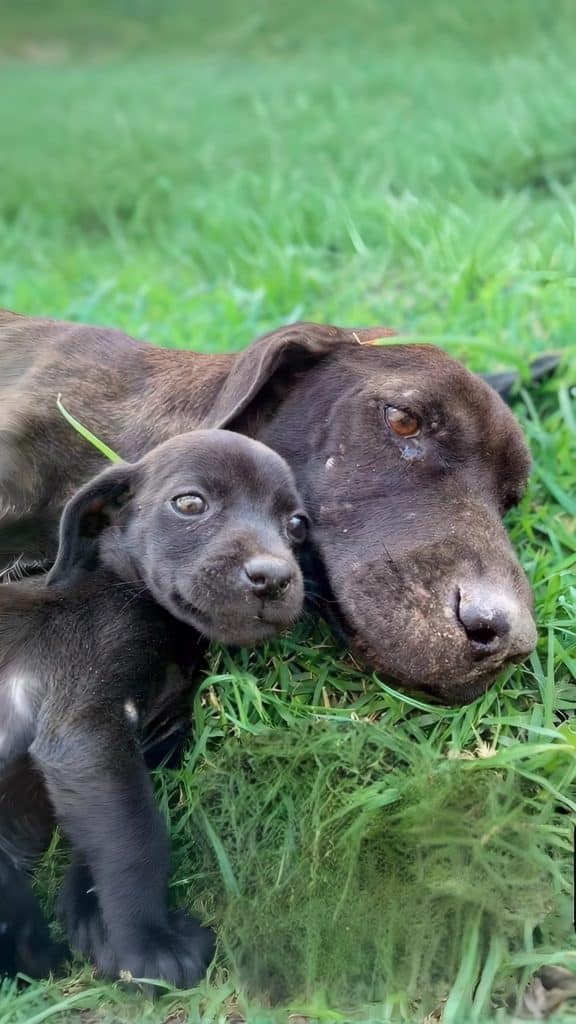
Paola looked exhausted before anyone even came close.
She was lying on the ground, barely moving.
Her body was dangerously thin.
Every rib could be seen beneath her dull coat.
Her breathing was slow, and even lifting herself appeared to take more energy than she could comfortably give.
At first, rescuers thought there was only one puppy beside her.
Then they looked around more carefully.
There were two more.
Three tiny puppies in total.
All of them were weak.
All of them were depending on a mother whose own body had almost nothing left.
And somehow, Paola had remained beside them.
There Were Three Puppies, Not One
The first puppy was easy to see because he stayed close to Paola.
The other two were nearby.
When rescuers discovered them, the situation immediately became more urgent.
This was not one exhausted dog needing help.
It was an entire family.
The puppies were small and fragile.
Their bodies lacked the energy expected from healthy young dogs.
Paola was in even worse condition.
Whatever food she had managed to find had not been enough to maintain her own body while caring for three growing puppies.
Still, she stayed close.
She checked on them.
She remained nearby whenever they moved.
The rescuers understood that all four dogs needed to leave the area together.
VIDEO: Paola Had Almost No Strength Left — But Three Tiny Puppies Were Still Depending on Her
At the Clinic, All Four Were Severely Malnourished
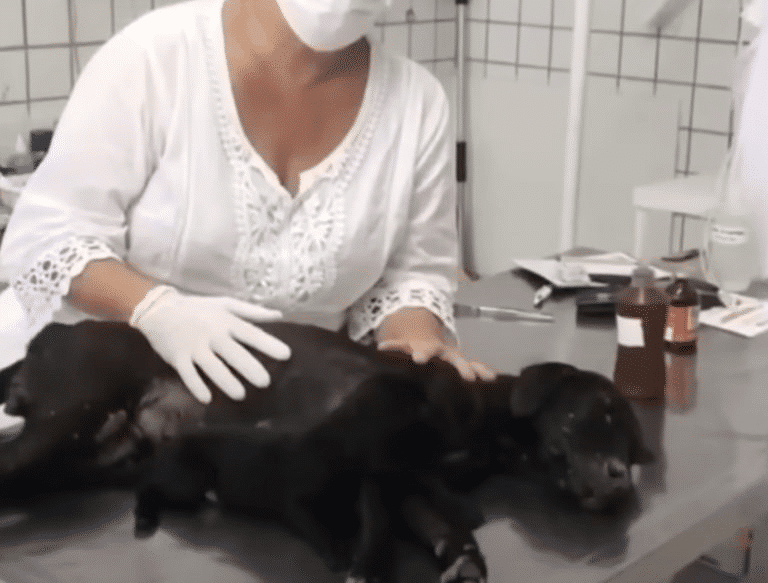
Paola and the puppies were transported to a veterinary clinic.
Examination confirmed what their appearance already suggested.
All four dogs were suffering from severe malnutrition.
The puppies had not developed as well as they should have.
Their bodies were weak.
Paola herself had been depleted to the point that standing was difficult.
This was not a situation that could be corrected by simply placing full bowls in front of them.
Their bodies needed food carefully.
Too much too quickly could create additional problems.
So the veterinary team introduced nutrition gradually.
Small meals.
Frequent monitoring.
Rest.
Time.
The goal was not to make them gain weight as quickly as possible.
It was to help their weakened bodies begin working normally again.
The Puppies Ate With an Urgency Their Bodies Could Not Hide
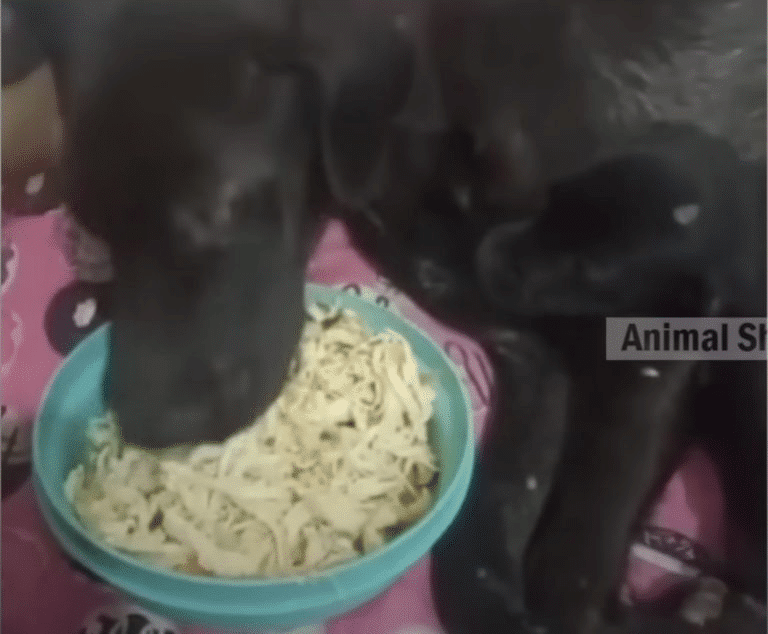
When food arrived, the puppies showed immediate interest.
They ate eagerly.
Their reaction made it clear how much their bodies needed nourishment.
Paola behaved differently.
She was slower.
More cautious.
She paused during meals.
Whatever the reason, the caregivers did not rush her.
They allowed her to eat at her own pace while making sure food continued to be available.
Meanwhile, Paola remained attentive to her puppies.
During feeding times, she watched them closely.
Even in her weakened condition, she continued staying near the litter.
The caregivers could now help carry some of the responsibility she had been handling alone.
The puppies had people monitoring them.
Paola had people watching her too.
One Puppy Was So Weak That Walking Was Difficult
The first days remained uncertain.
Paola struggled to stand.
Her legs trembled beneath her.
One of the puppies was especially weak.
Walking appeared almost impossible.
The caregivers supported the family carefully.
There was no pressure for the weakest puppy to move more than necessary.
Every improvement was measured in very small steps.
Eating a little more.
Holding the head higher.
Standing for a few seconds longer.
Moving across a short distance.
For healthy puppies, these would have been ordinary actions.
For this family, they were evidence that their bodies were beginning to respond.
The Second Week Looked Completely Different
By around the second week, the puppies had begun gaining weight.
Their movements became stronger.
They started taking uncertain steps around the room.
At first, those steps were clumsy.
They stumbled.
They bumped into one another.
Sometimes they moved only a short distance before resting again.
But they were moving.
Soon, those cautious little walks began turning into play.
Tiny paws crossed the floor more quickly.
Tails began moving.
The puppies started interacting with each other rather than spending nearly all their energy simply resting.
Even the weakest puppy improved.
The little dog who had struggled to walk was beginning to keep up with the others.
Paola’s Recovery Took More Time
The puppies changed quickly.
Paola did not.
Her body had carried the effects of malnutrition while also supporting three young dogs.
She needed more patience.
Her progress came gradually.
She began standing more steadily.
Her posture improved.
Her coat started looking healthier.
She showed more energy during everyday interactions.
The difference was visible, but it required time.
Caregivers continued with regular meals and close observation.
No one expected Paola to recover at the same pace as her puppies.
Her body had given away too much of its reserves.
Now those reserves had to be rebuilt.
She Could Finally Rest While Someone Else Watched the Puppies
Before rescue, Paola had been the only dependable adult near her puppies.
Afterward, that changed.
Caregivers could monitor the litter.
They could make sure the puppies ate.
They could notice if one became weak.
They could provide warmth and a safe environment.
That meant Paola did not have to remain constantly responsible for every need.
She could lie down.
Eat.
Recover.
And still remain close enough to the puppies to respond when they approached her.
The family was still together.
But survival no longer depended entirely on one severely underweight mother.
The Puppies Became Ready for Families of Their Own
As the weeks continued, the puppies became stronger and more active.
The fragile young dogs brought into the clinic were now able to play and explore.
Eventually, they reached the stage where adoption became possible.
Families began stepping forward.
One by one, the puppies left for new homes.
Each departure represented a major difference from the place where their story had begun.
They were no longer weak puppies relying on a mother who barely had enough strength to stand.
They had people prepared to care for them individually.
Regular food.
Comfort.
Safe places to sleep.
The future no longer depended on Paola finding enough resources for everyone.
Paola Did Not Have to Leave the People Who Helped Her Heal
Once the puppies had moved into their new homes, Paola’s own future still needed an answer.
The people who had stayed beside her through recovery made their decision.
They wanted her to remain.
Paola became part of their family.
The caregivers who had watched her struggle to stand were now the people providing her permanent home.
There was no more temporary recovery space.
No more uncertainty about where she would go next.
She had somewhere to stay.
As her health continued improving, Paola began enjoying ordinary things that had once seemed far away.
Moving through the yard.
Playing with toys.
Resting beside familiar people.
Meals that arrived every day.
The Mother Who Had Almost Nothing Finally Had a Life of Her Own
When rescuers first saw Paola, almost everything about her condition reflected scarcity.
Too little food.
Too little strength.
Three puppies needing more than her weakened body could provide.
Yet she had stayed beside them.
The rescue team changed the rest of the story by sharing that responsibility.
Veterinary care helped stabilize the family.
Careful nutrition rebuilt their strength.
The puppies grew.
The weakest one began walking.
Then playing.
Then each puppy moved into a home of its own.
And Paola stayed with the people who had cared for her through the hardest part.
She no longer had to use every bit of strength protecting three puppies while her own body faded.
Today, she has food.
Rest.
Play.
And people who chose her too.
Paola spent the beginning of her story making sure her puppies had whatever she could give.
In the end, someone finally made sure she did not have to keep giving everything just to survive.


