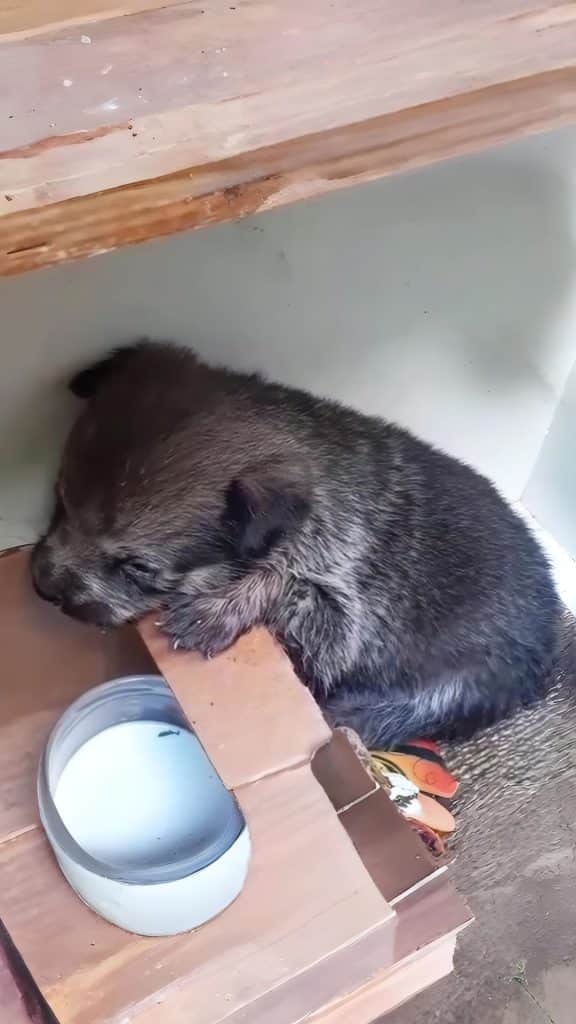
The wooden box sat quietly beside a neighborhood sidewalk, looking almost like something someone had carefully prepared for a special gift.
But when a passing woman stopped and opened the lid, she found something no one should ever have left there.
A newborn puppy.
The tiny baby was curled up alone, barely able to keep herself warm. A small bowl of milk had been placed beside her, but she was too weak to drink from it. Her eyes were barely open, and the only sound she could make was a faint, heartbreaking cry.
She was just a few days old, far too young to survive without proper care.
The woman gently lifted her from the box and brought her home. She would name the puppy Indigo.
But the little dog’s struggle was only beginning. Serious digestive problems, dehydration, and an uncertain eye condition would make her recovery far more complicated than anyone initially expected.
And then, an older dog named Stefania would become an unexpected part of her remarkable journey.
The Little Puppy Someone Left Inside a Wooden Box
It was an ordinary neighborhood sidewalk, the kind of place where people passed by without expecting to find anything unusual.
But that day, a small wooden box caught one woman’s attention.
It was decorated, almost as though it had once been intended to hold something precious.
At first, there was no obvious reason to believe anything was wrong.
Then the woman decided to look inside.
When she opened the lid, she discovered a tiny puppy curled up at the bottom.
The baby was only a few days old.
Her body was incredibly small, and her eyes were barely open. She appeared exhausted, with little strength to move or respond to the world around her.
Someone had placed a small bowl of milk beside her.
But the puppy had not touched it.
At such a young age, she needed far more specialized care than a bowl of milk could provide. She depended on proper feeding, warmth, and close attention, yet she had been left alone on the sidewalk.
The woman heard a faint cry.
It was quiet, but it was enough to make the seriousness of the situation clear.
This little puppy could not search for food.
She could not find a warmer place to sleep.
She could not take care of herself.
The woman carefully reached into the box and lifted her.
The puppy was so fragile that every movement required gentle handling.
There was no way to know exactly how long she had been there or what had happened to her mother.
But the woman knew she could not leave her behind.
She brought the tiny dog home, determined to give her the care she desperately needed.
And she gave her a name.
Indigo.
VIDEO: A Newborn Puppy Was Found Crying Alone Inside a Wooden Box With Troubled Eyes
The First Nights Were Filled With Worry
Bringing Indigo home was an important first step.
But her rescuer quickly realized that keeping such a young puppy alive would require constant attention.
Indigo was incredibly small.
Her body trembled easily, and she appeared to have very little strength.
Even her breathing seemed delicate.
The woman soon discovered that the puppy was also struggling with serious digestive problems that left her weak and dehydrated.
Her eyes were another concern.
They appeared cloudy, raising questions about her vision and whether she would eventually be able to see normally.
Indigo needed veterinary attention.
But she also needed someone to care for her throughout the day and night.
Her rescuer began establishing a careful routine.
Small feedings.
Warm blankets.
Frequent checks.
And the kind of constant attention that a newborn animal cannot manage without.
Because Indigo was so fragile, her meals had to be given patiently.
Her rescuer used formula and carefully helped her receive the nourishment she needed.
There was no room for rushing.
The puppy needed time to feed, rest, and recover.
Sometimes, she cried.
The sound was especially difficult for her rescuer to hear because Indigo was so young and had been found without her mother.
No one could know exactly what the little puppy was experiencing. Her cries could have reflected discomfort, hunger, or the needs of a newborn separated from her usual source of care.
Whatever the reason, the woman responded by checking on her and making sure she was comfortable.
Indigo was never left alone for long.
Her rescuer continued the feeding routine and watched closely for changes in her condition.
For a puppy who had begun life inside a wooden box, the difference was enormous.
She now had warmth.
Appropriate nourishment.
And someone who noticed when she needed help.
But the next veterinary examination would reveal that Indigo still had a difficult road ahead.
The Veterinarian Revealed Two Serious Concerns
At the veterinary clinic, Indigo received a careful examination.
Her digestive problems required treatment, and the dehydration accompanying them made her physical condition particularly concerning.
For a newborn puppy, proper nourishment and hydration are essential.
Indigo’s weakened state meant her progress would need to be monitored closely.
But there was another issue that worried the veterinary team.
Her eyes.
They appeared cloudy, and there was uncertainty about how her vision might develop.
The veterinarian explained that recovery would take time.
The digestive difficulties needed treatment, while her eyesight required continued observation and follow-up care.
There was no immediate promise that her eye condition could be completely corrected.
It was difficult news for the woman who had brought Indigo home.
She had already spent countless hours feeding the tiny puppy, keeping her warm, and responding to her needs.
Now, she understood that caring for Indigo might involve a longer medical journey than she had first imagined.
But she remained committed.
The woman continued following the treatment plan and providing the daily support Indigo required.
Every feeding mattered.
Every veterinary appointment mattered.
And every small sign of improvement offered encouragement.
Indigo remained fragile, but she was receiving the care that had been missing when she was discovered.
Back at home, her rescuer continued watching over her.
And before long, she discovered that she was not the only member of the household paying attention to the little puppy.
An older dog had noticed Indigo, too.
Her name was Stefania.
And she was about to become one of the most touching parts of the story.

An Older Dog Named Stefania Became Her Unexpected Companion
Stefania was already part of the household when Indigo arrived.
The older dog soon noticed the tiny new arrival and began showing interest in her.
There was something especially touching about watching such a small puppy receive attention from another dog.
Indigo had been discovered alone.
Her mother was nowhere to be found, and she had spent her earliest known moments inside a wooden box.
Now, she had an older canine companion who often stayed nearby.
Stefania appeared attentive to the little puppy.
When Indigo cried, the older dog would sometimes lie close to her.
She remained nearby as Indigo rested, offering the quiet companionship of another animal.
Their interactions gave the household some particularly tender moments.
The tiny puppy was still receiving careful feeding and medical attention from her human caregiver.
Stefania could not replace that essential care.
But her presence offered Indigo an opportunity to experience something she had been missing since the day she was found.
The company of another dog.
There was no dramatic transformation overnight.
Indigo still needed treatment for her digestive condition, and her eyes remained a medical concern.
Her rescuer continued the same demanding routine of feeding, monitoring, and keeping her comfortable.
But the puppy was no longer spending her days without companionship.
She had a human caregiver who was committed to her recovery.
And she had Stefania nearby.
The older dog became a familiar presence in Indigo’s new world.
As the days passed, the little puppy gradually grew stronger.
Soon, she would begin showing signs of curiosity about the environment around her.
And even with her vision still limited, Indigo was finding ways to explore.
A Tiny Puppy Began Discovering the World Around Her
The first days of Indigo’s life in her new home had revolved almost entirely around her immediate needs.
She needed to be fed.
She needed to stay warm.
She needed treatment and careful monitoring.
But as the weeks passed, her development became increasingly apparent.
Indigo remained small, yet her personality was beginning to emerge.
She started responding to familiar sounds and smells.
She appeared to recognize the voices of the people who cared for her.
And she became increasingly interested in the activity happening around her.
Her limited vision remained a challenge, but it did not prevent her from investigating her surroundings.
She learned to navigate her familiar environment through the sensory information available to her.
Then came a particularly sweet discovery.
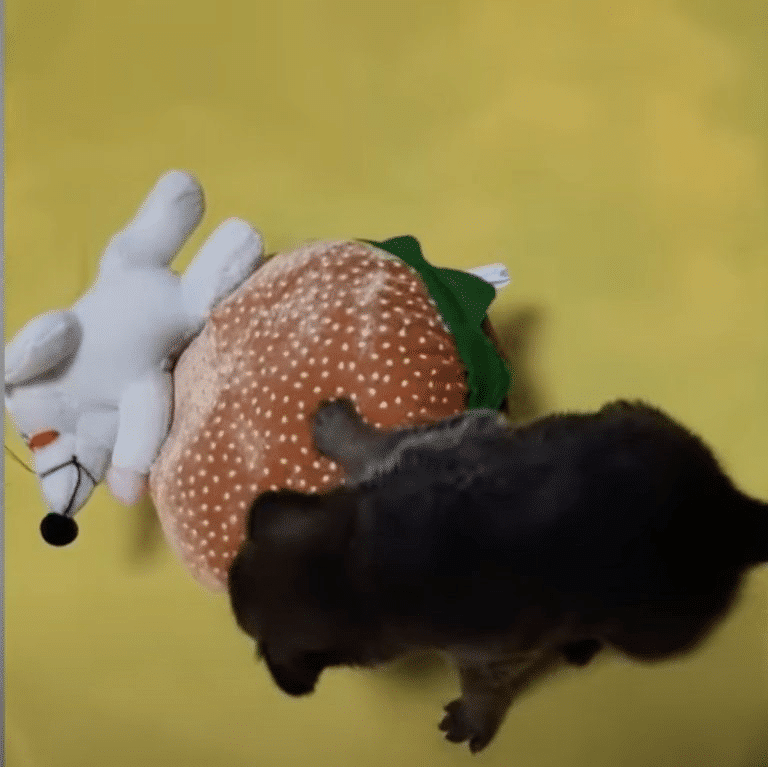
Toys.
At first, Indigo approached them cautiously.
She touched them and explored them without appearing entirely sure what to do.
But gradually, her curiosity grew.
The little puppy began interacting with her toys more confidently.
It was a remarkable change from the newborn who had been found barely moving inside a box.
Back then, she had been too weak even to drink from the bowl placed beside her.
Now, she was beginning to show interest in play.
Her tiny footsteps became part of the household’s daily routine.
The quiet home that had once been focused on keeping a fragile newborn comfortable was beginning to fill with the sounds of a developing puppy.
Indigo still had medical challenges ahead.
Her digestive condition required continued attention, and the uncertainty surrounding her vision had not disappeared.
But her behavior was changing.
She was becoming stronger.
More curious.
And increasingly willing to explore.
For her rescuer, watching Indigo discover toys and respond to familiar voices was deeply encouraging.
The puppy was no longer simply receiving care.
She was beginning to enjoy the world around her.
And soon, she would reach a milestone that would make all those difficult nights feel especially meaningful.
After Nearly Three Weeks, One Small Meal Changed Everything
For almost three weeks, Indigo’s rescuer had followed a demanding feeding routine.
The little puppy was too young and fragile to manage her nutritional needs independently when she was first found.
She required formula, careful assistance, and frequent attention.
Every feeding was part of the work of helping her grow.
And then, after nearly three weeks of constant care, something changed.
Indigo began eating on her own.
No bottle.
No assistance.
She was finally strong and developed enough to manage an important part of her feeding independently.
For the woman who had cared for her day and night, the moment was deeply rewarding.
It meant that Indigo had reached another developmental milestone.
The puppy who had once been too exhausted to touch the milk beside her wooden box was now able to eat without the same level of assistance.
Her body had grown stronger.
Her needs were changing.
And she was becoming a little more independent.
It was not the end of her recovery.
Indigo still needed continued care, and her eye condition remained an important concern.
But the feeding milestone showed how far she had come.
The woman could remember those first difficult nights.
The tiny body that trembled so easily.
The careful formula feedings.
The constant worry about whether Indigo was receiving enough nourishment.
Now, she was watching that same little puppy eat by herself.
It was a simple action.
Something healthy dogs do every day without anyone giving it a second thought.
But for Indigo, it represented weeks of patient care and gradual development.
Her rescuer had helped her reach a point that once seemed far away.
And while there was still uncertainty about her eyesight, Indigo was continuing to surprise the people around her.
The Question About Her Eyes Had Not Gone Away
Indigo’s physical development was encouraging.
She was growing stronger, becoming more curious, and learning to eat independently.
But her rescuer still had concerns about her vision.
The cloudiness that had been noticed during her early examination required continued attention.
At another veterinary checkup, the outlook remained uncertain.
The veterinarian could not promise that Indigo’s eye condition would be fully corrected.
For her rescuer, it was another difficult moment in a journey that had already required so much effort.
Indigo had survived the vulnerable newborn stage.
Her digestive problems had received treatment.
She had begun eating independently.
And her personality was becoming increasingly apparent.
Yet there was still no guarantee that her eyes would develop or recover exactly as everyone hoped.
The woman continued with the recommended treatment and veterinary appointments.
She remained committed to supporting Indigo, regardless of how quickly the condition improved.
Then, gradually, encouraging changes began appearing.
Indigo started responding more noticeably to movement.
She followed toys with greater interest.
She turned toward familiar faces.
Her caregivers observed improvements in how she responded to the world around her.
These changes were especially meaningful because of the uncertainty that had surrounded her eyesight.
The available account does not establish a precise diagnosis or confirm that Indigo eventually achieved completely normal vision.
What it does describe is a gradual improvement in her eyes and her ability to respond visually to movement.
For the little puppy, that progress opened the door to new experiences.
She could engage with toys in different ways.
She appeared increasingly interested in the people around her.
And her growing confidence made her development even more remarkable.
The woman who had found her inside the wooden box was now watching Indigo explore a world that had once seemed so difficult for her to experience.
But the greatest transformation would become apparent over the months that followed.
Six Months Later, Indigo Was Almost Unrecognizable
By the time Indigo reached six months old, the difference between her earliest condition and her new life was extraordinary.
The tiny newborn who had been discovered alone inside a wooden box had grown into a lively young dog.
Her coat was healthy.
Her energy had increased dramatically.
And her playful personality had become impossible to miss.
She moved confidently around the home, enjoying the familiar environment where she had grown up.
The puppy who had once relied on constant assistance for feeding was now able to eat independently.
The little dog who had struggled with digestive problems and dehydration had become stronger through treatment and consistent care.
And although her eyesight had once caused serious concern, her later progress included encouraging improvements in her ability to respond to movement and familiar faces.
Indigo now had the opportunity to enjoy ordinary puppy activities.
She played.
She explored.
She interacted with the people and animals around her.
Stefania, the older dog who had stayed close during Indigo’s fragile early days, had been part of her journey from the beginning.
The quiet companionship between the two dogs became one of the sweetest details of Indigo’s rescue story.
But the most remarkable change was visible in Indigo herself.
She was no longer the newborn who had been too weak to drink from a bowl.
She was an energetic young dog enjoying the safety of a familiar home.
Her earliest days had been marked by uncertainty.
Now, her daily life included companionship, play, regular meals, and comfortable places to rest.
For the woman who had opened that wooden box, the transformation was deeply meaningful.
She had seen Indigo at her most vulnerable.
She had experienced the difficult feeding schedule, the veterinary appointments, and the uncertainty surrounding her health.
Now, she could enjoy watching the little puppy grow into a happy companion.
Indigo’s story had begun with a frightening discovery.
Six months later, it looked entirely different.
The Woman Who Opened the Box Gave Indigo a Future
When Indigo was first discovered, she was only a few days old.
Her tiny body was curled inside a decorated wooden box beside a neighborhood sidewalk.
A bowl of milk had been placed beside her, but she had not been able to drink from it.
She was too young and weak to care for herself.
The woman who found her did not know how much work lay ahead.
She simply recognized that the puppy needed help and chose to bring her home.
That decision became the beginning of months of dedication.
Indigo needed careful feeding and constant warmth.
Her digestive problems required treatment.
Her dehydration made her condition concerning.
And the cloudiness in her eyes raised questions that could not be answered immediately.
Her rescuer followed the care routine, attended veterinary appointments, and continued supporting her through each stage of recovery.
Along the way, an older dog named Stefania became Indigo’s quiet companion.
She often stayed nearby, offering the little puppy the comfort of another dog’s presence.
Then came the first milestones.
Indigo began responding to familiar voices and smells.
She discovered toys.
She started exploring.
And after nearly three weeks, she was finally able to eat on her own.
Her eyesight remained a concern, but continued treatment and observation eventually brought encouraging signs of improvement.
By six months old, the puppy who had once been so fragile had become energetic, playful, and confident in her home.
Her story is a reminder that rescuing a newborn animal is rarely as simple as bringing it somewhere warm.
Young puppies require appropriate nutrition, medical attention when needed, and careful monitoring as they develop.
For Indigo, those essential forms of care made an enormous difference.
Her rescuer could not promise that every medical problem would disappear.
She could not know what the next veterinary examination would reveal.
But she could continue providing the help Indigo needed.
And she did.
Today, Indigo is no longer a helpless newborn crying inside a wooden box.
She is a happy young dog surrounded by the people and animals who helped her through the most vulnerable days of her life.
The little box where she was discovered remains part of her story.
But it is no longer the place that defines her world.
She has a home.
A familiar companion in Stefania.
And a family that has watched her grow from a fragile newborn into a playful young dog.
Once, Indigo was too weak to drink the milk left beside her. Six months later, she was running through the home of the woman who refused to leave her behind.


