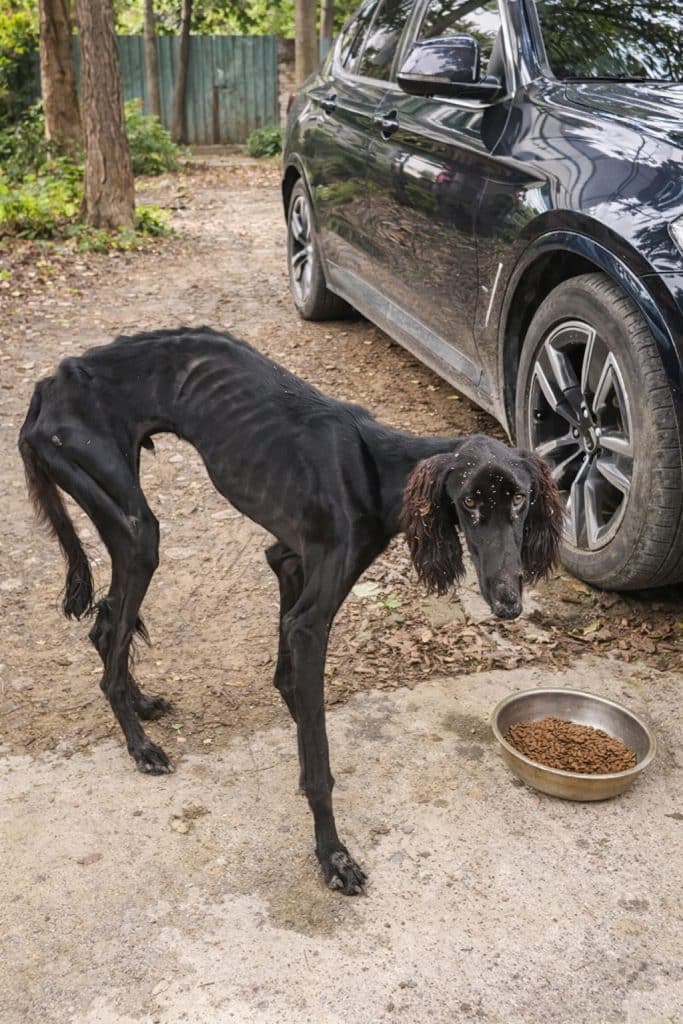
Beside a parked car, a painfully thin dog stood on trembling legs, watching the people around him with cautious eyes. His Greyhound-like frame was so depleted that the outlines of his body were clearly visible, and even remaining upright seemed to require an enormous effort.
When a young woman approached with a bowl of food, he finally had the chance to eat. But what happened afterward was something she had not expected.
Instead of leaving once his hunger eased, the exhausted dog began following her.
That simple encounter would lead him to a welcoming family, an alarming veterinary diagnosis, and fifteen days of treatment that would determine whether he could return to the home he had just discovered.
The Starving Dog Who Would Not Walk Away
The dog stood quietly beside a parked car.
He did not bark at the people passing nearby. He did not rush forward or demand attention.
He simply remained where he was, his thin body supported by legs that trembled beneath him.
His appearance was deeply concerning.
He had the long, elegant frame of a Greyhound or a similar breed, but his body had become severely underweight. Hunger and exposure to the cold had left him in a weakened condition.
Even the simplest movement appeared difficult.
When a young woman noticed him, she could see that he needed help.
She approached with a bowl of food.
The dog remained cautious, watching her movements before accepting what she offered.
Then he began eating.
For a hungry animal, a meal can provide immediate relief. But this dog needed much more than a single bowl of food to recover from his condition.
The woman could not know everything he had experienced before their meeting.
She did not know how long he had been wandering or what had happened to bring him to that parking area.
But she recognized that his condition was serious.
And when the dog finished eating, something unexpected happened.
He did not simply turn around and disappear.
Instead, he began following her.
Step by step, his fragile body moved behind the woman as she walked away.
He was still weak.
His legs were still unsteady.
Yet he remained close.
The woman could not know exactly why he had chosen to follow her. Perhaps he wanted more food, companionship, or simply somewhere safe to rest.
Whatever his reason, she was unwilling to leave him struggling on his own.
She decided to bring him home.
And that decision would become the beginning of a remarkable journey.
VIDEO: A Starving Dog With Trembling Legs Follows a Stranger Who Offers Him Food
A Family Opened Their Door to a Dog Who Needed Everything
When the young woman arrived home with the exhausted dog, her family immediately saw how vulnerable he was.
His body was painfully thin.
He appeared weak and tired, and his condition suggested that he needed more than temporary shelter.
But the family did not turn him away.
They welcomed him into their home and began providing the basic comforts he had been missing.
Food.
Clean water.
A warm place to rest.
For a dog who had been standing beside a parked car in such poor condition, these ordinary things represented an enormous change.
One of the most touching moments came when a man in the household approached him with warm clothing.
The man gently dressed the dog, helping protect his thin body from the cold.
He also offered calm, reassuring attention.
There was no need for excitement or dramatic gestures.
The dog needed warmth, nourishment, and somewhere he could rest without being disturbed.
The family prepared a blanket for him.
Gradually, he settled down.
His posture appeared less guarded, and he allowed himself to lie comfortably in the unfamiliar home.
It was a small moment, but it was deeply meaningful.
Only a short time earlier, he had been standing outside on trembling legs, uncertain about the people around him.
Now, he was resting on a blanket in a warm house.
The family had provided immediate safety.
But his physical condition remained concerning.
His severe weight loss and weakness suggested that there might be serious medical problems beneath the surface.
The young woman understood that kindness alone would not be enough.
He needed a veterinarian.
And the following morning, she would discover just how serious his condition had become.
The Veterinary Examination Brought Devastating News
The next morning, the young woman took the dog to a veterinary hospital.
She hoped the medical team could identify what was wrong and help him recover.
But the examination revealed a difficult situation.
Long-term hunger and exposure had taken a severe toll on his body.
His organs were failing.
He was dangerously weak, and his overall condition made recovery uncertain.
The veterinary team explained that treatment would be complicated.
It would require considerable time and expense, with no guarantee that he would survive.
For the woman who had only recently brought him home, the news was overwhelming.
She had found a dog who could barely stand.
She had offered him food and watched him follow her.
Her family had welcomed him, given him warm clothing, and prepared a comfortable place where he could rest.
Now, after just one night in their care, she was facing the possibility that he might not recover.
There was no simple solution.
The medical problems affecting him were serious, and the veterinary team needed to address them through proper treatment and careful monitoring.
The woman understood what lay ahead.
There would be difficult days.
Medical decisions.
Expenses.
And the uncertainty of not knowing whether his weakened body could respond.
But she had already made a commitment to him.
She wanted him to have the chance to recover.
And she made another decision that gave the little dog a new identity.
She named him Cát Tường.
The name carried a wish for good fortune, peace, and a brighter future.
He was no longer simply the starving dog she had found beside a car.
He had a name.
A family waiting for him.
And someone willing to remain involved in his treatment, even when the outcome was uncertain.
The Woman Who Would Not Leave Him Behind
Cát Tường’s recovery did not happen quickly.
His physical condition was extremely fragile, and the medical team needed time to address the problems revealed during his examination.
For the young woman, bringing him to the veterinary hospital was not the end of her responsibility.
She continued visiting him.
She stayed involved in his treatment and spoke with the veterinarians about his condition.
Every visit gave her an opportunity to see how he was responding to care.
Some days brought encouraging changes.
Others were filled with uncertainty.
Cát Tường was still weak, and no one could promise that the next day would be easier than the one before.
But the woman continued returning.
She spent time beside him and followed his medical progress closely.
There were difficult decisions and periods when his treatment demanded considerable attention.
His recovery required more than optimism.
It needed professional medical care, patience, and a caregiver prepared to continue supporting him through the process.
The woman remained committed.
She had already seen how gentle he could be.
She remembered the dog who had accepted food without pushing forward.
The fragile animal who had followed her home.
And the quiet moment when he had finally rested on a blanket surrounded by her family.
Those experiences made her determined to continue giving him the opportunity to recover.
Meanwhile, Cát Tường began recognizing her visits.
Even while his body remained weak, he responded to her presence.
Sometimes, his tail moved.
Sometimes, he looked toward her with greater alertness.
These were small gestures, but they were encouraging for someone who had watched him struggle from the beginning.
The medical team continued providing treatment.
The woman continued visiting.
And gradually, the dog who had arrived in such a critical condition began showing signs of improvement.

A Small Tail Wag Became a Reason to Hope
During Cát Tường’s earliest days at the hospital, progress was difficult to measure.
His body had been severely weakened by prolonged hunger and exposure.
The veterinary team needed to monitor his condition carefully, watching for signs that treatment was helping.
There was no dramatic transformation overnight.
Instead, improvements appeared gradually.
His medical indicators began stabilizing.
He became more responsive.
And his expression started looking less exhausted.
For the woman who continued visiting him, these changes mattered enormously.
She remembered how he had looked beside the parked car.
His trembling legs.
His thin body.
The cautious way he had accepted her food.
Now, although he remained fragile, he was beginning to respond more actively to the people around him.
When the woman arrived, Cát Tường sometimes greeted her with a little movement of his tail.
It was a simple gesture.
But after the frightening veterinary diagnosis, seeing him respond to her presence was deeply reassuring.
His eyes also began appearing brighter as his condition improved.
The caregivers continued focusing on his medical needs.
They understood that early improvement did not mean every problem had been resolved.
His body still needed time.
And a dog recovering from such serious physical weakness required continued monitoring and professional care.
But the changes suggested that treatment was making a difference.
Day after day, Cát Tường continued progressing.
He was not yet ready to return home.
There were still medical concerns to address, and the veterinarians needed to make sure he was stable enough to leave their care.
But the exhausted dog was beginning to regain strength.
And after approximately half a month of treatment, the moment his family had been hoping for finally arrived.
After Fifteen Days, He Was Finally Strong Enough to Leave
Fifteen days after beginning treatment, Cát Tường reached an important milestone.
He was well enough to leave the veterinary hospital.
For the young woman who had continued visiting him, it was a moment of enormous relief.
The dog she had brought to the clinic had been dangerously weak, with organ failure making his prognosis uncertain.
Now, after two weeks of medical attention and careful monitoring, his condition had improved enough for him to return home.
He was not necessarily finished healing.
His body still needed time to rebuild strength.
But he had made significant progress.
His movements appeared more confident.
His expression was brighter.
And he was no longer in the same critical condition that had caused such concern during his first examination.
The transformation was especially moving because the young woman knew how uncertain the outcome had once been.
She had been told that treatment could be difficult and expensive.
There had been no guarantee of success.
Yet she had continued supporting him.
And now she could finally bring him back to the house where his new life had begun.
The home was already familiar to him.
It was where the family had first welcomed him.
Where a man had gently dressed him in warm clothing.
And where he had been given a comfortable blanket after arriving exhausted and hungry.
Now, he was returning under very different circumstances.
He was stronger.
He had received the medical treatment he desperately needed.
And he had a family waiting to continue caring for him.
For Cát Tường, leaving the hospital was not simply the end of a medical stay.
It was the beginning of an opportunity to enjoy the home that had welcomed him before anyone knew whether he would survive.
The Family Who Welcomed Him Never Changed Their Minds
When Cát Tường returned home, the family continued providing the warmth and stability he needed.
They had welcomed him when he was severely underweight and exhausted.
Now, they could help him continue recovering in a familiar environment.
He had regular meals.
A comfortable place to sleep.
And people who paid attention to his needs.
The young woman who had first offered him food remained an important part of his life.
The man who had helped keep him warm was also part of the household that had chosen to care for him.
But Cát Tường was not the only animal in the home.
He also had the opportunity to spend time around other animals, adding another dimension to his new surroundings.
At first, his recovery had focused almost entirely on medical treatment.
His body had needed professional care, and his family had spent days worrying about whether he would become strong enough to leave the hospital.
Now, his daily life was beginning to include ordinary activities.
He could explore his surroundings.
Rest comfortably.
And enjoy being close to the people who had welcomed him.
As his strength continued returning, his behavior became increasingly lively.
The dog who had once stood motionless beside a parked car began showing interest in play.
For his family, watching him become more active was a remarkable change.
They could finally see him enjoying the life they had hoped to provide.
He was no longer simply an emergency patient.
He was becoming a companion.
A familiar presence in the household.
And a dog whose personality was emerging as his physical condition improved.
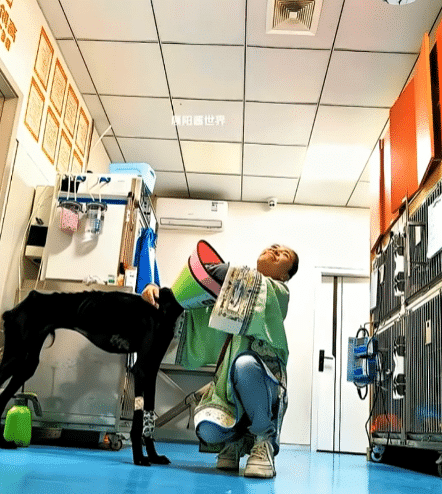
The Dog Who Once Trembled Began Playing Again
One of the most rewarding parts of Cát Tường’s recovery came after he returned home.
As he continued regaining strength, he began playing with his new owner and the other animals in the household.
It was a striking contrast to the day he had been discovered.
Back then, his legs trembled beneath his severely underweight body.
Even standing appeared difficult.
He had accepted a bowl of food and then followed the young woman home, but his physical condition remained so serious that the next morning’s veterinary examination revealed organ failure.
Now, after treatment and continued care, he could enjoy activities that had once seemed far beyond his strength.
He played.
He interacted with his family.
And he moved around his new environment with greater confidence.
His behavior reflected the changes in his daily life.
He no longer needed to remain beside a parked car, uncertain about where his next meal might come from.
Food was provided regularly.
He had somewhere warm to sleep.
And the people around him had made a lasting commitment to his care.
The family could now enjoy moments that had little to do with medical treatment.
Watching him play.
Seeing him interact with the other animals.
And sharing quiet time with a dog who had become part of their household.
Those experiences were ordinary in the best possible way.
For many families, playing with a dog is simply part of everyday life.
For Cát Tường, it was an opportunity made possible by the rescue and medical care he had received.
His recovery had involved difficult decisions and considerable uncertainty.
But now, the results were visible.
The dog who once could barely remain standing was enjoying life with the family who had given him a chance.
And the connection that began with one bowl of food had grown into something far more lasting.
One Bowl of Food Became a Lifelong Commitment
Cát Tường’s story began with a young woman noticing a dog who needed help.
He was standing beside a parked car, severely underweight and trembling from weakness.
She offered him food.
He accepted it.
And when she began walking away, he followed her.
That single encounter brought him into a household where he received warmth, nourishment, and a comfortable place to rest.
But the next morning revealed how serious his condition really was.
At the veterinary hospital, the medical team discovered that prolonged hunger and exposure had taken a severe toll on his body.
His organs were failing.
His chance of recovery was uncertain.
And the treatment ahead would be difficult.
The young woman could not change those medical findings.
But she could decide what to do next.
She chose to continue supporting him.
She gave him the name Cát Tường and remained involved throughout his treatment.
She visited regularly, followed his progress, and continued caring even when the outcome was uncertain.
Gradually, his condition improved.
His medical indicators stabilized.
His eyes became brighter.
And he began responding more actively when she visited.
After fifteen days of treatment, he was finally well enough to leave the hospital.
He returned to the same family who had welcomed him when he was at his weakest.
And over time, he became strong enough to enjoy playing with his owner and the other animals in the household.
The difference was extraordinary.
But Cát Tường’s transformation was not simply the result of one generous meal.
The food brought him into contact with someone who recognized that he needed help.
The family’s hospitality gave him somewhere safe to rest.
Veterinary treatment addressed the serious medical problems threatening his life.
And the woman’s continued commitment helped ensure that he received care through the difficult days that followed.
Each part mattered.
The rescue began beside a parked car.
But it continued through the hospital, the family home, and the many ordinary days of care that allowed Cát Tường to recover.
His story is a reminder that helping a vulnerable animal often requires much more than the first act of kindness.
It requires recognizing when medical attention is needed.
Making difficult decisions.
And continuing to provide care when recovery is uncertain.
For Cát Tường, those efforts created a future that had seemed terribly fragile when he was first discovered.
He Followed Her That Day—and Finally Found Somewhere to Belong
When the young woman first approached Cát Tường, she had no way of knowing how their lives would become connected.
She saw an exhausted, starving dog beside a parked car and offered him something to eat.
He accepted the food.
Then he followed her.
That simple sequence of events brought him to a family who welcomed him without turning away from his poor physical condition.
They provided food, clean water, warm clothing, and a comfortable place to rest.
The next morning, the young woman took him to a veterinary hospital, where she learned that his condition was far more serious than she had imagined.
His organs were failing, and the likelihood of recovery remained uncertain.
Yet she stayed committed to his care.
For fifteen days, Cát Tường received medical treatment while the woman continued visiting and following his progress.
Eventually, his condition improved enough for him to leave the hospital.
And when he returned home, the family was waiting.
The trembling dog who had once stood beside a car now had regular meals, companionship, and a safe place where he could continue rebuilding his strength.
He began playing with his owner and the other animals in the household.
He became more comfortable in his surroundings.
And he finally had the opportunity to enjoy the ordinary pleasures of being a family dog.
There is no way to know exactly what Cát Tường was thinking when he chose to follow the young woman that first day.
Perhaps he was still hungry.
Perhaps he wanted to remain close to the person who had fed him.
What matters is what happened afterward.
The woman noticed his condition, brought him somewhere safe, and made sure he received the medical treatment he needed.
Then she continued caring for him.
Cát Tường’s recovery was not guaranteed, and his medical problems were not something kindness alone could resolve.
But compassion brought him to the people who could help.
And their commitment gave him the opportunity to recover.
Once, he stood beside a parked car, barely able to support his own weight.
Today, he is playing beside the woman who offered him that first bowl of food.
He followed her because she stopped to help. And when his life became difficult, she never stopped helping him.


