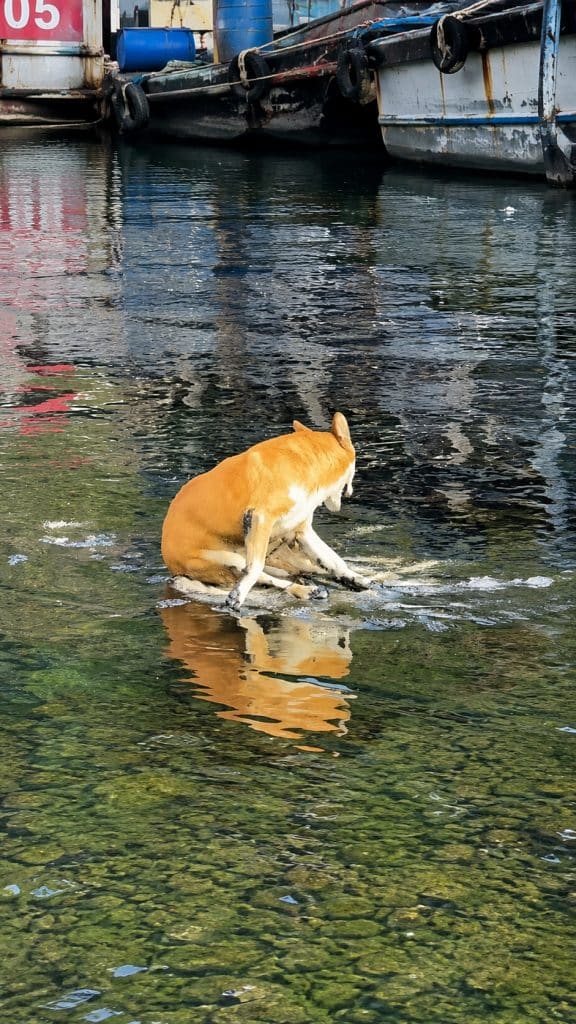
A tanker truck had overturned on a road in Quito, Ecuador, spilling thick, dark asphalt across the street. What began as a traffic accident quickly became a dangerous emergency for a dog who had wandered into the spill.
The sticky material clung to his paws and legs. Every attempt to move became more difficult, until he could no longer free himself.
He was stranded in the middle of the black surface, frightened and unable to reach solid ground.
Local residents noticed his struggle, but there was a serious problem. The asphalt was too dangerous to walk through, and anyone who stepped directly into it risked becoming trapped as well.
Then someone came up with an idea.
The residents began laying sheets of metal across the spill, creating a temporary path toward the helpless dog.
What followed was a carefully coordinated rescue involving ordinary neighbors and firefighters, all working toward one goal: getting a frightened animal out of a situation he could never escape alone.
A Road Accident Became a Terrifying Trap for One Dog
The accident happened on a road in Quito, Ecuador.
A tanker truck had overturned, releasing a large quantity of thick asphalt onto the street.
The dark material spread across the roadway, creating a hazardous environment for anyone nearby.
But one dog became caught directly in the spill.
He had somehow wandered into the asphalt, and the sticky material began clinging to his legs.
At first, he tried to move.
But his paws were trapped.
The more he struggled, the harder it became to free himself from the thick surface.
Eventually, the dog was unable to move normally.
He stood surrounded by the asphalt, with no clear way to reach the safe ground beyond it.
The situation was especially concerning because the material could be hot and was difficult to escape once an animal became stuck.
The dog could not understand what had happened.
The road beneath his paws had suddenly become something that held him in place.
He could not simply turn around and walk away.
And he had no way to remove the sticky material on his own.
Every passing moment made the situation more urgent.
The asphalt had already trapped his legs, and rescuers needed to avoid causing additional injuries while attempting to free him.
But there was another problem.
Reaching the dog meant crossing the same dangerous surface that had trapped him.
Anyone who tried to walk directly through the spill could become stuck, too.
The people nearby realized that helping him would require more than simply running toward him.
They needed a way to get close without putting themselves in the same position.
And that was when the local residents began working together.
VIDEO: A Dog Becomes Trapped in Spilled Asphalt After a Tanker Truck Overturns in Quito
The Neighbors Who Refused to Leave Him Trapped
When local residents noticed the dog, they immediately recognized that he was in trouble.
His legs were stuck in the asphalt, and he could not reach the edge of the spill.
The people watching could see that simply calling him would not help.
He needed someone to come close enough to free him.
But approaching was dangerous.
The thick material covered the road, making it difficult to cross safely.
A person stepping into the spill could lose their footing or become trapped.
The residents needed another solution.
Instead of attempting to walk directly through the asphalt, they began gathering sheets of metal.
The idea was simple.
By placing the sheets across the sticky surface, they could create a temporary route toward the dog.
It would not make the accident site completely safe.
The metal would need to remain stable, and anyone using it would still have to move carefully.
But it offered a possible way forward.
The neighbors began positioning the sheets across the asphalt.
One piece at a time, a narrow path started taking shape.
For the dog, the situation had not yet changed.
He was still trapped.
His paws remained stuck, and unfamiliar people were moving around him.
But the residents were no longer standing helplessly at the edge of the spill.
They had begun building a way to reach him.
It was a practical response to a difficult emergency.
No one could simply lift the dog from a distance.
Someone would have to get close.
And the temporary metal pathway was their attempt to make that possible.
A Narrow Path Across the Dangerous Asphalt
Building the temporary path was only the beginning.
The residents still needed to cross it.
The metal sheets had been placed over a sticky, hazardous surface, and their stability could not be taken for granted.
Every movement required caution.
The rescuers needed to maintain their balance while approaching the trapped dog.
They also had to consider how he might react when unfamiliar people came close.
An animal caught in an uncomfortable or painful situation may struggle when handled, even if the people approaching intend to help.
The residents understood that rushing could make the rescue more difficult.
They moved carefully along the makeshift route.
Step by step, they worked their way toward the dog.
The asphalt remained beneath the metal sheets.
The overturned tanker and spilled material were still part of a dangerous accident scene.
But the temporary pathway allowed the rescuers to approach without stepping directly into the sticky surface.
As they came closer, they could see how difficult the dog’s situation had become.
His legs remained trapped.
He could not move freely.
And freeing him would require careful handling rather than a sudden, forceful pull.
The residents continued working together, adjusting their approach as they tried to reach him.
There was no easy way to know exactly how firmly the asphalt was holding his paws.
Pulling too hard could cause injury.
But leaving him in place was not a safe option either.
The rescuers had to balance urgency with caution.
They continued moving toward him.
And as the effort developed, additional help arrived.
Firefighters had come to support the rescue.
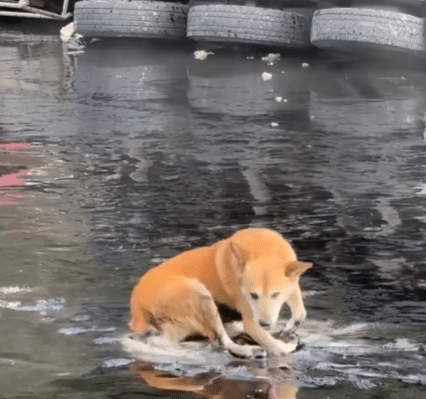
Firefighters Arrived to Help Bring Him Out
The arrival of firefighters added another important level of support to the operation.
The local residents had already recognized the emergency and begun creating a temporary pathway across the asphalt.
Now, they had additional help from people experienced in responding to dangerous situations.
The firefighters joined the effort to free the trapped dog.
The scene still required caution.
The asphalt covered part of the road, and the dog remained stuck in the thick material.
The rescuers could not simply grab him and pull without considering the possibility of causing further injury.
They needed to work together.
The residents had provided the metal sheets that allowed access to the trapped animal.
The firefighters helped coordinate the effort and assist with the difficult task of freeing him.
Each part of the rescue mattered.
The people approaching needed to remain stable on the temporary pathway.
The dog needed to be handled carefully.
And the rescuers had to avoid becoming trapped themselves.
They continued working toward him, paying attention to his position and the way the asphalt held his legs.
For the dog, the situation was still frightening.
He was surrounded by unfamiliar people and unable to move freely.
There was no way for him to understand why the rescuers were reaching toward him or what they were attempting to do.
But the team remained focused.
They had reached him.
Now, they needed to get him out.
The people involved worked together, carefully handling the dog while attempting to release him from the thick material.
It was a tense part of the rescue.
The asphalt had held him in place for an unknown amount of time, and there was no guarantee that he would come free easily.
But the rescuers continued.
And finally, their combined effort began to make a difference.
The Moment the Dog Was Finally Pulled Free
After the careful work of the residents and firefighters, the moment everyone had been hoping for finally arrived.
The rescuers managed to free the dog from the asphalt.
His legs were no longer held in place by the thick black material.
The animal who had been stranded in the middle of the spill could finally be moved away from the dangerous surface.
For the people involved, it was a moment of enormous relief.
They had seen how firmly the asphalt had trapped him.
They had recognized the danger of approaching.
And they had worked together to create a way across the spill without placing themselves directly into it.
Now, the dog was out.
The rescue team carefully brought him away from the immediate danger.
The overturned tanker and spilled asphalt remained part of the accident scene, but the animal was no longer trapped inside it.
His rescue had required several different actions.
First, residents recognized that he could not escape alone.
Then they developed a temporary path using sheets of metal.
Firefighters arrived and joined the effort.
Finally, everyone worked together to release him.
The result was what they had been trying to achieve from the beginning.
The dog was free.
But being removed from the asphalt did not automatically mean that every medical concern had been resolved.
Sticky petroleum-based materials can pose risks to an animal’s skin and paws, and exposure to hot asphalt may cause injuries that are not immediately obvious.
The available account does not document a detailed veterinary examination or confirm the extent of any injuries.
What it does establish is that the dog was successfully removed from the spill.
For an animal who had been unable to move, that was the essential first step.
He no longer had to remain trapped in the middle of the road.
And the people who had come together to help him had accomplished something that initially seemed extremely difficult.
A Rescue That Could Not Have Happened Without Teamwork
One of the most remarkable parts of the incident was the way the local community responded.
The dog was trapped in a dangerous situation created by a tanker accident.
The thick asphalt prevented him from escaping, but it also prevented people from approaching him directly.
There was no simple path to the animal.
And a careless rescue attempt could have placed another life in danger.
The residents recognized the problem and found a practical solution.
They used sheets of metal to create a temporary path across the spill.
It was an improvised measure, but it allowed the rescue effort to move forward.
Then firefighters arrived.
Their involvement brought additional assistance to a situation that required careful coordination.
The residents and firefighters worked toward the same goal.
Reaching the dog.
Freeing his trapped legs.
And bringing him away from the dangerous roadway.
No single part of the rescue would have been enough on its own.
Noticing the dog was essential, but the people watching still needed a way to reach him.
The metal pathway made an approach possible, but freeing the dog required careful handling.
The firefighters contributed to completing that difficult work.
Together, the people involved transformed a dangerous situation into a successful rescue.
The outcome did not depend on one dramatic gesture.
It depended on a series of practical decisions.
Someone recognized that the dog was trapped.
Someone thought of a way to cross the asphalt.
Others helped position the metal sheets.
And firefighters joined the effort to bring the animal out.
Each contribution moved the rescue a little closer to its goal.
By the end, the dog was no longer stuck in the roadway.
He had been freed because people recognized that helping him required cooperation.
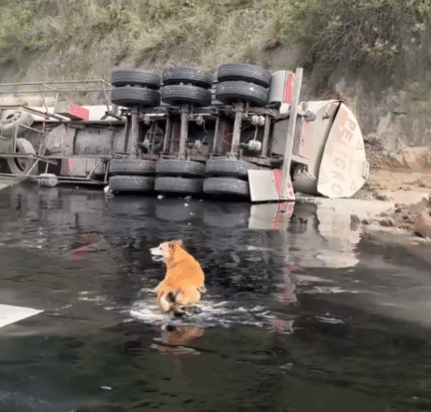
An Innocent Animal Caught in a Roadside Emergency
The dog had no connection to the tanker accident.
He could not understand what had caused the asphalt to cover the road or why the surface beneath his paws had suddenly become impossible to escape.
He had simply wandered into a dangerous situation.
For animals living near roads, construction sites, and areas affected by accidents, unfamiliar hazards can appear without warning.
A spill may create a surface that traps an animal.
Broken materials can cause injuries.
And emergency vehicles, debris, or damaged roads can make escape difficult.
This dog’s situation was a particularly striking example.
His paws and legs became stuck in asphalt, leaving him unable to move normally.
Even if he could see solid ground nearby, he could not reach it.
The residents who discovered him understood that the problem could not resolve itself simply by waiting.
The dog needed assistance.
But the material trapping him was also hazardous to anyone attempting a rescue.
That is why the careful response mattered.
The residents did not solve the problem by stepping directly into the spill.
They found a way to approach while reducing the immediate risk to themselves.
And when firefighters arrived, the group continued working together.
The incident also illustrates why specialized assistance is important when an animal becomes trapped in a hazardous substance.
Asphalt can be dangerous, particularly when hot, and attempting to pull an animal free without appropriate precautions may cause additional injuries.
Members of the public should avoid entering hazardous spill areas and contact emergency responders rather than attempting a dangerous rescue without suitable equipment and training.
In Quito, local residents and firefighters were able to coordinate their efforts.
Their response gave the trapped dog a way out of a situation he could not resolve alone.
The First Step Toward Recovery Was Simply Getting Him Out
By the end of the rescue, the dog’s immediate circumstances had changed completely.
He was no longer standing helplessly in the thick asphalt.
His legs had been freed.
And he had been brought away from the dangerous area surrounding the overturned tanker.
It was an encouraging outcome.
But the available account focuses on the rescue itself rather than documenting a complete medical recovery.
It does not establish whether the dog suffered burns or other injuries.
It does not provide details of any veterinary treatment after the rescue.
And it does not confirm that he was adopted or placed in a permanent home.
Those details should not be assumed.
What is clear is that local residents and firefighters successfully freed an animal trapped in a hazardous roadway spill.
That intervention was important in its own right.
The dog had been unable to escape.
The asphalt held his paws and legs in place, and every attempt to move seemed to make the situation more difficult.
Without assistance, he remained exposed to a dangerous environment.
The residents responded by creating access across the spill.
The firefighters joined them.
And together, they managed to remove the dog from the asphalt.
Further assessment and appropriate cleaning would be important considerations after this type of exposure, but the source does not describe those steps.
The rescue itself, however, was successful.
The dog was no longer trapped.
And the people who had noticed his struggle had managed to help him reach safety.
For an animal stranded in a dangerous place, that first intervention can be the difference between remaining helpless and having an opportunity to receive further care.
He Could Not Escape on His Own—But an Entire Community Came Together to Help
The accident in Quito began with an overturned tanker truck and asphalt spreading across the road.
For one dog, the spill became a trap.
He wandered into the thick material and found himself unable to escape.
His paws and legs became stuck.
Every movement grew more difficult.
And the dangerous surface surrounding him prevented him from reaching solid ground.
When local residents noticed what had happened, they realized that helping him would not be easy.
The asphalt was too dangerous to cross directly.
Anyone who attempted to walk through it risked becoming trapped as well.
So the residents found another way.
They placed sheets of metal across the spill, creating a temporary path that allowed them to approach the animal.
Then firefighters arrived to assist.
Working together, the group carefully reached the dog and managed to free him from the sticky material.
The moment he was removed from the asphalt marked the successful conclusion of the immediate rescue.
His longer medical outcome is not documented, but the people who helped him had accomplished the most urgent task.
They had brought him out of danger.
The incident is a reminder that animal rescue does not always begin at a shelter or inside a veterinary clinic.
Sometimes, it begins in the middle of an unexpected emergency.
A road accident.
A dangerous spill.
An animal who cannot move.
And a group of people who recognize that help is needed.
The residents could not simply make the asphalt disappear.
They could not ask the frightened dog to free himself.
But they could work together, create a safer approach, and call upon firefighters for additional assistance.
Their actions gave the animal a chance to escape the dangerous situation.
For the people watching, the moment he was finally freed brought relief after an uncertain rescue.
And for the dog, the difference was immediate.
The material that had held his legs in place was no longer trapping him.
He was no longer stranded in the middle of the road.
He could finally be brought somewhere safer.
The rescue did not need an invented adoption or an undocumented transformation to have a meaningful ending.
It was already a story about ordinary people recognizing a problem, finding a solution, and working alongside emergency responders to help an animal in need.
Once, the dog stood trapped in a thick pool of asphalt, unable to take another step.
Then neighbors built a path, firefighters joined them, and the people of Quito found a way to reach him.
He could not take a single step toward safety—so strangers built a path and came to him.


