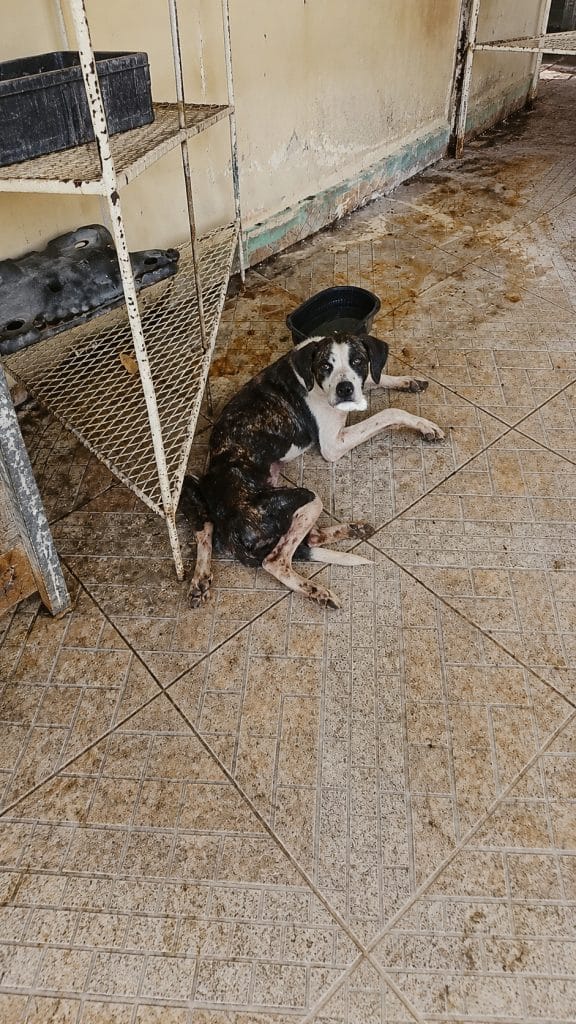
When rescuers first saw him, he was lying on the floor, his thin body almost motionless. His eyes were open, but even the smallest movement appeared to demand more strength than he had left.
Life on the streets had taken a terrible toll. Without reliable food, shelter, or medical care, the homeless dog had become severely ill, and his weakened legs could no longer support him.
He could not stand to greet the people who approached him. He could barely lift himself from the ground.
But someone had finally noticed his suffering.
And although no one could promise what the coming days would bring, he was about to receive something he had desperately needed for a long time.
A chance to recover.
A Fragile Dog Who Could No Longer Stand
There was something especially heartbreaking about the way he lay on the floor.
He was not running from strangers or searching for food. He was not exploring the world around him, as a healthy dog might have done.
He was simply lying there.
His body was painfully thin, and his movements were so limited that even changing his position appeared difficult.
Whatever illness had brought him to this condition had left him in urgent need of veterinary attention.
For a homeless animal, becoming seriously sick can mean losing the ability to search for the very things needed to survive. When walking becomes difficult, food and water can become even harder to reach.
And without someone to recognize the warning signs, the situation can quickly become dangerous.
The person who found him understood that he needed help.
There was no reason to wait for him to recover on his own.
He needed professional care, nourishment, and a safe place where he could rest without having to struggle through another day on the streets.
His rescuers stepped in.
The helpless dog who had been lying on the floor was finally on his way to receiving treatment.
VIDEO: A Severely Ill Stray Dog Is Rescued and Given a Chance to Stand Again
The Veterinary Team Faced an Urgent Challenge
At the veterinary facility, the seriousness of his condition became the immediate priority.
His body was severely weakened, and the medical team needed to provide support while investigating the causes of his illness.
He received a blood transfusion, medication, injections, diagnostic testing, and careful cleaning.
The team also monitored his condition closely.
For a dog in such a fragile state, treatment was not simply a matter of giving him medicine and expecting him to walk away.
His body needed time.
The medical team had to watch how he responded to treatment, manage his immediate needs, and adjust his care as his condition developed.
The blood transfusion was an important part of the support he received, although the available account does not identify the underlying condition that made it necessary.
What was clear was that his recovery would require more than one procedure.
He needed consistent medical attention.
He needed rest.
And he needed people willing to continue caring for him even when progress was difficult to see.
The veterinary team began that work, giving the weak little dog an opportunity he might never have found on the streets.
The Quiet Days When Every Small Change Mattered
The first stage of recovery did not bring a dramatic transformation.
He remained weak.
He spent much of his time resting, with little strength available for movement.
The caregivers continued administering his prescribed treatment and keeping a close watch on him.
They cleaned his body gently and made sure his medical needs were being addressed.
There were no shortcuts through this part of the journey.
A dog who has become severely ill cannot rebuild his strength in a single afternoon. Even after treatment begins, his body may need considerable time to respond.
The people caring for him watched for changes in his breathing, appetite, alertness, and energy.
Then, gradually, encouraging signs appeared.
His eyes began to look more alert.
He appeared increasingly responsive to the activity around him.
The exhausted dog who had barely moved when he was found was beginning to show signs of improvement.
These were not the kind of changes that would impress someone passing by.
A slightly brighter expression.
A little more awareness.
A body beginning to respond to treatment.
But to the people who had seen how weak he was, those small signs mattered enormously.
They meant the treatment was helping him move in the right direction.
And they gave his caregivers another reason to keep going.
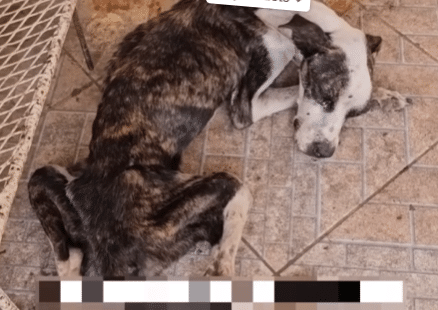
His First Attempt to Stand Changed Everything
There came a moment when the dog began trying to do something that had seemed almost impossible when he was rescued.
He tried to stand.
His legs were still weak, and his body had not yet recovered the strength needed for normal movement.
Getting up required visible effort.
He pushed himself carefully, trying to lift his body from the floor.
His movements were unsteady.
He had to work for every bit of balance.
But he was trying.
For an animal who had been lying almost motionless, this was a meaningful change.
The attempt did not mean he was completely healed. His muscles still needed to regain strength, and he was not yet ready to move with the ease of a healthy dog.
Nevertheless, the moment marked an important step in his recovery.
The dog who once could barely lift himself was beginning to support his own weight again.
Imagine what it must have meant to the people who had cared for him through the difficult early days.
They had seen his exhausted body.
They had watched him struggle.
They had provided treatment without knowing exactly how quickly he would respond.
Now, right in front of them, he was making an effort to stand.
It was not a long walk or an energetic run.
It was something quieter.
A fragile animal beginning to regain an ordinary ability that illness had taken away.
And it was only the beginning.
From the Veterinary Floor to the Grass Outside
As treatment continued, his strength slowly improved.
His movements became more comfortable, and he eventually began spending time outdoors.
For the first time in this part of his journey, the setting looked very different.
Instead of lying weakly on the floor, he was outside on the grass.
He could move.
He could feel the soft ground beneath his paws.
He could take gentle steps and explore the space around him.
There was nothing extraordinary about the grass itself.
For most dogs, walking across a lawn is an everyday experience, something they do without giving it a second thought.
But this dog had been too sick to stand.
Seeing him moving outdoors offered a striking contrast to the animal who had first arrived for treatment.
He was not simply being kept alive.
He was beginning to experience the world again.
His appetite was also improving.
He started eating more normally, giving his body the nourishment it needed as he continued recovering.
Each meal became another part of his care.
Each day of treatment supported the progress he was making.
And each step outdoors showed how far he had come from the moment someone found him helpless on the floor.
The Return of an Appetite Was Another Welcome Sign
For a dog recovering from serious illness, being able to eat normally can be an important part of rebuilding strength.
This little survivor had spent his early days in care receiving intensive treatment while his body struggled to recover.
As his condition improved, his appetite began returning.
He started eating more regularly.
It was a welcome change for his caregivers, who had seen how thin and exhausted he was when he arrived.
Food could now provide the nourishment his body needed as he regained weight and strength, alongside the veterinary treatment he continued receiving.
But the improvement was not about a single meal.
It was about consistency.
Regular food.
Appropriate medicine.
A clean place to rest.
People who monitored his progress and responded to his needs.
These ordinary acts of care began replacing the uncertainty of his former life.
On the streets, he had no guarantee of finding his next meal or getting help when he became sick.
Now, he was being cared for every day.
There was no need to search desperately for food while his body was still recovering.
He could rest.
He could eat.
He could regain strength at a pace his condition allowed.
And slowly, the difference began showing in the way he looked and moved.
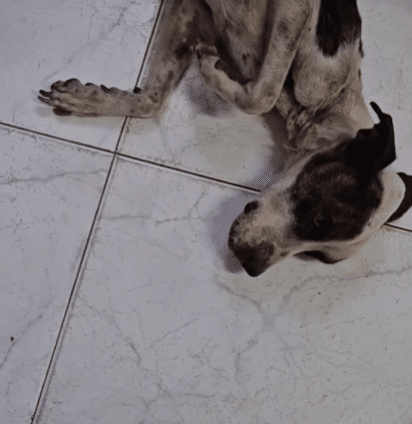
A Gentle Dog Begins to Feel Safe Around People
Physical healing was only one part of the transformation.
The dog had come from a life without dependable care, and his earliest moments in the rescue showed just how vulnerable he had become.
Now, his days were filled with a different kind of human attention.
Caregivers cleaned him gently.
They administered his treatment.
They provided food and continued watching over him as he recovered.
With time, he became increasingly comfortable in the environment around him.
The available account does not reveal everything he experienced before his rescue, and there is no way to know precisely how he felt during those difficult days.
But the changes in his behavior were encouraging.
The quiet, exhausted dog began showing more interest in his surroundings.
He became more active.
He could move around and enjoy the company of other animals.
His world was no longer limited to the small space where he had once lain too weak to stand.
There were new things to explore.
Familiar people nearby.
Other animals to spend time with.
And opportunities to enjoy the everyday experiences that had once been beyond his strength.
Perhaps the most touching part of this stage of his journey was how ordinary it became.
He was no longer just a desperately sick patient receiving urgent treatment.
He was becoming an active dog again.
The Transformation His Rescuers Had Hoped to See
By the later stages of the recorded recovery, the difference in his appearance was striking.
The severely thin, exhausted dog from the beginning looked much stronger.
His eyes appeared brighter.
His movements were more energetic.
He was walking, playing, and spending time with other animals.
The footage also showed him wearing little outfits, a sweet detail that reflected how different his daily life had become.
It was difficult to reconcile this lively dog with the fragile animal who had once been unable to support his own body.
Yet they were the same dog.
The difference was the care he had received between those two moments.
A person had noticed him when he needed help.
The veterinary team had provided medical treatment.
His caregivers had continued supporting him through the slower stages of recovery.
And his body had gradually regained strength.
The transformation did not erase the seriousness of his original condition.
It made the work of the people who helped him all the more meaningful.
They had not expected him to become healthy overnight.
They had simply continued giving him the support he needed, one day after another.
Now, he could do the things that had once seemed far beyond his reach.
He could walk across the grass.
He could eat normally.
He could play.
And he could enjoy a much safer life than the one he had known before.
He Could Finally Walk Toward a Different Future
The account does not identify a permanent adopter or provide details about where the dog would spend the rest of his life.
What it does show is a remarkable recovery under the care of the people who rescued and treated him.
He was no longer lying helplessly on the floor.
He was moving with greater confidence, interacting with other animals, and enjoying everyday activities again.
The dog who once needed urgent medical support had been given an opportunity to recover in safety.
His journey is a reminder that helping a seriously ill animal is rarely a single dramatic act.
Rescue may begin when someone notices a dog in trouble, but the work continues long after that first moment.
It continues in the veterinary clinic.
In the careful administration of treatment.
In the repeated examinations.
In the meals offered every day.
And in the patience required when recovery moves more slowly than anyone would wish.
There was no one moment that changed everything for this dog.
There was a series of moments.
Someone deciding to help.
A veterinary team beginning treatment.
A weakened body becoming more responsive.
The first effort to stand.
The first gentle steps across the grass.
And, eventually, a dog with enough strength to play again.
When he was first found, he could barely move.
By the end of his recorded journey, he was walking into a life filled with more comfort, companionship, and care.
Sometimes, the most extraordinary thing a rescued dog can do is something other dogs do every day.
Stand up.
Take a step.
And discover that the world is waiting for him again.


