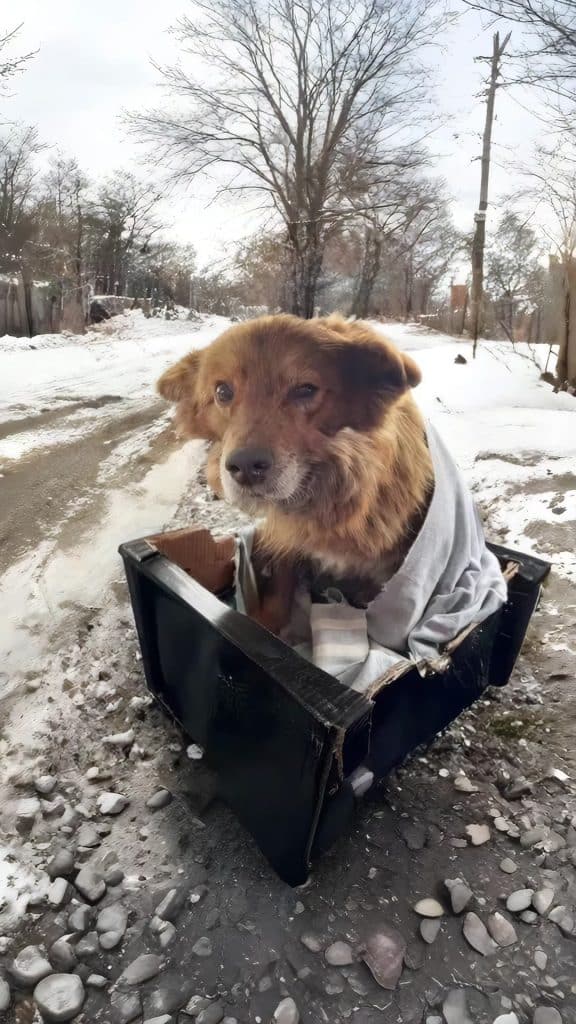
The fluffy dog lay almost motionless beside an empty road, her head resting low against the ground as cars continued passing.
She didn’t bark. She didn’t try to stand. Her exhausted body remained in the same place, and there was no sign that she could get herself to safety.
What no one knew at first was that she was pregnant.
The dog, later named Veta, was living with a serious spinal injury that had left her back legs paralyzed. She needed urgent medical attention, but she was also carrying a tiny life that would soon depend entirely on her.
Then, after so many vehicles had passed, one rescuer finally stopped—and the discovery that followed would change the future of both mother and baby.
The Dog Who Could Only Watch the Cars Pass
The road was quiet, with little around it to offer shelter.
Near its edge lay a fluffy dog whose unkempt coat and exhausted appearance suggested that she had been struggling for some time.
Her body barely moved.
Her head rested against the ground.
And when vehicles passed, she remained where she was.
She wasn’t simply a healthy dog resting beside the road. Something was preventing her from getting up and moving away.
The dog would later receive the name Veta, but at that moment, she was an animal in need with no one beside her.
Her fur was tangled and dirty.
Her body appeared weak.
She seemed to have little energy left for anything beyond lying quietly and observing her surroundings.
How long she had been there was unclear.
The full circumstances of her abandonment were also unknown.
But the visible situation was concerning enough.
She was lying beside a road, unable to move normally, with no protection from passing traffic or changing weather.
And there was another problem that wasn’t immediately obvious.
Veta was pregnant.
She was carrying a puppy while dealing with a serious condition of her own.
Without assistance, even finding a safe place to give birth would be an enormous challenge.
She couldn’t simply get up and search for shelter.
She needed someone to come to her.
And eventually, someone did.
VIDEO: Paralyzed and Pregnant, Veta Is Found Beside the Road Before Her Life Takes an Unexpected Turn
One Rescuer Stopped and Realized She Was Still Alive
A rescuer noticed the motionless dog from a distance.
Something about the way she was lying beside the road prompted them to slow down and investigate.
As they approached, they found Veta in an extremely fragile condition.
Her body showed little movement.
But when they looked closely, they noticed the faint rise and fall of her chest.
She was breathing.
The dog who had appeared almost lifeless from a distance was still alive and urgently needed help.
The rescuer approached carefully, mindful of her weakened state.
Veta did not get up or attempt to move away.
Her condition made it clear that she couldn’t simply be encouraged to stand and walk toward a vehicle.
She needed to be physically assisted.
The rescuer gently wrapped her and prepared her for transport to a veterinary clinic.
It was an important moment.
Until then, Veta had been lying beside the road without a way to reach safety on her own.
Now someone had recognized the emergency and was taking her somewhere she could receive proper medical attention.
The full extent of her injuries remained unknown.
Her pregnancy also made the situation more complicated.
The priority was to get her to the clinic and determine what was wrong.
But when veterinarians began examining her, they discovered that Veta’s condition was far more serious than her appearance alone had suggested.
The X-Rays Revealed an Injury That Could Not Be Reversed
At the veterinary clinic, Veta underwent urgent examinations.
Her body was exhausted, and her tangled fur reflected the difficult circumstances in which she had been found.
The veterinary team needed to understand why she could not move normally.
X-rays revealed the answer.
Several weeks earlier, Veta had suffered a spinal injury.
According to the rescue account, the injury had gone untreated, and the affected area had healed improperly.
The damage had left her hind legs completely paralyzed.
It was devastating news.
Veta had not simply become too tired to stand.
She had lost the use of her back legs because of damage to her spine.
By the time she reached the clinic, the veterinarians determined that surgery was no longer a viable option for her spinal condition.
The team could not offer a procedure that would restore her ability to walk.
But that did not mean there was nothing they could do.
Veta still needed medical care, comfort, and assistance with the daily challenges created by her paralysis.
Her body needed cleaning.
She needed a safe place to rest.
And she required ongoing attention to make sure her condition did not cause further complications.
The examination also revealed another concern.
A lump near her body needed testing.
The rescue account did not provide a confirmed diagnosis for the lump, so the veterinary team would need to investigate it rather than assume what it meant.
There were several uncertainties surrounding Veta’s health.
But one thing was already clear.
She could not return to life beside the road.
She needed a protected environment where her disability could be accommodated.
And because she was pregnant, her caregivers had to prepare for another possibility.
Her puppy might arrive sooner than anyone expected.
A Warm Bed Became the Beginning of Her New Life
After the examination, the rescue team focused on making Veta comfortable.
Her body had been exposed to difficult conditions, and her paralysis made it impossible for her to move around or reposition herself as freely as a healthy dog.
She needed help with even ordinary parts of daily life.
The caregivers cleaned her tangled coat and provided soft bedding.
They kept her warm and monitored her condition while the veterinary team continued evaluating her medical needs.
For a dog with paralyzed hind legs, an appropriate resting environment is particularly important.
Veta needed a surface that supported her body without placing unnecessary pressure on vulnerable areas.
She also needed assistance moving and consistent monitoring to keep her comfortable.
But her caregivers were attentive to more than her physical condition.
During the first days, Veta remained withdrawn.
She did not respond quickly when someone approached.
Her movements were limited, and she seemed cautious in the unfamiliar environment.
The rescue team did not force interaction.
They stayed nearby.
They spoke softly.
They allowed her time to become accustomed to the people caring for her.
Gradually, small changes appeared.
Veta seemed more relaxed.
She responded more calmly to gentle attention.
Her eyes and posture appeared less tense than they had during her first days.
These were encouraging signs, although they did not change the underlying spinal damage.
Her caregivers understood that she would continue needing assistance.
Still, they could give her something she had lacked beside the road.
A stable environment.
Consistent care.
And a place where her limitations would not prevent her from being comfortable.
Then, only a few days after her rescue, Veta’s situation changed again.
She began showing signs of labor.
Just Days After Her Rescue, a Tiny Puppy Arrived
The rescue team knew Veta was pregnant.
But caring for a mother who could not use her hind legs presented additional challenges.
She needed veterinary support and close monitoring, particularly because her body had already been through so much.
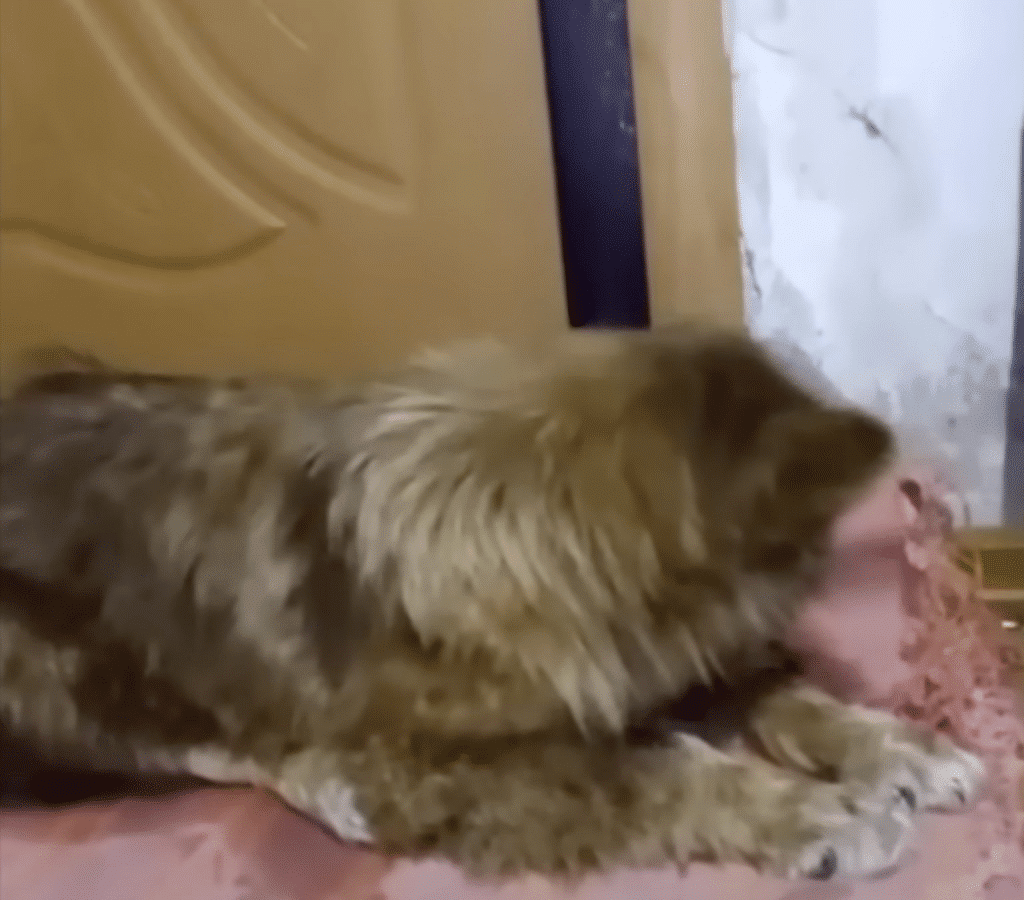
Just days after arriving in care, Veta went into labor.
The caregivers stayed attentive as the exhausted mother prepared to deliver her baby.
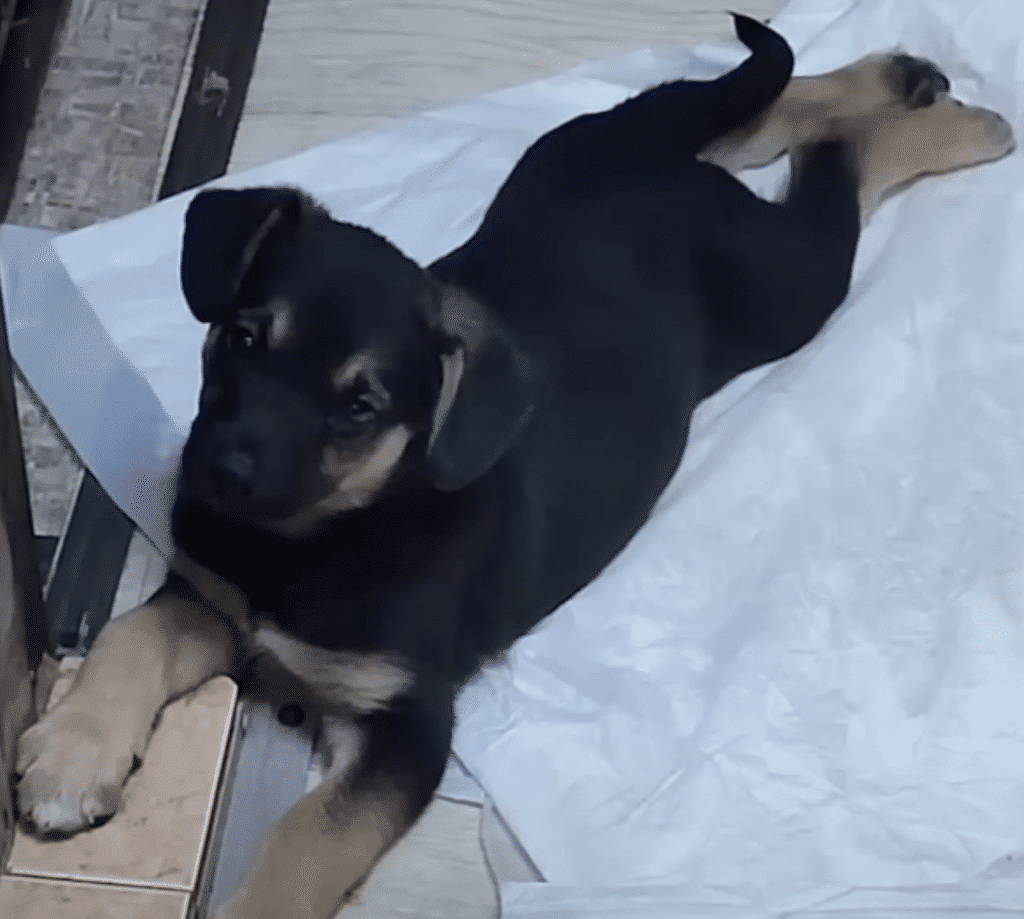
Despite her spinal injury and weakened condition, she gave birth to a single puppy.
He was alive.
The tiny newborn was given the name Timosha.
It was a remarkable turning point in Veta’s story.
Only a short time earlier, she had been lying beside the road, unable to stand and without a safe place to deliver her puppy.
Now, in a sheltered environment, she had become a mother.
Timosha was small and vulnerable, as all newborn puppies are.
He depended on warmth, nourishment, and careful attention during his earliest days.
Veta’s paralysis meant the caregivers needed to make sure she could interact with him safely and comfortably.
The team prepared a suitable resting area where mother and baby could stay close.
Soft bedding surrounded them.
The environment was kept warm.
And the caregivers continued monitoring both dogs.
Veta responded to her newborn by keeping him close and carefully curling around him as much as her limited mobility allowed.
The scene offered a moving contrast to the beginning of her rescue.
The dog who had been found lying alone beside the road was now resting with her tiny puppy.
Her legs remained paralyzed.
Her medical challenges had not disappeared.
But she no longer had to face them without help.
And Timosha had arrived in a place where both he and his mother could receive care.
A Mother Who Cared for Her Baby Despite Her Paralysis
As the days passed, Veta settled into her new role.
Her mobility remained limited, but she continued responding to her puppy’s needs.
She stayed close to Timosha.
She watched him.
And whenever he moved around their resting area, her eyes followed him.
The caregivers arranged their space so that mother and baby could remain together comfortably.
Veta couldn’t get up and follow her puppy in the ordinary way.
She relied on the rescue team to help her move and to make sure Timosha remained safe as he became more active.
But her disability did not prevent her from forming a close relationship with him.
The tiny puppy gradually began growing stronger.
His body developed.
His movements became more energetic.
And before long, he was starting to explore the world beyond the place where he had been born.
Timosha was discovering everything for the first time.
He moved with the clumsy curiosity of a young puppy, investigating his surroundings and gradually gaining confidence.
Often, he returned to his mother’s side.
Veta remained attentive to him, following his movements and keeping him close whenever she could.
For the caregivers, watching the pair together was especially touching.
They had rescued Veta because she was a vulnerable dog who needed urgent assistance.
Now they were caring for an entire little family.
Timosha’s development brought new activity into Veta’s daily life.
And as the puppy grew, his mother’s behavior began to change as well.
She appeared increasingly engaged with her surroundings.
Her body still required ongoing care, but she was no longer the withdrawn dog the rescuers had first brought to the clinic.
There was another side of her emerging.
A calm, attentive mother who seemed to enjoy being near her growing puppy.
Timosha Grew Stronger, but His Mother Still Needed Help
Weeks passed, and the little puppy continued developing.
Timosha became more playful.
He explored his surroundings with growing curiosity.
And he began moving around with the energy that comes naturally to a healthy young dog.
For Veta, those same movements remained impossible without assistance.
Her spinal injury had left her unable to use her hind legs, and the rescue team knew she would need a long-term mobility solution.
She could watch Timosha play.
She could interact with him when he returned to her side.
But she could not simply stand up and follow him.
That limitation became increasingly noticeable as the puppy grew more independent.
His world was expanding.
Veta’s remained restricted by her inability to walk.
The caregivers wanted to help her experience greater freedom while accommodating her disability.
They began working on a mobility aid.
A small wheelchair designed for her body.
The goal was not to cure her paralysis.
It was to support her hindquarters so she could move using the strength she still had in her front legs.
For a dog like Veta, an appropriately fitted wheelchair could offer an opportunity to explore, move toward familiar people, and interact more freely with her puppy.
It would require adjustment and careful supervision.
But it gave the rescue team a way to help her do something she had been unable to do since her injury.
Move toward the things she wanted.
And when the wheelchair was finally ready, Veta was given the chance to try it.
The Day Veta Was Finally Able to Move Toward Her Puppy
The wheelchair was simple, but it represented an important step in Veta’s care.
The rescue team fitted the mobility aid to support her paralyzed hindquarters.
With her back legs supported, Veta could use her front legs to move forward.
For a dog who had spent weeks relying on others to reposition her, the experience was a significant change.
She was no longer limited to remaining wherever someone placed her.
She had a way to move around.
And one of the most touching moments came when she used the wheelchair to approach Timosha.
Her little puppy was nearby.
Veta moved toward him.
And her tail began to wag.
The gesture was small, but it was a welcome sight for the people who had cared for her since the roadside rescue.
They had seen her lying motionless.
They had learned that her spinal injury could not be corrected surgically.
They had watched her give birth and care for her tiny puppy while relying on their help to move.
Now they were seeing her navigate her surroundings with a new form of support.
The wheelchair had not restored the movement in her hind legs.
But it had given her an opportunity to participate more actively in daily life.
She could approach her puppy.
She could explore with assistance.
And she could enjoy movement in a way that had previously been unavailable to her.
It was a reminder that disability does not eliminate an animal’s capacity for companionship, curiosity, or a good quality of life.
Sometimes, the right support can make an extraordinary difference.
For Veta, that support came through the efforts of people who recognized that she still had so much life ahead of her.
The Mother and Son Who Finally Had Somewhere Safe to Belong
Veta’s journey did not end with her wheelchair.
She and Timosha continued living in a protected environment where their needs could be met.
The little puppy grew into an energetic companion, running and exploring the space around him.
He continued returning to his mother’s side.
Veta watched him and interacted with him, supported by the care and assistance that allowed her to remain comfortable.
Their surroundings were a world away from the empty roadside where she had been discovered.
There was soft bedding instead of exposed ground.
There were people who provided food and monitored her health.
And there was a mobility aid that helped her move despite the permanent limitations caused by her spinal injury.
The rescue account describes mother and son living safely together, although it does not establish whether they were later adopted into a permanent home.
What matters is the transformation already documented.
Veta was no longer stranded beside a road.
She was receiving the assistance she needed.
Her puppy had survived birth and was growing stronger.
And the little family could remain together in a place where both animals were cared for.
Her condition still required attention.
Paralysis brings ongoing responsibilities, and a wheelchair is only one part of managing an animal’s long-term needs.
Veta would continue depending on caregivers who understood her limitations and were prepared to support her.
But the rescue team had shown that her disability did not have to define every part of her life.
She could be a mother.
She could enjoy companionship.
She could explore using her mobility aid.
And she could experience comfort and security despite the spinal injury that had once left her helpless beside the road.
She Could Not Walk Away From the Road, but Someone Finally Carried Her Toward a Better Life
There is one image from Veta’s story that remains especially difficult to forget.
A fluffy dog lying beside an empty road.
Her head lowered.
Her body almost motionless.
Cars passing while she remained unable to stand.
At the time, no one looking at her could have known the full extent of her condition.
They did not yet know about the untreated spinal injury.
They did not know that her hind legs were completely paralyzed.
And they did not know that, only days later, she would give birth to a tiny puppy named Timosha.
But one rescuer recognized that something was wrong.
They stopped.
They checked whether she was alive.
And when they discovered that she was still breathing, they brought her to safety.
That decision began a journey that would change two lives.
Veterinarians identified Veta’s spinal injury and provided medical attention.
Caregivers gave her a comfortable environment in which to rest.
They supported her through the birth of her puppy.
They helped Timosha grow.
And when Veta needed greater freedom of movement, they created a wheelchair that allowed her to approach her little companion on her own.
Her story was not a miraculous cure.
She did not suddenly regain the use of her hind legs.
Her disability remained part of her life.
But her circumstances changed profoundly.
The dog who once lay helplessly beside the road was now living in safety, surrounded by people who understood her needs.
And beside her was Timosha, the tiny puppy who had entered the world only days after his mother’s rescue.
Perhaps the most moving part of their story is the moment Veta used her wheelchair to move toward him.
A mother who could not walk.
A puppy she wanted to reach.
And a simple mobility aid that helped bring them together.
Veta’s journey reminds us that saving an animal does not always mean making every injury disappear.
Sometimes, it means recognizing what cannot be changed and finding ways to make life comfortable, meaningful, and full of connection anyway.
For Veta, a better life did not begin when she learned to walk again.
It began when someone stopped beside the road, saw that she was still alive, and decided she deserved the chance to keep going.
And today, with Timosha by her side, she has that chance.


