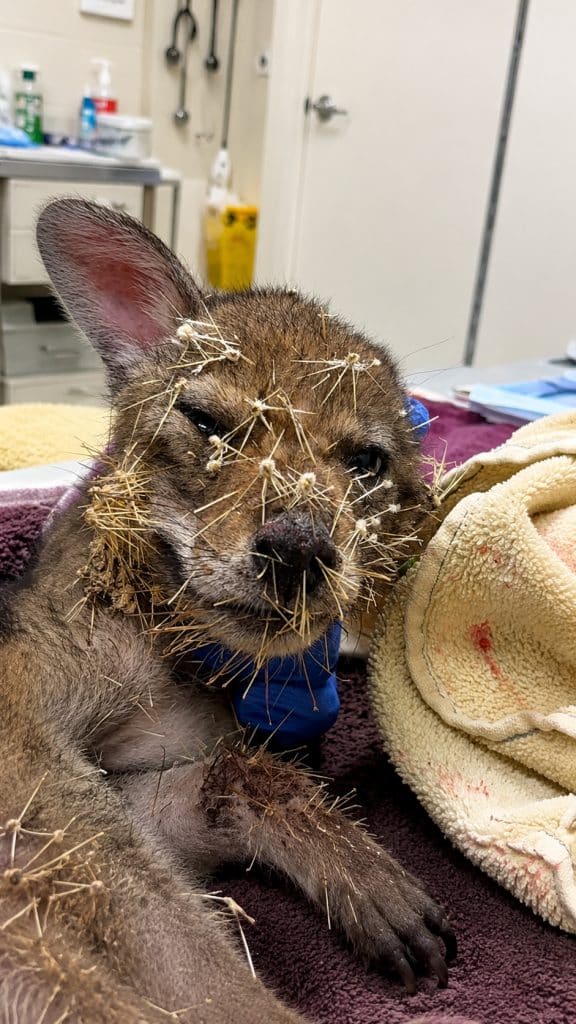
The young coyote could barely open his eyes when he arrived at the wildlife rescue center.
Sharp cholla cactus spines were embedded across his face, ears, belly, and legs. Some had pierced the delicate tissue of his ears, while others surrounded his eyes, making even the smallest movements appear uncomfortable.
He was tiny, frightened, and in urgent need of help.
At the Southwest Wildlife Conservation Center, the rescue team knew they had to act carefully. Removing the spines would take time, and treating a wild animal this young required special precautions.
But when the team finally finished the delicate procedure, the little coyote would be given something he had been missing since his painful encounter with the cactus.
A chance to rest without those sharp spines covering his body.
The Little Coyote Whose Face Was Almost Hidden Beneath Cactus Spines
When the young coyote arrived at the Southwest Wildlife Conservation Center, the extent of his condition was immediately apparent.
Cholla cactus spines covered much of his small body.
They were embedded in his face.
His ears.
His belly.
And his legs.
Some surrounded the sensitive area near his eyes, leaving him struggling to open them comfortably.
He appeared exhausted.
His little body was overwhelmed by an encounter with a cactus that had left sharp spines attached to him almost everywhere.
No one knew exactly how he had become covered in them.
Perhaps he had accidentally brushed against a cholla while moving through the desert. Perhaps he had become entangled while trying to escape another danger.
The available rescue account did not establish what had happened before he was found.
But the injuries were unmistakable.
Cholla cactus segments are covered in barbed spines that can attach readily to an animal’s fur and penetrate the skin. Trying to remove them without proper handling can cause additional injury.
For this tiny coyote, the problem was especially serious because of the number of spines and their location.
His face and ears required particularly careful attention.
He was also a wild animal, unfamiliar with the people now trying to help him.
The team understood that simply holding him still and pulling out the spines would not be an appropriate approach.
He needed pain relief.
He needed a controlled procedure.
And before the staff could begin, they had to make sure his small body could safely receive the necessary medication.
VIDEO: A Tiny Coyote Arrives Covered in Cholla Cactus Spines—Watch Rescuers Carefully Free Him
Before Removing a Single Spine, the Team Had to Make Him Comfortable
The first step was not removing the cactus spines.
It was weighing the young coyote.
The wildlife team needed an accurate measurement of his body weight to calculate the appropriate doses of medication.
For such a small animal, this was an essential precaution.
The staff also had to consider his distress.
He was injured, frightened, and surrounded by unfamiliar people.
Even gentle handling could cause discomfort when cactus spines were embedded across so much of his body.
The team prepared sedation and pain relief as part of the treatment.
Once the little coyote received the medication, they could begin working more safely and with less discomfort for him.
He would not have to remain fully alert through every movement of the forceps.
And the caregivers could concentrate on removing the spines without unnecessarily prolonging the procedure.
This was an important part of wildlife rescue.
Unlike a domestic puppy accustomed to being handled, a young coyote is a wild animal whose fear and natural responses must be considered throughout treatment.
The goal was to provide the medical care he needed while minimizing stress and unnecessary contact.
Once he was sufficiently sedated, the team carefully positioned him for the procedure.
His small body rested on the treatment surface.
The spines were still visible across his fur.
Some were shallow.
Others had penetrated more deeply.
And the delicate areas around his face and ears demanded particular attention.
The team gathered their medical instruments and began the painstaking work.
One spine at a time.
The Most Delicate Work Was Around His Face, Eyes, and Ears
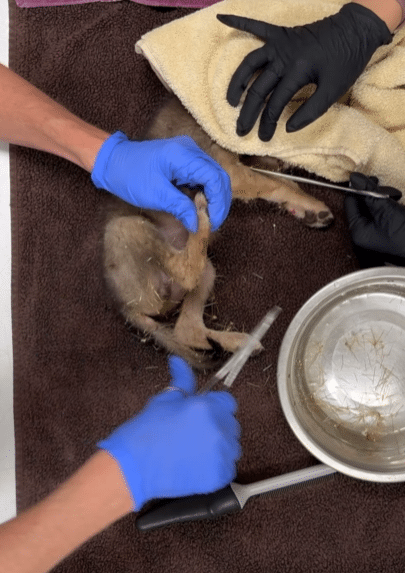
Using medical forceps, the rescuers began removing the cactus spines.
The work required patience.
Each spine needed to be grasped and pulled out carefully, with attention to the surrounding tissue.
There were spines across the coyote’s body, but some areas were especially concerning.
His face had been heavily affected.
Spines near his eyes made the procedure particularly delicate.
And several had pierced through the tissue of his ears.
The staff worked methodically, checking each area before moving on to the next.
There was no simple way to remove everything at once.
A careless movement could leave a spine behind or damage the sensitive tissue around it.
So the team continued slowly.
They removed spines from his face.
Then from his ears.
Then from the other affected areas across his little body.
As the procedure progressed, the difference became visible.
His face was gradually emerging from beneath the sharp cactus pieces.
The areas around his eyes became clearer.
And the painful objects that had covered his ears were being removed.
The process lasted more than 45 minutes.
For the people watching, the repeated movements of the forceps may have appeared simple.
But each one mattered.
A small spine left embedded in the skin could continue causing discomfort.
And with so many present, the team needed to examine the coyote carefully to find everything they could.
The rescuers continued until the visible spines had been removed.
Then they could finally turn their attention to the next stage.
Helping the little animal recover from the procedure.
After More Than 45 Minutes, His Little Face Was Finally Free
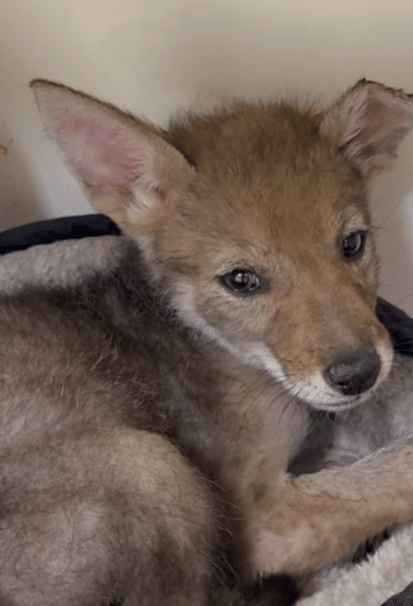
By the end of the procedure, the difference was remarkable.
The coyote’s face was no longer obscured by cactus spines.
His ears had been freed from the sharp pieces that had pierced them.
And the staff had removed the visible spines from the affected areas of his body.
He was still a young, vulnerable wild animal.
His skin would need time to recover from the punctures, and the team could not assume that removing the spines meant every medical concern was resolved.
But the most immediate source of discomfort had been addressed.
The sharp cactus pieces were gone.
For the first time since arriving at the center, his face could be seen clearly.
His eyes were no longer surrounded by the same mass of spines.
And the caregivers could begin focusing on keeping him comfortable while he recovered from sedation.
The team prepared a warm, quiet incubator.
It would provide a protected space where the little coyote could rest while his condition was monitored.
After such an extensive procedure, he needed somewhere calm.
He did not need unnecessary noise or handling.
He needed warmth, observation, and time for the effects of the medication to wear off.
The rescuers carefully transferred him into the incubator.
Then they added an unexpected little companion.
A stuffed fox.
It was a simple gesture, but it created one of the sweetest moments in the entire rescue.
A Stuffed Fox Waited Beside Him in the Warm Incubator
The little coyote was placed in a warm incubator to recover.
His body was still small and fragile.
He had undergone sedation and a lengthy procedure, and the staff needed to make sure he recovered safely.
The quiet enclosure provided a controlled environment where they could continue monitoring him.
Then someone placed a stuffed fox beside him.
The soft toy was nearly as memorable as the treatment itself.
After arriving covered in painful cactus spines, the young animal was now resting beside a plush companion in a protected space.
The account described the stuffed fox as a source of comfort.
It is not possible to know exactly how the coyote perceived it, but soft objects are sometimes used in wildlife care to provide appropriate support or a sense of nearby contact for young animals.
The rescue team remained focused on his recovery.
He still needed medical attention after the spine removal.
His hydration was another concern.
The staff assessed his condition and provided subcutaneous fluids to support him.
For an animal that had arrived stressed and injured, restoring and maintaining hydration was part of the broader treatment plan.
The fluids were administered beneath the skin, allowing them to be absorbed gradually.
The team continued observing him as he recovered from sedation.
They monitored his condition.
They checked that he was waking appropriately.
And they made sure he remained comfortable in the incubator.
The hardest part of the spine removal was over.
But the coyote was not ready to return to the wild yet.
He still needed to regain strength.
And the next encouraging sign would come when he began waking and responding to his surroundings.
His Eyes Began Opening More Comfortably as He Recovered
As the effects of sedation wore off, the young coyote gradually became more alert.
The team continued observing him closely.
His eyes, which had been surrounded by painful cactus spines when he arrived, appeared clearer.
His face was no longer covered by the same sharp pieces that had made opening his eyes so uncomfortable.
And his body began responding more normally as he recovered from the procedure.
It was an encouraging development.
The rescue had begun with a tiny animal whose appearance made the extent of his discomfort impossible to overlook.
Now, he was resting in a warm environment without the visible spines embedded across his face and body.
His caregivers still needed to watch for complications.
Puncture wounds require monitoring, and the young coyote had undergone an extensive treatment session.
But the immediate progress was clear.
He was waking.
He was becoming more aware of his surroundings.
And the staff could begin evaluating how well he was recovering.
The account described his appearance as noticeably improved.
His little face was easier to see.
His eyes looked more alert.
And he appeared calmer than he had when he first arrived.
There was still another important step ahead.
He needed nourishment.
After receiving treatment and supportive care, the young coyote would need to begin eating as part of his recovery.
The staff prepared to offer him food.
And when he finally accepted his first meal, it became another welcome sign of progress.
The First Meal Marked an Encouraging Step Forward
After the difficult procedure, the coyote began receiving food as part of his recovery.
The team offered him a meal and watched how he responded.
For an animal who had arrived stressed, injured, and in need of medical attention, his willingness to eat was encouraging.
It suggested that he was becoming more settled and able to take in nourishment.
But it was only one part of the picture.
Eating after treatment does not automatically mean an animal has recovered completely.
The staff would still need to monitor the puncture sites, hydration, energy, and overall condition.
For this young coyote, recovery required continued observation.
He had experienced an extensive encounter with cholla cactus.
Some spines had penetrated deeply.
Others had affected sensitive tissue.
And the procedure to remove them had lasted more than 45 minutes.
His body needed time.
The warm incubator provided a protected place to rest.
The fluids supported his hydration.
And the food offered an opportunity to begin replenishing his energy.
Little by little, the coyote was moving beyond the immediate emergency that had brought him to the center.
The footage’s later scenes showed a noticeably different animal.
He was no longer almost hidden beneath cactus spines.
His face was visible.
His eyes appeared clearer.
And he was receiving ongoing care from the wildlife team.
The improvement was meaningful.
But the final goal of his rescue remained ahead.
He needed to recover well enough to live as the wild animal he was.
The Before-and-After Images Revealed an Extraordinary Difference
The final comparison in the video showed just how dramatic the treatment had been.
Before the procedure, the little coyote’s face was covered in cholla spines.
His ears had been pierced.
Spines were embedded across his belly and legs.
And the area around his eyes was so heavily affected that opening them appeared difficult.
After treatment, the visible spines were gone.
His little face could finally be seen.
His ears were free of the sharp pieces that had passed through the delicate tissue.
And he was resting in a warm environment while receiving continued care.
The transformation was striking.
But unlike a domestic animal rescue, the objective was not to make the young coyote comfortable around people or prepare him for adoption as a pet.
He was a wild animal.
The Southwest Wildlife Conservation Center’s role was to treat his injuries, support his recovery, and preserve his opportunity to return to an appropriate wild environment when he was ready.
That distinction is important.
Wildlife rehabilitation requires balancing necessary medical intervention with the animal’s long-term welfare.
The rescuers needed to provide treatment without encouraging unnecessary dependence on humans.
They needed to monitor him while allowing him to retain his natural behaviors.
And they needed to make decisions about his next steps based on his health and readiness.
The available account does not confirm that he had already been released.
It describes him as continuing to recover.
But the before-and-after images show the important progress achieved during the initial rescue.
A young coyote arrived with his body covered in painful cactus spines.
The team removed them.
They provided supportive care.
And he began recovering in a safe environment.
It was an encouraging beginning.
His Future Belonged in the Wild, Not in Someone’s Living Room
There was something particularly moving about how carefully the wildlife team handled this tiny coyote.
He was young.
He was injured.
And his body was covered in spines that he could not remove on his own.
The rescuers provided the care he needed, but their goal was never to turn him into a household companion.
Coyotes are wild animals.
Their needs, behaviors, and place in the environment differ from those of domestic dogs.
Even a young coyote who requires close human attention during rehabilitation must eventually be assessed for whether he can return to life in the wild.
The team understood that.
They weighed him before giving medication.
They provided sedation and pain relief.
They removed the spines with medical instruments.
And they placed him in a warm, controlled environment while he recovered.
Each action served a specific purpose.
The staff were not trying to change his nature.
They were trying to help him survive an injury and regain the ability to live normally.
The account does not reveal what happened to the coyote after the documented recovery period.
It does not provide a release date or confirm that he had returned to the desert.
For that reason, his long-term outcome remains unknown.
What is documented is that he received specialized care and began showing encouraging signs of improvement.
He was becoming more alert.
He accepted food.
And he was free of the visible cactus spines that had covered his small body.
For the wildlife team, those were important steps toward the possibility of a future release.
And for the little coyote, they meant he had a chance to recover from a dangerous encounter that he could not have resolved alone.
One Tiny Coyote, Hundreds of Spines, and a Team That Refused to Rush
The image from the beginning of this rescue is difficult to forget.
A young coyote arrives at the Southwest Wildlife Conservation Center with cholla cactus spines embedded across his body.
They cover his face.
They pierce his ears.
They cling to his belly and legs.
And they surround his eyes, leaving him struggling to open them comfortably.
He is frightened, injured, and far too small to remove the sharp spines himself.
But the team is ready to help.
They begin by weighing him so they can calculate the correct medication doses.
They provide sedation and pain relief.
Then, using medical forceps, they carefully remove the spines one by one.
The procedure lasts more than 45 minutes.
There is no rushing.
Every movement is deliberate, particularly around the delicate tissue of his eyes and ears.
Finally, the visible spines are removed.
The young coyote is placed in a warm incubator, where a stuffed fox rests beside him.
He receives fluids and is monitored as he wakes from sedation.
His eyes become more alert.
His appearance improves.
And he begins eating.
The footage does not document his eventual release, so there is still a part of his journey that remains unknown.
But the initial transformation is clear.
The little coyote who arrived covered in sharp cactus spines is now resting in a protected environment, receiving the care he needs to recover.
His story is a reminder that wildlife rescue often involves quiet, highly specialized work.
Sometimes, it means weighing a tiny animal before administering medication.
Sometimes, it means spending nearly an hour removing embedded spines with forceps.
And sometimes, it means watching carefully as a frightened wild baby wakes in a warm incubator and takes his first meal after treatment.
For this young coyote, those careful actions created the possibility of a future that had seemed uncertain when he arrived.
He was not ready to return to the wild just yet.
But he was no longer struggling beneath the painful burden of the cactus spines.
He arrived with his tiny face almost hidden beneath sharp spines. After more than 45 minutes of careful treatment, he could finally rest—and begin the journey toward the wild home where he belongs.


