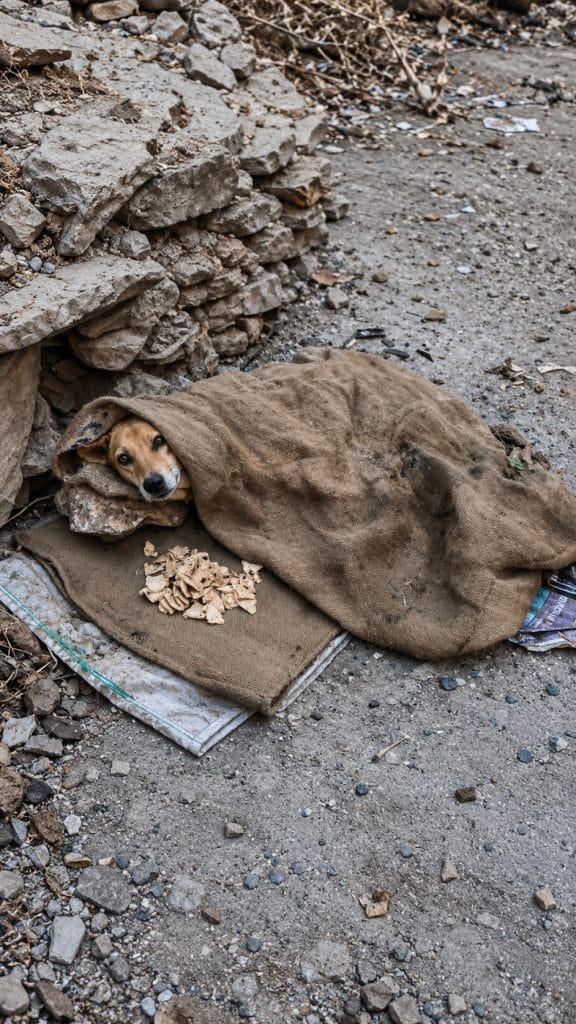
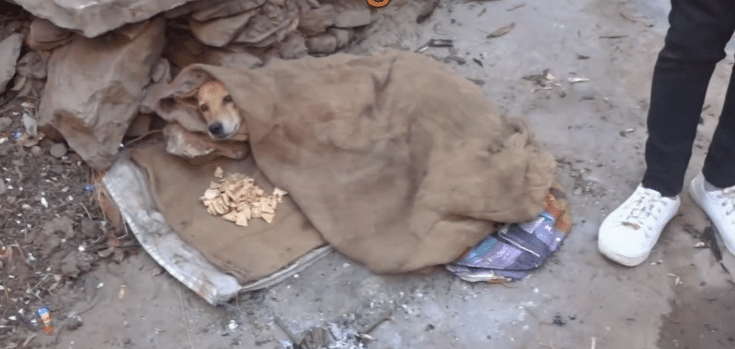
Buster was lying on a pile of debris when rescuers first saw him.
He was an elderly dog.
His body barely moved.
And when he tried to change position, his legs could not support him.
Someone nearby had already noticed that he was struggling.
A blanket had been placed over him.
A small sweater covered his body against the cold.
They were simple things, but for a dog unable to get up and find shelter for himself, they mattered.
Then rescuers arrived.
Buster did not try to move away as they approached.
He simply remained where he was while unfamiliar people gathered around him.
Soon, they carefully lifted the elderly dog from the debris.
At that moment, nobody knew whether Buster would ever walk normally again.
Six weeks later, they would have their answer.
Buster Could Not Get Up on His Own
Up close, the seriousness of Buster’s condition became clearer.
He could not stand independently.
Even repositioning himself required considerable effort.
For an elderly dog, that loss of mobility created problems beyond simply being unable to walk.
He could not easily search for food.
He could not move somewhere warmer when the temperature dropped.
He could not leave the uncomfortable ground beneath him.
The blanket and sweater someone had provided offered temporary protection, but Buster needed much more than that.
Rescuers approached carefully and prepared to transport him for medical evaluation.
Buster remained calm while they lifted him.
Then the pile of debris disappeared behind him.
For the first time, he was heading somewhere his inability to walk could be properly investigated.
Video: Elderly Buster Is Found Unable to Stand as Rescuers Carry Him Toward Help
The Examination Revealed a Spinal Injury
Veterinarians began evaluating Buster soon after his arrival.
They discovered that he was dealing with a spinal injury that had severely affected his mobility.
The diagnosis explained why his legs were struggling to support him.
Standing was extremely difficult.
Walking independently was not possible.
And because Buster was already an older dog, nobody could guarantee how much mobility he might regain.
There was no instant treatment that would have him running again the next morning.
Instead, recovery would require time and consistent rehabilitation.
The team could support him.
They could work on preserving and rebuilding strength.
They could help him practice movement safely.
What they could not do was promise an outcome.
So they began with what Buster could manage.
And during those first days, that was not much.
Physical Therapy Began With the Smallest Movements
Buster’s rehabilitation was gradual.
His caregivers worked with him through physical therapy designed to help maintain muscle strength and improve his ability to move.
At first, even standing was a challenge.
His legs could give way beneath him.
He needed assistance.
Then he needed rest.
The team adjusted each session to what his body could tolerate rather than pushing him beyond his limits.
Some days seemed encouraging.
On others, progress was difficult to see.
That was part of the process.
A dog who had lost significant mobility was not going to rebuild it through one successful therapy session.
Buster needed repetition.
Place the paws.
Support the body.
Try to stand.
Rest.
Then return another day and try again.
Gradually, those repeated attempts began producing small changes.
One Stronger Step Became Two
The first milestones were easy to overlook.
Buster supported himself slightly longer.
His balance improved.
A movement that had required considerable assistance began requiring a little less.
Then came the steps.
At first, they were uncertain.
His body still needed to relearn how to coordinate movement, and his weakened muscles had to become stronger.
But Buster was moving.
The caregivers celebrated the progress without assuming his recovery was complete.
One step did not mean the spinal injury had disappeared.
A good day did not guarantee that the following day would be equally easy.
Still, every improvement gave them something concrete to build on.
A little more balance.
A little more strength.
A slightly longer distance.
The dog who had been unable to rise from a pile of debris was beginning to move forward.
His Caregivers Kept Returning on the Difficult Days
Recovery did not move in a straight line.
There were sessions when Buster’s legs appeared stronger.
There were others when standing remained difficult.
His caregivers continued working with him through both.
They supported him when necessary.
They allowed him to rest when his body needed it.
Then they returned for the next session.
Buster also remained cooperative during his rehabilitation, allowing the team to guide him through the exercises he needed.
That consistency mattered.
There was no single dramatic moment responsible for his progress.
Instead, improvement came from many ordinary sessions repeated over time.
A supported stand.
A cautious step.
A little more balance.
Another day of practice.
Then another.
Eventually, the distance Buster could manage began growing.
And the amount of assistance he needed began shrinking.
At Six Weeks, Buster Walked Without Support
Six weeks after rehabilitation began, Buster reached the milestone everyone had been working toward.
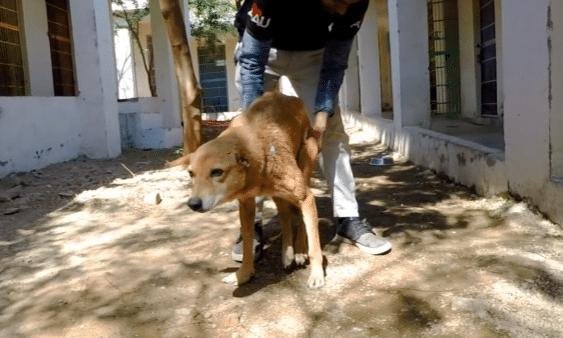
He walked on his own.
No one was holding his body upright.
No support was keeping him on his feet.
Buster was carrying himself.
The elderly dog who once could not stand had regained enough strength and coordination to move independently.
Soon, he was doing more than taking a few careful steps.
He began exploring.
His movements became increasingly confident.
And eventually, Buster was able to run.
For the people who had seen him on his first day, the contrast was remarkable.
Six weeks earlier, someone had needed to place a blanket over him because he could not simply get up and find somewhere comfortable himself.
Now Buster could decide where he wanted to go.
And his own legs could take him there.
Independence Changed His Entire Day
Regaining mobility gave Buster more than the ability to walk.
It gave him choices.
If he wanted to explore, he could move.
If something caught his attention, he could go investigate it.
He no longer needed someone to reposition him every time he wanted a different place to rest.
That independence also allowed more of his personality to emerge.
Buster became active.
He interacted with the people around him.
His tail moved freely as he explored.
The physical therapy sessions that had once focused on simply getting him upright now existed alongside ordinary daily activities.
Walking around.
Exploring his surroundings.
Spending time with caregivers.
Resting after using his recovering legs.
For an elderly dog, those ordinary freedoms represented an enormous change.
Six Weeks of Recovery Were Built From Very Small Wins
Looking only at Buster walking later, it would have been easy to miss what came before.
The pile of debris.
The sweater.
The blanket.
The legs that could not hold his weight.
The diagnosis of a spinal injury.
The uncertain first attempts at standing.
Buster’s progress was not one sudden leap from immobility to running.
There were many steps between those two images.
Physical therapy.
Assisted standing.
Rest.
Another session.
A stronger movement.
Better balance.
The first uncertain steps.
Then a few more.
Each improvement became the foundation for the next one.
That is what eventually carried Buster through six weeks of rehabilitation.
Not one extraordinary day.
Many ordinary days of consistent work.
The Dog Who Had to Be Carried Can Now Choose Where to Go
Buster’s age did not disappear when he regained his mobility.
Neither did the fact that he had suffered a serious spinal injury.
But his first condition did not become his permanent one.
When rescuers found him, Buster could not stand.
Someone had covered him with a blanket and sweater because there was little he could do for himself.
Then people carried him away.
Veterinarians identified the problem.
Caregivers began rehabilitation.
And Buster kept participating, session after session.
Six weeks later, his legs were carrying him again.
Today, the most meaningful part of Buster’s recovery may not be how quickly he can move.
It is that he can move when he chooses.
He can get up.
He can explore.
He can walk toward the people around him.
And sometimes, he can even run.
Once, Buster needed someone else to carry him away from a pile of debris.
Six weeks later, he was carrying himself toward whatever caught his curiosity next.


