The boy had been standing near the far wall for almost twenty minutes before anyone noticed him.
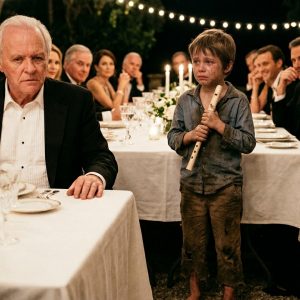
Not because he was invisible. Because he was wrong for the room. Tweed coat, scuffed shoes, a collar that had been pressed too many times until the fabric remembered the crease better than it remembered being new. He stood close to the display table without touching anything, watching the room with dark, steady eyes that didn’t quite belong on a twelve-year-old face.
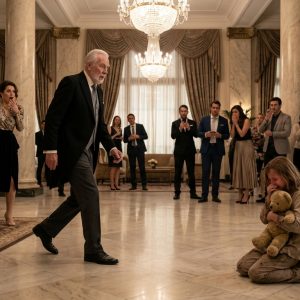
The Calloway Foundation Gala was the kind of event where everything cost more than it appeared to. The champagne flutes were hand-blown crystal. The flower arrangements were imported from Amsterdam. The guests wore the kind of confidence that only comes from never having been told no — at least, not by anyone who mattered.
And there, commanding the center of it all, was the vault.
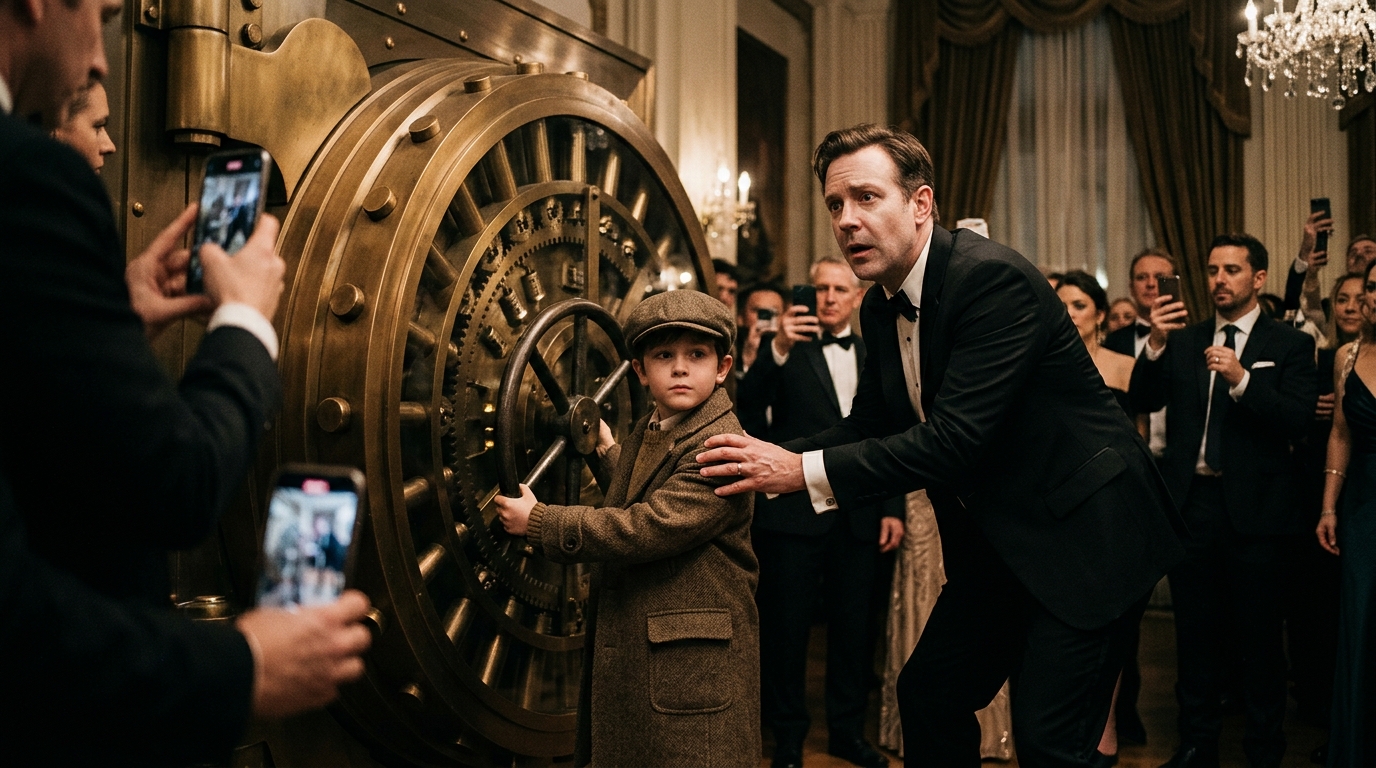
It rose nearly eight feet from the polished marble floor, its face a burnished gold so deep and warm it seemed almost alive under the chandelier light. A massive iron wheel sat at its center like the helm of a ship, flanked by three rows of combination locks. The vault was the centerpiece — an antique designed by Harlan Voss, a craftsman who had built exactly nine of them in his life before dying quietly in a workshop fire forty years ago. The host of the evening, a man named Gerald Whitmore, had purchased it at auction four years prior for reasons he described as “an appreciation of functional artistry.”
No one had opened it since it arrived.
Or so Gerald said.
Gerald was laughing when it started. He had been laughing for most of the night — a loud, polished laugh that always seemed designed to be heard from a distance. He was the kind of man who wore a tuxedo like armor. Fifty-eight years old. Silver-templed. The sort of handsome that came from money and maintenance rather than genetics.
He spotted the boy near the vault and made his way over with the easy stride of someone who had never once been embarrassed in public.
“Admiring the craftsmanship?” he asked, projecting his voice so the cluster of guests nearby could hear. A small audience began to form. They always did around Gerald.
The boy looked up at him without flinching. “I’ve seen one like it,” he said. “Smaller version. My father built them.”
Gerald’s eyes lit up with the particular gleam of a man who had found entertainment for the evening. He glanced back at his guests — the smiles forming, the phones already rising — and turned back to the boy.
“Is that so?” He reached into his jacket pocket and pulled out a folded stack of bills. He held them up slowly, deliberately, letting the moment breathe. “I’ll give you ten thousand dollars if you can open it.”
The grand hall fell into a charged, glittering hush.
The boy looked at the money. Then at the vault. Then back at Gerald Whitmore.
And he walked toward the vault without another word.
The Hands That Already Knew The Lock
The room leaned in.
Not all at once. Gradually. The way a crowd does when something shifts from entertainment to something they can’t quite name. Phones tracked the boy’s movement as he approached the massive iron wheel. Someone near the back whispered something to their companion, and the companion shushed them.
The boy reached out and placed both hands on the wheel.
He didn’t test it. He didn’t hesitate. He gripped it with a precision that was almost clinical — thumbs positioned at exact angles, fingers curved just so — the way a surgeon holds an instrument, or a musician holds an instrument they have held ten thousand times before.
He turned it left. Three full rotations. Then stopped.
Someone near Gerald laughed softly. “He’s just spinning it. He has no idea.”
Gerald smiled. That easy, practiced smile.
Then the boy moved to the first secondary lock. His fingers found the dial without looking at it. He closed his eyes briefly — not dramatically, not for show — just the way someone closes their eyes to hear something more clearly. His lips moved almost imperceptibly. Counting. Or remembering.
Click.
One tumbler disengaged. Deep inside the steel. The sound was small but unmistakable, and it cut through the ambient noise of the room like a stone dropped in still water.
The laughter nearby stopped.
The boy moved to the second lock. Same motion. Same closed eyes. Different count. His hands barely trembled.
Click.
Gerald’s smile had not disappeared, but it had changed. It had become the kind of smile a person keeps on their face because removing it would mean admitting something.
The third lock. The boy’s fingers worked slower here. More deliberate. There was a sequence buried inside this one — not just a number, but a pattern within the number, a designed irregularity that Harlan Voss had apparently used as his signature on the more complex builds. The boy knew it. He navigated it the way you navigate a familiar staircase in the dark — not thinking, just knowing where to put your foot.
Click.
The vault breathed.
That was the only word for it. A sound came from inside the steel — not mechanical, not precisely — more like pressure equalizing, like something that had been held shut for a very long time quietly deciding it was time to release. The iron wheel shifted a half-inch on its own, responding to the released tumblers.
Gerald Whitmore took one involuntary step forward.
“Who taught you that?” he said.
The question came out wrong. Too quiet. Too stripped of the performance he had been building all evening. His guests heard it and felt the change in his voice even if they couldn’t name it.
The boy still hadn’t looked at him.
“My father built this safe.”
Three seconds of absolute silence.
Then Gerald moved.
Not the measured stride of a host managing a situation. Something faster. Something that didn’t belong at a charity gala. His hand shot out and seized the boy by the shoulder, pulling him back from the vault door with enough force that the boy stumbled and had to catch himself against the display table.
The room held its breath.
The boy turned slowly.
His expression hadn’t broken. Not into fear, not into anger. Just that same dark, steady gaze that had seemed wrong on his face from the beginning — and now suddenly seemed exactly right.
“Why?” he said. “Is your name still inside?”
The color left Gerald Whitmore’s face so completely and so fast that two of his closest friends later said they thought he was having a medical episode.
He wasn’t.
He was remembering.
And whatever he was remembering — it was worse than anything happening in this room right now.
What The Vault Had Always Been Holding
My name is Owen Voss. I am twenty-nine years old, and I have been planning this evening for four years.
The boy near the vault is my brother, Elliot. He is twelve, and he is the best thing our father ever made — more than any safe, more than any lock, more than the nine golden masterworks that Harlan Voss left behind when the workshop fire took him.
I need to explain why we were there. Why we came at all.
Our father didn’t die in an accident.
I know that’s a large thing to state plainly. I’ve been carrying it for four years without saying it plainly to anyone — not to detectives who had already closed the case, not to the insurance adjuster who processed the claim, not even to our mother, who cried quietly for six months and then stopped crying and started looking at job listings, because the life insurance payout had conditions and one of those conditions had been quietly, professionally contested.
Contested by Gerald Whitmore’s lawyers.
My father and Gerald had a history that most people didn’t know about. Harlan Voss wasn’t just a craftsman who worked in isolation. In the early years, before his reputation was built, he took commissions through a broker. One of those commissions came from a young, ambitious man who had recently inherited a mid-sized investment firm and wanted something built to specification — a vault that could hold documents, that could hold assets, that could hold the kind of things that a man of ambition accumulates before the law catches up with him.
Gerald Whitmore’s vault. The one displayed in his grand hall.
My father built it to Gerald’s exact specifications. And somewhere in the process — in the reviewing of blueprints, in the consultation meetings, in the trust that forms naturally between a craftsman and a client — my father saw something he wasn’t meant to see.
He never told me exactly what it was. He was careful that way. Protective. He called it “insurance” and he said he had put the insurance in a place that only he and God knew about, and that as long as he kept quiet, it would stay there.
He kept quiet for eleven years.
Then someone from Gerald’s firm approached him about building a second vault for a new facility. My father declined. He gave no reason. The firm pressed. My father declined again. Three weeks later, the workshop fire happened at two in the morning on a Thursday, and my father was found inside by the responding crew, and the fire marshal’s report cited faulty electrical wiring in the rear storage room, and the case was closed in less than thirty days.
I was twenty-five when it happened. Elliot was eight.
I spent the next four years becoming the kind of person who could walk into a room like this one. I got a job in financial compliance. I studied. I asked the right questions to the right people and I kept my face very still while I did it. I learned things about Gerald Whitmore’s firm that his own board members didn’t know. And slowly, piece by piece, I assembled a picture.
The vault in the grand hall was the center of that picture.
Not because of what Gerald stored inside it — I didn’t know exactly what that was, not yet. But because my father had built it with a second compartment. A hidden cavity inside the main chamber, accessible only through a secondary sequence that Gerald’s combination would never reach. A craftsman’s secret. A builder’s insurance.
Whatever my father had hidden there — evidence of what he had seen, what he had known — it was still inside. It had to be. Gerald had purchased the vault at auction but never had it cracked. He was afraid to bring in an expert, afraid that an expert would find the hidden chamber and expose what was inside. So the vault sat in his grand hall as a display piece, locked and untouched, the secret trapped inside the steel along with everything else.
Elliot remembered every sequence our father had ever taught him. Our father believed in passing things down. He would sit with Elliot for hours in the workshop, drilling the combinations into his memory like poems, like prayers.
We needed to get inside that room.
We needed someone to open the vault without triggering suspicion.
And Gerald had handed us the invitation himself.
The Name Beneath The Hidden Panel
The room had stopped being a party.
The phones were still recording — that hadn’t changed — but the faces behind the phones had changed completely. No one was smiling for their followers anymore. No one was performing the experience of the gala. They were just watching. Because something real was happening, and real things don’t require a filter.
Gerald still had his hand on Elliot’s shoulder. But he wasn’t gripping anymore. He had gone very still, the way a person goes still when their mind is moving faster than their body can keep up with.
I stepped out from the edge of the crowd.
I had been there the whole time. Not hidden — just unremarkable in a rented suit, a glass of champagne I hadn’t touched, standing near the column at the east side of the hall where the light was slightly softer. I had watched Gerald spot Elliot. I had watched the performance begin. I had watched Elliot walk to the vault and do what our father had spent years preparing him to do.
And now I walked toward the center of the room.
“Let go of him,” I said.
Gerald turned. His eyes registered me slowly, like a man waking from something. He released Elliot’s shoulder.
“Who are you?” he asked.
“Owen Voss,” I said. “Harlan Voss was my father.”
Something moved through the crowd. A murmur, low and spreading. Some of them knew the name. The fire had made papers. The Calloway Foundation had even issued a brief statement of condolence at the time, because Gerald Whitmore sat on the Foundation’s advisory board and it was the appropriate thing to do.
Gerald’s jaw tightened. “This is not the place for—”
“Open it the rest of the way, Elliot,” I said.
Elliot turned back to the vault. He gripped the iron wheel again with both hands and pulled. The door swung open on its bearings — smooth, almost silent, the engineering perfect even after decades — and the interior cavity was revealed. A single overhead spotlight in the hall caught the inside of the vault and illuminated it clearly.
Shelves. Documents in protective sleeves. Folders. A sealed metal box in the lower right corner.
And there, on the interior wall of the vault — engraved in the steel itself, small but visible from where I stood — a name.
Not Gerald’s name.
My father’s.
H. VOSS — BUILDER — 1987.
Standard practice for my father. He signed his work the way painters sign canvases. From the inside.
“Don’t,” Gerald said.
The word came out as a command. But it had no purchase. He had no authority in this room anymore. He could feel it leaving him — the way heat leaves a room when a window breaks in winter. Fast. Complete.
I reached past Elliot and pressed my thumb to the interior left panel — the third panel from the base, slightly recessed. My father had told me about this. Not the combination — that was Elliot’s — but the location. He had described it to me once in the parking lot outside a diner, speaking quietly, without looking at me, the way people speak when they’re saying something they hope they never have to say again.
“If something happens to me,” he had said, “the builder always leaves a way in.”
The panel released with a sound like a held breath finally let go.
The hidden compartment was there.
Inside it, sealed in a heavy plastic envelope — yellowed at the edges, slightly damp from years of compressed air — a document. Handwritten. Pages of it. And clipped to the front, a single photograph.
I didn’t need to read it fully to understand what I was holding. I had spent four years building the framework. This was the confirmation. The document was in my father’s handwriting — methodical, precise, the same handwriting that had labeled every dial and every sequence in his workshop journals. It described, in detail, a financial arrangement he had witnessed. Assets passed through the vault. Names. Account numbers. Dates. The kind of detail that only a man given total access to a private commission could have observed.
Gerald Whitmore had used this vault — in its early years, before he displayed it publicly — to hold documentation of funds moved across three shell companies. Not legitimate funds. The kind that, if traced, led to people who needed to stay untraceable.
And my father had seen enough of it to write it all down.
And Gerald had known. And the fire had happened.
I turned to face the room. My hands were steadier than I expected them to be.
Among the guests frozen in the grand hall were two people I recognized. A woman named Patricia Hendricks — a senior partner at a federal financial crimes unit who had been investigating Whitmore’s firm for eighteen months and had hit a wall at every turn. I had arranged, quietly, for her to receive an invitation to the gala through a mutual contact. She had come as a guest. She had a recorder in her jacket pocket. She was looking at the documents in my hand with an expression I will remember for the rest of my life.
And beside her — a photographer from a national paper who had been assigned a puff piece on the gala and was now shooting something that would appear on a very different page.
Gerald had built the room. Gerald had set the stage. Gerald had even provided the audience.
He just hadn’t understood which direction the performance would face.
After The Lights Came Back On
They took Gerald Whitmore out of the grand hall at 10:47 PM.
Not in handcuffs — that came later, formally, on a Tuesday morning three weeks afterward when the federal case had been properly assembled and the arrest could be made with the weight of the documented evidence behind it. That night, Patricia Hendricks simply asked him to accompany two colleagues to a quiet room for a conversation. Gerald went without visible protest. The performance instinct stayed with him to the end — he shook two hands near the door as if he were simply stepping away for a business call.
No one in the room was fooled.
The video footage from that evening — all of it, from every phone, from every angle — spread within hours. Not as the humiliation reel Gerald had imagined when he made the bet. As something else entirely. The clip that circulated most widely was not the vault opening. It was the twenty seconds after. Elliot’s face, still and composed. Gerald’s hand on his shoulder. And then Elliot’s voice, quiet and clear.
“Why? Is your name still inside?”
It became the question that defined what followed. Journalists used it as a headline. The federal filing referenced the vault discovery as a critical breakthrough in their investigation. The phrase entered the coverage of the case the way certain phrases do when they arrive at exactly the right moment to crystallize something that people already understood but hadn’t said out loud yet.
Elliot didn’t watch any of it. He sat in the car afterward with his coat folded on his lap and his eyes out the window, and when I asked him how he was feeling, he thought about it for a long time before answering.
“Like Dad heard it,” he said.
I didn’t trust my voice to respond to that. I just drove.
The federal investigation that Patricia Hendricks had been building for eighteen months closed within six months of that night. The documents from the vault’s hidden compartment gave her team the thread they needed to finally pull. Three shell companies were dissolved. Assets were frozen. Two additional individuals connected to the financial arrangement my father had documented were charged alongside Whitmore. One cooperated with prosecutors. One did not.
The life insurance dispute — the one that Gerald’s lawyers had quietly contested through a series of procedural challenges — was withdrawn within a week of his arrest. Our mother received the full payout. She sat at the kitchen table with the letter for a long time without opening it, and then she opened it, and then she went to the window and stood there for a while, and I stood beside her and neither of us said anything because there wasn’t anything to say that would have been adequate.
Adequate was never going to be available.
The vault itself became evidence. It was transported from the grand hall under federal supervision and catalogued as part of the case materials. I was told it would eventually be returned — after proceedings concluded — to the estate, meaning to us. I thought for a long time about what to do with it when that day came.
I called Elliot and asked him.
He said, “Put it somewhere people can see it. Dad made it. It should be seen.”
So that’s what we did. When the case concluded and the vault was returned, we donated it to the city’s craftsmen heritage museum. It sits in the main hall now with a plaque on the wall beside it. The plaque lists my father’s name. His years of work. His nine completed builds.
It does not list Gerald Whitmore’s name. It does not describe the fire. Some things can be acknowledged through the space you choose not to fill.
On the day we delivered the vault to the museum, Elliot walked up to it alone and stood in front of it for a few minutes. He didn’t touch the wheel. He didn’t reach for the locks. He just looked at it the way you look at something that belongs to someone you miss — not wanting to possess it, just wanting to be near it for a while.
Then he turned around and found me by the door and we walked out into the afternoon light together, and he put his hands in his pockets, and for the first time in four years, the weight in my chest felt different.
Not gone. I don’t think it goes. Not when the loss is that particular shape. But different. Shifted. The kind of weight you can carry forward instead of being pinned beneath.
Our father built nine vaults in his life. Each one signed from the inside. Each one carrying, somewhere in its steel, the mark of the man who made it — patient, precise, impossible to erase.
He built them to last.
It turned out, so did everything else he left behind.