The coffee hit first.
Not the shoulder. Not the table. All of it — a full, scalding mug — directly into the old man’s lap, soaking through the thin fabric of his flannel shirt, spreading dark and hot across his chest, dripping from the edge of the booth seat to the floor below.
No one moved.
Not the waitress behind the counter. Not the couple in the corner booth. Not the three teenagers near the window who had gone completely rigid, their half-eaten plates of food forgotten.
For one suspended second, the only sound in the diner was the distant crackle of a Patsy Cline song from the jukebox — soft, old, completely out of place — and the slow, deliberate thud of a boot coming down on the linoleum floor.
Then the laughter started.
It boomed through the room like something designed to break things. Loud. Cruel. Meant to be heard by every single person in the building. The kind of laugh that wasn’t really about finding something funny — it was about making absolutely certain that everyone else understood who was in charge of this room.
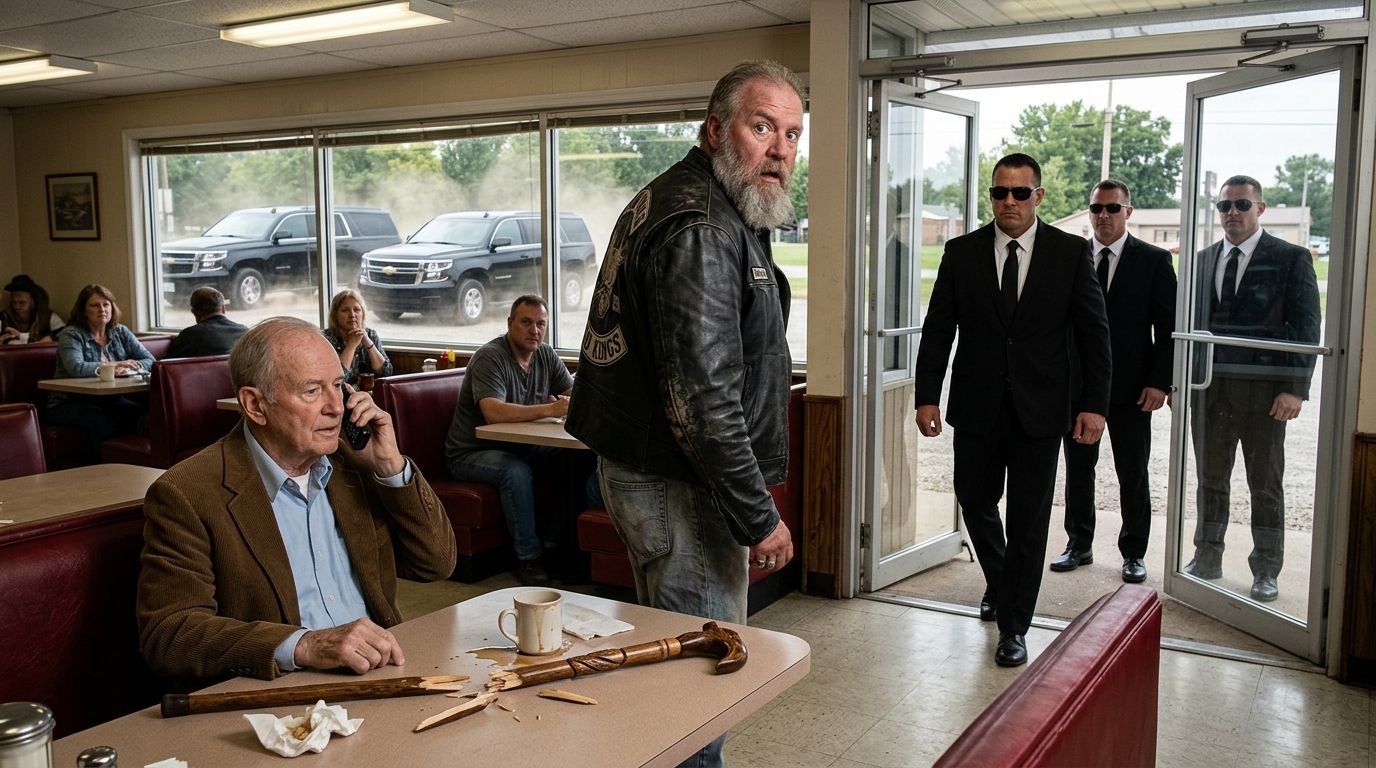
Denny Marsh stood at six feet four, two hundred and sixty pounds of leather and contempt. His vest was covered in patches that told stories he clearly wanted strangers to be afraid of. He had walked into the County Line Diner off Route 9 with two friends who had taken positions near the door like they knew exactly how scenes like this were supposed to go.
And the old man — sitting alone in the corner booth, his hand-carved oak cane propped against the table’s edge, a half-eaten slice of apple pie going cold in front of him — hadn’t looked up.
Not when Denny knocked over the coffee. Not when the heat of it spread across his lap. Not when the laughter filled every corner of the room.
He just sat there. Still. Quiet. Age-spotted hands resting flat against the table.
That stillness was what made Denny angrier.
“What now, Grandpa?” he said, leaning down, his face close enough that the old man would have felt the breath of the words on his skin.
Still nothing.
That was when Denny grabbed the cane.
He picked it up in both hands, held it above his head for exactly long enough to make sure everyone in the room saw what was coming — and then brought it down over his knee with one sharp, vicious motion.
The crack of it split the air like a gunshot.
Clean. Final. Irreversible.
He dropped both halves on the table in front of the old man, still grinning. Waiting for the flinch. Waiting for the trembling lip, the watery eyes, the apology that would make him feel enormous.
The old man reached slowly into the breast pocket of his vest.
And pulled out a phone.
Not a modern one. A small, older model — the kind that flipped open, that belonged to a different era entirely. He pressed a single button. Held it to his ear. And when he spoke, his voice was so low, so completely controlled, that somehow it carried to every corner of the room.
“It’s me,” he said. “Bring them.”
He closed the phone. Set it on the table beside the broken cane. And finally — for the first time since Denny had walked through that door — he looked up.
The rumble came before anything else.
Low. Deep. The kind of vibration you feel in your chest before your ears fully register it. Then it grew. Closer. Louder. Until the windows of the County Line Diner trembled faintly in their frames.
Three jet-black SUVs curved into the parking lot in tight formation, headlights cutting through the late afternoon haze like blades. They didn’t park so much as they positioned — angled, deliberate, sealing off the lot with practiced efficiency.
The doors opened before the engines had fully stopped.
The Men Who Don’t Knock
They didn’t storm the diner the way bikers storm a room — with noise, with theater, with the need to be noticed. They moved differently. Quietly. The kind of quiet that isn’t absence but presence — dense, focused, completely controlled.
Six men in total. Dark suits. Earpieces. Eyes behind sunglasses that caught the light and gave nothing back. The lead man was the first through the door, and he didn’t scan the room the way a person does when they’re unsure of their surroundings. He looked once — and everything he needed to know was already processed.
His gaze went directly to the old man in the corner booth.
Then to Denny.
Denny hadn’t moved. His two friends near the door hadn’t moved either, though one of them had taken a half-step back without appearing to realize it. The laughter was gone now. Completely gone. What was left on his face was something he probably hadn’t felt in a long time — the specific, particular confusion of a man who was very certain about the kind of person he was, suddenly standing in a world where that certainty meant absolutely nothing.
The lead man — broad-shouldered, jaw set, with the particular economy of movement that speaks to years of training — walked to the corner booth. He did not address Denny. He looked at the old man and said quietly, “Sir. Are you hurt?”
The old man shook his head once. “Just wet,” he said.
The lead man — his name, as I would learn later, was Carver — nodded. Then he turned and looked at Denny with the kind of attention that made the air in the room feel different. Not threatening. Not performed. Just deeply, uncomfortably real.
“Step back from the booth,” Carver said.
Denny’s jaw tightened. Old instinct. The automatic resistance of someone who has never once been told to step back by anyone and complied without a fight.
“You don’t know who you’re talking to,” Denny started.
“Step back from the booth.”
The same words. The same tone. Zero repetition of emotion.
Something in Denny’s posture changed. The math had shifted, and some part of him — the part that had survived long enough by reading rooms — was finally doing the calculation. Six men. Suits. Earpieces. Three vehicles outside. An old man who hadn’t flinched at a broken cane and had made exactly one phone call.
He stepped back.
One of the other agents moved to the broken halves of the cane on the table. He looked at them for a moment, then looked at the old man.
“That’s the one from the ranch?” he asked quietly.
The old man’s expression shifted slightly. Just slightly. Something behind his eyes that wasn’t quite grief but was adjacent to it. “My son made that,” he said. “Took him six weeks.”
The agent nodded. He set both halves carefully aside — not discarding them, but treating them with a specific kind of deliberateness, like evidence. Or like something that mattered.
I was sitting two booths away from all of this.
My name is Ray Calhoun. I’m a freelance journalist, forty-three years old, and I had stopped at the County Line Diner because I was two hours into a six-hour drive and needed coffee badly enough to accept whatever came with it. I had been watching the whole thing unfold with the practiced stillness of someone who had learned early in his career that the moment you reach for a notepad, people stop behaving naturally.
I hadn’t reached for anything. I had just watched.
And something about the old man — even before the SUVs, even before the phone call — had made me watch carefully.
It was the stillness. The absolute, unshakeable stillness. I had seen frightened people try to be still before. I had seen proud people perform stillness. This was different. This was the stillness of someone who had been in rooms far more dangerous than this diner, and had learned a long time ago that reaction is a form of information — information you don’t always want to give.
Now I watched Carver lean close to the old man and murmur something I couldn’t hear. The old man shook his head again. Carver straightened, glanced at his team, and something was communicated without words — the way it only can be between people who have operated together long enough that language becomes almost redundant.
Two of the agents positioned themselves on either side of Denny. Not touching him. Just there. The way walls are there.
“I didn’t do nothing illegal,” Denny said, his voice finding some of its old volume but none of its old confidence. “Spilling a drink isn’t a crime.”
“No,” Carver agreed pleasantly. “It isn’t.”
A pause.
“Destruction of personal property is a different conversation.”
Denny looked at the broken cane. Then back at Carver. Something was dawning on him — slowly, the way cold water rises rather than hits.
“Who is he?” Denny asked.
No one answered.
And somehow, that was worse than any answer could have been.
What the Cane Already Knew
The waitress — her name tag read Cheryl, and she had the expression of a woman who had seen a great many unusual things in twenty years of working Route 9 diners but was prepared to admit this was different — eventually brought a fresh cup of coffee to the old man’s booth. Her hands were steady, which impressed me.
“On the house,” she said.
He smiled at her. It was a real smile — the kind that settles into the lines of a face that has smiled the same way thousands of times. “Thank you, sweetheart,” he said. “What’s your name?”
“Cheryl.”
“Cheryl.” He repeated it like it mattered. “I’m Walter.”
I don’t know what made me do it. Journalistic instinct, maybe. Or the particular magnetism of a man who could sit soaking in spilled coffee, watch his son’s cane get snapped in half, and then ask a waitress her name like he had all the time in the world.
I picked up my coffee, walked to his booth, and said, “Mind if I sit down?”
He looked at me for a moment. Those eyes — pale grey, deep-set, the kind that had catalogued a great deal and given very little of it back — moved over my face with quiet efficiency.
“You’re a writer,” he said.
Not a question.
“Journalist,” I said.
He gestured to the bench across from him. “Sit down, then. Journalists drink their coffee standing up, they get restless.”
I sat. And for a moment, neither of us said anything. Outside, I could see Denny and his two associates talking to two of the suited agents in the parking lot. There was no confrontation. There was no raised voice. There was only the particular posture of men who have been made, very efficiently, to understand the nature of their situation.
“The cane,” I said finally. “Your son made it?”
Walter looked at the two halves still on the table. He reached out and touched the larger piece — the handle end, dark-grained oak worn smooth by years of use, carved with a small pattern along the grip that I could now see was deliberate. Not decorative exactly. Intentional.
“He spent six weeks on it,” Walter said. “Used wood from a tree on our property. Old black oak. Had to dry the wood himself — got impatient twice, started over once.” A short exhale through the nose. Almost a laugh. “He was always impatient. Stubborn about everything else, but impatient.”
He pulled his hand back.
“He passed fourteen months ago,” Walter said. “Cancer. Forty-one years old.”
The words landed in the space between us without drama. That was somehow what made them heaviest.
“I’m sorry,” I said.
He nodded once. Accepted it the way men of a certain generation accept condolence — briefly, completely, without performance.
“The cane is just wood,” he said. “But it was the last thing he made with his hands. So.” He picked up his coffee. “It’s not just wood.”
I looked at the broken halves. Then I looked at the man across from me — the wet shirt, the absolutely undisturbed expression, the single phone call that had brought six men in suits to a diner off Route 9 in under eight minutes.
“Walter,” I said. “Who are you?”
He considered the question with what appeared to be genuine seriousness. Like it deserved proper thought rather than a reflexive answer.
“Retired,” he said finally.
“From what?”
Carver appeared at the edge of the booth before he could answer. He leaned down and said something quietly to Walter, who listened and then nodded. Carver straightened, looked at me for exactly two seconds in a way that was professionally neutral and somehow deeply uncomfortable, and then walked back toward the door.
“Is this a problem?” I asked. “Me sitting here?”
“No,” Walter said. “Carver worries. It’s his job to worry.” He set his coffee down. “What’s your name?”
“Ray Calhoun.”
“Ray.” He extended one age-spotted hand across the table. The grip, when I shook it, was firm in the way that has nothing to do with effort. “Walter Graves.”
I didn’t react. But my brain ran the name immediately, the way a search engine runs — fast, automatic, pulling from everything stored.
Walter Graves.
The name circled in my head and didn’t immediately attach to anything specific — but it attached to a category. A weight. The kind of name that appears in certain rooms, certain documents, certain conversations that happen several layers below the ones that get reported.
“Walter Graves,” I said carefully.
“That’s me.”
I set my coffee down. “The Walter Graves who ran the Office of Strategic Threat Analysis from 1989 to 2003?”
His expression didn’t change. But something behind it shifted — the faint, almost imperceptible acknowledgment of a man who has had his name recognized by people who weren’t supposed to know it, and has made a kind of peace with that.
“Retired,” he said again. With the smallest possible trace of a smile this time.
Outside, through the diner window, I watched one of the agents hand Denny a card. Denny looked at it. He didn’t say anything. He put it in his pocket. His two associates had already gotten back on their motorcycles, and the particular urgency with which they were pretending to adjust their helmets told me everything I needed to know about how the conversation had gone.
Then, one detail stopped me cold.
The card Denny had been handed — I had seen, even at this distance, that it was plain white. No logo. Just text. And as he turned it over in his fingers once before pocketing it, I caught a glimpse of something on the back.
A handwritten number.
Not a phone number.
A case number.
The Weight of the Card
I didn’t ask about the card right away. Some questions need room to breathe before they get asked — ask too fast, you get the surface answer, the polished one. Wait long enough, and sometimes the real answer finds its own way out.
Instead, I let Walter drink his coffee. I ordered a piece of the apple pie — the same kind he had been eating when all of this started, which now felt like a different era entirely — and I sat with the particular patience that long-form journalism teaches you, the patience that is not passive but deeply, deliberately active.
The diner slowly returned to its version of normal. Cheryl refilled waters. The couple in the corner finished their meal and paid, giving the booth a wide berth on the way out. The teenagers had gone silent-phone-scrolling in the way young people do when they want to document something without appearing to document it. Two of the suited agents had taken up positions near the entrance — not blocking it, just present — while the others remained outside.
Walter looked around the room. Not nervously. Almost fondly. “I used to stop here when I drove this route,” he said. “Twenty, twenty-five years ago. It looked exactly the same.”
“Same pie?” I asked.
“Better pie. But essentially the same.”
A moment passed.
“The card,” I said.
He set his cup down slowly. He wasn’t surprised. He had known it was coming — he was a man who had spent decades anticipating the next question.
“What about it?”
“The number on the back,” I said. “It wasn’t a phone number.”
He looked at me with those grey eyes, running some private calculation I couldn’t see the workings of.
“No,” he confirmed. “It wasn’t.”
“A case number,” I said. “Or a file number. Something that man now has a record of.”
Walter was quiet for a moment.
“There is a man,” he said finally, “who has been operating a protection racket out of three counties along this highway for approximately eleven months. Small businesses. Diners. Gas stations. Trucking companies.” He picked up his coffee again. “The man who broke my cane today — he isn’t the architect of that enterprise. But he is a named participant in the federal investigation of it.”
I stared at him.
“You knew who he was,” I said. “Before he walked in.”
“I had a photograph,” Walter said. “Yes.”
“You stopped here on purpose.”
He tilted his head slightly. The small motion of a man neither confirming nor denying — but not quite deflecting either.
“I stopped here because I was hungry,” he said. “And because I have driven this road before and I remembered the pie.” He paused. “The rest of it was coincidence. But sometimes coincidence is just pattern recognition arriving late.”
“He recognized you,” I said. “Denny. Not as Walter Graves — he clearly didn’t know who you were. But he recognized something. That’s why he targeted you specifically.”
Walter’s expression shifted slightly.
“Old men alone in corner booths are a particular kind of target,” he said. “It has nothing to do with recognition. It’s arithmetic. They look for the person least likely to fight back.”
He said it without bitterness. The way you state a law of physics.
“But you knew what the card would do,” I pressed. “Once he had that number — he knows he’s in a file. He knows someone is watching. You weren’t just having coffee.”
Walter looked at the two halves of the broken cane on the table. He was quiet long enough that I wondered if I had pushed past the line.
Then he said: “Carver wanted to take them all in today. We had enough for that.” He touched the handle piece of the cane again — that same gentle, brief contact. “I said no.”
“Why?”
“Because I’m more interested in the man giving them their orders.” He looked up. “You arrest the foot soldiers, the general promotes new ones. You leave the foot soldiers in the field with evidence that their name is in a federal file — suddenly they’re making phone calls they wouldn’t otherwise make. Having conversations they wouldn’t otherwise have.”
He picked up the handle of the cane. Turned it in his hands.
“My son taught me that,” he said quietly. “He was a detective. Twenty-two years. He understood patience better than anyone I ever met.”
The words sat there between us, and I didn’t fill the space. Because now I understood something I hadn’t understood before. The stillness wasn’t just training. It wasn’t just a lifetime of operating in dangerous rooms. It was grief that had calcified into something useful — the immovable quality of a man who had already lost what he couldn’t afford to lose, and had made a decision about what to do with the time that remained.
He had come to this diner because he remembered the pie. Everything else had found him.
And he had handled it the only way he knew how.
But I was still turning over one thing. One detail that didn’t quite fit the shape of everything else.
The case number on the card was handwritten. Not printed. Not pre-prepared. It had been written in the parking lot, in the approximately four minutes between the SUVs arriving and Carver handing it to Denny. Which meant Carver hadn’t known it would be needed. Which meant something had changed — some piece of information had shifted — in those four minutes that elevated Denny from known participant to something more urgent.
I was about to ask.
But then the door to the diner opened, and the agent who had been stationed outside walked directly to Carver, said something quietly, and Carver’s face changed in a way that was very small and very significant.
He crossed the room in seven steps and leaned down to Walter.
“Sir,” he said. “His phone.”
Walter didn’t ask which phone. He didn’t ask what about it. He just stood up from the booth with the steady deliberateness of a man who has been standing up to go do something difficult his entire life.
“Excuse me, Ray,” he said.
And walked out the door.
I sat there for three seconds. Then I left a twenty on the table and followed.
The Number That Wasn’t His
Outside, the late afternoon had tipped into that bruised, amber hour just before dusk. The parking lot of the County Line Diner felt like a different place now — the three black SUVs still positioned at their angles, engines idling softly, the light catching the dark glass of their windows and giving nothing back.
Denny was standing near the lead vehicle. Not restrained. Not under arrest. But positioned — bracketed by two agents, close enough that the option of leaving had been made technically available and practically impossible.
In his hand — now held by one of the agents in a latex glove — was his phone.
The screen was still lit. Whatever was on it had prompted the walk back inside. I positioned myself at the edge of what was happening without walking into the center of it. Old habit. You learn where the lines are.
Walter stood in front of Denny. The contrast between them, now that I was outside seeing it clearly, was almost architectural. Denny still had the physical size, the leather, the years of presenting himself as a particular kind of force. But it had hollowed. The substance had gone out of it, the way a set piece looks different once the lights change.
Walter looked at the phone. Then at Denny.
“How long have you been meeting with him?” Walter asked.
Denny said nothing.
“The man you’ve been texting,” Walter continued. His voice was patient. Unhurried. Like a teacher who has explained the same theorem many times and is genuinely unbothered by the need to explain it again. “I know his name. I know the arrangement. I’m asking how long.”
Silence from Denny.
“Seven months,” one of the agents said quietly, reading from his own device. “Based on the thread.”
Walter nodded.
“Seven months,” he said to Denny. “And in that time, you’ve collected from fourteen businesses along this corridor. Six of them are now operating at a loss. Two have closed.” He paused. “The woman who ran the flower shop on County Road 7 — she put thirty years into that business. It closed in March.”
Something moved across Denny’s face. Not remorse — not yet. More like the first uncomfortable awareness that actions he had categorized one way were being categorized differently, by someone with the authority to make that categorization matter.
“I want a lawyer,” Denny said.
“Of course,” Walter said. “You’ll have one.” He looked at the phone once more. “Before that happens — and this is the only time I’ll offer this — you can tell me about the meeting on Friday.”
Denny’s jaw worked silently for a moment.
“What meeting?” he said finally.
“The one in your calendar,” Walter said. “8 PM. Bridger Road. Labeled ‘maintenance.'” He looked up from the phone. “It’s not maintenance.”
The color left Denny’s face. Not gradually. All at once.
“That’s—” he started.
“I know what it is,” Walter said quietly. “And you know that I know. So the question is only whether you want to have that conversation now, before the situation becomes considerably more complicated for you, or after.”
Another long silence. The amber light deepened. Somewhere on the highway, a truck rumbled past, its sound rising and then fading like a tide.
Denny looked at the ground. Then at the two agents beside him. Then, finally, at Walter — really at him, for what appeared to be the first time. Seeing not just the wet shirt and the old face and the broken cane, but whatever was actually there behind the grey eyes.
“He’ll know if I talk,” Denny said. His voice had dropped to something close to its actual register — stripped of performance, smaller than I expected.
“Yes,” Walter agreed. “He’ll know you talked. That’s the calculation you’re making.”
Denny exhaled slowly. Looked at the sky. Looked back down.
“Friday,” he said. “8 PM.”
And then he started talking.
I was far enough away that I caught pieces rather than the whole — names, a location reference, something about a warehouse and a chain of payments that moved through three different holding companies. Carver was recording. Another agent was taking rapid notes on a tablet. The specific, efficient machinery of an operation that had been waiting for exactly this kind of crack in exactly this kind of wall.
I thought about what Walter had said inside. You leave the foot soldiers in the field with evidence that their name is in a federal file — suddenly they’re making phone calls they wouldn’t otherwise make.
Except in this case, he hadn’t even needed to wait that long.
Because the foot soldier had walked into the right diner. On the right afternoon. And had broken the wrong man’s cane.
I looked at Walter. He was standing very still while Denny talked, listening with absolute attention, the broken halves of the oak cane held loosely in one hand. He hadn’t put them down since he’d picked them up off the table inside. He carried them the way you carry something that can’t be fixed but shouldn’t be left behind.
And then — briefly, for just a second — he looked back at me.
Not the look of a man conducting an operation. Not the look of a professional evaluating a civilian presence. Just a man. With wet clothes drying in the late afternoon air. Holding two pieces of something his son had made with his hands.
He gave me the smallest nod.
I don’t know exactly what it meant. Maybe acknowledgment. Maybe permission. Maybe just the particular solidarity between two people who had both, unexpectedly, ended up in the right place at the right time.
Whatever it was — I knew I was going to write this story.
What Remains When the SUVs Leave
It took another forty minutes.
Denny was eventually placed into the back of one of the SUVs — not roughly, not with drama, with the same quiet procedural efficiency that had defined the entire afternoon. His two associates had long since gone. The parking lot of the County Line Diner had returned, in the way such places always do, to a version of ordinary — a pickup truck pulling in, a family getting out, the door opening and closing with its familiar bell sound.
Carver spoke to Walter for several minutes near the lead vehicle. Walter listened, nodded occasionally, said very little. Then Carver got into the passenger seat, the engines came alive, and the three black SUVs pulled out of the lot in formation and turned north onto the highway.
By the time I came back outside with two cups of coffee — Cheryl had insisted, had refused payment — Walter was sitting on the low wooden bench beside the diner’s entrance. The bench that had probably been there since the 1970s, its paint worn gray-pale by decades of seasons.
He was looking at the broken cane.
I sat down beside him. Handed him the coffee. He accepted it.
For a while we just sat there, watching the highway. The evening was coming on properly now, the light going soft and gold along the tree line, the temperature dropping in the particular way it does in early autumn — not cold yet, but reminding you that cold is coming.
“Will the Friday meeting work?” I asked.
“Yes,” he said simply. “Carver’s team will be in position by Thursday evening. The man they’ve been building toward for eleven months will be there. He’ll have documentation on him. He won’t be expecting it.”
“Because he thinks Denny is reliable.”
“Because he thinks men like Denny are reliable,” Walter said. “They always do. It’s a consistent miscalculation.”
I turned the coffee cup in my hands. “The flower shop woman,” I said. “The one on County Road 7. Did you know about her specifically, or was that — ”
“Cheryl told me,” Walter said.
I looked at him.
“While you were outside,” he said. “She lost a friend when that shop closed. They’d been customers here together, on and off, for twenty years.” He paused. “I asked her if she knew why the shop had closed. She told me.” Another pause. “People tell you things when you ask them properly. It’s remarkable how often people forget that.”
I thought about the cane again. About the six weeks his son had spent on it. About the black oak from the ranch property, dried and worked and shaped by hands that knew what they were doing.
“Can it be repaired?” I asked.
Walter looked at the break. Ran his thumb along the clean edge of it.
“A woodworker could join it,” he said. “The grain would hold. You’d be able to see the repair, but it would hold.” He set the two pieces across his knees. “My son would have said to leave it broken. He thought repaired things were more honest than replaced things. You can see what happened to them.”
He was quiet for a moment.
“I think I’ll have it joined,” he said. “And leave the seam visible.”
We sat for another few minutes without talking. The highway hummed. A crow landed on the parking lot’s edge, regarded us with professional skepticism, and left.
“The story,” Walter said eventually. “You’re going to write it.”
“Yes,” I said. “When it’s appropriate. After Friday.”
He nodded. “Leave out the operational details. Carver will send you what’s releasable after the arrests.”
“Understood.”
“You can write about the cane,” he said. “And the pie. And a man named Denny who made a serious miscalculation about a person he had never met.” He took a long sip of his coffee. “People should know that story. It’s a useful story.”
“Why?”
He thought about it seriously. The way he thought about everything — with real time and real attention.
“Because people forget,” he said, “that the world is full of people who look one way and are something else entirely. Most of the time, that works against the vulnerable. Occasionally—” he held up the joined pieces of the cane against the fading light, “— it works the other way.”
He stood. Slowly, carefully, with the particular deliberateness of a man whose body has accumulated a great many years and is managing them with dignity.
He finished his coffee. Set the cup on the bench. And tucked both halves of the broken cane carefully under one arm.
“Get home safely, Ray,” he said.
“You too, Walter.”
He walked to the remaining vehicle — one SUV had stayed — and got in. The door closed. The engine came alive, quiet and powerful. And then it was gone, pulling smoothly into the evening traffic heading north.
I sat on that bench for a while longer. Long enough for the last of the gold to leave the sky. Long enough for the diner’s sign to flicker on, casting its warm pale light across the parking lot.
I thought about a man who built a cane for six weeks from wood he dried himself. Who was impatient, stubborn, and dead at forty-one. Whose father sat in a corner booth every time he drove this road, ordered the same pie, and carried the thing his son had made until the day someone broke it in half.
I thought about the seam. The visible repair. The idea that a repaired thing is more honest than a replaced one — that you can see what happened to it, and the seeing is part of what it is now.
Some stories are like that too.
You can see exactly where they broke. Exactly where someone tried to hurt something that mattered. And you can see — if you sit still long enough, if you watch carefully enough — the moment the weight shifted, and the thing that was supposed to be broken turned out not to break after all.
I went back inside. Cheryl was wiping down the counter. She looked up when I came in.
“He tipped me two hundred dollars,” she said. Not bragging. Slightly awed. “For a cup of coffee and a slice of pie.”
“Sounds about right,” I said.
She shook her head slowly. Set down her cloth. “Who was he, really?”
I picked up my jacket from the booth. Looked at the corner table — the seat still slightly damp, the ghost of a coffee stain on the edge, the space where two pieces of a broken oak cane had sat side by side for the better part of an hour.
“Someone’s father,” I said. “Mostly.”
She nodded. Like that was the right answer. Like it was enough.
I drove north in the dark, the highway unreeling ahead of me, and thought about the seam that would be visible in the wood after the repair. The clean line where something broke and was put back together — different now, but holding. Stronger, maybe, in the way that broken and healed things sometimes are.
Somewhere ahead of me, in a warehouse on Bridger Road, a man who had built a small empire on other people’s fear was spending his last peaceful Thursday evening without knowing that Friday had already been decided.
And somewhere behind me, in the amber glow of the County Line Diner, Cheryl was still shaking her head and smiling at the improbable grace of an ordinary afternoon.