Some rescues begin with a dog running toward help.
This one began with complete stillness.
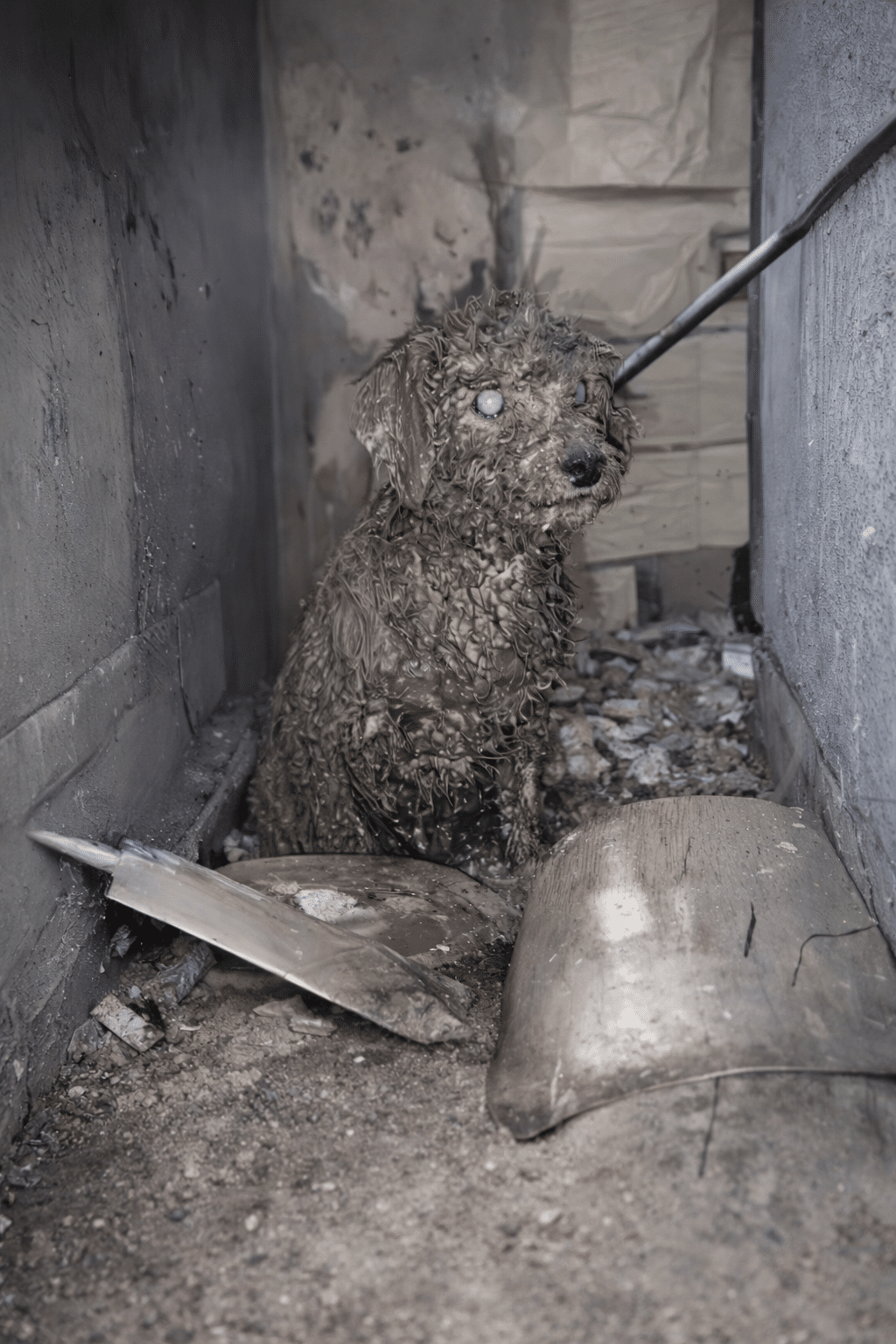
More than five meters beneath the ground, at the bottom of a narrow garbage pit, a frightened stray stood among mud and discarded debris.
The walls surrounding him were smooth.
The opening above was barely wide enough for a person to enter.
And after trying unsuccessfully to escape, the dog appeared to have stopped fighting.
He could not see the rescuers gathering overhead.
He could only hear unfamiliar voices echoing through the darkness.
Then a ladder began descending toward him.
Someone had decided he would not be left below.
A Dog Found Where Escape Was Impossible
The rescue team had received a call from residents after a stray dog disappeared in the neighborhood.
People searched the nearby streets and empty spaces, hoping he had simply wandered somewhere quiet.
Eventually, they discovered the narrow opening of a vertical garbage pit.
When they looked inside, they saw a small figure far below.
The dog had fallen more than five meters.
The shaft was only about half a meter wide, leaving him almost no room to turn or move freely. Its walls were steep, smooth, and slippery.
There was nothing his paws could grip.
No ledge where he could rest.
No path that led back to the surface.
At the bottom, rubbish and damp debris surrounded his body.
The dog was standing motionless against the wall.
He did not jump toward the voices above.
He did not bark.
He did not continue trying to climb.
He simply waited in the darkness, conserving whatever strength remained.
No one knew exactly how long he had been trapped.
But his stillness made one thing clear.
He had already learned that he could not escape alone.
Video: Five Meters Underground, a Blind Dog Waited for Someone to Bring Him Back to Light
The First Ladder Could Not Reach Him Safely
The rescuers needed to move quickly, but the narrow shaft allowed no room for mistakes.
Their first plan was to lower a wooden ladder into the pit.
It seemed like the simplest way for someone to descend.
But once the ladder was positioned, the team realized it was not long enough to reach the bottom securely.
It also shifted too easily inside the confined opening.
One wrong movement could send the rescuer falling.
It could also cause debris to drop onto the dog below.
The ladder was pulled back out.
The team replaced it with a longer aluminum extension ladder, carefully lowering it until it reached the bottom of the shaft.
Even with the proper equipment, the descent remained dangerous.
The person climbing down would have almost no space around him.
He would need to balance on the ladder while approaching a terrified dog whose behavior was impossible to predict.
John volunteered.
He positioned himself above the opening and began climbing.
One careful step at a time.
The voices from the surface became quieter as he moved farther below.
The light faded.
The air became heavier.
And the frightened dog remained pressed against the wall, listening as someone entered the place from which he had been unable to escape.
John Reached the Bottom and Chose Not to Move
When John finally reached the bottom, the dog began trembling violently.
He could hear a person nearby.
He could smell him.
But he could not see what was happening.
The dog pressed his body tightly against the wall, trying to create distance in a space where there was nowhere left to go.
John did not immediately reach for him.
He did not corner him or attempt to lift him by force.
Instead, he became still.
In the darkness, patience was the safest tool he had.
The dog needed time to understand that the person beside him was not another threat.
John spoke softly.
He kept his movements slow.
Then he took out several slices of ham and held them close enough for the dog to smell.
Hunger gradually overcame fear.
The stray leaned forward.
He took one piece.
Then another.
With every bite, the trembling began to ease.
The food did more than satisfy his empty stomach.
It gave the dog a reason to move toward the unfamiliar person beside him.
A reason to believe that the hands reaching into the darkness might be there to help.
John waited until the dog’s body softened.
Then he carefully gathered him into his arms.
The Slow Climb Back Toward Daylight
Holding the frightened dog securely, John signaled to the rescuers waiting above.
The return to the surface needed to be even more careful than the descent.
The shaft was narrow.
John could not climb normally while keeping both arms safely around the dog.
The team above began helping them upward.
Slowly, the distance between the bottom of the pit and the opening became smaller.
The dog remained quiet in John’s arms.
He did not struggle.
Perhaps exhaustion had taken over.
Or perhaps the food, gentle voice, and steady embrace had convinced him that he no longer needed to fight.
As they moved higher, daylight gradually replaced the darkness.
Then John emerged from the opening with the dog still held tightly against him.
Only then could everyone clearly see the condition of the animal they had brought up.
His fur was covered in thick mud and grime.
Filth clung to nearly every part of his body.
A strong odor suggested that he had spent a significant amount of time surrounded by waste below the street.
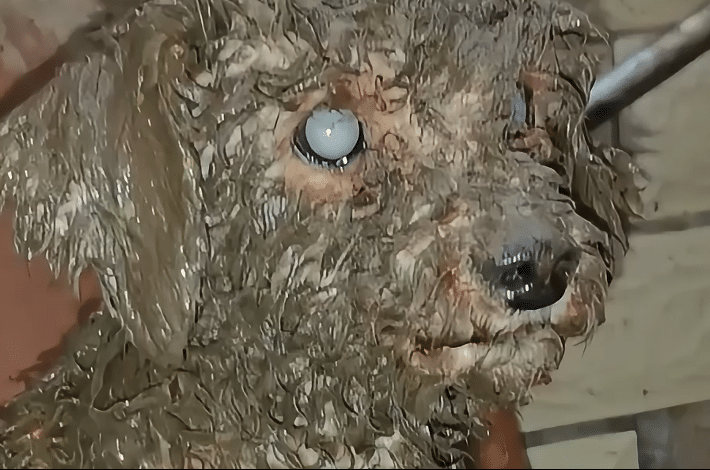
But the most painful discovery was in his eyes.
They were cloudy and pale.
The dog could not see.
The darkness inside the pit had not been temporary for him.
He was completely blind.
Four Baths Revealed the Dog Beneath the Dirt
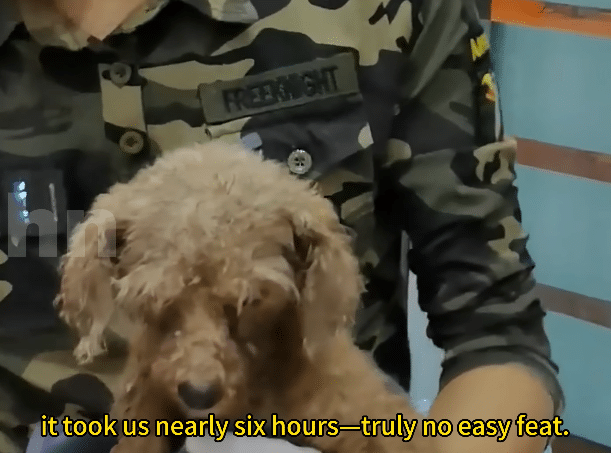
The rescued dog was taken to the shelter, where the team began cleaning him.
One bath was not enough.
Mud had settled deep into his coat.
Parasites and grime clung to his skin.
The water quickly turned dark as the first layer washed away.
Then he was bathed again.
And again.
It took four separate washes before the water finally began to run clear.
Throughout the process, caregivers moved gently.
The unfamiliar sounds of water, towels, and people working around him could easily have frightened a dog who relied completely on hearing and scent.
But he remained calm.
He allowed the rescuers to clean him.
He listened to their voices.
And slowly, the body hidden beneath the dirt began to emerge.
The team gave him a new name.
Happiness.
It may have seemed like an unusual name for a dog whose life had included hunger, blindness, and a terrifying fall beneath the street.
But they did not choose it to describe his past.
They chose it for the life they hoped he could still have.
His Eyes Would Not Recover, but His Life Could
A veterinary examination confirmed that Happiness was blind.
The cloudiness in his eyes was not a temporary effect of dirt or exhaustion.
His vision would probably never return.
He would not see the faces of the people who had climbed down to save him.
He would not watch sunlight enter the shelter each morning.
And he would need to learn every new environment through sound, scent, memory, and touch.
But blindness was not the end of his story.
Happiness was otherwise given the care he needed to begin recovering.
Medication was provided for his eyes.
His body received proper nourishment.
A safe resting area replaced the garbage and damp ground beneath the street.
At first, unfamiliar noises caused him to become tense.
A door opening.
Footsteps approaching.
Another animal moving nearby.
Without sight, he could not immediately identify whether those sounds meant danger.
Caregivers began speaking before touching him.
They allowed him to smell their hands.
They kept his food, water, and bedding in predictable places so he could gradually build a mental map of the shelter.
Nothing was moved without reason.
Routine became his guide.
He Learned to Recognize Kindness Without Seeing It
During his first week, Happiness began to change.
His appetite improved.
He stopped startling at every sound.
He accepted his daily eye medication with growing patience.
Most importantly, he began responding to gentle touch.
At first, his body remained cautious whenever someone came near.
Then he started leaning toward familiar hands.
He recognized the voices of the people caring for him.
He learned the sound of footsteps that brought meals.
He understood that the hands touching his face were there to administer medicine, not cause pain.
Trust did not require sight.
It grew through repetition.
A calm voice returning each morning.
A food bowl placed in the same location.
A warm hand resting gently against his body.
Happiness could not see the people around him smile when he relaxed.
But he could feel the relief in their touch.
He could hear the warmth in their voices.
And he could recognize that no one was leaving him alone in the darkness again.
A World Built From Sound, Scent, and Safety
As Happiness became more secure, he began navigating the shelter with greater confidence.
He listened before stepping forward.
He used his nose to identify familiar places and people.
He memorized where objects stood.
The world had not become visible.
But it had become understandable.
His blindness placed limits on how he experienced his surroundings, yet it did not prevent him from enjoying affection or forming relationships.
He could feel warmth.
He could recognize safety.
He could choose to move closer when someone he trusted called his name.
The terrified dog who once pressed himself against the bottom of a pit began leaning into companionship.
His body no longer shook every time a person approached.
He no longer expected every unfamiliar sound to bring danger.
The darkness remained part of his physical world.
But fear no longer filled all of it.
Someone Looked Down and Decided He Mattered
Happiness may never understand every part of his rescue.
He will not know how many people searched after he disappeared.
He will not see the narrow opening through which John descended.
He cannot look at the ladder that carried him back toward the surface.
But he knows what happened in the way that matters most.
Someone came.
Someone entered the darkness with food, patience, and gentle hands.
Someone held him against his chest and refused to leave him below.
The rescue did not restore Happiness’s eyesight.
It did not erase whatever difficulties had come before the fall.
But it gave him a safe place from which to begin again.
Today, he knows the location of his meals.
He recognizes trusted voices.
He accepts medication and affection with quiet confidence.
And he no longer has to stand alone, waiting for help that may never arrive.
His story reminds us that rescue is not always about returning an animal to a perfect body or an uncomplicated life.
Sometimes the damage cannot be reversed.
Sometimes healing means adapting rather than recovering what was lost.
And sometimes saving a life means climbing into the darkest place imaginable simply to let someone know they have not been forgotten.
Five meters below the surface, Happiness could not see the person coming toward him.
But when John reached the bottom, the frightened dog discovered something more important than sight.
He discovered that he was no longer alone.


