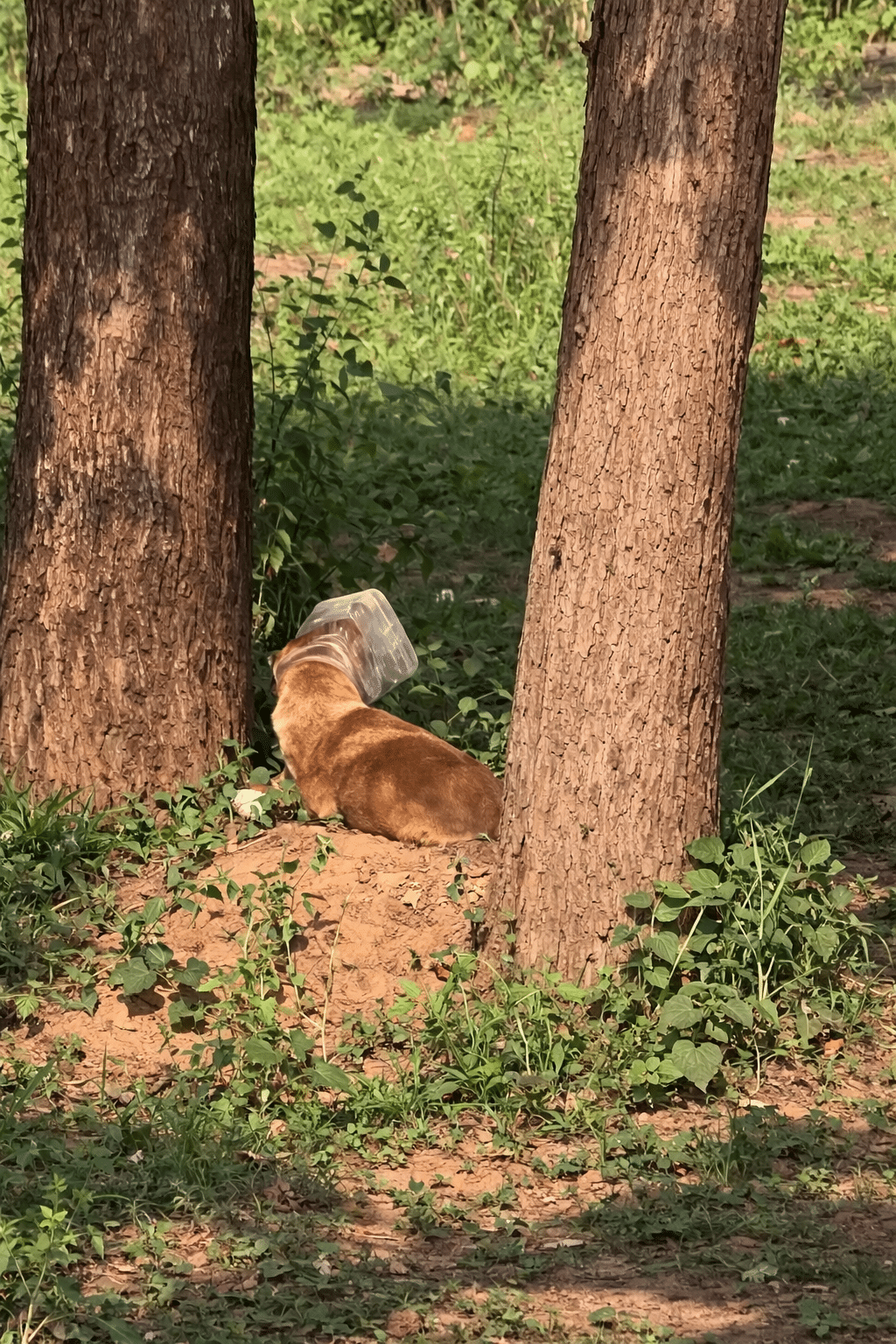
At first, the brown dog looked like a distant figure wandering near the edge of an open field.
Then rescuers realized why his movements seemed so uncertain.
A transparent plastic container was tightly stuck around his head, blocking his vision and preventing him from eating or drinking normally. Frightened and confused, he continued moving as though searching for any way to escape the object surrounding him.
He could not remove it alone.
But help had already begun moving toward him.
A Dog Wandering Blindly Across the Field
The scene was immediately concerning.
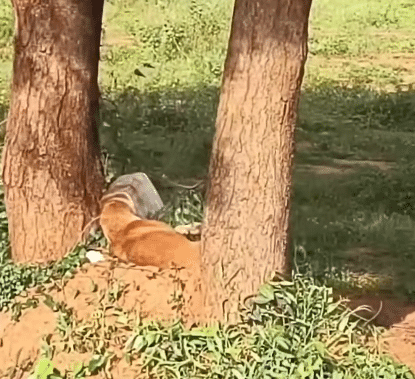
The dog walked near a line of trees with the rigid plastic container completely covering his head. The opening appeared caught around his neck, preventing the object from simply falling away.
He could see very little through the cloudy surface.
Every step required caution.
He moved without fully understanding what was ahead of him, occasionally shifting his head as though trying to loosen the trap.
The container had turned ordinary survival into a serious challenge.
Reaching food was nearly impossible.
Drinking safely was no longer realistic.
And the longer he remained trapped, the greater the risk of exhaustion, dehydration, or further distress.
Still, the dog continued walking.
He had no way to ask for help beyond remaining visible long enough for someone to notice.
Video: His Head Was Trapped Inside a Plastic Container — The Careful Rescue That Set Him Free
Rescuers Knew Chasing Him Could Make Things Worse
A rescuer from Animal Warriors arrived after receiving information about the trapped dog.
The situation required more than simply approaching and pulling the container away.
The dog was frightened, unable to see clearly, and unlikely to understand that the stranger moving toward him intended to help. If startled, he could run toward the trees, become harder to locate, or accidentally place himself in greater danger.
The rescuer remained patient.
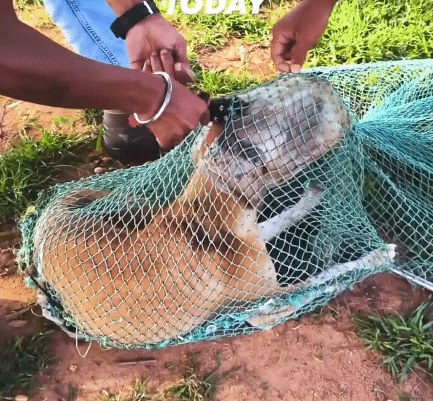
He watched the dog’s movements and prepared a capture net, waiting for the safest opportunity to contain him without causing unnecessary harm.
There was no loud pursuit.
No sudden attempt to corner him.
The rescuer allowed the dog to move into a position where the net could be used effectively.
Then, when the moment came, he acted quickly.
The net fell around the dog and prevented him from escaping deeper into the field.
For the first time, the rescue team was close enough to begin freeing him.
The Frightened Dog Could Not Understand What Was Happening
The dog struggled briefly beneath the net.
His reaction was not aggression.
He was frightened and confused.
He could not clearly see the people surrounding him, and the sensation of the net added another unfamiliar experience to an already overwhelming situation.
The rescuers stayed calm.
They did not pull roughly or force him into an unsafe position. Instead, they used the net to limit his movement while keeping his body as secure as possible.
Every action had to consider the container around his head.
If the dog twisted suddenly, the rigid edge could place additional pressure around his neck. If the team tried to pull it off without first opening the plastic, they could cause unnecessary discomfort.
The rescuers understood that capturing him was only the first step.
Now came the most delicate part.
One Wrong Movement Could Cause More Harm
The container was too tightly lodged to slide away normally.
A cutting tool was needed.
One rescuer carefully positioned the dog while another began working along the hard plastic. The tool had to remain close enough to cut through the container but far enough away from the dog’s face and neck.
The team moved slowly.
Each cut was controlled.
After every adjustment, they checked the dog’s position before continuing.
There was no room for impatience.
The frightened animal moved slightly beneath the net, but the rescuers maintained a steady hold and continued speaking calmly.
Bit by bit, the rigid shell began to open.
The plastic that had resisted the dog’s every attempt was finally giving way beneath careful human hands.
Minutes passed.
Then came one final cut.
The container loosened.
And at last, it slipped completely away from the dog’s head.
For a Moment, He Simply Stood There
Once the plastic was removed, the dog did not immediately run.
He remained still for several seconds, as though trying to understand what had changed.
The world was visible again.
Nothing surrounded his face.
The pressure around his neck was gone.
After spending an unknown amount of time looking through the cloudy container, suddenly seeing the open field clearly may have felt unfamiliar.
The rescuers began loosening the net.
They gave him space rather than crowding around him. Their role was not to force affection or keep him restrained longer than necessary.
They had come to remove the danger.
Now they wanted him to feel free.
The dog looked ahead.
Then his body seemed to realize what his mind was still processing.
He could move without the container.
He Ran Across the Field With His Freedom Restored
The moment the net released him, the dog sprang forward.
He ran across the open ground with an energy that had been hidden beneath fear and confusion only moments earlier.
There was no container striking against his body.
No cloudy barrier blocking his path.
No need to move cautiously while guessing what might be in front of him.
He simply ran.
The rescuers remained behind and watched as he crossed the field, increasing the distance between himself and the object that had nearly placed his life in danger.
His quick departure was not rejection.
For a frightened stray, freedom often means creating distance from unfamiliar people as soon as the immediate threat has passed.
What mattered was that he could finally see where he was going.
He could lower his head toward water.
He could search for food.
And he could move normally again.
A Discarded Object Had Become a Dangerous Trap
Plastic containers may appear harmless once they are empty.
But for curious or hungry animals, they can become serious hazards.
A dog may push its head inside while searching for food residue. If the opening is narrow or shaped in a way that catches behind the ears or neck, the animal may be unable to pull free.
Panic can make the situation worse.
The dog may run blindly, strike nearby objects, or travel far from the place where the container first became trapped.
This is why responsible disposal matters.
Containers can be cut open, crushed, or placed securely inside closed waste bins before being discarded. Removing food residue can also reduce the likelihood that an animal will investigate them.
These actions take only a few moments.
But they may prevent an animal from experiencing hours or days of fear.
His Rescue Began Because Someone Paid Attention
The dog could not explain what had happened.
He could not remove the container with his paws or lead rescuers toward him.
His survival depended on being seen.
Someone noticed the unusual figure moving near the trees.
Someone recognized that the container was not simply resting over his head—it was trapped.
And someone contacted people equipped to help.
That chain of attention turned a dangerous situation into a successful rescue.
The team did not rush blindly toward the dog.
They studied his movements.
They used appropriate equipment.
And they removed the plastic slowly enough to protect him throughout the process.
Compassion was important.
Patience made that compassion effective.
He Left the Plastic Behind
Only minutes earlier, the dog had been wandering through the field unable to see clearly or meet his most basic needs.
Then a net was placed carefully around him.
A cutting tool opened the rigid plastic.
And the burden he could not escape alone finally fell away.
The rescue did not end with a dramatic embrace.
It ended with something more natural for him.
The dog ran.
He crossed the field under his own strength, leaving the container and the rescuers behind.
For the team watching, that was enough.
He was free.
He was moving safely.
And because someone chose to notice and act, an ordinary piece of discarded plastic did not become the final chapter of his life.


