For years, Meg survived by expecting very little.
Each day meant searching for something to eat. Each night meant finding a place quiet enough to rest without being chased away.
There was no family waiting for her.
No warm bed.
No certainty that the next day would be any kinder than the one before.
Then Meg wandered into the yard of a Texas home—and for the first time in years, someone looked closely enough to understand what she had been carrying.
A Tired Dog Appeared Without Warning
No one knew where Meg had come from.
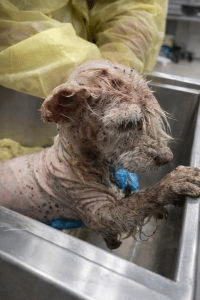
She simply appeared in the yard one day, thin, exhausted, and moving with the caution of a dog accustomed to surviving alone.
Her condition immediately revealed that this was not the result of one difficult night.
Meg’s body was painfully underweight. Fleas covered her coat, and one of her ears showed serious damage consistent with a condition that had gone untreated for far too long.
Every movement appeared slow.
She did not explore the yard with excitement or approach the house demanding food.
She simply remained there, as though she had reached the end of another long search and no longer knew where else to go.
But what affected the homeowner most was not Meg’s thin frame.
It was her expression.
There was no aggression in her eyes.
There was no attempt to threaten or defend herself.
Only a deep, quiet weariness—the look of a dog who had learned not to expect anyone to help.
The homeowner could not ignore her.
Video: Meg Wandered Into a Texas Yard After Years of Surviving Alone
One Photograph Reached the Right People
The homeowner wanted to help Meg but understood that her condition required more than a bowl of food and a temporary place to sleep.
She needed experienced rescuers.
She needed veterinary treatment.
Most importantly, she needed help quickly.
Photos of Meg were shared on social media along with an explanation of her condition. The hope was simple: someone familiar with animal rescue might see the post and know what to do next.
The community responded almost immediately.
People shared the images.
Others offered advice and encouragement.
With every repost, Meg’s story traveled farther beyond the yard where she had finally stopped.
Before long, the message reached a Houston-based rescue organization experienced in helping animals facing serious neglect.
The team began arranging assistance.
A dog who had spent years unnoticed was suddenly being seen by hundreds of people.
One homeowner had paused.
Then a community paid attention.
And soon, help was on its way.
She Was Too Gentle to Understand the Urgency
When rescuers arrived, Meg remained calm.
They approached slowly, careful not to overwhelm her. Dogs who have survived on the streets may panic when strangers move too quickly, even when those strangers are trying to help.
Meg did not run.
She did not bark or resist.
Despite the discomfort she was experiencing, she allowed the team to come near and prepare her for transport.
Her gentleness surprised everyone.
Years of hunger and hardship had not made her hostile. Instead, she seemed to accept whatever happened around her with quiet patience.
Perhaps she was too tired to protest.
Perhaps she sensed that the people touching her were different.
Either way, when they lifted her, Meg surrendered her fragile body into their care.
For the first time in a very long while, she no longer had to decide where to sleep or how to find her next meal.
Someone else had taken responsibility for keeping her safe.
The Examination Revealed Years of Discomfort
At the veterinary clinic, the extent of Meg’s condition became clearer.
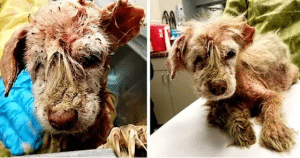
She weighed just over eleven pounds—far below what would have been healthy for a dog of her size.
Her body carried several signs of prolonged neglect.
Veterinarians found a severe flea infestation as well as lice. Her ears were painfully infected, and the damage suggested she may have lived with discomfort for a considerable amount of time.
Her thin body needed nourishment, but recovery could not be rushed.
After long periods without proper food, suddenly offering large meals can place additional strain on an already weakened system. The veterinary team carefully monitored her intake and created a nutritional plan designed to help her gain strength safely.
Medication was provided for the infections.
Treatment began eliminating the parasites.
Her skin and coat received the care they had been missing.
Then Meg was given something that may have felt unfamiliar.
A warm place to rest.
There was no need to search for shelter.
No need to watch every passing person.
No need to protect the little energy she had left.
For once, Meg could simply sleep.
Her First Tail Wag Said More Than Words Could
During the first days of treatment, Meg’s progress appeared in small, quiet moments.
She began eating regularly.
Her body responded to consistent nourishment, and the exhaustion that had weighed down every movement slowly started to ease.
As the parasites disappeared, her skin became less irritated. Her coat began showing early signs of improvement.
But the most meaningful changes could not be measured on a scale.
They appeared in the way Meg began responding to her caregivers.
At first, she watched them carefully.
Then her posture started to relax when familiar people entered the room.
One day, her tail moved.
It was only a cautious wag.
Brief.
Almost uncertain.
But it showed that Meg was beginning to connect human presence with something other than disappointment.
Soon she started looking toward caregivers for reassurance.
She accepted gentle touch without becoming tense.
She no longer appeared ready to leave the moment a door opened.
For a dog who had relied entirely on herself, these changes were extraordinary.
Trust was returning.
Not all at once.
But one safe moment at a time.
Leaving Survival Mode Behind
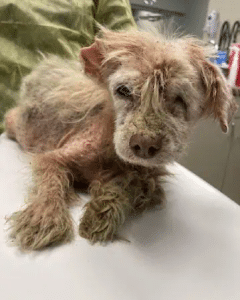
As the days passed, Meg’s personality slowly began emerging from beneath the exhaustion.
Her eyes grew brighter.
Her movements became more purposeful.
Instead of focusing only on food and rest, she started paying attention to the people and activity around her.
The transformation was gradual because her hardship had also developed gradually.
Years of uncertainty could not be undone in a few days.
But Meg no longer had to heal alone.
Her caregivers monitored her medical needs, prepared the meals her body required, and gave her space whenever she seemed overwhelmed.
There was no pressure to behave like a carefree dog immediately.
She was allowed to recover at her own pace.
Each day brought another sign that she was beginning to understand her new reality.
Food would return.
Her bedding would remain dry and warm.
The people caring for her would come back.
Safety was no longer something she had to search for before nightfall.
It was now waiting for her every morning.
The Chain of Kindness That Changed Her Future
Meg’s rescue did not begin with a large organization discovering her on the street.
It began when one homeowner noticed that the dog in the yard needed more than temporary assistance.
That person took a photograph and asked for help.
Others shared the message.
A rescue team responded.
Veterinarians treated the conditions that had been ignored for so long.
None of these actions seemed extraordinary on their own.
Together, they changed Meg’s future.
There are countless stray animals living in places where people pass every day. Some hide beneath buildings or sleep behind businesses. Others wander through neighborhoods searching for food without drawing much attention.
Meg’s story shows what can happen when one person chooses to look more closely.
The dog who arrived in a Texas yard had nearly stopped expecting kindness.
She was thin, uncomfortable, and exhausted from carrying the responsibility of survival alone.
Now, she rests surrounded by people committed to helping her heal.
There is still progress ahead.
Her body needs time to recover fully, and trust formed after years of hardship must be protected with patience.
But the most important change has already happened.
Meg is no longer invisible.
She no longer searches alone.
And the life that once offered her nothing certain has finally given her something every dog deserves:
A safe place.
Gentle care.
And a reason to expect kindness again.


