The afternoon heat pressed heavily against the empty rural landscape.
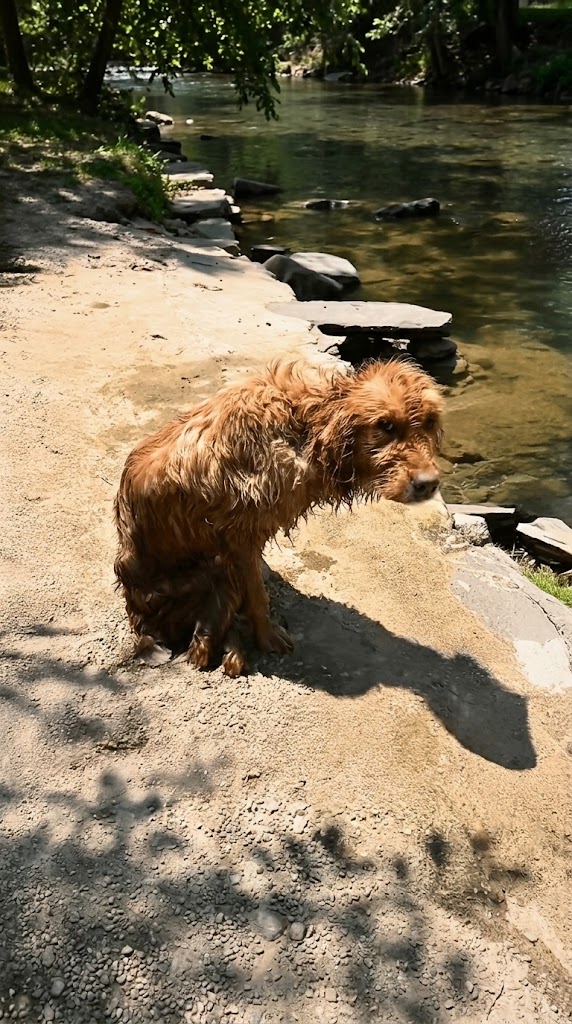
Near the edge of a shallow river, a stray dog pulled herself across the rough ground using only her front legs. Her hind limbs trailed helplessly behind her, while every movement demanded what little strength she had left.
The water had become more than a place to drink.
It was her shelter from the heat—and perhaps the reason she was still alive.
When she lifted her eyes toward the people watching from the road, there was fear in her expression.
But there was also a quiet plea that was impossible to forget.
A Lonely Dog Struggling Toward the Water
The dog’s condition was immediately concerning.
Her hind legs appeared unable to support or propel her body. To move, she pressed her front paws into the dusty ground and dragged herself forward across stones and uneven earth.
Each short distance required enormous effort.
Her fur was wet from the river, suggesting she had been spending time in the shallow water to escape the heat and remain hydrated.
There was no shelter nearby.
No bowl of food.
No person watching over her.
Only a disabled dog using instinct to keep herself alive for one more day.
The couple who discovered her could not stop thinking about what they had seen. Even after leaving the area, the image of the exhausted dog remained with them.
By the following morning, they had gathered supplies and returned.
They did not know whether she would still be there.
But when they reached the river, they found her in the same place.
Still waiting.
Still surviving.
Video: Unable to Use Her Hind Legs, Candy Crawled to the River to Stay Alive
The Moment She No Longer Had to Struggle Alone
The dog watched cautiously as the man stepped into the shallow water.
She had survived without dependable human care, so there was no way to know how she would react when someone approached.
He moved slowly and spoke gently.
When he reached her, he placed his arms beneath her fragile body and lifted her from the water.
She trembled.
But she did not fight.
For the first time in an unknown length of time, she no longer had to drag herself over the ground.
Someone else was carrying her.
The couple transported her to a veterinary clinic, where examinations revealed serious damage affecting her hind legs. The injuries appeared connected to significant trauma from her past.
Her long-term mobility remained uncertain.
Treatment would require time, ongoing care, and expenses the couple had not expected. They understood that they might not be able to provide every available medical option.
But returning her to the river was never considered.
They could not promise that she would walk normally again.
They could promise that she would not face the future alone.
A Childhood Home Became Her Place to Heal
Extended hospitalization was not financially realistic, so the couple transformed part of the man’s childhood home into a recovery space.
It was not an elaborate medical facility.
But it was clean, protected, and prepared with care.
The dog received soft bedding, regular meals, and help with the movements her body could not yet manage independently.
When a bowl of warm food was placed in front of her, she ate urgently.
The way she approached each meal revealed how long hunger had likely been part of her life. She did not yet understand that food would return every day.
The couple gave her a new name.
Candy.
The name represented a fresh beginning—one no longer defined only by the riverbank, her injuries, or the life she had endured before rescue.
During the first weeks, Candy remained cautious.
She watched every movement and seemed unsure of the unfamiliar routine around her. But no one forced her to respond before she was ready.
Meals arrived consistently.
Her sleeping area remained safe.
The same people returned each morning.
Gradually, the fear in her eyes began to soften.
She was learning that this home was not another temporary stop.
The Wheelchair That Gave Her Back Her Freedom
Candy’s weakened hind legs made independent movement extremely difficult.
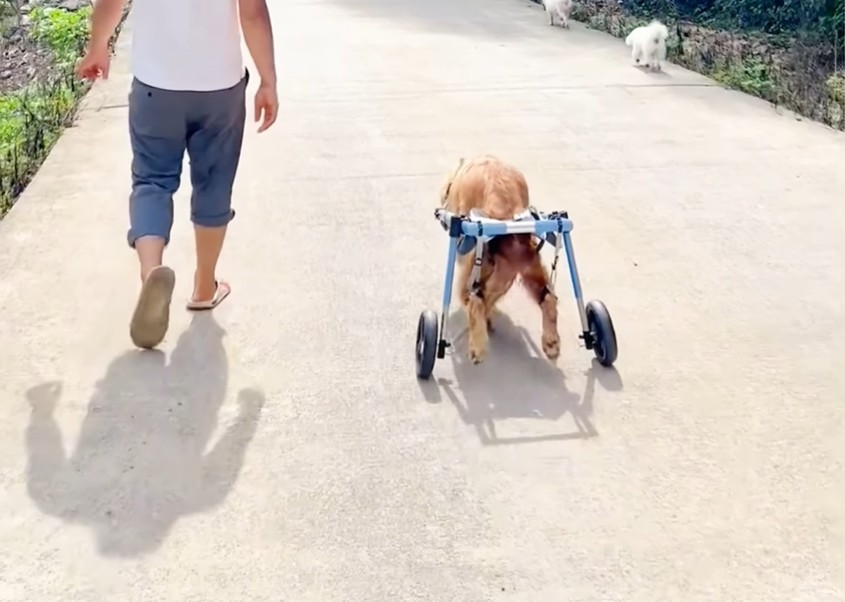
Wanting to help her explore without dragging herself across the ground, the family ordered a custom mobility cart designed for dogs with limited use of their back legs.
The first attempt was unfamiliar.
Candy had to adjust to the support around her body and learn how her front legs could guide the wheels. At first, she moved cautiously and appeared uncertain about the new equipment.
Then she began to understand.
She could move forward.
She could turn.
She could choose where she wanted to go.
For a dog whose world had been limited by the distance she could pull herself, the wheelchair created an entirely new kind of freedom.
Candy began exploring the area around the home without scraping her body across rough surfaces.
She could follow the people caring for her.
She could experience movement without exhausting herself immediately.
The wheelchair did not change who she was.
It simply allowed the determined dog inside her to move more safely through the world.
The Thirty-First Day Brought an Unexpected Moment
Veterinarians had warned the family to remain realistic.
The damage to Candy’s hind legs was extensive, and the likelihood of her walking independently appeared very low.
Still, her caregivers continued supporting her rehabilitation.
They gently massaged her legs.
They encouraged safe movement.
They helped her practice while remaining careful not to place excessive strain on her body.
Progress was measured through the smallest responses.
A slight movement.
A stronger posture.
A little more control than the day before.
Then, on the thirty-first day of rehabilitation, Candy surprised everyone.
She pressed her front paws firmly against the ground.
Her body shifted upward.
And for a brief moment, she stood.
The attempt did not last long.
She was unsteady, and she still required support.
But the length of time did not matter.
Candy had raised herself from the ground.
The moment represented far more than physical movement. It showed that her body was responding and that her determination remained as strong as it had been beside the river.
No one assumed that one stand guaranteed a complete recovery.
But it gave the family another reason to continue.

Small Steps Toward a Different Life
Candy’s improvement continued over the following months.
The wheelchair remained an important source of support, especially when she wanted to travel farther or move without becoming exhausted.
But she also began attempting short steps without it.
At first, the movements were hesitant.
Her balance was imperfect, and every effort required concentration.
Still, she continued.
One step became another.
Her caregivers celebrated without pressuring her to move faster than her body allowed.
Candy’s value had never depended on whether she could walk again. Even if she had needed the wheelchair permanently, she would still have been deserving of the same home and affection.
Her progress was meaningful because it gave her additional comfort and independence—not because it made her more worthy of love.
As her physical strength increased, her emotional transformation also became visible.
She no longer watched every person with fear.
Her appetite became calmer once she understood that meals would always return.
She relaxed in her sleeping space and began responding to familiar voices with growing enthusiasm.
The dog who once focused entirely on survival was beginning to enjoy the life around her.
The Family She Followed Home
Candy eventually moved permanently into the family’s home.
There, she formed an especially close connection with their young daughter.
She enjoyed following the child around, remaining nearby during ordinary family moments and welcoming every gentle gesture of affection.
For Candy, these experiences were completely different from the lonely existence she had known.
There were people who noticed when she needed help.
Someone prepared her meals.
Someone assisted with her mobility.
And every evening ended in a place where she was protected.
Her tail began wagging excitedly whenever family members returned home.
She no longer had to seek relief in shallow water beneath the afternoon heat.
She no longer dragged herself along an empty road looking for the next place where she might survive.
Now she had a home to explore, a family to follow, and people willing to adapt their lives to her needs.
She Found More Than the Ability to Stand
Candy’s journey is often remembered for the moment she rose on her own.
But her recovery involved something even more important than learning to stand.
She learned that help could return every day.
That a physical disability did not make her a burden.
That movement could take many forms—and a wheelchair could represent freedom rather than limitation.
Her life changed because two people saw a suffering dog beside a river and refused to let the image become only a sad memory.
They returned.
They lifted her.
They created a place where she could heal.
And when the future became expensive and uncertain, they continued giving what they could.
Candy’s story did not require a perfect recovery to become a happy one.
She had already succeeded the moment survival was no longer her responsibility alone.
Once, she crawled toward the water because instinct told her it might keep her alive.
Today, she moves toward the people she loves—knowing they will always be there to meet her.


