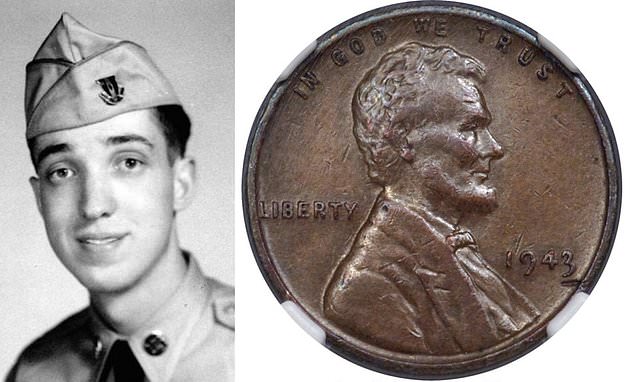
In March 1947, 16-year-old Don Lutes Jr. received ordinary change from his high school cafeteria in Pittsfield, Massachusetts. One coin immediately looked out of piliar brownish color of copper rather than the pale, silvery appearance of the wartime steel cents still circulating at the time. s already interested in coins, so he did not spend it. He set the penny aside and began trying to understand why a coin dated 1943 looked unlike nearly every other cent made that year.
The answer was hidden in a production mistake. Lutes had found a rare 1943 bronze Lincoln cent, struck during the year U.S. pennies were supposed to be made from zinc-coated steel. More than seven decades later, the coin sold at auction for $204,000. enny That Looked Wrong
The detail that caught Lutes’s attention was not a secret mark or unusual portrait. It was the metal itself.
Americans who had handled 1943 cents knew they looked different. Instead of the usual copper-brown color, the standard wartime cents were light gray because they were struck on zinc-coated steel blanks. Lutes remembered those “steelies,” and the copper-colored coin in his cafeteria change did not fit the pattern. osity led him through one of the best-known rumors in American coin collecting. Stories claimed that Henry Ford would give a new automobile to anyone who produced a genuine 1943 copper penny. Lutes contacted the Ford Motor Company and learned that the offer was only a rumor. He also wrote to the Treasury Department, which replied that all 1943 cents had been made from zinc-coated steel. cial denial did not change the object in his possession. Lutes kept the coin instead of selling or spending it. In 1958, he took it to a coin convention in Worcester, Massachusetts, where numismatist Walter Breen examined it and identified it as genuine. The penny later appeared in specialist publications and exhibitions, but Lutes continued to own it. he eventual auction, Numismatic Guaranty Company certified the coin as a genuine 1943 cent struck on a bronze planchet and graded it AU53, indicating a lightly circulated coin with much of its original detail still present. ost 1943 Cents Were Made of Steel
The metal switch was a direct result of World War II.
Copper was considered strategically important because it was needed for wartime materials, including shell casings, communications wire and other military equipment. To conserve copper, the Treasury authorized the U.S. Mint to produce 1943 Lincoln cents on zinc-coated steel planchets instead of the bronze alloy used in the preceding year. ge created one of the most visually distinctive regular-issue cents in U.S. history. A normal 1943 steel cent had a bright gray or silver-colored surface when new, although many later darkened or developed corrosion after the zinc coating was damaged.
The bronze planchet used for Lutes’s coin was different in both composition and weight. Heritage Auctions listed it as 95 percent copper, with the remaining 5 percent made up of tin and zinc, and recorded its weight at 3.11 grams. ference is also why color became such an important clue. A copper-colored 1943 cent was not automatically genuine—ordinary steel cents have often been copper-plated, and dates on other pennies have been altered. The U.S. Mint recommends a simple magnet test as an initial screen: a steel cent should stick, while a bronze cent should not. A coin that passes that test still requires professional authentication. Bronze Blank Entered the Press
The accepted explanation begins at the end of 1942, when the Mint was still using bronze planchets.
Heritage Auctions reported that a small number of those bronze blanks became trapped in the doors or crevices of mobile tote bins used to feed planchets into coin presses. When the bins were filled with zinc-coated steel blanks for 1943 production, the leftover bronze pieces remained unnoticed. ly, a few of the older blanks came loose and entered the presses with the steel planchets. The dies did exactly what they were designed to do: they stamped the 1943 Lincoln cent design onto whatever properly sized blank arrived beneath them.
The resulting bronze cents were then mixed into an enormous stream of ordinary steel coins. Because the error involved the wrong metal rather than a dramatic defect in the design, the coins could pass through inspection and enter circulation. t surviving population is difficult to summarize with one number. Heritage’s detailed 2019 catalog cited an estimate of roughly 10 to 15 Philadelphia examples, about six confirmed San Francisco pieces and a single Denver example. Certification records can include resubmissions or the same coin crossing between grading services, so responsible estimates are usually presented as ranges rather than a fixed total. E EMBED — PRIMARY SEARCH QUERY: “Don Lutes 1943 bronze penny Heritage Auctions”**
The Decades-Long Wait Before Auction
Lutes’s penny was especially attractive to collectors because its ownership history was unusually clear. He found it in cafeteria change in 1947, recognized its unusual color, preserved it and retained it for the rest of his life.
Although the coin became known within the numismatic community, it did not appear at public auction while Lutes was alive. He died in September 2018, several months before Heritage Auctions offered the piece as part of its January 2019 FUN U.S. Coins Signature Auction in Orlando, Florida. ion catalog described it as the “discovery specimen,” reflecting its status as the first widely recognized 1943 bronze cent found in circulation. That provenance connected the physical coin directly to the school-cafeteria story that had helped make the error famous. also carried a local legacy. Lutes directed that the proceeds go to the Berkshire Athenaeum, the public library in Pittsfield where he had been active for many years. E EMBED — SECONDARY SEARCH QUERY: “1943 steel penny bronze error explained”**
Why Collectors Paid More Than $200,000
The penny’s value came from several factors working together.
First was extreme scarcity. The Mint produced huge numbers of steel cents in 1943, but only a very small group of bronze planchets accidentally reached the presses. A collector was therefore not simply buying an old penny. The bidder was buying evidence of a brief breakdown in a carefully controlled wartime production change.
Second was authentication. Rare 1943 bronze cents are frequently imitated through copper plating or altered dates. The Lutes coin had been studied for decades, documented in numismatic references and certified by NGC. Its 3.11-gram weight, non-steel composition, genuine surfaces and matching production characteristics supported the conclusion that it was an authentic off-metal error. s provenance. Many valuable coins have complicated or incomplete ownership histories. This one had a simple, memorable chain: school lunch change, a teenage collector, decades of preservation and a first public auction after the owner’s death.
Heritage estimated the coin at $170,000 before the sale. On January 10, 2019, more than 30 bids pushed the final price to $204,000. CBS and the Associated Press later identified the winning bidder as Massachusetts collector Tom Caldwell, who said he intended to display the coin at coin shows. answered the central question behind the ordinary-looking penny. It was worth six figures because its copper-brown color revealed a metal that should not have been in a 1943 coin press. Wartime conservation made steel the rule, a leftover bronze blank created the exception, and careful recognition preserved that exception long enough for experts and collectors to establish its value.
A single cent became a $204,000 object not because someone assigned meaning to an ordinary coin, but because Don Lutes noticed one small inconsistency and understood that it deserved a second look.

