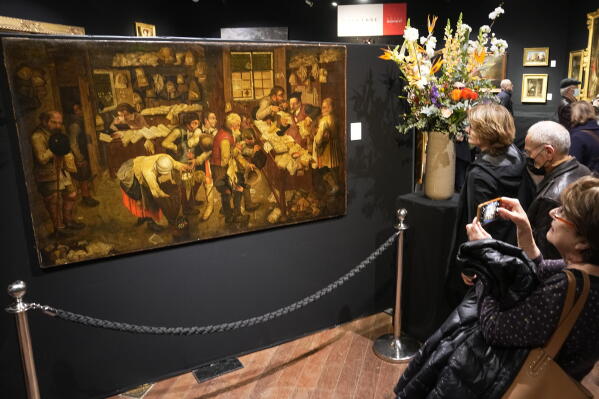
The room was dim, and the large canvas was easy to overlook. Most of it hung behind an open door in the television room of a family home in northern France, where it had quietly collected dust for years.
Auctioneer Malo de Lussac had come to inspect the family’s possessions. As he turned inside the room, he noticed that roughly two-thirds of an unusually large painting remained visible beyond the edge of the door.
The family considered it an old copy. De Lussac saw something far more important: a composition, technique and level of detail associated with the Flemish painter Pieter Brueghel the Younger.
The work was eventually attributed to Brueghel, authenticated by specialists and sold in Paris for €780,000—about $845,000 at the time.
The Painting Behind the Television-Room Door
The painting had been hiding in plain sight rather than locked inside an attic or forgotten in a storage box.
It measured approximately 112 centimeters high by 184 centimeters wide, or about 44 by 72 inches. Its size made it difficult to miss once someone looked directly at it, but its position behind the television-room door prevented visitors from seeing the entire composition at once.
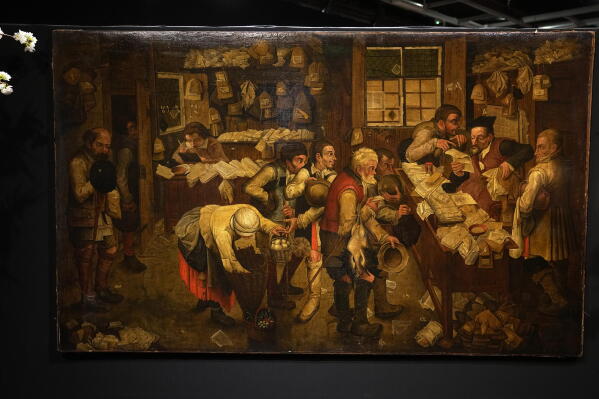
The oil painting showed a crowded rural office. Villagers pressed toward a seated legal official while carrying documents and small offerings, including eggs and poultry. The scene is commonly known as L’Avocat du village, or The Village Lawyer. It has also appeared under titles such as The Payment of the Tithe, The Tax Collector’s Office and The Notary’s Office.
The subject was not unknown to art historians. Brueghel produced numerous versions of the composition, and other paintings based on the same scene survive in public and private collections.
What made this example remarkable was its scale. It was substantially larger than most known versions, allowing small facial expressions, clothing details and signs of rural labor to appear with unusual clarity. De Lussac noted that the large format revealed details as specific as dirt beneath the villagers’ fingernails and fear in some of their faces.
The work was also in unusually good condition for a painting believed to date from the early 17th century. Experts placed its creation around 1615 to 1617, during the period when Brueghel was repeatedly developing this popular scene.
Why the Family Believed It Was a Copy
The painting had belonged to the same family since approximately 1900. Earlier members of the family apparently acquired it as an original work, but that understanding gradually disappeared as the painting passed from one generation to another. Its history before entering the family remains uncertain.
Later generations continued calling it “the Brueghel,” but the name became something of a family joke. They assumed the canvas was a reproduction or decorative imitation rather than an authentic work by the artist.
That belief was understandable. Brueghel the Younger operated a productive workshop and created many versions of successful compositions. His paintings were also copied by assistants, followers and later artists, leaving specialists with the difficult task of separating works painted by Brueghel from workshop versions and later imitations.
The Village Lawyer is a particularly complicated subject. Signed and authenticated examples exist, but so do many similar works that have not been accepted as paintings by Brueghel or his workshop. An authentic version dated around 1617 is held by the Louvre, while other variations are found in European collections.
For the French family, there was no obvious reason to believe their darkened household painting belonged in the same category as those museum works. It had no active place in the art market, its provenance had faded from memory, and no recent expert attribution supported the old family name.
The canvas remained part of the room rather than part of a recognized collection.
What the Visiting Appraiser Noticed
De Lussac did not authenticate the work during his first glance. He recognized that its characteristics justified a serious investigation.
The first clue was the subject itself. The crowded office, the villagers waiting with gifts and the satirical portrayal of rural legal business matched the established Village Lawyer composition.
The second clue was the quality of the painting. Although part of the canvas had been obscured by the door, the visible section showed sophisticated figures, expressive faces and carefully observed details. The execution did not immediately resemble an inexpensive modern reproduction.
Its extraordinary size was another important signal. Most Brueghel paintings based on this scene were smaller. The newly examined canvas was among the largest known examples, with a format that gave the composition space to display details less visible in other versions.
The physical construction of the work also required examination. The painting was executed on canvas, an atypical but documented support for versions of this subject. Its material structure was thick enough that the specialists initially considered whether the image might have been transferred from a wooden panel.
None of those clues alone proved that Brueghel had painted it. Together, however, they persuaded De Lussac that the family’s supposed copy might be an important rediscovery.
YOUTUBE EMBED — PRIMARY SEARCH QUERY: “Brueghel painting found behind door AP auction”
How the Attribution Was Established
The discovery inside the house was only the beginning. A valuable attribution had to be supported by specialists who understood Brueghel’s materials, workshop practices and repeated compositions.
The painting was first taken to Cabinet Turquin in Paris. Founder Éric Turquin and Old Master specialist Stéphane Pinta examined the canvas and recognized qualities they associated with Brueghel’s craftsmanship.
The work was then sent to Germany for further examination by Klaus Ertz, a leading specialist on Pieter Brueghel the Younger and the author of an important catalogue of the artist’s paintings. Ertz confirmed the attribution in December 2022.
Experts could compare the newly discovered painting with known versions of the composition. Details in the background, the colors of particular garments and changes made to the scene helped place it within an early group believed to have begun around 1615.
In versions produced after approximately 1618, for example, braided ropes along the back wall were replaced by a dark cloth, while the clothing of a figure at the far left was changed. The newly found canvas preserved features associated with the earlier series.
Specialists also had to consider the unusual canvas support and its dimensions. Only one other recorded version was reported to share exactly the same large measurements. That did not establish authorship by itself, but it provided another point of comparison within the known body of work.
The completed expert review transformed the painting’s status. It was no longer offered merely as an old work “in the style of” Brueghel or as a family copy. It went to auction with a certificate of authenticity and an attribution to Pieter Brueghel the Younger.
The appraiser’s glance had opened the investigation, but comparative art history and specialist examination supplied the evidence needed for the market to accept the painting.
The Paris Auction and Final Price
Daguerre offered the painting at Hôtel Drouot in Paris on March 28, 2023.
Before the sale, it carried an estimate of €600,000 to €800,000, reflecting both its newly confirmed attribution and its unusual scale. The family remained anonymous, as did the precise location of the home where the painting had hung for generations.
Bidding reached €780,000. Gazette Drouot’s official result records that amount as the adjudicated auction price, while Associated Press coverage converted it to approximately $845,000 at the exchange rate then in use. The available Drouot result does not separately list a final buyer’s total with fees.
The buyer was identified only as a collector from Switzerland. No additional public information about the buyer or the painting’s intended destination was released.
YOUTUBE EMBED — SECONDARY SEARCH QUERY: “Daguerre Val de Loire Brueghel painting auction”
The result fell within the original estimate, but the number tells only part of the story. Before the appraisal, the painting had little practical value to its owners because they believed it was a copy. It had no current attribution, no documented expert approval and no place in the recognized catalog of Brueghel’s work.
What changed was not the canvas itself. The crowded village office, the expressive figures and the early 17th-century paint had been present all along.
The change came from recognition.
De Lussac noticed that the partially hidden image contained more skill and historical significance than the family suspected. Paris specialists identified Brueghel’s craftsmanship. Klaus Ertz compared it with the artist’s established work and confirmed the attribution. The auction house then presented it with the documentation collectors needed.
A painting once treated as an unimportant copy left the family’s television room and entered a major Paris auction. It sold for €780,000—about $845,000—because one appraiser looked beyond the open door and recognized the visual language of Pieter Brueghel the Younger.

