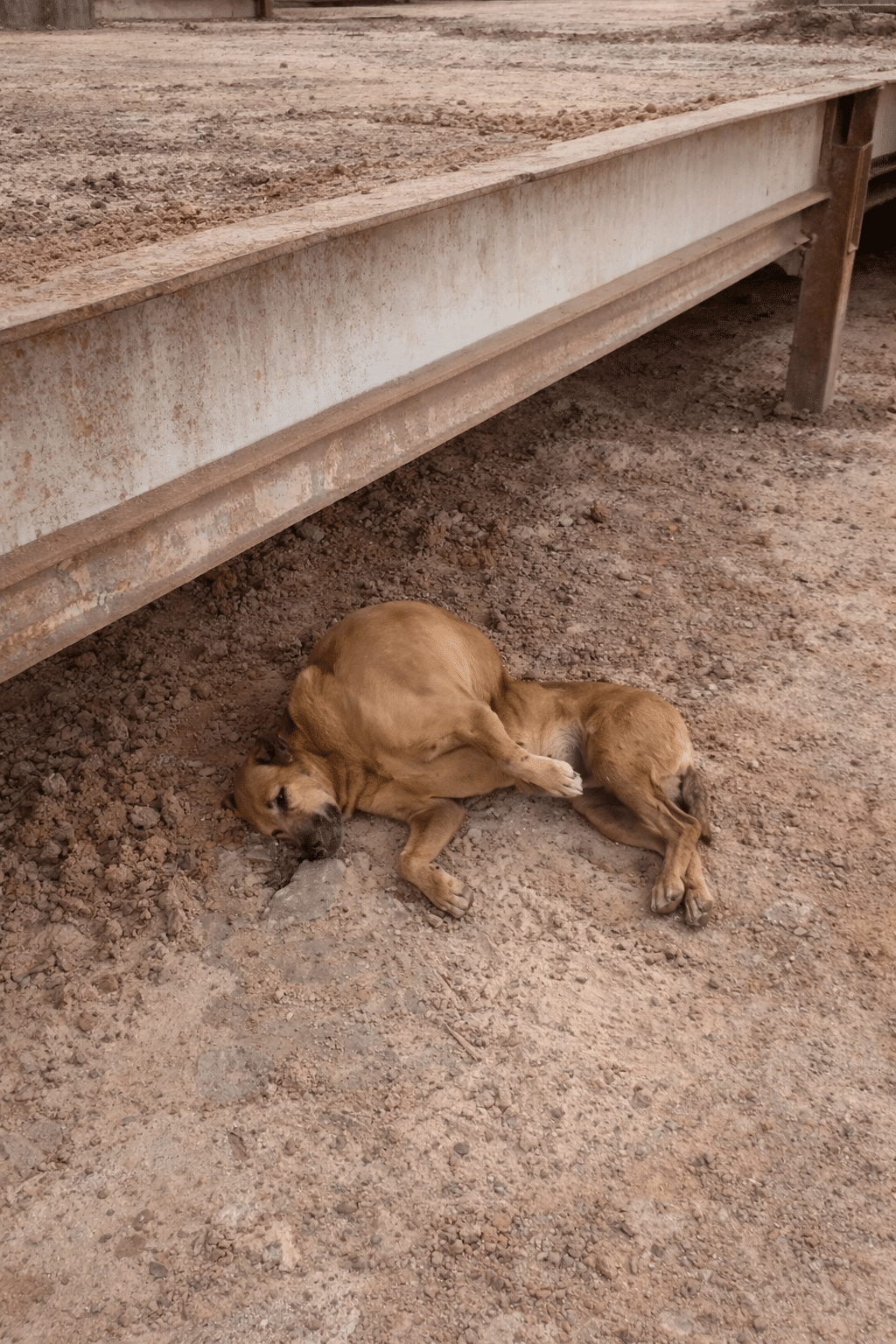
Vitória sat alone beside a bus stop in Cajazeiras, too weak to travel anywhere.
Her coat was thin and uneven. Her body trembled against the pavement, and a large mass around her right shoulder and neck made every movement appear uncomfortable.
People passed throughout the day.
Some noticed her.
Most continued walking.
Then one person crouched beside the exhausted dog and reached out carefully.
Vitória pressed her head against the offered hand and managed a faint movement of her tail.
That tiny response became the beginning of everything that followed.
The Dog Waiting Beside the Bus Stop
No one knew exactly how long Vitória had been sitting there.
She did not bark at the people moving around her or attempt to follow them. She remained close to the bus stop, conserving what little energy she had left.
Her physical condition was impossible to overlook.
She was thin and visibly weak.
Large areas of her coat were sparse, leaving little protection against the ground and changing weather. Most concerning was the swollen mass extending across her right shoulder and toward her neck.
The growth affected the way she held her body.
Standing required effort.
Even shifting her weight appeared uncomfortable.
When the rescuer approached, Vitória watched quietly. There was no aggressive response, but her weakened condition made every movement cautious.
The person lowered themselves beside her rather than reaching down from above.
Vitória did not pull away.
Instead, she leaned her head gently into the waiting hand.
Then her tail moved.
It was only a small wag, but it showed that she was still responsive and willing to accept help.
The rescuer named her Vitória—the Portuguese word for “victory.”
At that moment, no one could know how much meaning the name would eventually carry.
Video: Vitória Wagged Her Tail Beside a Bus Stop—Then Doctors Faced an Almost Impossible Decision
The Examination Revealed a Dangerous Challenge
Vitória was transported directly to a veterinary clinic.
The medical team examined the large mass and assessed her overall condition. Its location made treatment especially complicated.
The growth extended around the shoulder and neck area, close to structures that made surgery difficult. Vitória was also weak, and a persistent fever created further concern.
According to the account shared by her rescuers, the veterinarian initially estimated that her likelihood of surviving such an operation was below ten percent.
It was devastating news.
The surgery itself carried serious risk, but leaving the mass untreated would also allow her condition to continue worsening.
Before making a final decision, the team focused on stabilizing her and giving her as much comfort as possible.
Vitória received soft bedding and appropriate meals.
Her fever was monitored.
Caregivers remained close, speaking gently and allowing her to rest without unnecessary handling.
When she had enough strength, she took short, supported walks. She appeared to enjoy the fresh air and the quiet attention of the people around her.
These ordinary moments mattered.
Vitória’s future remained uncertain, but she was no longer sitting alone beside a road.
Every decision was now being made by people who considered her comfort and quality of life.
Saving Her Required More Than Removing the Mass
After repeated examinations and veterinary consultations, the medical team reached a difficult conclusion.
Removing only the visible growth might not be enough.
Because of its size and location, the operation would also require the removal of Vitória’s right front leg.
Amputation is never a minor decision.
However, in Vitória’s case, the veterinarians believed it offered the best available chance to remove the affected area and relieve the burden she had been carrying.
The rescuers considered the risks carefully.
Vitória was already weak.
Her fever had not resolved completely.
The procedure would be lengthy, and recovery would require her to adapt to balancing on three legs.
But without intervention, her options were extremely limited.
The team agreed to proceed.
Vitória was prepared for surgery while the rescuers waited outside the operating room.
There was nothing more they could do except trust the veterinary professionals working to give her a chance.
The hours passed slowly.
Then the door opened.
The veterinarian emerged with the news everyone had been hoping to hear.
Vitória had survived.
The mass had been removed along with her right front leg.
She was alive, but the most delicate stage of her recovery was only beginning.
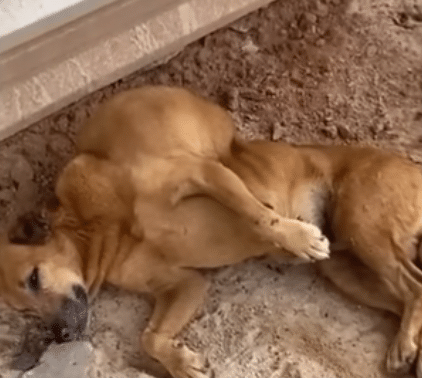
Her First Steps on Three Legs Were Not Easy
Vitória needed time before attempting to stand.
Her body had endured a major operation, and the way she balanced had changed completely. The leg she had once relied on was gone, requiring her remaining limbs to support and move her differently.
Her first attempts were uncertain.
She pushed herself upward and struggled to find a stable position.
Sometimes she managed only a few seconds before lowering herself again.
On other occasions, she took a step and stumbled.
The caregivers stayed close but avoided forcing her to move before she was ready. They supported her when necessary and made sure the floor provided enough traction for safer practice.
Vitória also needed rest.
Some days, exhaustion limited how much she could do. Her medical team continued monitoring the surgical area while managing her comfort and nutrition.
Progress came through repetition.
Standing for slightly longer.
Taking one controlled step.
Then another.
Learning how to turn without losing balance.
As her appetite returned, so did her strength.
Vitória began lifting her head whenever familiar caregivers entered. Her tail moved more frequently, and she accepted affection from the people assisting with her rehabilitation.
She was not suddenly free from every difficulty.
But each new attempt showed that she was adapting.
The dog who had barely moved beside the bus stop was now learning how to walk toward people again.
Joy Returned Through Ordinary Moments
As Vitória became stronger, her surroundings began to feel less like a place of treatment and more like a temporary home.
She developed a routine.
Meals arrived at regular times.
Caregivers helped her practice moving safely.
She rested on soft blankets and spent peaceful periods outside in the sunlight.
Other dogs at the shelter gradually became part of her world. Vitória watched them, rested nearby and eventually began interacting more confidently.
Toys also caught her attention.
At first, she only observed them.
Later, she reached forward and began playing in the careful way her new balance allowed.
The change was visible in her entire posture.
When first found, Vitória had held her body low, every movement shaped by weakness and the weight around her shoulder.
Now she stood with greater stability.
She approached familiar people.
She stretched out comfortably in warm areas and appeared able to rest without the constant discomfort that had once followed her.
Her three-legged body did not prevent her from seeking companionship or enjoying daily life.
Vitória simply learned a different way to move through the world.
The caregivers also learned from her.
They adjusted walking routes.
They kept surfaces clear.
They allowed extra time when she needed it.
Recovery was not about making Vitória behave as though nothing had changed.
It was about building a safe life around the dog she had become.
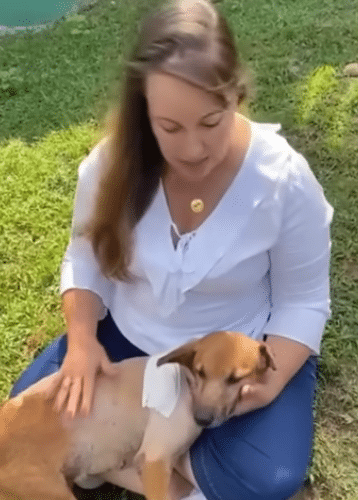
A Family Saw More Than Her Missing Leg
As Vitória’s health and mobility improved, the possibility of adoption became real.
She needed a family who understood her medical history and was prepared to support a three-legged dog. Her future home would need to provide regular veterinary care, appropriate exercise and a safe environment where unnecessary strain could be avoided.
Eventually, someone came forward.
The adopter did not see Vitória as a damaged dog or a difficult responsibility.
She saw an affectionate companion who had survived an extraordinary medical journey and still welcomed gentle attention.
Their connection developed without pressure.
Vitória was allowed to approach at her own pace.
The woman learned how to support her body comfortably and paid attention to the surfaces and routines that made movement easier.
When Vitória finally left for her permanent home, the people who had cared for her experienced a mixture of emotions.
They remembered the silent dog beside the bus stop.
They remembered the uncertain hours outside the operating room.
They remembered her first unsuccessful attempts to stand.
Now that same dog was leaving in the arms of someone committed to protecting her.
The rescue team had not merely kept Vitória alive.
They had helped her reach a life in which survival was no longer her only concern.
The Name Vitória Finally Made Sense
Today, Vitória spends her days surrounded by stability and affection.
She rests in her adoptive mother’s arms.
A favorite toy is often kept nearby.
She enjoys warm places to nap and moves around her home with the confidence she gradually developed during rehabilitation.
The surgical scar remains.
So does the absence of her right front leg.
But neither prevents her from participating in the life around her.
Vitória’s journey was not defined by one miraculous moment.
It was created through a series of difficult, practical decisions.
Someone stopped at the bus station.
Veterinarians examined a condition others might have considered hopeless.
A rescue team accepted the risks of surgery.
Caregivers supported her through every uncertain attempt to walk.
And eventually, a family chose to continue that care for the rest of her life.
Her story does not promise that every medical crisis will end the same way.
It shows what can happen when an animal is given careful treatment, honest consideration and the opportunity to try.
Once, Vitória sat beside a bus stop while the world continued moving around her.
Then someone noticed her tiny tail wag.
Today, she no longer waits for kindness to arrive.
She wakes up surrounded by it.


