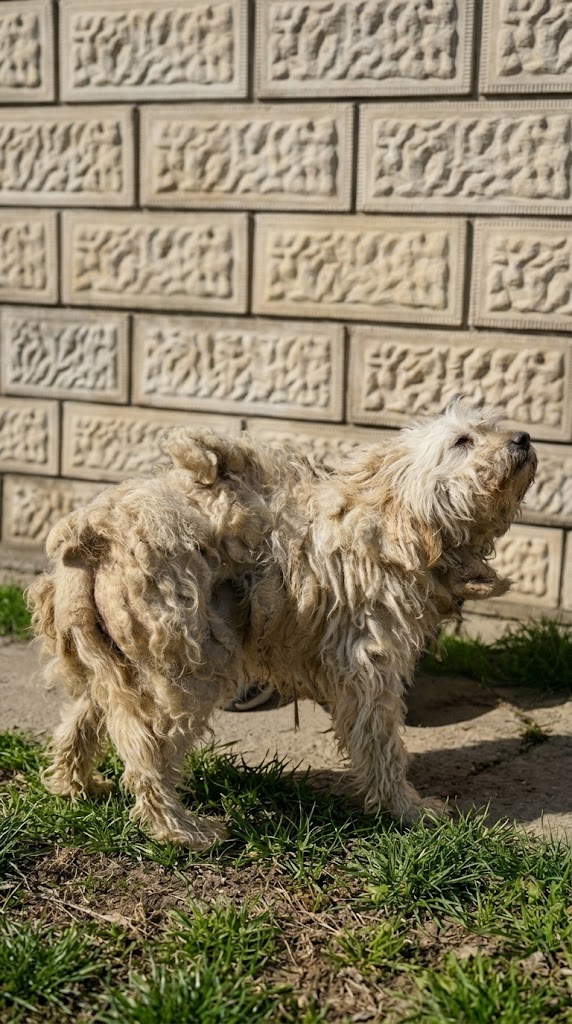
The small dog sat almost motionless on the grooming table.
Her body was hidden beneath a thick shell of tangled fur that had tightened into heavy cords around her legs, chest, and face. Only small parts of her expression remained visible.
She did not growl when the groomers approached.
She simply trembled.
Every sound made her more alert. Every hand moving toward her seemed to bring another moment of uncertainty.
The people around her understood that removing the mats would require more than grooming skill.
It would require patience with a dog who did not yet know whether help could be trusted.
A Small Dog Trapped Beneath Her Own Coat
The dog was believed to be a Maltese mix from a rural area.
By the time she reached the grooming salon, her coat had gone far beyond ordinary tangling.
Long sections of fur had twisted together and hardened close to the body. Dirt, debris, and small insects were reportedly trapped inside some of the mats.
Her natural shape was difficult to see.
The thick coat concealed her legs and made her appear much larger than she really was. Around her face, tangled fur limited visibility and left only narrow openings through which she could observe the unfamiliar room.
Each time she shifted position, the mats pulled with her.
Areas of skin underneath appeared irritated and sensitive once the groomers began examining her more closely. Some discoloration and pressure marks were visible, although their precise causes could not be confirmed from appearance alone.
The grooming team knew they could not simply pull the knots apart.
Brushing would have caused more discomfort.
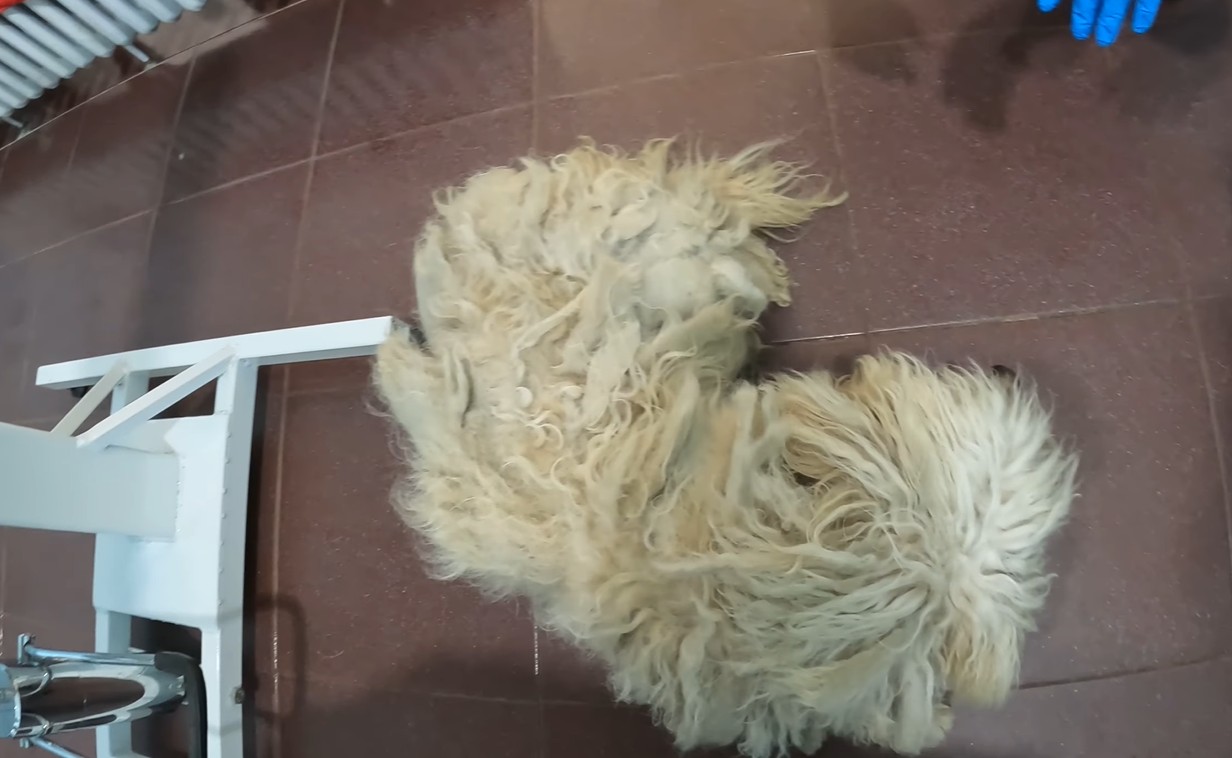
The coat needed to be removed slowly with clippers, one small section at a time.
Before beginning, the groomers lowered their voices and allowed the dog several moments to observe them.
She remained frightened.
But she stayed on the table.
Video: Terrified Beneath a Hardened Coat, She Panicked While Groomers Tried to Set Her Free
Every Section Required Patience
The first challenge was finding a safe place to begin.
Because the coat had tightened so close to the body, the groomers could not always see where the skin ended and the mats began. Sliding a tool too quickly beneath the fur could have caused an accidental injury.
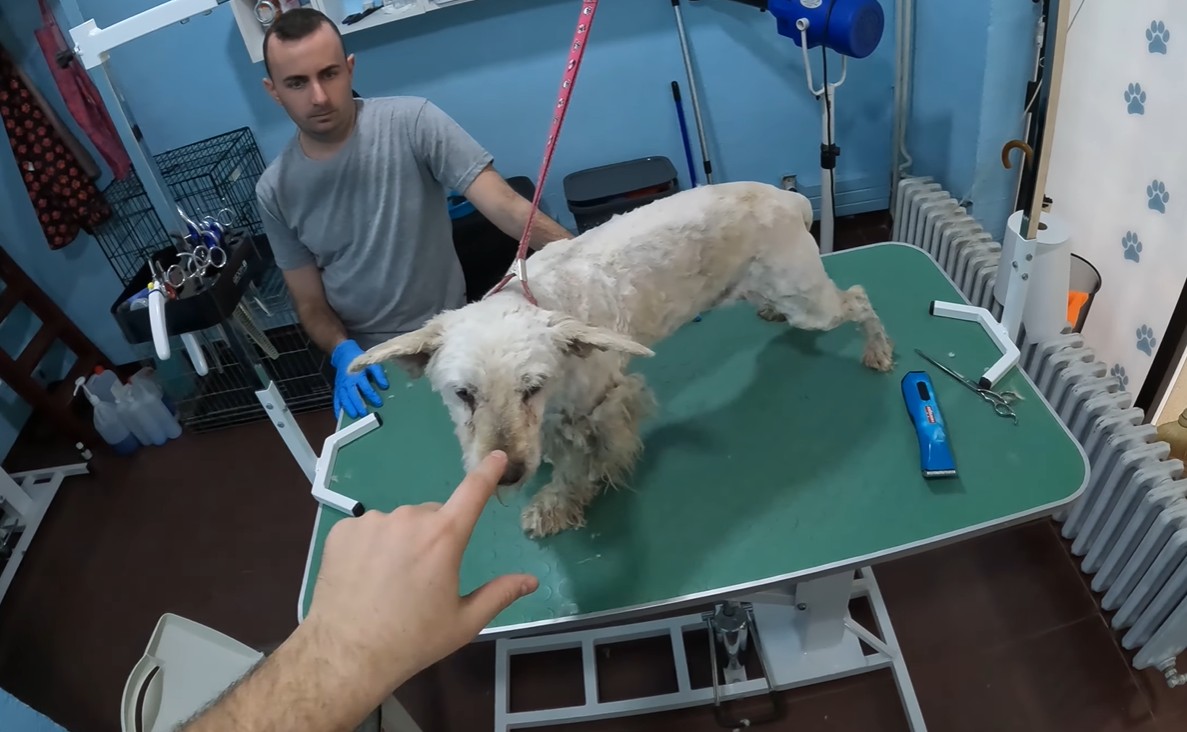
One person remained near the dog’s head, supporting her gently and watching her reactions.
Another carefully guided the clippers through the dense coat.
The sound of the machine made her tense.
Her legs trembled beneath the heavy fur, and her eyes followed every movement around the table.
The groomers paused frequently.
They allowed her to breathe.
They changed position whenever she appeared overwhelmed.
Slowly, the first sections began to separate.
A compact piece of fur fell onto the table.
Then another.
Underneath, a much smaller body began to appear.
The dog did not suddenly relax as the weight disappeared. She was still surrounded by unfamiliar people, sounds, and sensations.
But the physical pressure was beginning to ease.
Her legs had more room.
Her skin was no longer being pulled in quite the same way.
The team continued without rushing her.
One Loud Sound Triggered a Frightened Reaction
After much of the coat had been removed, the grooming process moved toward cleaning and drying.
Then the blow dryer was turned on.
The sudden noise and rush of air startled the dog.
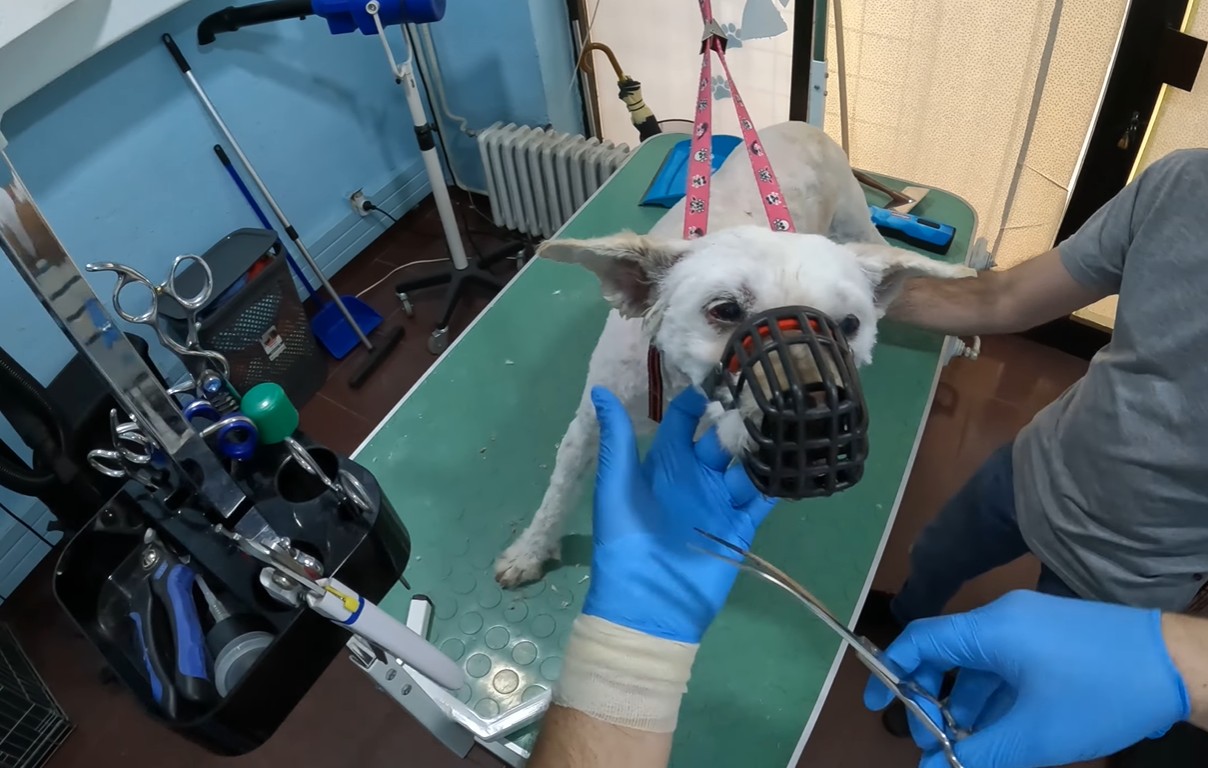
She lunged forward and bit one of the groomers on the hand.
The moment happened quickly.
It would have been easy to describe her as aggressive, but the circumstances suggested something more complicated.
She had already endured a long, unfamiliar grooming session. Her body was sensitive, her movement had been restricted, and she had shown fear from the moment she arrived.
The dryer introduced a loud sound and an unexpected sensation before she was ready.
The groomer stepped back and cared for the injury.
No one shouted at the dog.
No one punished her.
Instead, the team stopped the session and gave her space to settle.
The bite was treated as a warning that she had reached her limit—not as proof that she was dangerous.
Before continuing, the groomers adjusted their approach.
They reduced unnecessary noise and moved even more slowly.
A soft muzzle was introduced for safety during the remaining work. It was used carefully and only to protect both the dog and the people handling tools near her sensitive skin.
The goal had not changed.
Help her without creating more fear.
Warm Water Replaced the Heavy Layers
Once the most difficult mats had been removed, the dog was gently placed into warm water.
The bath allowed the team to clean dirt that had remained trapped close to her skin and inspect areas that had previously been impossible to reach.
A mild shampoo was worked carefully across her body.
No rough scrubbing.
No sudden movements.
The caregivers supported her throughout the bath, watching for signs that she needed another pause.
At first, she remained tense.
Her posture was rigid, and her eyes continued tracking every nearby hand.
Gradually, however, she appeared to settle.
The water was warm.
The grip supporting her was steady.
And nothing painful followed.
As the remaining dirt washed away, her natural coat and delicate frame became clearer.
The dog hidden beneath the hardened mats was much smaller than the figure that had first entered the salon.
Her face could now be seen fully.
Her legs moved without dense cords of fur wrapped around them.
For the first time during the session, her body no longer carried the same constant pulling.
Relief Did Not Mean Trust Had Fully Returned
The physical transformation was immediate.
The emotional one would take longer.
Once clean and closely trimmed, the dog could stand more naturally. She adjusted her paws and turned her body without the heavy coat resisting every movement.
But she remained cautious around the people nearby.
A successful grooming session could remove the mats.
It could clean her skin.
It could reduce the discomfort she had been carrying.
It could not instantly teach her that every unfamiliar sound or touch was safe.
The caregivers respected that difference.
They did not expect a tail wag or sudden affection as proof that the rescue had worked.
Her quieter breathing and freer movement were enough for the moment.
Alexander wrapped her in a warm towel after the bath, keeping her securely supported while she dried.
The dog watched him closely.
She did not lean forward for affection.
But she did not struggle either.
The session ended with a small dog resting inside a towel, no longer hidden beneath the coat that had restricted her body.
That was the first step.
Trust would need to be built afterward through many calmer experiences.
The Dog Beneath the Fear Was Finally Visible
When the grooming was complete, the difference was striking.
The dense shell of dirty fur was gone.
Her face was open and expressive.
Her legs could move independently.
Her natural size and shape were visible again.
She looked lighter because she was lighter.
But the most important change was not cosmetic.
The mats were no longer tightening around her skin.
She could sit without heavy sections folding beneath her.
She could turn her head freely.
She could take a few careful steps without the coat pulling against her body.
The dog who had appeared almost frozen on the table began cautiously exploring the space around her.
She remained alert.
New sounds still made her pause.
That was understandable.
The grooming team had helped her body feel more comfortable, but the experiences that would rebuild her confidence had only just begun.
Regular meals.
Quiet shelter.
Predictable routines.
Gentle handling.
People who noticed when she became overwhelmed and stopped before fear took control.
Those ordinary moments would matter as much as the dramatic removal of the coat.
Helping Her Meant Listening When She Was Afraid
This rescue was not a simple before-and-after transformation.
It included fear.
A moment of panic.
An injured hand.
And a team that had to change its methods when the dog communicated that she could no longer cope.
That response mattered.
The groomers did not treat her fear as disobedience.
They recognized that an animal can resist necessary care without understanding why the care is being given.
The dog could not know that the clippers would free her skin.
She could not know that the bath would remove dirt and insects.
She could not know that the towel around her body meant warmth rather than restraint.
All she knew was what she felt in each moment.
So the team slowed down.
They protected themselves without punishing her.
And they continued helping in the gentlest way the situation allowed.
By the end of the session, the physical shell surrounding her body had been removed.
The invisible fear remained—but it no longer had to be faced while carrying the additional weight of painful mats.
Freedom Began With One Careful Grooming Session
The little dog entered the salon hidden beneath a coat that had become a prison.
She was frightened by touch, overwhelmed by unfamiliar sounds, and unable to understand why strangers were placing tools near her body.
At one point, fear took over.
But the people helping her did not walk away.
They paused.
They listened to what her reaction was telling them.
Then they found a safer way to continue.
Hours later, a small Maltese-like dog stood where the hardened shape had been.
Clean.
Lighter.
Able to move again.
Her rescue did not end when the last mat fell to the floor.
That was only when a new kind of work could begin.
Teaching her that hands could approach without causing pain.
That unfamiliar rooms could become safe.
And that when she became frightened, someone would finally pay attention.
The coat around her body was removed in a single day.
The fear beneath it would require patience.
But for the first time, she had people willing to give her that time.


