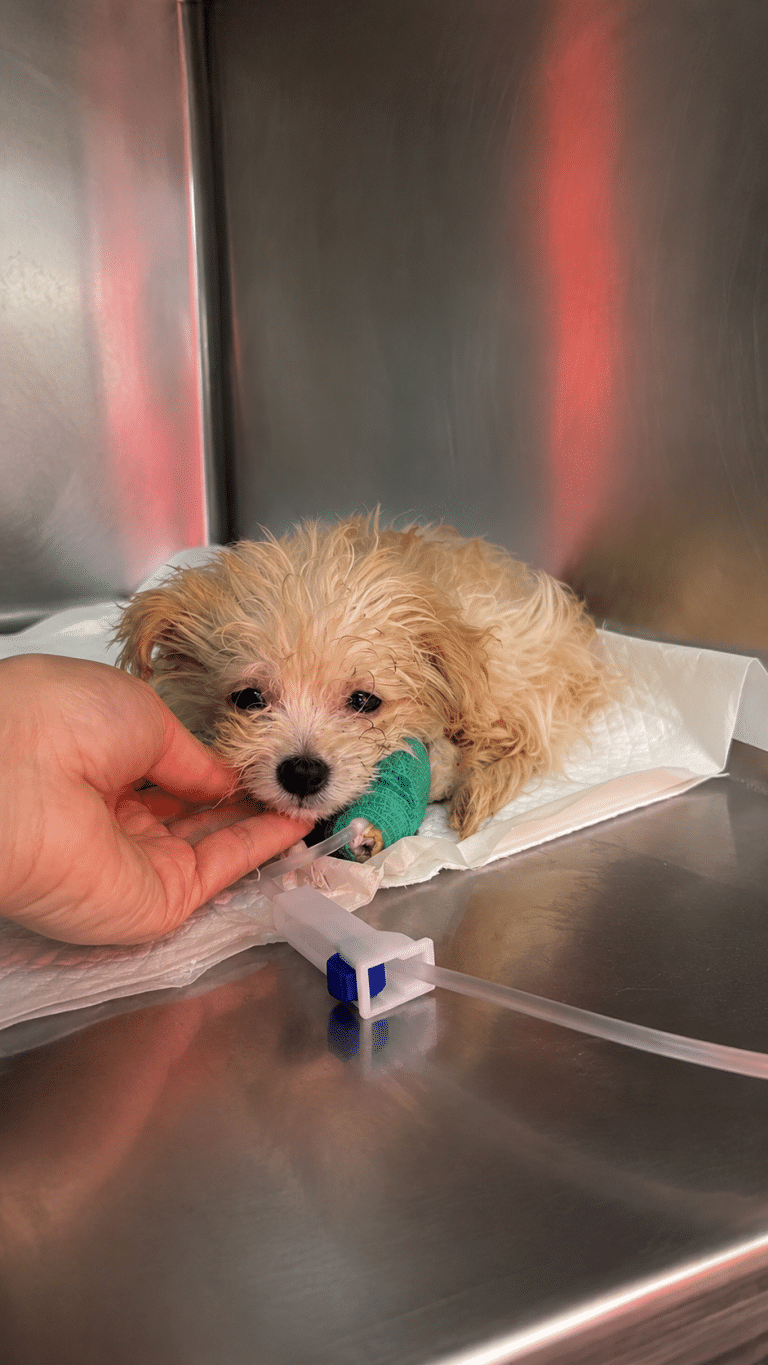
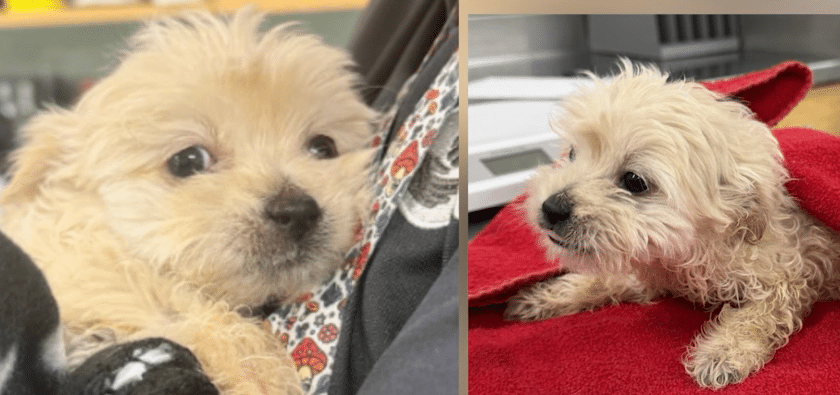
Carlos weighed barely four pounds.
He was a tiny terrier mix, small enough to be carried against one person’s chest and vulnerable enough that a freezing winter morning could quickly become life-threatening.
When shelter workers discovered him outside their building, his body was already dangerously cold.
They rushed him indoors and began emergency care immediately.
For the next two hours, an entire team focused on one fragile dog who should never have been left outside alone.
A Four-Pound Dog Found in the Freezing Air
The morning began with a discovery no shelter worker wants to make.
Outside the building sat a tiny dog exposed to bitter winter temperatures.
There was no warm blanket around him.
No person waiting nearby.
No explanation that could change the urgency of what staff were seeing.
The dog was Carlos.
His small body had been outside long enough for the cold to place him in severe distress. Because he weighed only around four pounds, he had little protection against rapidly falling body temperature.
Staff did not waste time asking how he had arrived.
They lifted him carefully and carried him inside, away from the freezing air. Warmth was introduced cautiously while the team assessed his breathing, responsiveness, and overall condition.
Every second mattered.
Carlos had reached the shelter, but he had not reached it safely.
Video: Shelter Staff Fight to Save Four-Pound Carlos After He Was Left Outside in the Cold
Two Hours of Emergency Care
Once Carlos was indoors, shelter staff and veterinary professionals began trying to stabilize him.
They wrapped his tiny body in warm materials.
They monitored him closely.
They used the emergency measures available to help raise his temperature and support his weakened condition.
The room remained focused on Carlos.
For nearly two hours, the team continued working.
A dog as small and cold as Carlos could not simply be warmed as quickly as possible. Treatment had to be controlled and carefully monitored because severe exposure can affect far more than the surface of the body.
His heart, circulation, breathing, and internal organs may all have been under enormous strain.
The staff gave him every opportunity they could.
They remained beside him through each attempt to stabilize his condition, hoping his body would begin responding to the warmth and care surrounding him.
But Carlos had already endured more than his fragile system could overcome.
Despite the team’s efforts, he died.
The shelter had done everything it could after finding him.
The tragedy was that help had arrived only after the cold had already caused critical harm.
The Loss That Left Staff Searching for Answers
Carlos’s death affected the people who tried to save him.
Shelter workers regularly care for frightened, injured, and abandoned animals. They understand that not every emergency will have the outcome they hope for.
Even so, some losses are especially difficult.
Carlos had been brought within reach of help, yet he had been left outside instead of being safely transferred into someone’s care.
A door separated him from warmth.
People trained to help were nearby.
But no one had made sure that staff knew he was there before walking away.
According to reports about the case, authorities later opened an investigation. A suspect was identified, and animal cruelty charges were filed.
The legal process could not change what happened to Carlos.
It did, however, emphasize that abandoning an animal in dangerous conditions is not a harmless way to surrender responsibility.
Extreme temperatures can become deadly very quickly, particularly for puppies, elderly animals, small breeds, and pets that are already ill or underweight.
Leaving an animal outside a shelter does not guarantee that someone will notice immediately.
Staff may be caring for animals inside.
The building may be closed.
A doorway or parking area may not be constantly monitored.
By the time someone sees the animal, the opportunity to help safely may already be disappearing.
A Shelter Door Is Not the Same as a Safe Surrender
People sometimes assume that leaving a pet near an animal shelter is safer than abandoning the animal elsewhere.
But placing a dog outside a building without speaking to staff creates serious risks.
The animal may wander into traffic.
It may become frightened and run away.
It may be exposed to cold, heat, rain, or other animals.
A leash can become tangled.
A carrier can tip over or remain unnoticed.
Even when the shelter is open, employees may not immediately see what has been left outside.
A safe surrender requires communication.
The animal should be transferred directly to a staff member, rescue volunteer, veterinarian, animal control officer, or another responsible person who has agreed to receive it.
That direct contact allows important information to be shared.
Does the animal need medication?
Has it eaten recently?
Is it frightened of strangers?
Does it have a history of seizures or other medical concerns?
Has it shown signs of illness?
Even limited information can help caregivers make safer decisions during the first critical hours.
Carlos could not explain what he had experienced before he was found.
The shelter team could respond only to the emergency in front of them.
Asking for Help Early Can Protect Both Pets and Families
People surrender animals for many different reasons.
Some are facing housing problems.
Others can no longer afford food or veterinary treatment.
A family member may become ill.
A dog’s behavioral needs may feel impossible to manage safely.
These situations can be painful and complicated. Recognizing that does not make abandonment safe, but it does show why support must be sought before the situation reaches a crisis.
Many shelters and animal welfare groups can provide information about local resources.
Depending on the area and availability, assistance may include:
Temporary pet food support.
Low-cost veterinary clinics.
Vaccination or spay-and-neuter programs.
Behavioral guidance.
Short-term foster placement.
Pet-friendly housing resources.
Advice for responsible rehoming.
Scheduled owner-surrender appointments.
Not every organization will have immediate space. Many shelters are managing overcrowding, limited funding, and more requests than they can accept at once.
That is why early contact matters.
Calling before food runs out is safer than waiting until a pet has gone several days without eating.
Seeking veterinary assistance when symptoms begin is better than waiting until the animal collapses.
Starting a responsible rehoming process early provides more options than leaving a frightened pet outside overnight.
Even when the first organization cannot help directly, staff may be able to suggest another shelter, rescue group, clinic, or community program.
A difficult phone call can still open a safer path.
Shelter Workers Carry the Outcomes Home With Them
Carlos’s story also reveals the emotional burden carried by animal care workers.
The people who found him did not know him during the earlier parts of his life.
They did not know where he had slept, who had cared for him, or when his circumstances began to change.
They knew him only during an emergency.
For two hours, they tried to give him what had been missing outside.
Warmth.
Attention.
Medical care.
A person beside him.
When those efforts were not enough, the loss did not remain inside the treatment room. Shelter workers often remember the animals they could not save, particularly when the suffering might have been prevented through an earlier request for help.
Carlos was not a number on an intake form.
He was a tiny dog whose final hours were witnessed by people determined not to let him remain alone.
They could not give him the long future he should have had.
But they could hold him, care for him, and continue trying until there was nothing more medicine could do.
What Carlos’s Story Asks Us to Remember
Carlos’s life should not be remembered only for the morning he was found.
His story should also change what happens the next time someone feels unable to care for an animal.
Do not leave a pet outside and assume someone will find it in time.
Do not wait for dangerous weather to pass.
Do not allow embarrassment or fear of judgment to prevent an early request for help.
Call the shelter.
Speak to animal control.
Contact a rescue group or veterinary clinic.
Explain the situation honestly and ask what safe options are available.
There may be waiting lists.
There may be difficult conversations.
The solution may not appear immediately.
But direct communication gives an animal a far better chance than being left alone in a place where no one knows it is waiting.
Carlos was only four pounds.
He depended entirely on people to protect him from conditions his small body could not survive.
When shelter workers found him, they gave him every chance still available.
His story now carries a responsibility beyond grief.
It asks people to act sooner.
To ask for help before desperation becomes abandonment.
And to remember that placing an animal near safety is not the same as placing that animal safely into someone’s care.
Carlos did not receive the future he deserved.
But what happened to him can still help protect another vulnerable animal from being left outside, unseen, and waiting in the cold.


