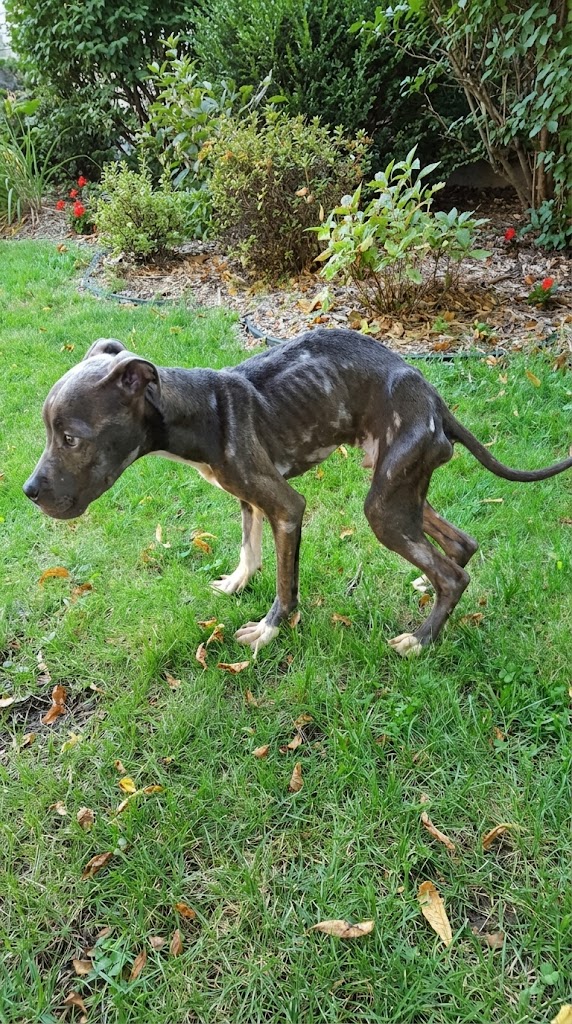
The young Pit Bull lay beside a concrete gutter, so still that rescuers initially feared they had arrived too late.
His body had been reduced to barely 15 pounds.
Every rib was visible beneath his skin. His spine formed a sharp line along his back, and he appeared too weak to raise his head from the dusty ground.
Then, as someone reached toward him, his tail moved.
It was only a faint flick.
But it was enough to show that he was still conscious—and that there was still time to help him.
The Small Movement That Changed the Rescue
Nothing about the roadside scene suggested that the dog had much strength left.
He did not attempt to stand when rescuers approached.
He did not bark or pull away.
His body remained pressed against the ground as the team examined him carefully, looking for signs of breathing and responsiveness.
Severe malnutrition had left him dangerously fragile. At only 15 pounds, he weighed far less than a healthy young Pit Bull normally should.
Even lifting him required caution.
His weakened muscles offered little support, and sudden movement could place additional strain on a body already struggling to function.
Then his tail shifted again.
The movement was small enough to miss, but the rescuers saw it.
They wrapped him carefully and carried him away from the gutter. There was no certainty about what would happen next, but the dog had responded to their presence.
That was reason enough to move quickly.
Video: The 15-Pound Pit Bull Moves His Tail as Rescuers Lift Him From the Roadside
Three Critical Days Under Veterinary Care
The dog was transported directly to emergency veterinary care.
His condition required immediate stabilization.
He was severely underweight, dehydrated, and too weak to support himself. Even raising his head from the examination surface appeared difficult.
The medical team began with the most urgent needs.
His hydration had to be restored carefully.
His temperature and vital signs needed continuous monitoring.
Nutrition had to be introduced slowly because a body weakened by prolonged starvation may not safely tolerate a large meal.
There was no sudden transformation during those first hours.
The dog rested under close observation while the team waited to see whether his system would respond.
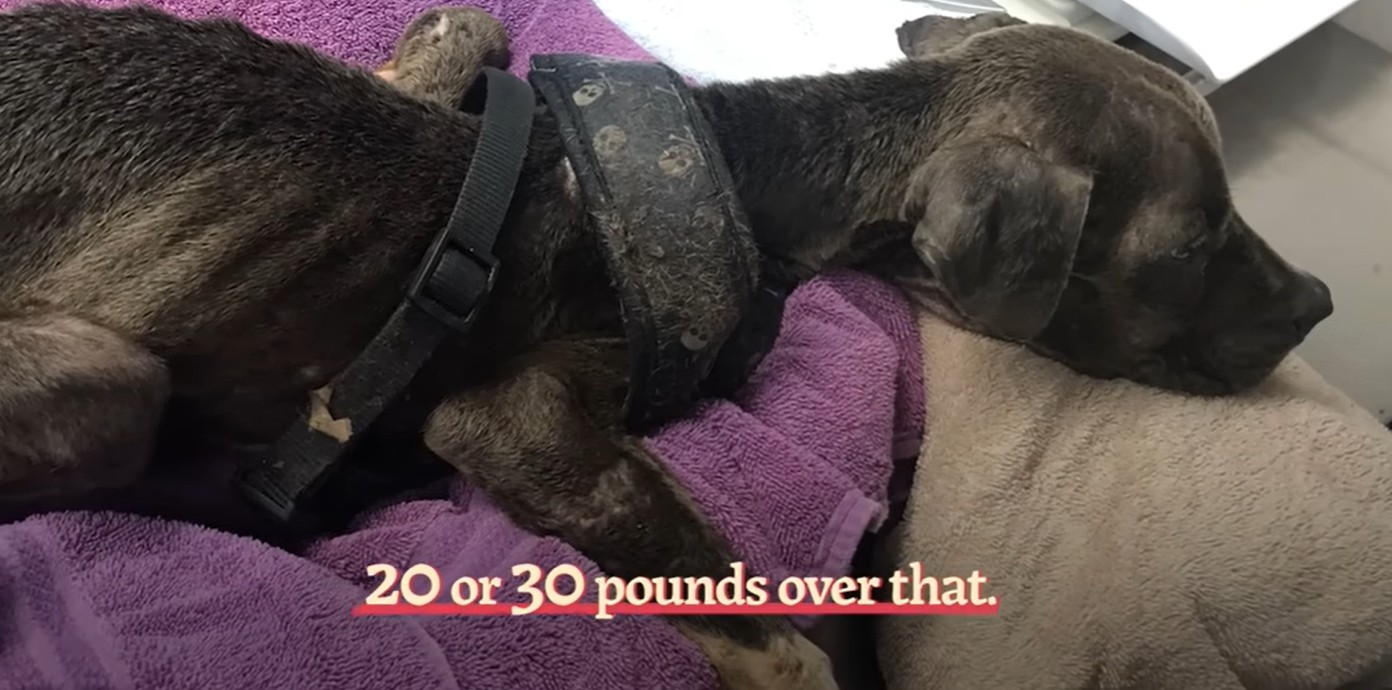
For three days, he remained in intensive care.
Progress was measured through details that might ordinarily seem insignificant.
A steadier breath.
A slightly stronger response to touch.
Eyes that remained open for longer.
The ability to swallow a small amount of food.
Each sign suggested that his body was beginning to stabilize.
By the third day, the veterinary team believed he was strong enough to leave intensive care and continue recovering in a quieter environment.
The most immediate danger had eased.
But he still had a long distance to go.
A Foster Home Built Around Slow Recovery
The young dog was placed with an experienced foster caregiver who understood that rehabilitation could not be rushed.
During his first days in the home, he slept for long periods.
His body needed rest, and he showed little interest in exploring. Most of his energy was still being used for basic recovery.
His meals were prepared in carefully measured portions.
Giving him too much food too quickly could create serious complications, so his intake was increased gradually under veterinary guidance.
Water, medication, rest, and nutrition became the structure of each day.
There were no expectations that he should immediately play or seek affection.
He was allowed to remain quiet.
By around the third day in foster care, subtle changes appeared.
His eyes began following people as they moved through the room.
His ears reacted to nearby sounds.
When his caregiver approached, he appeared more aware of her presence.
These were small responses, but they showed that the dog was beginning to engage with his surroundings rather than simply sleeping through them.
His body was still weak.
Yet his attention was returning.
The First Time He Pushed Himself Up
Near the end of his first week, the dog attempted something that had been impossible beside the gutter.
He tried to stand.
His front legs pressed against the floor while his back legs trembled beneath him. At first, he could hold the position for only a short moment before lowering himself again.
He rested.
Then he tried once more.
This time, he remained upright slightly longer.
The attempt was not graceful or steady, but it demonstrated that his muscles were beginning to respond to food and care.
Soon, standing became a few cautious steps.
He crossed a short section of the room before stopping to rest. His foster caregiver stayed close but allowed him to control the movement rather than pulling him forward.
Every step required concentration.
The dog who had been unable to lift his head was now deciding where he wanted to go.
His progress continued gradually.
One day he stood longer.
Another day he crossed the room without immediately lying down.
The distance remained small, but the direction had changed completely.
He was no longer confined to the place where someone set him down.
A Calm Rottweiler Helped Him Learn the Household Routine
During his second week in foster care, the young Pit Bull began showing interest in another dog living in the home.
The household Rottweiler was much larger but calm around the recovering newcomer.
At first, the Pit Bull simply watched.
He observed the Rottweiler walking through the house, approaching people, resting on a bed, and responding to familiar routines.
Soon, he began following.
The larger dog appeared to offer a quiet example of what daily life in the home looked like.
Meals arrived consistently.
People moved nearby without causing harm.
A dog could sleep deeply and wake to find everything still safe.
As the Pit Bull’s strength increased, he became more curious.
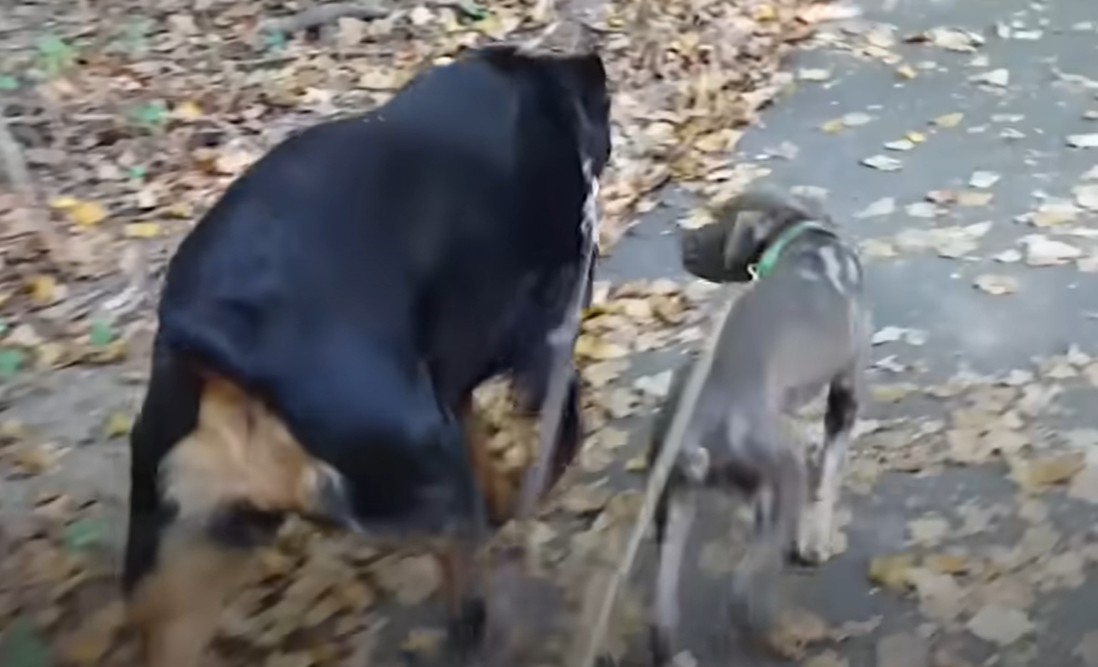
He walked behind the Rottweiler from room to room.
He investigated nearby objects.
He began responding when his foster caregiver spoke to him.
By the second week, brief moments of playfulness had started appearing. His movements were still limited by his recovering body, but he was no longer using all his energy simply to remain upright.
There was now room for curiosity.
Three Weeks After the Gutter, He Walked Outside
By the third week, the dog was ready to experience more of the world beyond his recovery space.
His foster caregiver introduced him to a leash and allowed him to move slowly outdoors.
The first outings were short.
New sounds made him pause. Different surfaces required more balance than the familiar floor inside the house.
But he continued.
He sniffed the ground.
He looked toward his caregiver.
Then he took another step.
His body was beginning to fill out as regular meals restored some of the weight he had lost. His coat also started improving, replacing the dull appearance seen on the day of his rescue.
The changes were visible, but his recovery was not complete.
He still needed rest.
His diet remained carefully managed.
Veterinary checkups continued.
Even so, the contrast was unmistakable.
Three weeks earlier, he had been carried away from the roadside because he could not stand.
Now he was walking outside and deciding which direction to explore.
Tim Met the Dog He Was Becoming
Around the fifth week of recovery, a man named Tim met the young Pit Bull.
By then, the dog no longer resembled the motionless figure first discovered beside the gutter.
He was stronger.
More attentive.
And increasingly comfortable around people.
Tim did not meet a dog who had forgotten everything that happened to him. He met a dog still recovering—one who needed consistency, continued care, and a home prepared to support his progress.
Their first interaction was quiet.
The Pit Bull observed Tim before moving closer.
Tim gave him space and allowed the dog to decide how quickly the introduction should proceed.
Gradually, the distance between them narrowed.
There was no need for an instant, dramatic display of affection.
The dog remained nearby.
That was enough for the connection to begin.
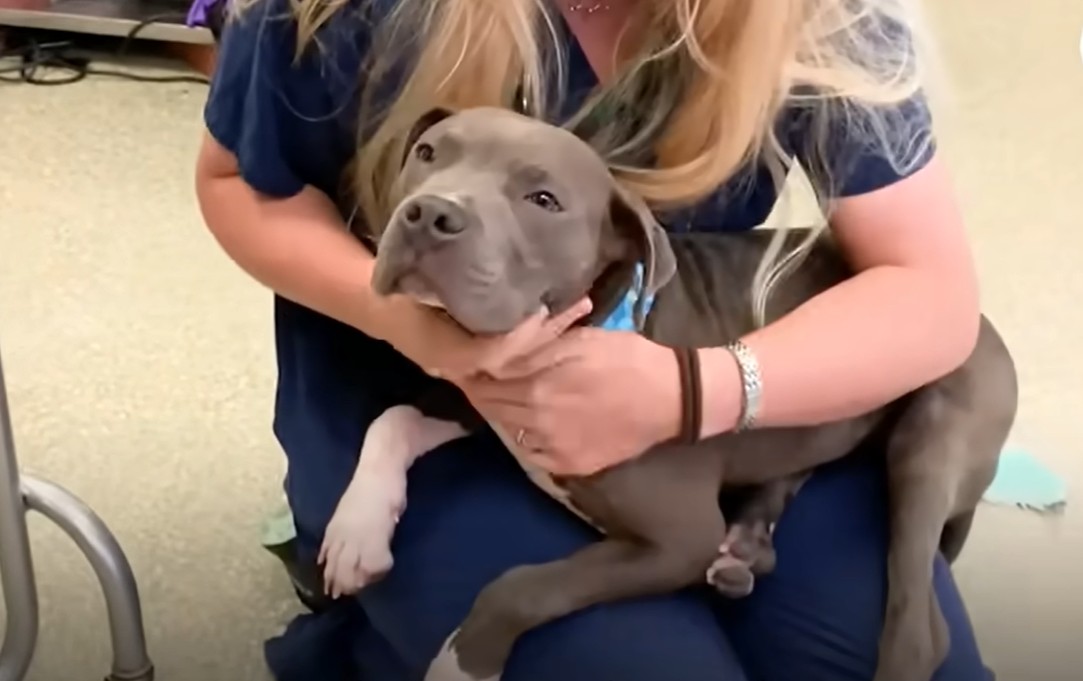
After learning more about his medical history and recovery needs, Tim chose to adopt him.
The decision gave the young dog something he had not possessed beside the road.
A permanent place to continue healing.
He Walked Into the House and Found the Couch
The dog entered his new home cautiously.
He explored the unfamiliar space, taking in new smells and watching the other rescue dogs already living there.
Then he discovered the couch.
The young Pit Bull climbed onto it and settled down as though soft furniture had always been part of his life.
The moment was ordinary.
That was what made it meaningful.
He no longer needed to sleep beside a gutter.
He no longer had to use every bit of strength simply to remain conscious.
There were other dogs nearby.
Meals arrived on a schedule.
A familiar person noticed when he needed reassurance, exercise, or rest.
As the days passed, he became increasingly comfortable within the household. He rested beside the other dogs and began participating in the routines around him.
His trust appeared through small choices.
Approaching Tim.
Remaining close when touched.
Choosing to lie beside another dog.
Following family members from one room to another.
The frightened, exhausted animal found by the road had not disappeared overnight.
He had been answered with enough safe experiences that fear no longer controlled every movement.
The Tail Movement That Became a Beginning
It is tempting to describe this dog’s recovery through its most dramatic images.
Fifteen pounds beside a gutter.
Three days in intensive care.
The first attempt to stand.
The first walk outside.
The couch in his permanent home.
But his life changed through much smaller moments repeated over time.
A rescuer noticing that faint tail movement.
A medical team introducing food carefully.
A foster caregiver remaining patient when he could do little except sleep.
A calm dog showing him the rhythm of a safe home.
An adopter allowing trust to develop without pressure.
None of these actions alone completed his recovery.
Together, they created the conditions in which recovery became possible.
The young Pit Bull did not survive because he understood the future waiting for him.
He survived long enough for people to reach him.
Then those people gave his body time to respond.
On the roadside, his tail moved only slightly.
It was not proof that everything would be all right.
It was proof that he was still there.
And for the rescuers who lifted him from beside the gutter, that was all the reason they needed to keep going.


