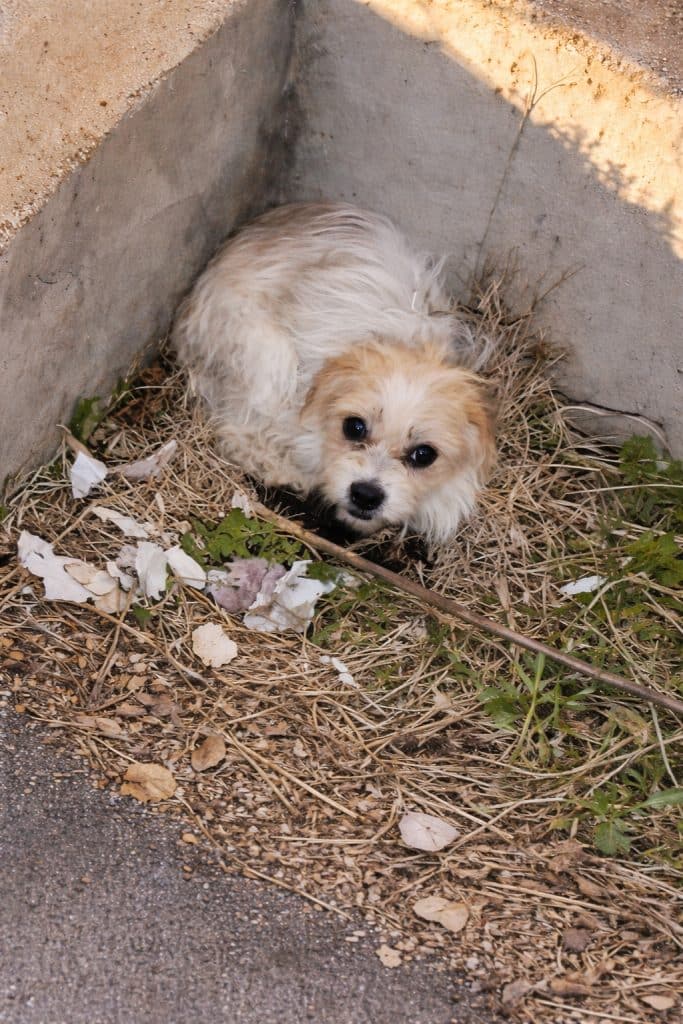
The stray dog remained hidden beneath a wall of tangled branches.
Each time rescuers moved closer, a low growl rose from the undergrowth. Her body stayed tense, her eyes following every hand and every step.
At first, it seemed that she was simply frightened.
Then the team realized she was protecting something beneath the leaves.
Five puppies had been born in that forgotten garden—but by the time help arrived, only one was still breathing.
A Warning From Beneath the Branches
Rescuers came to the neglected garden after residents reported seeing a stray dog repeatedly returning to the same patch of dense vegetation.
The property had been left unattended for some time. Weeds covered the ground, branches crossed narrow paths, and thick leaves created dark hiding places beneath the plants.
The dog had chosen one of those hidden spaces.
As the team approached, she did not run.
Instead, she lowered herself beneath the branches and growled.
Her reaction made it clear that moving too quickly could create more danger. A frightened mother might flee into the surrounding area or attempt to defend the space if she believed her puppies were threatened.
The rescuers stopped at a respectful distance.
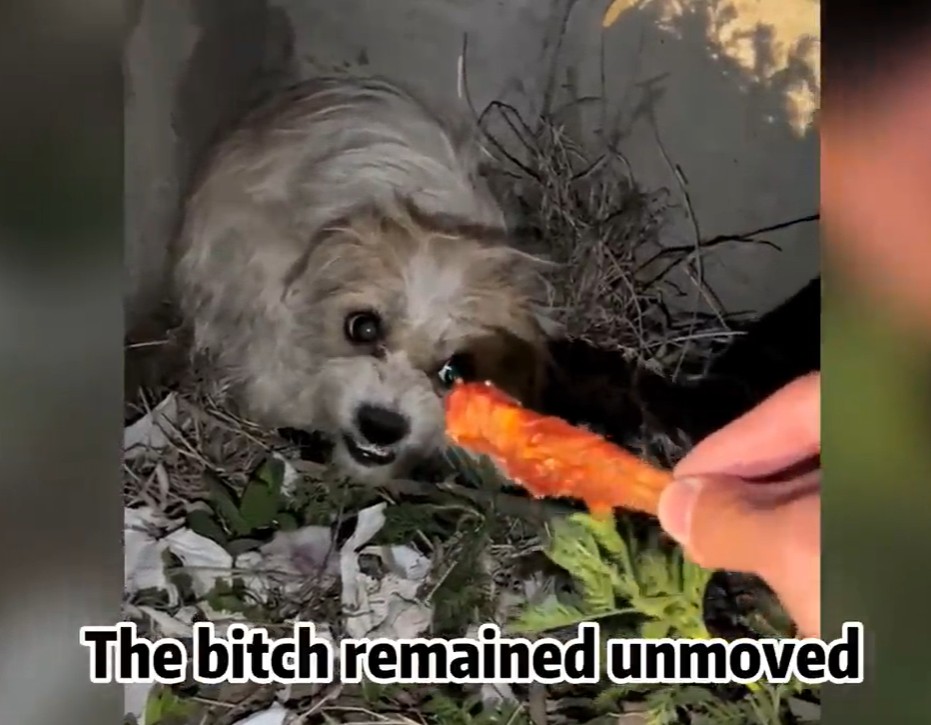
They spoke quietly and avoided reaching into the undergrowth. Food was placed near the edge of the hiding place, close enough for the dog to smell but far enough that she would not feel surrounded.
At first, she remained still.
Her eyes moved between the rescuers and the food.
Then hunger brought her forward.
She ate quickly, returning several times for the pieces placed near her. Her urgency suggested that she had not been finding enough food while remaining close to the hidden nest.
The team continued feeding her in small amounts.
With each careful approach, her posture became slightly less rigid.
Eventually, she allowed one rescuer to touch the top of her head.
Video: Rescuers Follow a Guarding Mother Dog Into the Garden and Find One Puppy Still Alive
The Worn Collar Around Her Neck
As the mother moved farther out of the leaves, rescuers noticed an old collar around her neck.
It was frayed and loose, but its presence suggested that she may once have lived around people.
A collar alone could not explain how she had arrived in the garden.
She may have become lost.
She may have been abandoned.
She may have wandered away while pregnant and chosen the quietest place she could find to give birth.
Whatever had happened, she was now caring for the litter without reliable food, shelter, or medical support.
Residents said a male dog had also been seen in the area several days earlier, but he was no longer nearby.
The mother appeared to be handling everything alone.
Her body looked thin, and nursing puppies would have placed additional demands on her limited energy. Leaving the garden to search for food also meant leaving the litter unprotected.
That conflict may have kept her close to the nest even as her own condition weakened.
The rescuers needed to inspect the hidden area, but they could not simply push past her.
They continued offering food while allowing her to observe them.
When she no longer growled at every movement, one member of the team began gently moving the outer branches aside.
The mother watched closely.
She did not leave.
Only One Puppy Was Still Breathing
The space beneath the plants was small and poorly protected.
There was no proper bedding.
The puppies had been lying directly against the cold ground, surrounded by damp leaves and loose soil.
Five tiny bodies were gathered near their mother.
Four were unresponsive.
The rescuers checked them carefully, but there were no signs of life.
The fifth puppy was still breathing.
He was extremely small and weak, with movements so slight that they could easily have been missed from outside the garden.
The mother moved repeatedly between the puppies.
She nudged them with her nose and licked their bodies. These are normal maternal behaviors used to clean and stimulate newborn puppies, but the four who had died did not respond.
The rescuers could not know exactly what caused the losses.
Cold exposure, lack of nutrition, infection, birth complications, or a combination of factors may all threaten newborn puppies living outdoors.
What mattered immediately was the one puppy who remained alive.
He needed warmth and medical attention.
But removing him without first securing the mother could cause her to panic or disappear.
The team prepared a transport crate and placed food inside it.
They positioned the crate close to the nest and waited.
The Mother Had to Be Moved First
Guiding the mother into the crate required patience.
She was hungry enough to approach the food, but she continued turning back toward the puppies. Each unfamiliar sound made her pause.
The rescuers did not chase her.
They allowed her to step forward and retreat several times until she became comfortable entering the crate.
Once she was safely inside, the door was closed gently.
Only then did the team return to the nest.
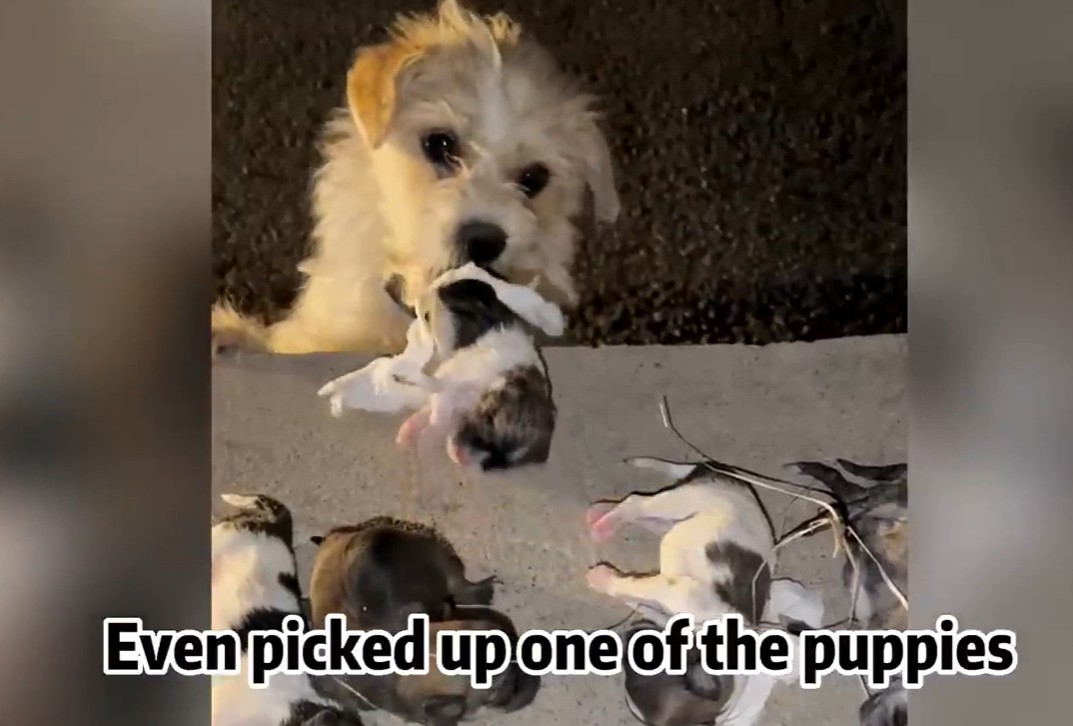
The surviving puppy was lifted carefully and wrapped to preserve what little body heat he still had. The four puppies who had died were also removed from the cold ground.
Throughout the process, the mother remained alert inside the crate.
She watched the rescuers closely and shifted whenever a puppy was carried past her.
The living puppy was placed beside her first.
She immediately lowered her head toward him, sniffing and licking his body.
Once the family was together inside the transport space, her pacing slowed.
The team could finally move them away from the garden.
There was no time to remain at the property.
The puppy’s breathing was weak, and both mother and baby needed professional care.
Warmth and Food Became the First Treatment
At the recovery facility, the surviving puppy was placed in a warm, controlled environment.
Newborn puppies cannot regulate their body temperature effectively. A puppy who is already cold and weak may not be able to nurse properly until his temperature begins to stabilize.
The team warmed him gradually and monitored his breathing.
His mother received food, water, and a quiet area where she could remain beside him.
She ate without needing to leave the nest or search through the garden.
The nourishment was important for her own recovery and for maintaining enough milk to feed the puppy.
When the puppy became warm enough, he was placed close to her.
After some assistance, he began nursing.
The action was small but encouraging.
He still required close observation, and there was no guarantee that a puppy in such fragile condition would recover without complications.
But he was receiving warmth, milk, and medical attention that had not been available beneath the branches.
The mother curled her body around him.
Whenever someone entered the room, she raised her head and watched. She no longer growled at every approach, but her attention remained fixed on the puppy.
The caregivers respected that protectiveness.
They avoided unnecessary handling and allowed mother and baby long periods of quiet rest.
The Four Puppies Were Given a Gentle Farewell
The four puppies who did not survive were treated with care after being removed from the garden.
Their lives had been brief, and there was little anyone could do to change what had already happened before the rescue team arrived.
Still, the rescuers did not leave them behind in the undergrowth.
They were buried respectfully near the area.
The loss was difficult for the team, particularly because the puppies had been found so close to help yet had remained hidden by the dense garden.
The scene also demonstrated how quickly newborn animals can decline when born outdoors without protection.
A mother dog may provide warmth, cleaning, and milk, but she cannot always overcome severe weather, illness, hunger, or complications after birth.
She may also remain hidden from people because protecting the nest feels safer than approaching strangers.
That is why reports from residents can matter.
A dog repeatedly returning to one location may be caring for puppies.
A mother who appears defensive may not be aggressive by nature. She may be trying to protect a litter that people have not yet seen.
Looking carefully—and contacting experienced rescuers instead of confronting the animal—can give the family a safer chance.
Trust Returned Through Repeated Care
During the first days inside, the mother rarely moved far from her surviving puppy.
She ate beside him.
She slept curled around him.
When caregivers needed to examine him, they worked slowly and kept him within her view whenever possible.
Her behavior gradually changed as the routine became familiar.
Food arrived regularly.
No one tried to take the puppy away permanently.
Hands entered the enclosure carefully and withdrew when the examination was complete.
The mother began allowing caregivers to approach without immediately tensing.
Her body also began responding to regular meals and rest. She no longer had to spend energy searching for food or protecting an exposed nest from the conditions outside.
The puppy continued nursing.
He remained fragile, but each successful feeding provided energy his small body desperately needed.
The team watched for signs of dehydration, infection, breathing problems, and failure to gain weight.
Recovery at that age could not be rushed.
For now, remaining warm, feeding consistently, and resting beside his mother were the most important milestones.
What the Garden Had Hidden
From outside, the overgrown property appeared empty.
The branches concealed the mother.
The leaves concealed the nest.
And the mother’s warning growl initially concealed the reason she refused to leave.
Only by slowing down did the rescuers understand what was happening.
They did not interpret her fear as a reason to walk away.
They did not force their way toward the puppies.
They used food, distance, and patience until she allowed them close enough to help.
The rescue came too late for four members of the litter.
That loss remained part of the story.
But it came in time for the mother and her surviving puppy.
They no longer sleep against damp soil.
The mother no longer has to choose between searching for food and remaining beside her baby.
The puppy no longer depends on a cold garden for shelter.
Their future was still uncertain during those first days of care, but they had reached the place where recovery could begin.
A warm bed.
Regular nourishment.
Medical supervision.
And enough quiet for a protective mother to understand that she no longer had to guard her last puppy alone.


