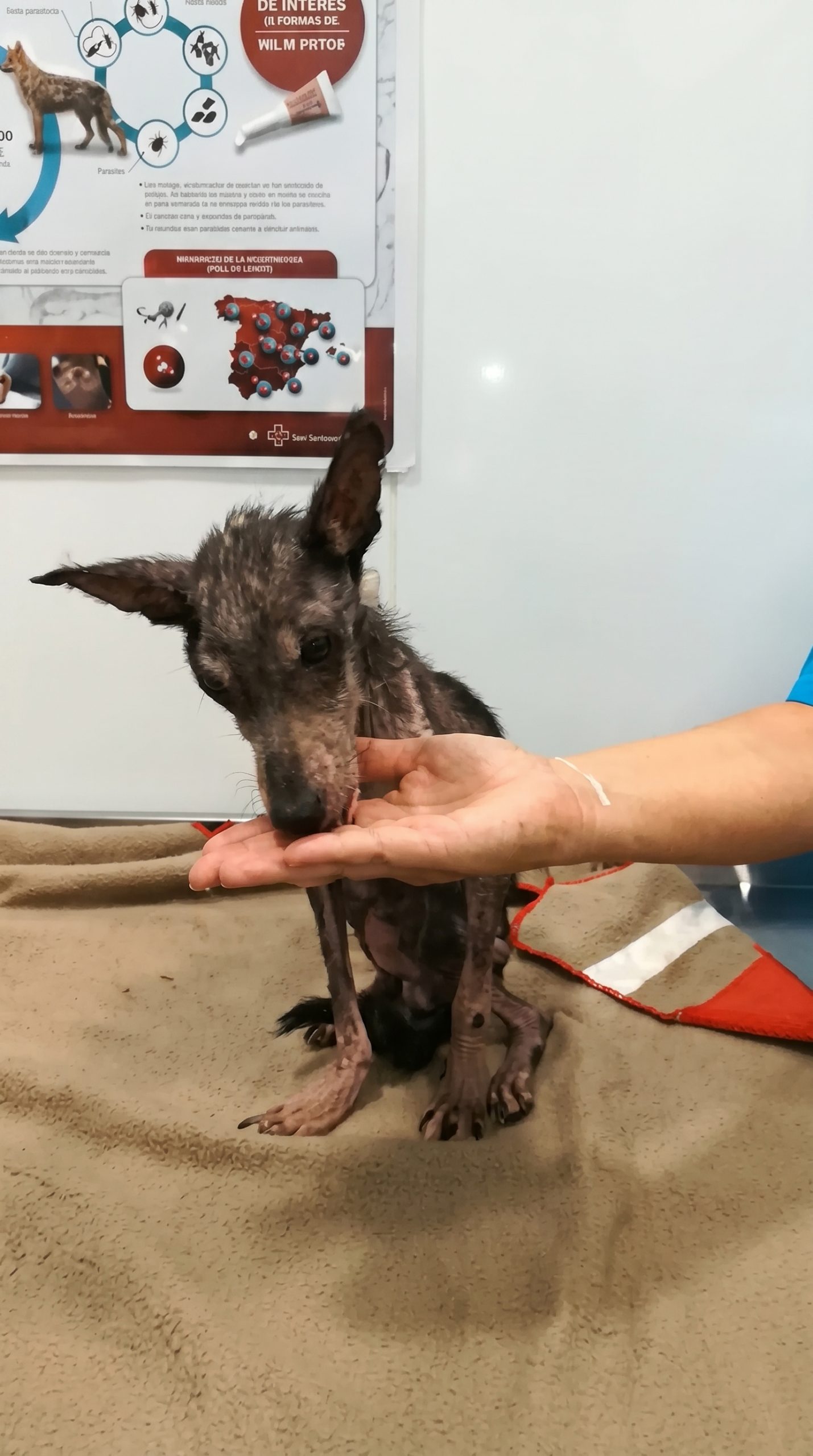
A bowl of warm food sat only inches from the dog’s face.
He looked toward it, but his body did not move.
Every rib showed beneath his thinning coat. His legs appeared too weak to lift him, and even holding his head above the ground required effort.
The food was within reach.
Kong simply did not yet have the strength to eat it.
The Dog Waiting Inside a Broken Enclosure
Rescuers found Kong inside a neglected pen behind a deteriorating property.
The fencing was rusted, the ground was dirty, and there was little protection from the conditions around him. Kong remained low against the floor when the team approached.
He did not bark.
He did not attempt to escape.
His body had become so thin that the outlines of his ribs, spine, and hips were clearly visible. Muscle loss had weakened his legs, leaving him unable to stand normally.
A bowl of warm broth was placed near him.
Kong noticed it.
He lowered his face slightly, appearing interested in the smell, but he could not bring himself close enough to begin eating.
For a healthy dog, reaching a bowl is an ordinary movement.
For Kong, it had become an exhausting task.
The rescuers understood that feeding him at the enclosure would not be enough. His condition required veterinary care, controlled nutrition, and monitoring that could not be provided where he had been found.
They opened the pen and lifted him carefully.
He offered no resistance.
Video: Kong Looks Toward a Bowl of Food but Is Too Weak to Take His First Bite
His Body Felt Almost Weightless
Kong had to be supported completely as he was carried away from the enclosure.
His body provided little resistance in the rescuer’s arms. The loss of both fat and muscle had left him dangerously fragile, and every movement had to be controlled to avoid causing additional pain or stress.
At the veterinary clinic, the team began evaluating his most immediate needs.
He was severely malnourished.
He was dehydrated.
His weakened condition suggested that the lack of adequate care had continued for a significant period.
The veterinary team could not safely correct everything at once.
A severely starved animal may face serious complications if given a large meal too quickly. After prolonged deprivation, the body needs time to adjust to receiving and processing nutrients again.
Kong’s hydration also required careful restoration.
Intravenous fluids were introduced to support his circulation and weakened organs. His temperature, breathing, and general responsiveness were monitored while the team developed a gradual feeding plan.
During those first hours, the goal was not to make Kong look better.
It was to help his body remain stable enough to reach the next day.
The First Meals Came in Tiny Portions
Kong was offered small amounts of nutrient-rich food throughout the day.
At first, he needed assistance.
He could not sit upright for long, and his caregivers supported his head and body while encouraging him to swallow safely.
The portions were intentionally small.
Each meal had to provide nourishment without overwhelming a digestive system that had received too little for too long.
There was no single moment when his appetite suddenly returned.
Progress began slowly.
A few swallows.
A short rest.
Then another carefully measured offering later in the day.
The team watched how his body responded before increasing the amount.
Eventually, Kong began showing more interest when food entered the room. He lifted his head toward the bowl and followed it with his eyes.
Then came the moment his caregivers had been waiting for.
Kong ate without being fully assisted.
It was not a large meal, but it was something his body had been unable to do when he was found.
The bowl no longer sat untouched before him.
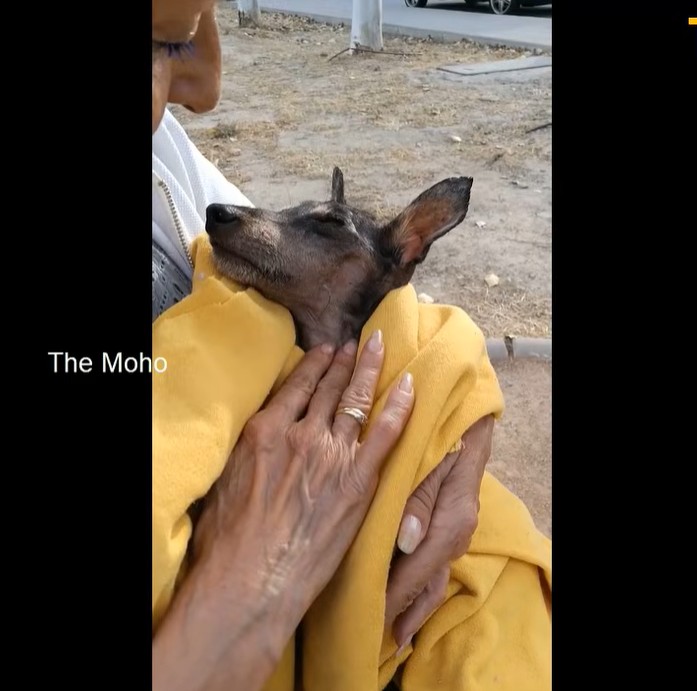
Standing Became His Next Challenge
As regular nutrition and hydration began restoring some of Kong’s energy, his caregivers encouraged gentle movement.
His legs had lost much of the strength needed to support his body.
Standing could not be rushed.
At first, Kong pushed against the bedding with his front paws but could not lift himself completely. A caregiver supported his chest and helped position his legs beneath him.
He remained upright only briefly.
Then he rested.
Later, they tried again.
The exercises were short and carefully supervised. The goal was not to force him to walk, but to help his muscles begin working without causing exhaustion.
Gradually, Kong carried more of his own weight.
He stood for several seconds.
Then he took one unsteady step.
Another followed.
His legs still trembled, but they no longer collapsed immediately beneath him.
The dog who had once lacked the strength to reach a nearby bowl was beginning to decide where he wanted to move.
Video: Kong Stands on His Own After Weeks of Carefully Managed Meals and Treatment
A Warm Bed Replaced the Enclosure Floor
Kong’s recovery continued in a quiet environment where his needs could be monitored.
Soft bedding protected his thin body from pressure against hard surfaces.
Meals arrived on a predictable schedule.
Medication and veterinary checks became part of his routine.
Most importantly, he no longer had to remain inside the neglected enclosure where he had been found.
During the early days, Kong spent much of his time sleeping.
His caregivers did not expect immediate affection or playfulness. His body needed to direct its limited energy toward healing.
As the weeks passed, his behavior began changing alongside his appearance.
Kong raised his head when familiar people entered.
He followed their movements around the room.
He stopped tensing at every gentle touch.
Eventually, he began moving closer to receive attention.
These were not signs that he had forgotten everything that happened before his rescue.
They showed that repeated, safe interactions were becoming familiar.
Food arrived without competition.
Hands touched him carefully.
People returned each morning.
For a dog whose needs had gone unanswered for so long, consistency became an important part of treatment.
His Body Slowly Filled Out Again
The changes became more visible over time.
Kong gained weight.
The sharp lines of his ribs and hips gradually softened.
His posture improved as muscle began returning to his legs and shoulders.
Areas of damaged or thinning fur started growing back, revealing a healthier coat beneath the effects of neglect.
His movements also became stronger.
Short walks across the recovery space became longer outings. He no longer needed support every time he stood, and he began exploring his surroundings with increasing confidence.
Kong’s caregivers continued monitoring his progress rather than assuming that visible improvement meant treatment was complete.
Recovery from severe malnutrition can require ongoing veterinary care, dietary management, and patience.
There could still be difficult days.
His body had spent a long time without what it needed, and rebuilding that strength would not happen on a fixed schedule.
But Kong was no longer lying motionless while food remained beyond his ability to reach.
He could walk toward his bowl.
He could finish a meal.
He could choose a soft place to rest afterward.
Those ordinary actions marked an extraordinary distance from the enclosure.
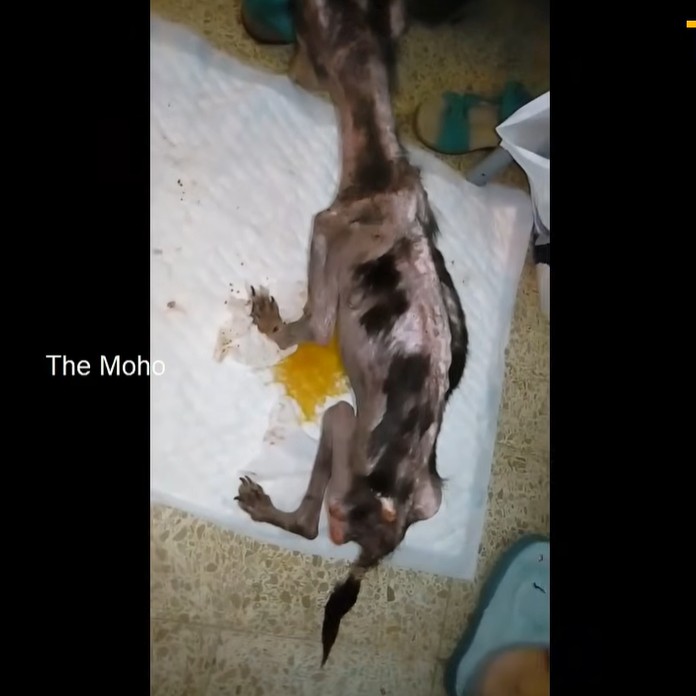
The Gentle Dog Who Had Been Waiting Underneath
As Kong’s strength returned, more of his personality became visible.
He accepted affection from his caregivers.
He rested near them rather than keeping his distance.
When someone called to him, he began approaching instead of remaining still.
His trust did not appear through one dramatic gesture.
It developed in small decisions.
Allowing a hand to rest against his head.
Following someone through a doorway.
Lying down in the same room instead of searching for a place to hide.
Eventually, Kong began showing playful energy.
He moved more quickly outdoors and became interested in the sights and smells around him. Open ground gave him room to use the legs that had once been unable to support him.
The transformation was striking, but Kong had not become a different dog.
Care had simply given him enough physical strength and security to show the personality that severe neglect had hidden.
The Bowl That No Longer Had to Wait
The image of Kong sitting before the untouched food remains one of the most difficult parts of his story.
He was hungry.
The food was there.
But hunger alone could not give his body the strength to reach it.
What changed his life was not one bowl or one dramatic rescue moment.
It was a series of careful decisions.
Someone opened the enclosure.
Veterinary workers restored his hydration gradually.
Food was offered in portions his body could safely process.
Caregivers supported him when he first tried to stand.
They continued returning even when progress was almost impossible to see.
Over time, the bowl stopped representing something beyond his reach.
It became part of an ordinary daily routine.
Kong could walk toward it.
Eat without assistance.
Then lift his head and look for the people who had placed it there.
Once, his world was limited to a deteriorating pen and a body too weak to move.
Now he can cross open ground under his own strength.
His recovery reminds us that freedom does not begin only when a cage door opens.
Sometimes it begins when a starving dog finally takes one small swallow—and people remain beside him long enough for that swallow to become a meal.


