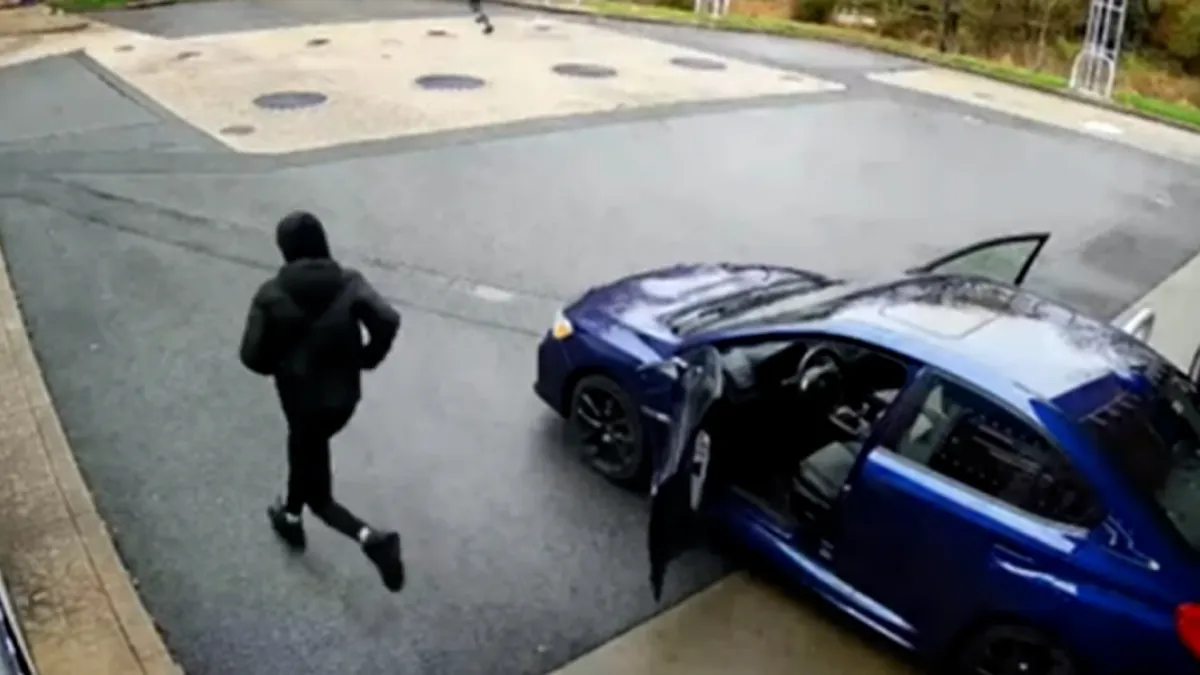
The engine roared. Tires did not move. For a few long seconds on a San Diego street, a carjacking that had gone according to plan suddenly stopped going anywhere at all.
The suspect had already done the hard part. He had confronted the victims, forced them out of the car and dropped into the driver’s seat. What happened next was not a dramatic chase or a quick escape. It was the sound of an engine being pushed by someone who had no idea what to do next.
The car stayed exactly where it was. And the suspect eventually ran away on foot.
The reason had nothing to do with a car alarm, a kill switch or a GPS tracker. It came down to one mechanical feature that millions of American drivers have never learned to use.
The car had a manual transmission — and the carjacker could not drive a stick shift.
The Carjacking That Reached the Driver’s Seat
According to San Diego Police Department reports and local news coverage of the incident, the carjacking followed a pattern investigators recognize: a suspect approaches a vehicle with occupants inside, uses intimidation or force to remove them, and attempts to drive off before anyone can respond.
In this case, the victims were forced out of the car. The suspect got in, settled into the driver’s seat and attempted to get the vehicle moving. He had control of the car. He had the keys. He had a clear path.
What he did not have was the ability to operate the car in front of him.
San Diego Police confirmed the basic sequence of events: victims removed from vehicle, suspect inside, failed departure, suspect fled on foot. The property taken and the specific block where the incident occurred were documented in police reporting, and local news outlets covered the story as an example of a carjacking that unraveled because of a skill gap rather than a physical barrier.
Why the Engine Revved but the Car Stayed Put
Anyone who has watched someone try to drive a manual transmission for the first time knows the moment. The engine climbs in pitch. There is noise, vibration and the suggestion of motion — but the car does not move. Or it lurches once and stalls. Or it simply sits there while the driver frantically works the pedals in the wrong order.
A manual transmission requires the driver to coordinate three separate inputs simultaneously: the clutch pedal on the left, the gas pedal on the right, and the gear shift in the center console. Release the clutch too fast without enough throttle and the engine stalls. Apply gas without engaging the clutch correctly and the engine revs loudly while the drivetrain does nothing.
For someone who has only ever driven an automatic — where all of that coordination happens inside the gearbox without any input from the driver — sitting down in a manual car without training is genuinely disorienting. The pedal layout is different. The left foot, which has no real job in an automatic, is suddenly responsible for the most critical timing in the sequence.
The result, in this carjacking, was exactly what mechanics and driving instructors would predict: the engine made noise, the car did not move, and the clock ran out on the suspect’s getaway window.
The Manual Transmission Problem
This is not a unique incident. Law enforcement officials and automotive researchers have noted for years that manual transmissions function as an unintentional anti-theft feature. The share of American drivers who know how to operate a stick shift has declined significantly over decades as automatic transmissions became standard on most consumer vehicles sold in the United States.
By the time this carjacking occurred, estimates from automotive industry sources suggested that fewer than 20 percent of American drivers could competently operate a manual transmission. Among younger demographics, that number was lower. The practical result is that a significant portion of would-be car thieves — who reflect the broader driving population — will encounter a manual-equipped vehicle and simply be unable to move it.
Car theft statistics have reflected this for years. Vehicles with manual gearboxes are stolen at lower rates than comparable automatics, a pattern that insurance industry analysts have documented. No special technology required — just a third pedal and a gear lever.
In the San Diego case, the suspect was not facing a sophisticated countermeasure. He was facing a mechanical interface that a significant portion of adult Americans never learned to use.
YOUTUBE EMBED — PRIMARY SEARCH QUERY: “San Diego carjacker could not drive manual transmission”
How the Suspect Left the Scene
After the failed attempt to drive the car, the suspect abandoned the vehicle and fled on foot. San Diego Police documented the departure and the investigation proceeded from there. The victims, who had been forced out of the car during the initial confrontation, were not reported to have suffered serious physical injuries in the carjacking itself.
The case was reported by local San Diego news outlets, and the police department’s account of events confirmed the core sequence: force, entry, failure, flight. The suspect’s description was released as part of the investigation. The status of any arrest or prosecution in the case should be confirmed through San Diego Police Department public records or official court filings for the most current information.
What the police report and media coverage both made clear was that the carjacking ended not because of a physical struggle, a pursuing officer or an electronic countermeasure — but because the suspect sat in a functioning car with keys in hand and could not make it move.
Why Stick Shifts Still Stop Some Thieves
The San Diego incident drew attention in part because it illustrated something counterintuitive: older, simpler technology can sometimes outperform newer security systems in specific situations.
Modern vehicles come equipped with keyless entry, immobilizers, GPS tracking and remote shutdown capability. All of those systems require either the right electronic signal or intervention from a third party. A manual transmission requires nothing except driver knowledge — and that knowledge either exists in the moment or it does not.
Automotive security experts have occasionally pointed out that manual transmissions, once considered inconvenient relics being phased out of the market, quietly retain this practical deterrent effect. A thief who targets a vehicle opportunistically — quickly, under pressure, without time to assess the controls — will not have time to figure out the clutch. The engine will rev. The car will not move. The window will close.
That is essentially what happened in San Diego. The suspect chose a target, executed the first phase of the carjacking, and then discovered — inside the car, with seconds to work — that he did not have the skill the vehicle required.
The Feature That Ended the Getaway
No alarm sounded. No tracker pinged a monitoring center. No bystander intervened. The vehicle simply demanded a competency the suspect did not have, and that was enough.
The carjacking in San Diego is documented precisely because it failed in the most ordinary way possible: the car had three pedals, the driver only knew how to use two, and the getaway never happened. The victims lost control of their vehicle for the length of time it took the suspect to realize he was stuck — and then got it back.
In a landscape of increasingly sophisticated vehicle security systems, a manual gearbox accomplished what it always has. It moved only for the person who knew how to ask it to.

