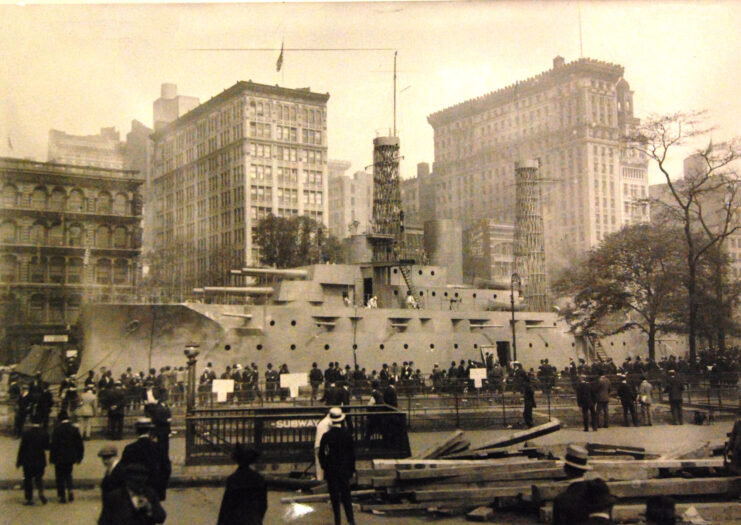
In the spring of 1917, New Yorkers walking through Union Square encountered something that stopped them cold: a full-scale battleship sitting in the middle of Manhattan. It had guns, a hull, a uniformed crew and a working deck. What it did not have was water.
The ship was not a model, a prop or an artist’s rendering. It measured roughly 200 feet in length, rose several stories above the sidewalk and was staffed by actual U.S. Navy sailors around the clock. Crowds gathered every day to stare at it, climb aboard and, eventually, sign up to serve.
This was exactly the point.
USS Recruit was a full-size wooden landship — a Navy recruiting station and Liberty Bond attraction built to look like a wartime battleship, placed deliberately in one of Manhattan’s most trafficked public squares to pull the country into the war effort one enlistee at a time.
The Battleship That Appeared in Union Square
The United States entered World War I in April 1917. The Navy needed men, money and public enthusiasm — fast. Traditional recruiting offices were quiet rooms with desks. The Navy wanted something that could not be ignored.
The solution was the landship concept: build a convincing warship in a high-traffic urban location, man it with a real crew, conduct actual Navy business aboard and let the spectacle do the recruiting work. Union Square in Manhattan was selected for its density of foot traffic, its central location and its long history as a site of public rallies and civic events.
Construction of USS Recruit began in late 1917. The structure was built primarily of wood and rose to a height that gave passersby on all sides a clear view of a warship’s profile — hull, deck, superstructure and armament. It sat on dry land in the park, anchored to the ground rather than to any harbor, with city pavement beneath it instead of water. Contemporary photographs, preserved in the Library of Congress collection, show the ship surrounded by urban buildings, its profile unmistakably naval against the Manhattan skyline.
USS Recruit officially opened to the public in December 1917 and remained in operation through 1920.
How a Wooden Landship Was Made to Look Real
The Navy’s goal was not to deceive anyone about the ship’s nature — it was openly a recruiting station — but to make the experience of approaching and boarding it feel as close to a real warship as possible. The physical details were taken seriously.
The hull was constructed to suggest a battleship’s profile at full scale. Guns were mounted on deck, although they were replica weapons rather than functional armament. The deck planking, rails, ladders and interior spaces were designed to give recruits and visitors a genuine sense of what Navy life looked and felt like. For many young men from inland cities and rural areas who had never seen a naval vessel up close, USS Recruit was their first encounter with that world.
The crew assigned to the landship were real Navy sailors in full uniform. They performed duties, maintained the ship’s appearance and processed recruits. Naval officers conducted enlistment paperwork aboard. The ship functioned as a legitimate naval station in every administrative sense, even though it was rooted to a city block in the middle of one of the most densely populated neighborhoods in the country.
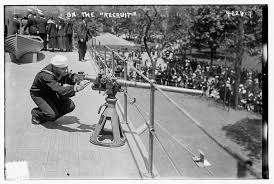
The weapons on deck — visually imposing to any pedestrian walking through the square — were replicas, a detail confirmed in Navy and historical records. No live ordnance was present. The goal was atmosphere and inspiration, not armament.
What Happened Aboard USS Recruit
Beyond enlistment, USS Recruit served a second and equally important wartime function: selling Liberty Bonds. The U.S. government used Liberty Bonds to finance the war, and public campaigns to sell them ranged from celebrity appearances to theatrical events. A landlocked battleship in Union Square was a natural anchor for those efforts.
The ship’s location made it accessible to enormous numbers of New Yorkers daily. Union Square was already a hub for labor rallies, political speeches and public gatherings. The Navy understood that placing a recruiting station in that environment — one that looked like a warship rather than an office — would draw crowds who might never walk into a conventional recruitment facility.
Sailors aboard gave tours of the accessible portions of the ship. Visitors could examine the deck, the replica guns and the equipment laid out for inspection. The combination of spectacle and accessibility was deliberate. Navy officials wanted the public to feel connected to the service, not kept at a distance from it.
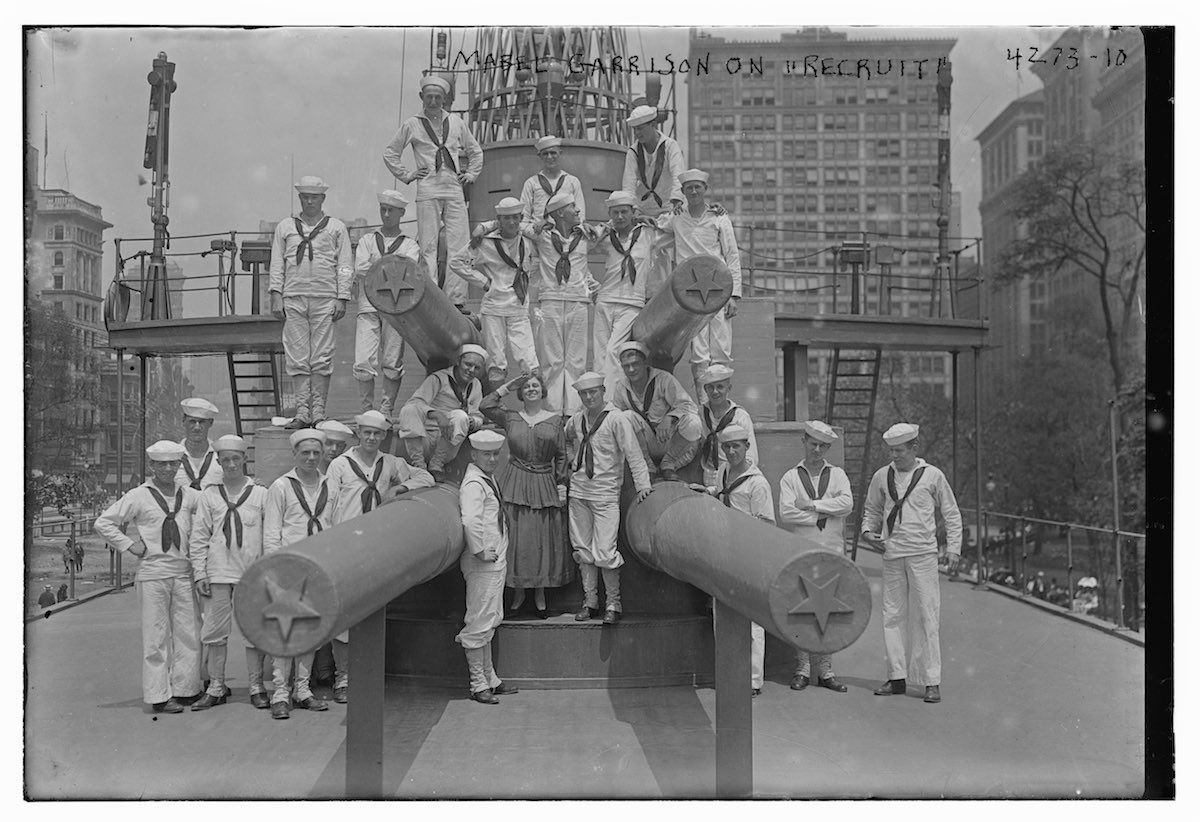
Recruiting events, Liberty Bond drives and public demonstrations were held at and around the ship throughout its operation. Newspaper coverage from the period confirms the ship drew consistent attention across its years in Union Square.
YOUTUBE EMBED — PRIMARY SEARCH QUERY: “USS Recruit Union Square wooden battleship documentary”
Why the Navy Considered It a Success
By any measure of the Navy’s stated goals, USS Recruit performed. The ship operated for approximately three years, spanning the final phase of World War I and the immediate postwar period. It processed enlistments, supported bond sales and generated sustained media coverage throughout.
The landship concept worked precisely because it was unexpected. A recruiting poster could be ignored. A full-scale wooden battleship occupying a city block in Manhattan could not. The novelty drew people who had no intention of enlisting — curious pedestrians, families, tourists — and placed them in an environment where Navy sailors could speak with them directly.
Naval historians and WWI centennial materials note that the landship represented an early and unusually sophisticated example of experiential recruiting — using environment and spectacle to build connection and commitment rather than relying solely on printed material or speeches. The approach anticipated techniques that would become standard in military recruitment campaigns decades later.
Library of Congress records and U.S. Naval Institute historical materials document the ship’s presence, its crew, its public role and its physical characteristics, providing a detailed archival record of a structure that no longer exists in any physical form.
YOUTUBE EMBED — SECONDARY SEARCH QUERY: “Library of Congress USS Recruit Union Square”
The Uncertain Fate of Manhattan’s Landlocked Ship
USS Recruit was dismantled in 1920 after the Navy concluded its use. The war had ended in November 1918, and the recruiting and bond-selling urgency that had justified the landship’s construction faded in the postwar years. The ship was taken apart, and Union Square returned to its familiar configuration — no hull, no guns, no sailors on deck.
What the dismantling took away physically, the archival record has preserved in striking detail. The Library of Congress holds a substantial collection of photographs documenting USS Recruit from multiple angles, at various stages of its operation. These images show the ship in context: surrounded by Manhattan buildings, visible to street-level pedestrians, its deck occupied by uniformed crew.
The photographs remain the clearest record of how the landship actually appeared in its setting — and they make plain how unusual the spectacle was. A wooden warship, built to full battleship scale, standing in a public park in the middle of New York City, staffed by the U.S. Navy and open to anyone who walked past.
No comparable structure has been built in an American city since. USS Recruit stands in the historical record as a one-of-a-kind artifact of wartime public outreach: part functional naval station, part civic theater, entirely impossible to overlook. The archival photographs that survive it are the only evidence that such a thing ever existed — and they are more than enough to make the landship’s story believable.

