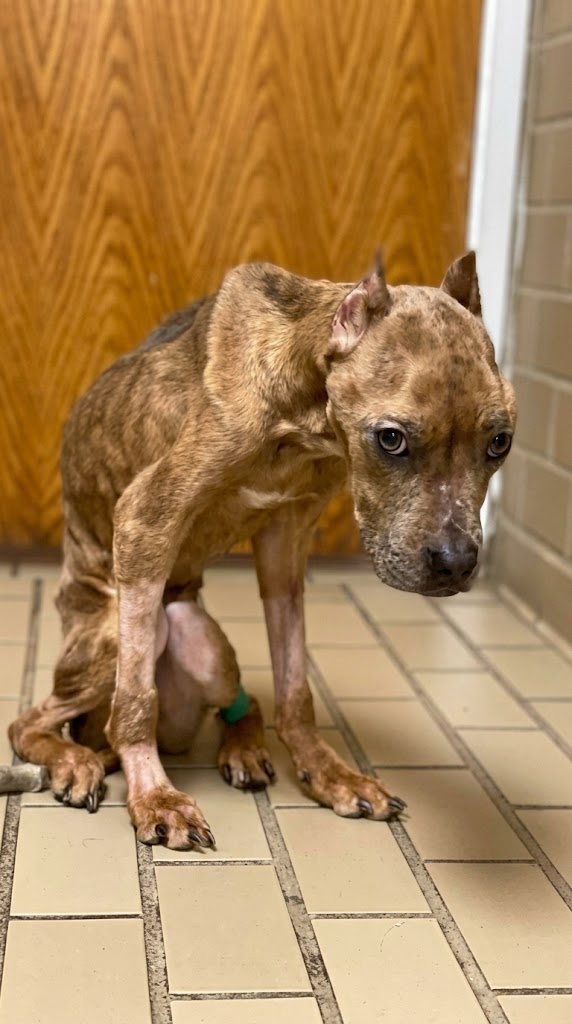
Khaleesi was lying on the pavement when help finally reached her.
She was too weak to stand.
Her body was painfully thin, and even lifting her head appeared to require energy she no longer had. Cars passed through the quiet neighborhood in Lehigh Acres, Florida, while the young dog remained almost motionless near the edge of the street.
No one knew how long she had been there.
No one knew when she had last eaten a proper meal.
But when rescuers looked into her eyes, they saw something that made them move quickly.
Khaleesi was still holding on.
The Dog Who Could No Longer Stand
When members of Mutty Paws Rescue arrived, they immediately understood that this was not a situation that could wait.
The dog’s ribs, spine, and hips were clearly visible beneath her skin. She had lost so much strength that walking was no longer possible.
There was no attempt to run from the strangers approaching her.
No barking.
No resistance.
Khaleesi simply remained where she had collapsed, allowing the rescuers to lift her carefully from the pavement.
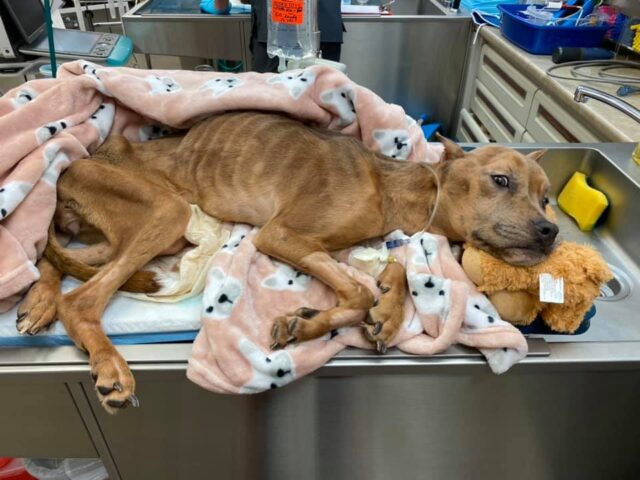
They wrapped her gently and transported her to an emergency veterinary hospital, where the medical team placed her in intensive care.
Her condition was critical.
At that moment, no one could promise that she would survive the night.
The rescuers gave her the name Khaleesi—a powerful name for a dog whose body appeared to have almost nothing left to give.
They hoped strength was still hiding somewhere inside her.
Video: A Young Dog Found Too Weak to Stand Begins Her Fight for Survival
The Truth About Her Age Changed Everything
When veterinarians first examined Khaleesi, they believed she might be an elderly dog approaching the final stage of her life.
Her frail appearance seemed to support that assumption.
Her muscles had wasted away.
Her coat looked dull.
Her entire body carried the visible effects of prolonged deprivation.
Then the examination revealed something the rescue team was not prepared to hear.
Khaleesi was only about one year old.
She was not an aging dog whose body had gradually weakened with time.
She was still young.
At an age when most dogs are learning to play, exploring their surroundings, and discovering the comfort of a family, Khaleesi was fighting to keep her organs functioning.
The discovery made her condition even more difficult to understand.
A dog so young should have been energetic and curious.
Instead, she lay beneath hospital blankets while veterinary staff monitored her around the clock.
Despite her exhaustion, Khaleesi did not turn away from the people caring for her.
She watched them quietly.
She allowed them to touch her.
And when someone leaned close to comfort her, her expression remained gentle.
Michelle Holsinger, co-founder and vice president of Mutty Paws Rescue, had spent more than a decade helping animals in difficult circumstances.
Even so, Khaleesi’s condition left a lasting impression.
She had seen neglect before.
But she had never seen a dog so young appear so close to the end of her life.
Her Recovery Could Not Be Rushed
For more than a week, Khaleesi remained in the intensive care unit.
The veterinary team needed to restore her strength without placing additional stress on her weakened body.
For a severely undernourished dog, eating again is not as simple as being given a large bowl of food.
Her meals had to be small.
Her response had to be monitored.
Every change in her breathing, digestion, temperature, and energy level mattered.
During the first days, the numbers on the scale barely moved.
To someone watching from the outside, the progress might have seemed almost invisible.
But the people beside Khaleesi noticed other changes.
She began following the nurses with her eyes.
She rested more comfortably when someone sat near her.
Her head lifted a little higher.
The distant expression she had carried from the street gradually began to soften.
These were not dramatic milestones.
Khaleesi did not suddenly stand and run through the hospital.
She did not transform overnight.
Her recovery appeared in smaller ways.
A calmer breath.
A finished portion of food.
A moment of interest when someone entered the room.
Each one showed that her body was responding—and that she had not stopped trying.
A Foster Family Rearranged Their Lives for Her
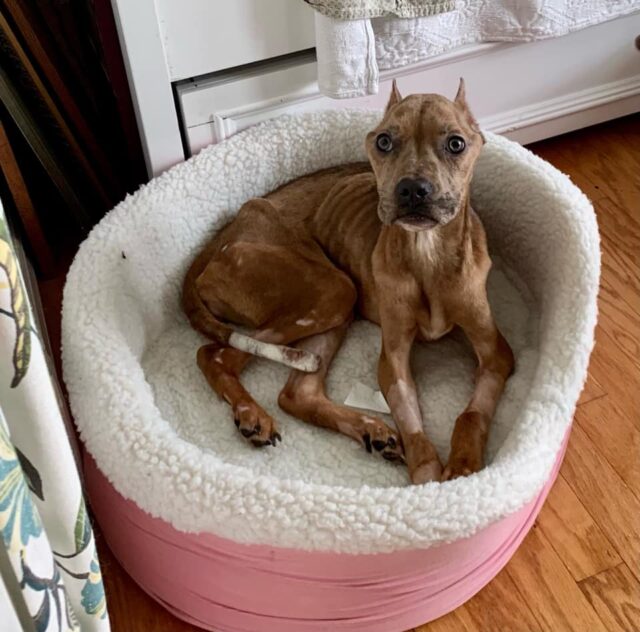
Eventually, Khaleesi became stable enough to leave intensive care.
She still required veterinary monitoring, careful meals, and long periods of rest. But she no longer needed to spend every hour inside the hospital.
A foster family offered to continue her recovery in their home.
They understood that Khaleesi could not be treated like a healthy dog arriving for an ordinary foster stay.
She needed supervision.
She needed consistency.
Most of all, she needed to learn that she would not be left alone again.
The family rearranged their schedules so that someone could remain near her during the most delicate stage of her recovery.
For the first time, Khaleesi had a soft bed instead of pavement.
Food arrived at predictable times.
Gentle voices replaced uncertainty.
And when she closed her eyes, someone was still there when she opened them again.
The foster home also gave her something the hospital could not provide in quite the same way.
A canine friend.
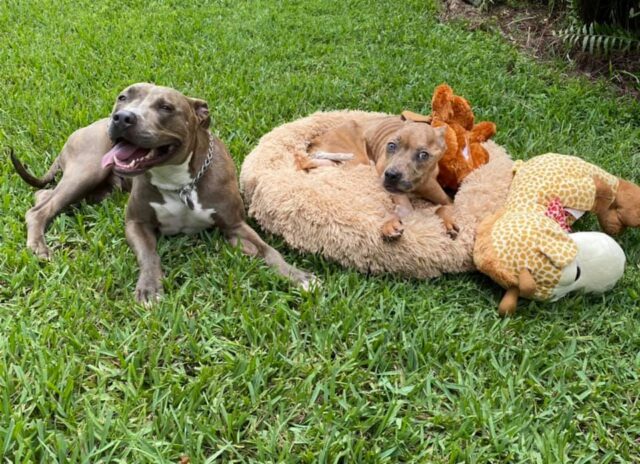
The family’s resident Pit Bull approached Khaleesi with patience. The larger dog did not overwhelm her or demand that she play.
He simply stayed nearby.
They rested together.
They moved slowly through the house together.
And as Khaleesi became stronger, she began looking toward him for reassurance.
The friendship appeared to help her understand the rhythm of this unfamiliar life.
Beds were safe.
Meals would return.
People could walk out of a room and still come back.
Little by little, Khaleesi began experiencing the ordinary comforts that had been missing from her first year.
The Investigation Led to Three More Dogs
While Khaleesi concentrated on healing, law enforcement officers began investigating how she had reached such an extreme condition.
Authorities followed information connected to her abandonment and eventually traced the case to a residence in Cape Coral.
According to the original report, investigators found three additional dogs at the property living in troubling conditions.
The animals were removed and taken for medical evaluation.
For the rescue community, the discovery brought mixed emotions.
Khaleesi had survived long enough to be seen.
But the investigation suggested that other animals may also have been waiting for someone to notice what was happening.
Authorities later announced the arrests of Ashley Howard and Charles Koon, who were charged in connection with the alleged neglect.
Lee County Sheriff Carmine Marceno credited the county’s Animal Cruelty Task Force with investigating the case and locating the animals.
The legal process could not erase what Khaleesi had experienced.
It could not return the months when her young body should have been growing safely.
But accountability mattered.
And because investigators continued looking beyond the dog found on the pavement, three more animals were brought out of the same environment.
Justice Was Only One Part of Her New Beginning
For many people following Khaleesi’s story, the arrests represented justice.
But the most meaningful part of her recovery could be seen inside the foster home.
Khaleesi was learning to play.
She was becoming interested in other dogs.
She was discovering that a hand reaching toward her might offer affection rather than harm.
Her body still needed time.
Ongoing medical appointments and careful monitoring remained part of her routine. Recovery from such severe neglect could not be measured only by appearance or weight.
Yet emotionally, Khaleesi was beginning to resemble the young dog she had always deserved the chance to become.
She rested without constantly watching the door.
She welcomed attention from the people who cared for her.
She participated in small celebrations surrounded by those who once feared she might never leave the hospital.
The dog found motionless on a Florida street was no longer waiting alone for someone to notice her.
She had a name.
A bed.
A dog beside her.
And people who had built their daily lives around helping her heal.
Khaleesi’s journey reminds us that justice can take more than one form.
It can mean investigating cruelty and holding people accountable through the legal system.
But it can also mean restoring what neglect tried to take away.
Safety.
Comfort.
Trust.
The freedom to grow older.
Khaleesi could never recover the beginning she should have had.
But every warm meal, peaceful night, and gentle moment now gives her something the past could not.
A future.
When rescuers first lifted her from the pavement, they did not know how much time she had left.
Today, Khaleesi is no longer simply surviving.
She is learning how beautiful an ordinary life can feel when she is finally surrounded by kindness.


