The sound was faint enough to ignore.
Eleven friends were canoeing along the Minnesota River near Carver, enjoying an afternoon together before Mitch White’s upcoming wedding. The water was calm, the group was relaxed, and nothing suggested that their bachelor party trip was about to become a rescue mission.
Then someone heard a dog barking from the shoreline.
At first, they could not see where the sound was coming from.
But as the canoes moved closer, a large head appeared above the riverbank.
The rest of the dog had disappeared beneath the mud.
Only His Head Remained Above the Riverbank
The men guided their canoes toward shore and quickly realized how serious the situation was.
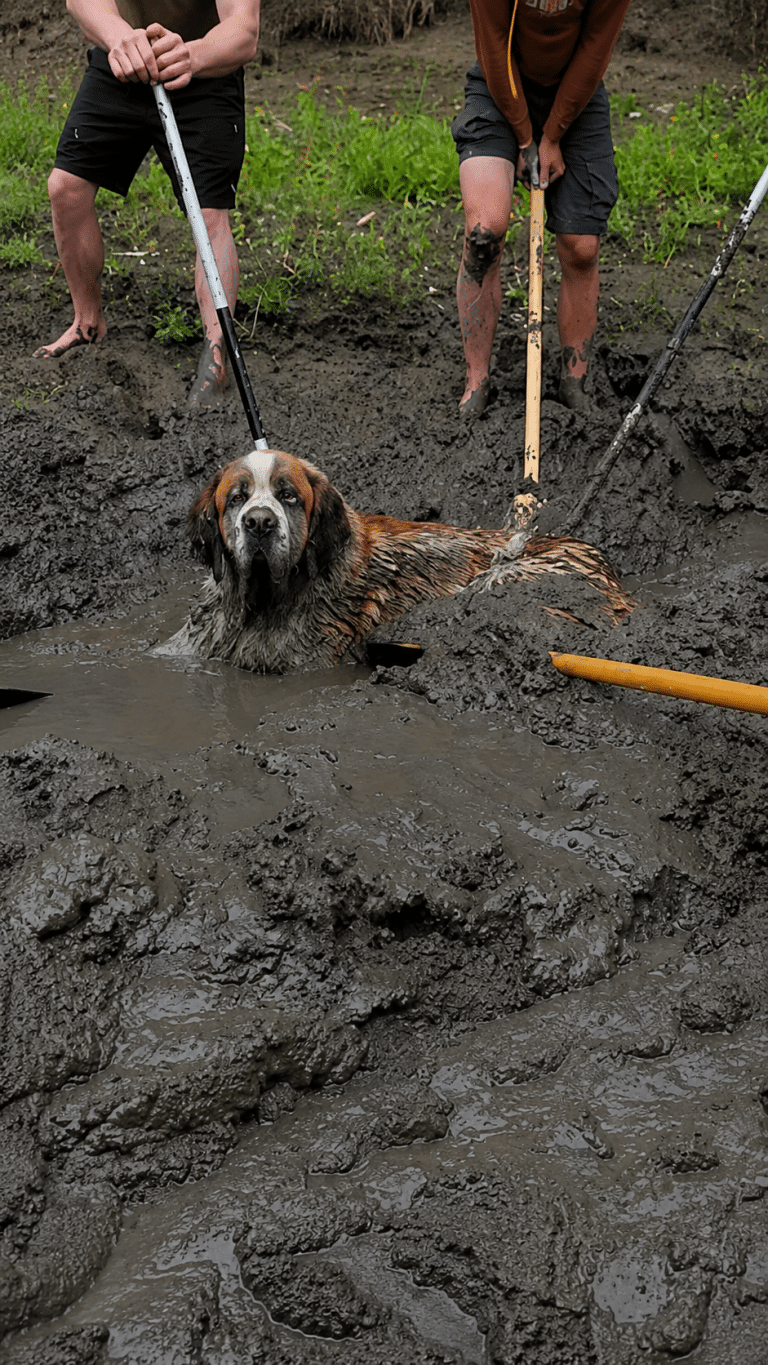
A Saint Bernard had become trapped in a deep section of mud near the edge of the Minnesota River. His large body had sunk so far into the thick sludge that only his head and part of his neck remained visible.
He could not climb out.
Each attempt to move seemed to pull him deeper or exhaust what little strength he had left.
No one knew exactly how long he had been trapped there. But the dog’s condition suggested that he had already spent a considerable amount of time struggling alone.
The men did not know his name.
They did not know whether he belonged to someone nearby.
They only knew that he needed help.
Their canoes were pulled onto the bank, and the celebration that had brought them to the river was immediately forgotten.
Paddles, shovels, and whatever useful equipment they had were gathered.
Then all eleven friends began working.
Video: Friends Follow a Faint Bark and Find a Saint Bernard Buried in Riverbank Mud
Eleven Strangers Began Digging Around Him
Freeing such a large dog from deep mud was far more difficult than simply pulling him upward.
The thick sludge clung tightly to his body. Every section they cleared seemed to fill again, and the unstable riverbank made it difficult to find secure footing.
The group had to work carefully.
Pulling too hard could frighten or injure the exhausted animal. Digging too quickly near his body could also cause harm.
So they cleared the mud little by little.
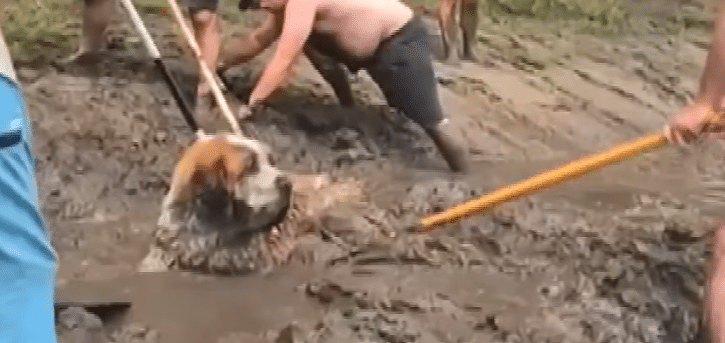
Some used paddles.
Others used shovels.
Several worked with their hands, loosening the heavy earth surrounding the dog’s shoulders and legs.
The Saint Bernard remained remarkably calm while the unfamiliar men gathered around him. He did not appear to resist their touch or react defensively.
Instead, he conserved his energy.
The group offered him water and food, hoping to keep him alert while they continued digging.
For more than half an hour, they worked together along the muddy bank.
Their clothing became coated in dirt.
Their shoes sank beneath them.
Progress remained slow.
But no one suggested leaving.
This was no longer simply a group of friends enjoying a canoe trip.
They had become the only people standing between the trapped dog and another long period alone in the mud.
The Mud Would Not Release Him Easily
Despite the group’s effort, the Saint Bernard’s size and the depth of the mud made the rescue increasingly difficult.
He was too weak to push himself upward.
The men could clear space around his body, but they still needed a safe way to lift him without causing additional distress.
It became clear that more equipment and support would be necessary.
Emergency responders were contacted, and personnel from the Carver County Sheriff’s Office and the local fire department arrived at the riverbank.
The professionals joined the canoe group rather than replacing them.
Together, they continued removing mud from around the dog’s body and searched for the safest way to bring him onto solid ground.
The rescue required patience and coordination.
Several people supported the dog while others worked beneath and around him. The mud resisted every movement, holding tightly to the animal who had already spent hours trying to escape it.
Then, slowly, his body began to rise.
First his shoulders emerged.
Then more of his back.
Finally, after one last coordinated effort, the Saint Bernard was lifted free.
For the first time since the men had heard his bark, the entire dog was visible.
He was safe.
But he was exhausted.
He Was Too Weak to Walk Away
Once the dog was placed on firmer ground, rescuers could see how much the ordeal had taken from him.
His body trembled.
His legs struggled to support his weight.
Standing without assistance was difficult, and walking normally was not yet possible.
The men who had spent the afternoon digging remained beside him as he rested.
The dog had survived the mud, but he still needed warmth, food, medical attention, and time for his strength to return.
Then authorities discovered that the Saint Bernard was not an unknown stray.
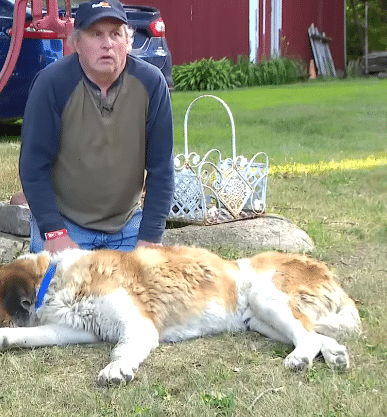
His name was Ed.
And somewhere nearby, a family had been searching for him.
Ed’s owner, George Niskanen, had reported him missing nearly twenty-four hours earlier.
According to George, Ed had wandered away before and usually managed to find his way home. But this time, the hours passed without any sign of him.
George could not have known that his dog had become trapped along the riverbank, unable to take another step toward home.
The call confirming that Ed had been found brought an explanation for his disappearance—and tremendous relief.
His dog was alive because a group of strangers had listened to a distant bark.
The Bachelor Party Ended With a Family Reunion
After the rescue, Ed was reunited with his family and taken home to recover.
At first, the effects of the ordeal were still visible.
He remained extremely weak and had difficulty walking. His muscles needed time to recover after supporting his body in the mud for so long.
But he was no longer alone beside the river.
He had food.
He had a safe place to rest.
And he had the familiar people who had spent nearly a day wondering where he had gone.
With care and time, Ed gradually began regaining his strength.
For George, the eleven men who had stopped their canoe trip were more than fortunate passersby.
They were the people who brought his dog home.
He reportedly hoped to identify everyone involved so he could personally thank them—not only the emergency responders, but also the friends who first heard Ed and chose to investigate.
They had no professional rescue training.
They had not gone to the river expecting to save anyone.
They simply recognized that something needed help and refused to continue paddling.
The Bark They Could Have Ignored
Ed’s rescue began with a sound that could easily have blended into the background.
A single bark along a wide river.
The men might have assumed it came from a nearby home.
They might have decided that someone else would investigate.
They might have continued downstream and never known what was hidden along the bank.
Instead, they turned their canoes toward the sound.
That choice revealed a Saint Bernard buried so deeply that only his head remained visible.
It brought eleven friends into the mud.
It brought sheriff’s deputies and firefighters to the riverbank.
And eventually, it brought a missing dog back to his family.
The afternoon had begun as a celebration for Mitch White before his wedding.
By the time it ended, the group had created a memory none of them could have planned.
They would remember the mud.
The difficult digging.
The moment Ed’s body finally came free.
But most of all, they would remember the faint bark that asked them to stop.
Ed could not pull himself from the riverbank.
He could only make enough sound for someone to hear him.
Fortunately, eleven people did.
And instead of paddling past, they came ashore.


