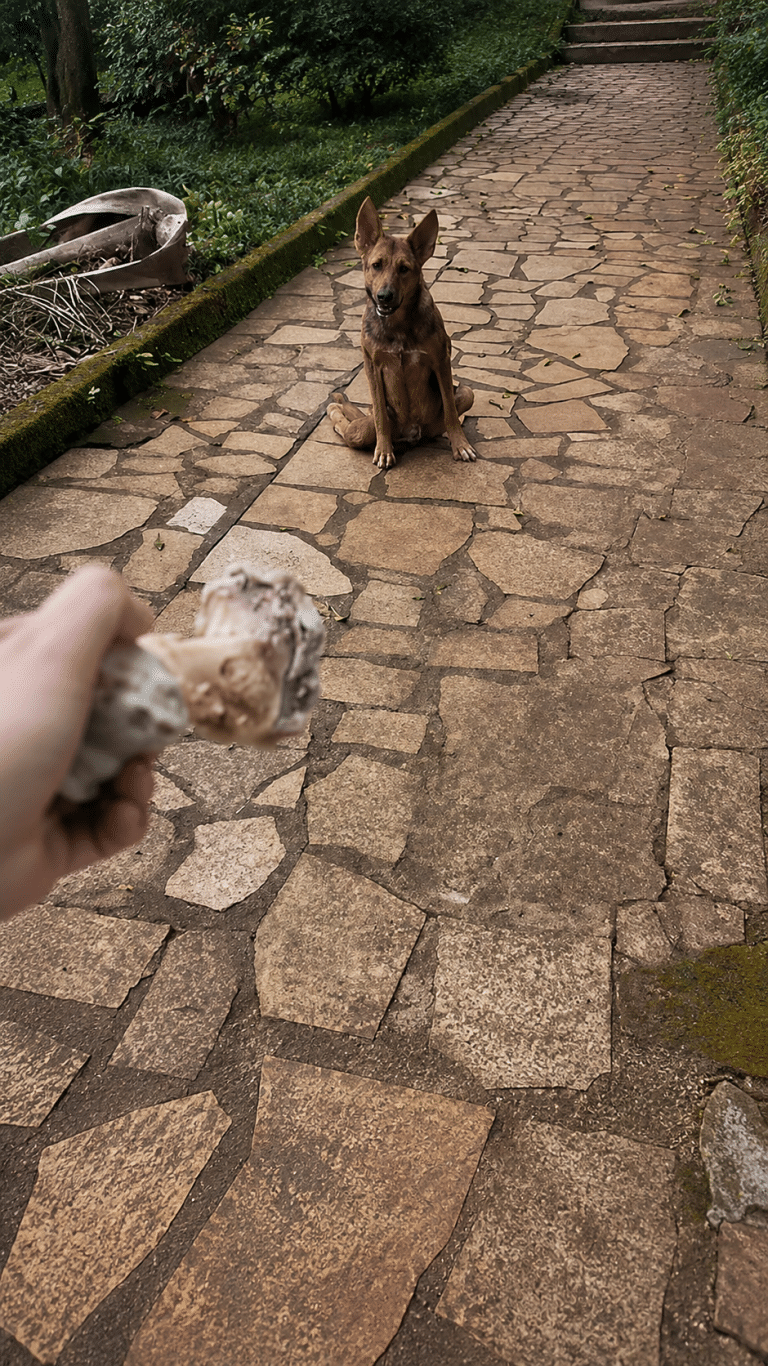
The little dog could move only by pulling himself forward with his front paws.
His back legs trailed behind him across the rough stone path, unable to support his weight. Each small stretch of pavement demanded effort, yet he continued inching forward because stopping offered him no path to food, shelter, or safety.
People may have seen him before.
Some may not have known how to help.
But on this particular day, one man stopped walking, lowered himself to the dog’s level, and offered him something simple.
A reason to come closer.
The Dog Moving With Only His Front Legs
The shepherd mix appeared to have lost the use of his hind legs.
Instead of walking normally, he pressed his front paws against the pavement and pulled the rest of his body behind him. His hips remained low, and his back legs scraped along the surface with each movement.
There was no wheelchair.
No protective support beneath his body.
No one walking beside him.
The dog seemed accustomed to navigating the street this way, though every movement looked slow and physically demanding.
When the man approached, the dog did not immediately come toward him.
He watched carefully.
A stranger standing above him could easily have felt threatening, especially when he had no quick way to retreat. So the man crouched instead, making himself smaller and less intimidating.
In his hand was a small bone.
He placed it close enough for the dog to notice, then waited.
Video: A Disabled Dog Dragging Himself Along the Pavement Finally Meets Someone Who Stops
He Needed Time Before Coming Closer
The dog appeared interested in the food, but he remained cautious.
He looked at the bone.
Then at the stranger.
Moving closer required more than physical effort. It also meant placing himself within reach of someone he did not know.
The man did not grab him.
He did not push the food toward his mouth or attempt to force an interaction.
He simply stayed in place and allowed the dog to make the decision.
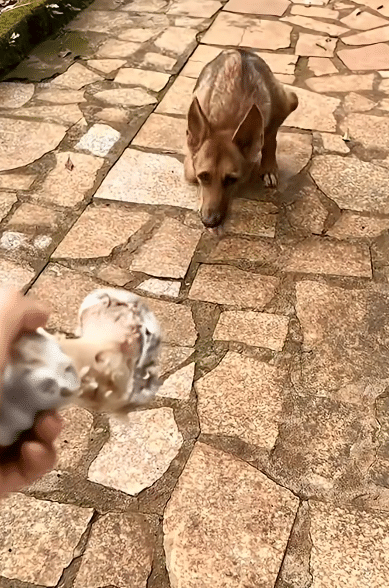
Little by little, the shepherd mix pulled himself forward.
His front paws shifted against the stone.
His body followed slowly behind.
When he finally reached the man, he accepted the bone gently.
There was no snapping.
No defensive reaction.
The dog simply began eating while the stranger remained beside him.
Food may have encouraged him to approach, but what happened afterward suggested that hunger was not the only thing he had been missing.
The Man Stayed After the Food Was Gone
Many people might have offered the dog something to eat and then continued on their way.
This man did not.
He remained crouched beside the shepherd mix and slowly reached toward his head. His movements were careful, giving the dog time to react or pull away.
The dog allowed the touch.
The man stroked the top of his head and gently rubbed the back of his neck while speaking in a calm voice.
At first, the dog still appeared uncertain.
Then his posture began to change.
His body lowered more comfortably against the pavement. The tension around his head and shoulders softened, and he stopped watching every movement the stranger made.
Instead of trying to create distance, he remained close.
For a dog forced to rely almost entirely on his front legs, physical vulnerability was part of every interaction. He could not quickly stand and run if something frightened him.
Yet beside this stranger, he appeared willing to rest.
The man had offered food.
By staying, he offered something else.
Reassurance.
A Gentle Touch Meant More Than It Seemed
As the interaction continued, the dog leaned toward the man’s hand.
At moments, he softly licked the stranger’s fingers. It was a small response, but one that showed he was no longer focused only on the bone.
He was responding to the person beside him.
No one could know exactly how long the dog had lived with his disability or what experiences had shaped his caution around people.
What could be seen was simpler.
He had been struggling to move alone.
A man approached without forcing him.
And after several quiet minutes, the dog allowed himself to settle beside that person.
There was no sudden physical recovery.
His back legs did not begin working again.
The encounter did not erase the medical care, mobility support, and long-term safety a paralyzed dog would still need.
But for those few minutes, he was no longer an overlooked figure pulling himself across the pavement.
Someone saw him.
Someone touched him gently.
Someone stayed close enough for him to rest.
Not Every Meaningful Rescue Is Dramatic
Some animal rescue stories involve emergency vehicles, complicated procedures, or dramatic transformations.
This moment was much quieter.
There were no crowds gathered nearby.
No large team arrived with specialized equipment.
The dog’s entire life did not visibly change within the video.
What changed was the way he was treated.
Instead of being viewed as part of the background, he became a living being worthy of someone’s time.
The man recognized that approaching a frightened, disabled dog required patience. He did not assume that food alone would solve everything.
He gave the animal room to decide.
When the dog moved closer, he responded with gentleness.
When the dog relaxed, he did not immediately stand and leave.
That kind of attention may appear small from the outside.
To an animal accustomed to moving through the world alone, it can mean far more.
He Was Asking for Something Simple
The shepherd mix could not explain what had happened to his legs.
He could not tell anyone whether he had a home, whether he was in pain, or how long he had been pulling himself along the street.
His body communicated what words could not.
Moving was difficult.
He was cautious around strangers.
Yet he still wanted food, comfort, and contact.
When kindness was offered without pressure, he accepted it.
The dog’s response did not show weakness.
It showed that despite his circumstances, he remained willing to connect.
That is what makes the scene so difficult to forget.
Not because a dramatic miracle happened.
But because something very ordinary had been missing from his life.
A person willing to stop.
A hand offered slowly.
A few quiet minutes in which he did not have to keep dragging himself forward.
The man could not repair the dog’s legs with a gentle touch.
But he could remind him that he had not become invisible.
Sometimes compassion begins before a full rescue plan is possible.
It begins when someone notices suffering that others have learned to walk around.
It begins by getting down on the ground.
And sometimes, it begins with a small bone held in one hand—and the other hand waiting patiently to offer comfort.


