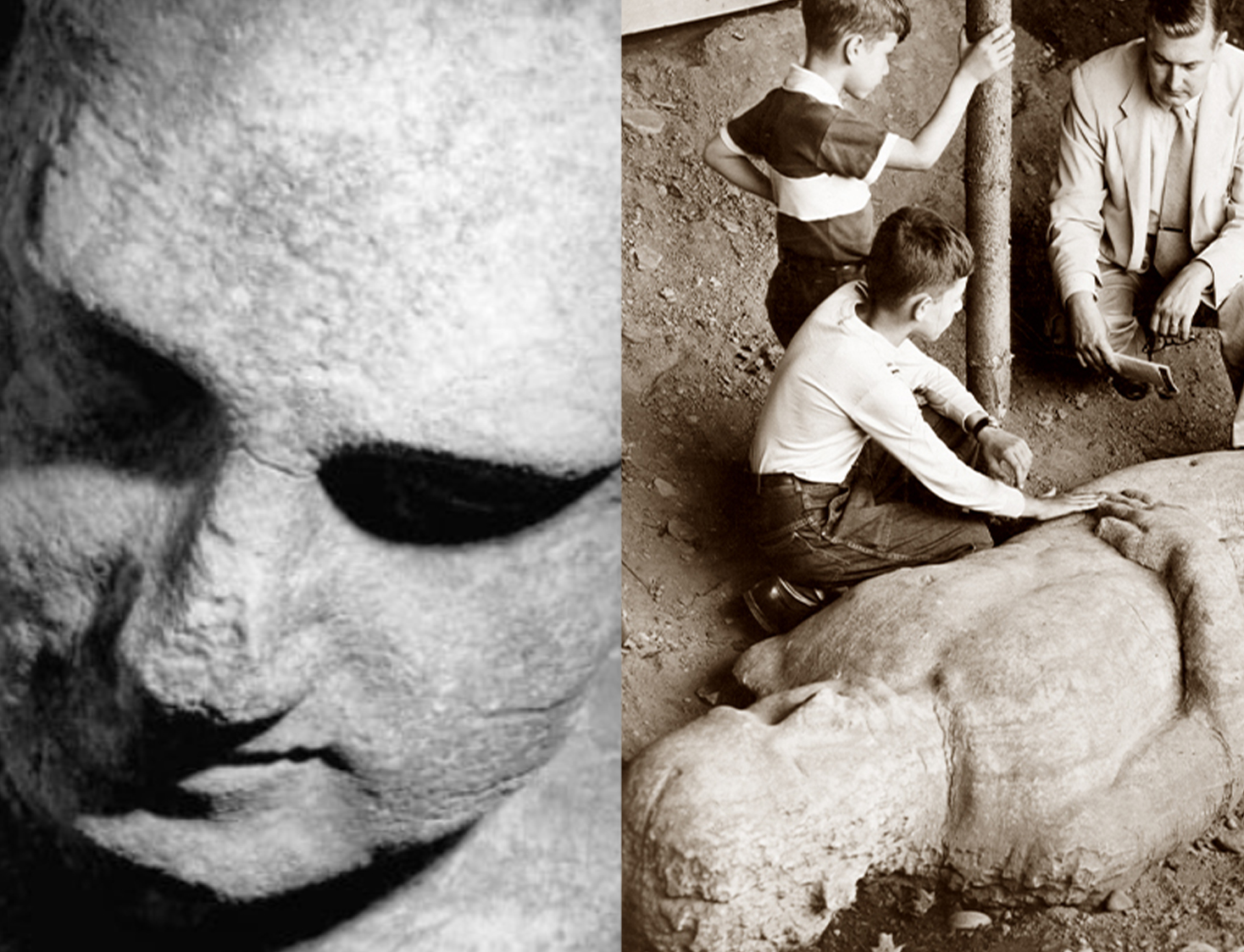
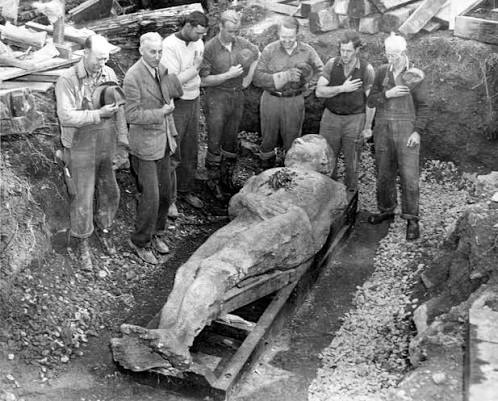
On October 16, 1869, two laborers digging a well on a farm in Cardiff, New York, struck something solid about three feet below the surface. As they cleared away the soil, the outline of an enormous stone foot appeared.
The excavation revealed a human-shaped figure lying on its back. It stretched more than ten feet from head to toe, weighed close to 3,000 pounds and appeared to have skin, muscles and pores hardened into stone.
News traveled quickly. Visitors arrived by wagon to see what newspapers described as a possible petrified man, and farmer William “Stub” Newell soon placed a tent over the pit and charged admission.
The figure was not an ancient human being. It was a gypsum statue commissioned by New York cigar maker George Hull, artificially aged, secretly buried on Newell’s farm and deliberately “discovered” nearly a year later. The Cardiff Giant had been created to exploit public fascination with science, religion and unexplained discoveries.
The Giant Beneath Newell’s Farm
Gideon Emmons and Henry Nichols had been hired to dig a well near Newell’s barn. They did not know that Newell had directed them toward a carefully selected spot.
Their tools soon struck the buried figure. Once enough soil had been removed, the workers could see a massive human form with crossed legs, a hand resting across its abdomen and a faint expression carved into its face.
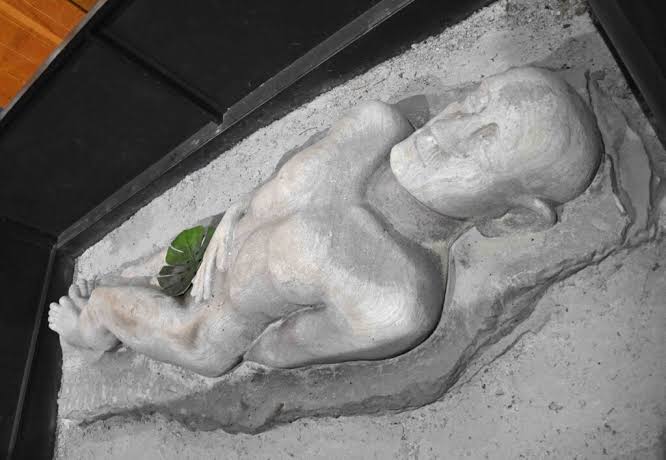
Cardiff was located in a region where fossils were familiar enough to make an extraordinary underground discovery seem possible. Some observers proposed that mineral-rich water had transformed an ancient body into stone. Others believed the object was an old statue, perhaps carved centuries earlier.
Newell initially allowed people to view the figure before turning the discovery into a paid attraction. He covered the excavation with a tent and began charging admission. Accounts indicate that the price started at 25 cents and quickly rose to 50 cents as demand increased. Approximately 2,500 people reportedly visited during the first week.
The debate over whether the giant was a petrified man or an ancient sculpture helped the business. Visitors did not need to agree about its identity. They only needed to believe that seeing it might help them decide.
George Hull’s Plan Began With an Argument
The hoax began roughly two years before the staged discovery.
George Hull was a cigar maker and tobacco dealer who was skeptical of biblical literalism. According to later accounts, the idea formed after he argued with a revivalist preacher in Iowa about a passage in Genesis referring to giants on Earth.
Hull wondered whether people who accepted the passage literally could be persuaded to believe that a giant human body had been found underground. He also recognized that such a discovery could become profitable.
He obtained a five-ton block of gypsum near Fort Dodge, Iowa, reportedly telling people that the stone would be used for a monument to Abraham Lincoln. The block was transported to Chicago, where stoneworkers carved it into the shape of a giant man.
Hull used his own body as a general model. The completed figure was more than ten feet long, with carefully positioned limbs and an expression designed to look natural rather than heroic.
The project was expensive and complicated. The stone had to be purchased, transported, carved, treated and moved again without revealing its true purpose. Historical accounts place Hull’s investment at more than $2,600, with some estimates approaching $3,000.
How the Stone Was Made to Look Ancient
A newly carved statue would not have supported Hull’s story. Its surface needed to appear weathered, porous and old enough to have rested underground for centuries.
The workers treated the gypsum with chemicals, including sulfuric acid, to roughen and discolor its exterior. Hull also used a needle-covered tool to create tiny marks that could be mistaken for pores in human skin.
The statue’s imperfect workmanship became part of the deception. Viewers examining the shallow grooves, damaged surface and uneven texture could interpret them as evidence of age rather than signs of recent manufacture.
When the work was finished, Hull arranged for the giant to be shipped in a reinforced crate to the farm of his relative William Newell. On a wet night in November 1868, the men concealed the shipment and later lowered the figure into a prepared hole near the barn.
They placed it beneath roots and packed soil around it to suggest that it had been buried for a very long time. Hull then waited almost a year before instructing Newell to arrange its discovery.
That delay was important. Freshly disturbed ground might have exposed the plan. Months beneath the soil gave the site time to settle and allowed the statue to acquire additional staining.
The discovery was therefore not an accident. The location of the well, the unsuspecting laborers and the dramatic appearance of the stone foot had all been arranged in advance.
YOUTUBE EMBED — PRIMARY SEARCH QUERY: “Cardiff Giant Smithsonian America’s biggest hoax petrified giant documentary”
Why So Many People Paid to See It
The Cardiff Giant appeared at a moment when Americans were intensely interested in fossils, archaeology, geology and public exhibitions.
Scientific discoveries were challenging traditional explanations of the natural world, but most people did not have direct access to trained specialists. Traveling displays, newspaper reports and public lectures became important ways of encountering new ideas.
The giant also seemed to connect science with religious belief. To some spectators, a petrified giant could support a literal interpretation of biblical references to unusually large people. To others, the figure might represent an unknown ancient culture.
The object’s ambiguity made it more powerful. Even experts disagreed over whether it was a human body, a historic statue or a modern deception.
Newspapers amplified the uncertainty. Crowds arrived not only because they believed the giant was real, but because the argument itself had become a national spectacle. Smithsonian reporting notes that visitors across social classes were drawn by the opportunity to examine the object and reach their own conclusions.
The giant soon passed into the hands of a group of businessmen who purchased a major ownership interest and moved it to larger exhibitions in Syracuse, Albany and eventually other cities. The attraction continued earning money even as skepticism increased.
The Details Experts Could Not Accept
Several observers doubted the giant almost immediately.
Some noted that the figure’s anatomy did not resemble a naturally preserved human body. Others saw tool marks that should not have remained sharp if the object had spent centuries underground.
Yale paleontologist Othniel Charles Marsh examined the figure and declared it a recent creation and a clear fraud. A mining engineer also observed that gypsum would have deteriorated in the wet soil where the giant had supposedly rested for an immense period.
Questions emerged about the site itself. Why had a well been placed in that exact location? Why did local residents remember George Hull transporting a massive crate through the area the previous year?
Reporters also followed the money. Newell had transferred funds to Hull after selling an interest in the attraction, creating a visible connection between the farmer and the man later identified as the hoax’s organizer.
By December 1869, Hull was publicly acknowledging that the giant was not genuine. Additional confirmation came when the Chicago stoneworkers involved in carving it described their role in the scheme.
The deception had survived for only a short time as a serious scientific claim. As a public attraction, however, it remained valuable even after exposure.
P. T. Barnum Created a Fake of the Fake
Showman P. T. Barnum understood that controversy could attract as many customers as authenticity.
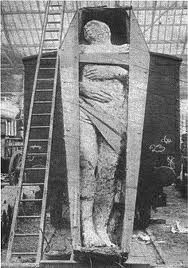
After seeing the Cardiff Giant, Barnum attempted to purchase it. When its owners refused, he commissioned a replica and displayed his version in New York, claiming that his was the genuine figure and that the traveling Cardiff attraction was the copy.
The owners of Hull’s original fake attempted to stop Barnum’s exhibition through legal action. The dispute produced one of the strangest complications in the story: people who were profiting from a fraudulent giant were asking a court to protect them from someone else’s fraudulent giant.
Stories about the case later became mixed with the famous phrase “There’s a sucker born every minute.” The Library of Congress found no reliable court transcript proving that the line was spoken during the dispute, and its connection to either Barnum or Cardiff Giant owner David Hannum remains uncertain.
Barnum’s replica attracted large crowds, sometimes outperforming the original. Other copies appeared around the country, turning a single planted statue into an entire category of public entertainment.
Where the Original Cardiff Giant Is Today
Exposure did not destroy the Cardiff Giant. Instead, it changed the reason people wanted to see it.
The figure continued appearing in exhibitions and passed through several owners. Its popularity declined, but its place in American cultural history grew as the story became a warning about sensational claims, commercial spectacle and the human desire to believe extraordinary discoveries.
In 1947, the original giant was acquired by the institution now known as Fenimore Farm in Cooperstown, New York. The ten-foot gypsum figure remains on display inside the museum’s main barn.
Visitors no longer pay to decide whether it is a petrified human. They see the physical object George Hull commissioned, the marks used to imitate skin and the stone body that once drew thousands of curious spectators.
The Cardiff Giant worked because every part of the deception reinforced the next: a believable underground discovery, an ambiguous object, conflicting expert opinions, aggressive newspaper coverage and paid access that made the attraction seem important.
Its creators did not uncover a lost giant. They manufactured a question that people were willing to pay to answer.
The figure was carved from gypsum, buried for less than a year and exposed as a fraud within months. Yet more than 150 years later, it remains one of America’s most memorable hoaxes—and proof that a spectacle does not need to be genuine to become part of history.

