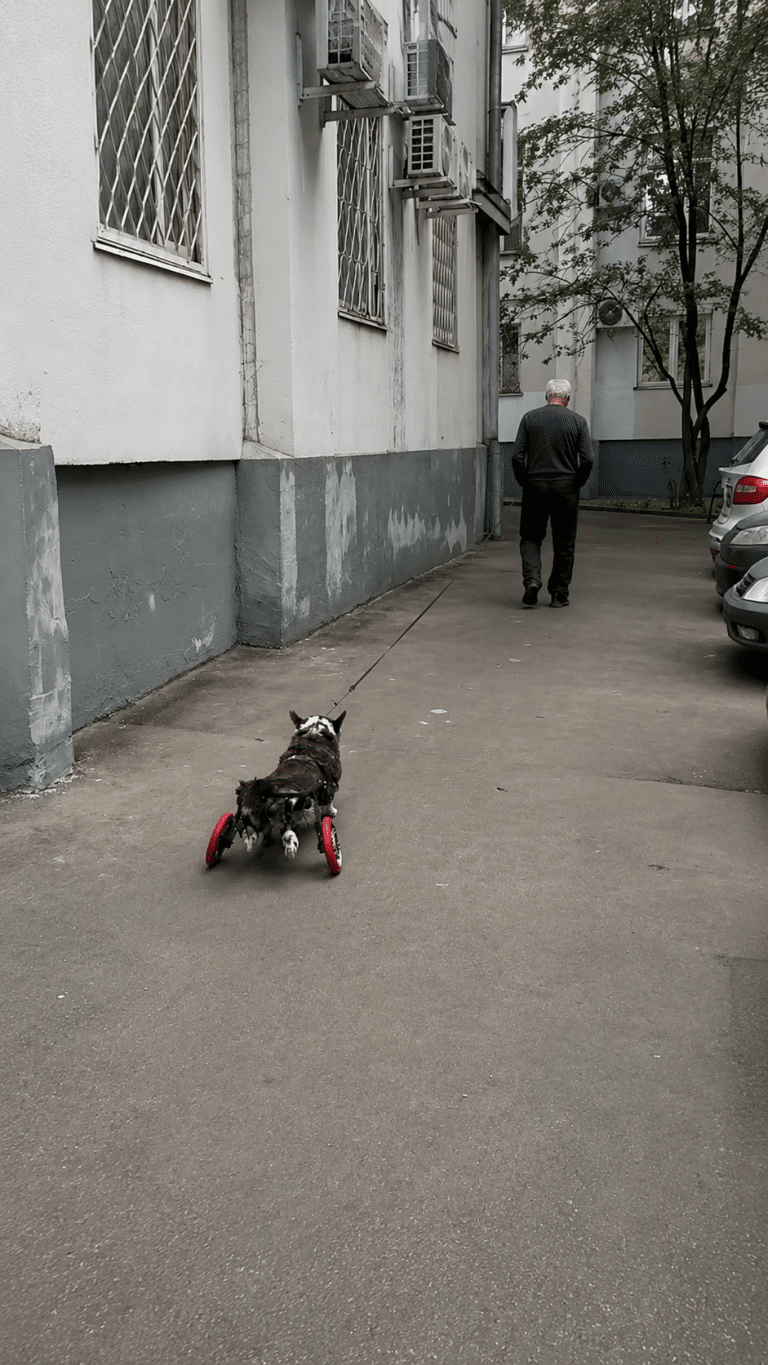
They moved slowly along the quiet neighborhood street.
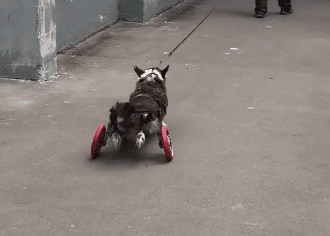
The small dog rolled forward in a wheelchair with bright pink wheels, using his front legs to pull himself ahead. Beside him, an elderly man walked at the same careful pace.
Neither of them moved quickly.
The dog needed time to complete each step. The man could have walked ahead, but he never did.
He remained close, matching the rhythm of the companion who had likely spent many ordinary days walking beside him before everything changed.
His Walks Did Not End When His Back Legs Stopped Working
The little dog could no longer use his hind legs.
Without assistance, the back half of his body would have remained unsupported, making normal movement impossible. But a specially designed wheelchair gave him another way to explore the world.
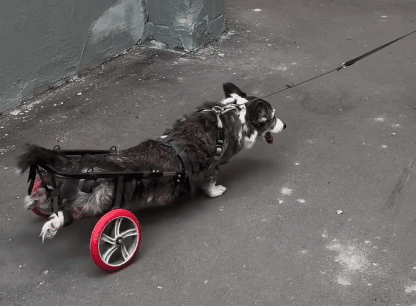
Two pink wheels supported his hindquarters while a fitted frame held his body in position.
His front paws did the work.
He pressed them against the pavement, pulled himself forward, and allowed the wheels to carry the rest of his body behind him.
The movement required coordination and effort.
Every few steps, he appeared to adjust his balance before continuing. He did not move with the effortless speed of a younger, fully mobile dog.
But he moved.
He could still feel the outdoor air.
He could still follow familiar streets.
He could still experience the daily walk that had likely been part of his life long before the wheelchair became necessary.
Most importantly, he did not have to do it alone.
Video: Elderly Man Matches Every Step of His Disabled Dog’s Walk
The Man Never Asked Him to Move Faster
The elderly owner remained beside the dog throughout the walk.
His own pace was careful and measured. He did not appear to be hurrying toward a destination or treating the outing as something that needed to be completed quickly.
When the dog slowed, the man slowed.
When the wheelchair rolled forward again, he continued beside it.
He did not pull the dog along.
He did not move several steps ahead and wait impatiently.
He simply stayed close enough to offer reassurance and help if the wheelchair encountered difficulty.
That small detail became the heart of the video.
The man was not asking his dog to keep up with him.
He was choosing to keep up with his dog.
Cars passed nearby, and daily life continued around them. But the pair appeared focused on the short journey they were taking together.
For another person, it might have looked like an ordinary walk lasting only a few minutes.
For this dog, every completed stretch of pavement represented continued freedom.
For the man beside him, the slower pace was not an inconvenience.
It was simply the pace they shared now.
The Pink Wheels Gave Him Back Part of His Routine
Mobility aids cannot reverse paralysis.
They do not remove every challenge faced by a disabled or aging dog. The animal may still require help getting into the device, careful monitoring for skin irritation, and assistance navigating curbs, stairs, or uneven ground.
But the wheelchair gave this little dog something valuable.
Independence.
Instead of remaining inside because his back legs could no longer support him, he could continue moving under his own power.
He chose the direction.
He controlled the speed.
He decided when to pause and when to continue.
The bright pink wheels followed wherever his front paws carried him.
For dogs, a walk is about much more than physical exercise.
It provides new smells, changing sounds, familiar landmarks, and opportunities to engage with the world beyond the home.
Paralysis had changed the way this dog experienced those things.
It had not removed his interest in them.
With the wheelchair supporting his body and his owner beside him, the outside world remained available.
The route may have become shorter.
The pace may have become slower.
But the walk still belonged to both of them.
Caring Became More Demanding, but He Stayed
Living with a disabled dog often requires adjustments that are not visible during a short video.
The wheelchair must be fitted properly.
The dog may need assistance entering and leaving it.
Daily routines may include additional cleaning, veterinary appointments, medication, rehabilitation, or careful checks for discomfort.
As animals grow older, those needs can become more complex.
Caring for them is different from the years when they could run, climb, and move independently.
That difference is where commitment becomes visible.
The elderly man could no longer care for his companion only through filling a food bowl or opening the door for a walk.
The dog now depended on him in more direct ways.
Someone had to prepare the wheelchair.
Someone had to make sure the straps were comfortable.
Someone had to remain patient when a short distance took longer than it once had.
In the footage, the man did not appear burdened by that responsibility.
He simply walked beside the dog.
His actions suggested that this was not a special performance arranged for the camera.
It was part of their life together.
Their circumstances had changed.
The relationship had not.
Neither of Them Moved Like They Once Had
The image touched so many viewers partly because the man and dog appeared to understand the same slower rhythm.
Age had affected them differently.
The dog relied on wheels because his back legs no longer worked.
The man remained on his feet, but his steps were also careful.
Neither hurried the other.
They moved down the street as two aging companions adapting to a chapter that asked more patience from both of them.
There was no visible sadness in the way the man walked.
There was no suggestion that the dog’s life had become less valuable because his mobility had changed.
Instead, the video showed continuity.
The same companionship.
The same daily outing.
The same decision to remain together.
Only the method of walking was different.
That is what made the scene more meaningful than a simple video of a dog using a wheelchair.
The device helped the animal move, but the man’s presence showed why continuing to move mattered.
The dog was not being pushed through a rehabilitation exercise by a stranger.
He was sharing another walk with the person he knew.
A Lifetime Commitment Is Built in Ordinary Moments
Welcoming a dog into a family often begins during an easier chapter.
There are playful years filled with energy, curiosity, and long walks. The animal may need training and attention, but physical care remains relatively simple.
Then time passes.
Movement slows.
Medical needs appear.
The dog who once waited eagerly at the door may need help reaching it.
The promise made at the beginning becomes more demanding near the end.
That promise is rarely expressed through one grand decision.
It is honored through small, repeated actions.
Attaching the wheelchair.
Checking the straps.
Opening the door.
Waiting while the dog finds his balance.
Walking slowly even when the person could move faster.
The elderly owner did not need to explain his commitment.
It could be seen in the space he maintained beside his dog.
He remained close enough to help but allowed the animal to move independently.
He did not make the disability the center of their relationship.
He treated the dog as the same companion he had always known.
Two Old Friends Continued Forward Together
The final moments of the video are quiet.
The dog keeps pulling the pink wheels along the pavement.
The man continues beside him.
There is no dramatic destination waiting at the end of the street.
No sudden transformation.
No moment when the dog leaves the wheelchair and begins running again.
That is not what this story promises.
Its meaning comes from something more realistic.
The dog’s condition had changed, and his owner adapted with him.
Paralysis took away the use of his hind legs.
It did not take away his walks.
It did not take away his place within the family.
And it did not take away the person who had been beside him through earlier chapters of life.
The man could not restore his companion’s mobility.
But he could make sure the dog still experienced fresh air, familiar streets, and the simple pleasure of moving forward.
So he prepared the wheelchair.
He stepped outside.
And he walked at exactly the speed his friend needed.
Neither of them was as young as before.
Neither moved very quickly.
But they were still together.
Sometimes love is not shown through dramatic rescues or extraordinary sacrifices.
Sometimes it looks like an elderly man walking slowly beside a little dog on pink wheels—never rushing ahead and never allowing his oldest friend to face the road alone.


