At first, there was only an opening in the pavement.
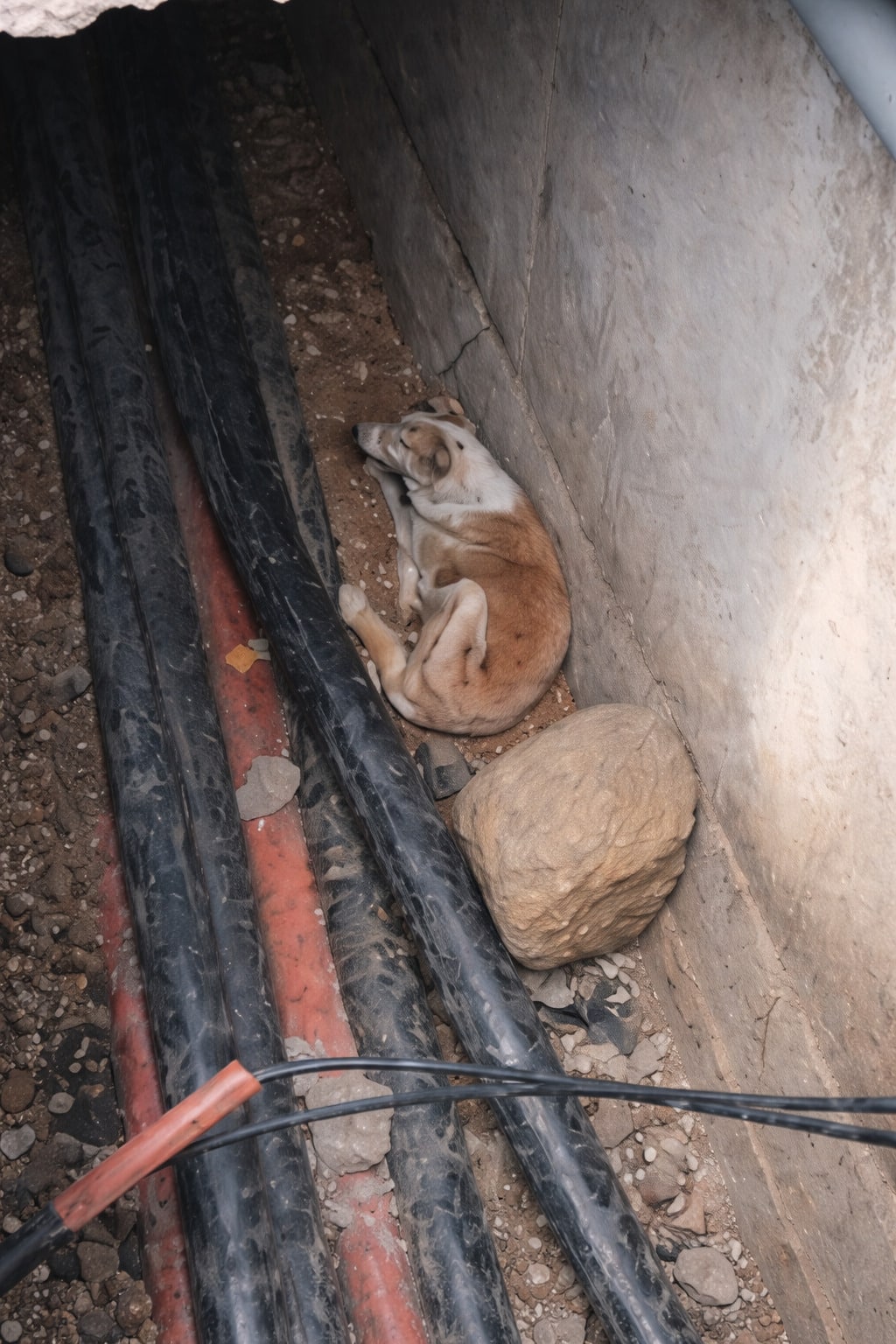
A large stone had been placed nearby, perhaps as a warning that something beneath the sidewalk was unsafe. But for one small yellow-and-white dog, the warning had come too late.
He had already fallen through.
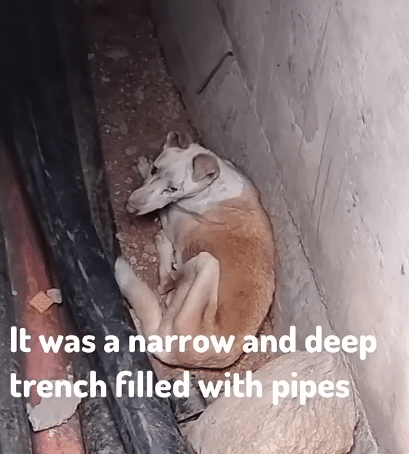
Far below street level, the dog was trapped inside a narrow concrete trench filled with pipes and underground infrastructure. The walls were too high to climb, and the opening above offered no route he could reach by himself.
For nearly an hour, he remained hidden beneath the city.
Then rescuers looked into the darkness and realized the dog had begun moving deeper underground.
The Sidewalk Opening Led to a Hidden Concrete Trench
The exposed hole did not appear especially dramatic from above.
People walking past might have noticed the stone near the opening and simply stepped around it. Few would have imagined that an animal was stranded beneath their feet.
Inside was a very different environment.
Concrete walls surrounded the dog on all sides. Utility pipes crossed the narrow trench, leaving limited space for him to stand or turn around. The opening through which he had fallen sat high above him.
There was no ladder.
No slope.
No surface his paws could grip well enough to climb back toward the sidewalk.
The dog initially remained curled inside the dim space, looking upward toward the daylight he could no longer reach.
He was not visible from most angles.
Anyone passing nearby could easily have missed him entirely.
Eventually, someone realized what had happened and contacted a rescue team.
By the time help arrived, however, the dog was no longer waiting directly beneath the opening.
He had started searching for another way out.
Video: Rescuers Find a Missing Dog Walking Across Pipes Deep Beneath a Sidewalk
He Began Moving Through the Underground Passage
Remaining in one place offered the dog no clear chance of escape.
So he moved.
To travel through the trench, he had to step onto the narrow pipes running along the underground passage. The surfaces were rounded and offered little room for his paws.
Each movement required balance.
One paw was placed carefully ahead of the other.
His body remained low as he crossed sections where a slip could have sent him to the bottom of the trench or into an even harder position to reach.
The footage does not reveal what guided him forward.
Perhaps he saw light farther along the passage.
Perhaps he heard voices.
Perhaps he was simply searching every available route because the place where he had fallen offered no way back.
Whatever the reason, the dog continued.
The movement made the rescue more complicated.
He was no longer directly below a single accessible opening. He was navigating an underground space that may have contained multiple narrow sections and hidden turns.
If rescuers approached too quickly, the frightened dog could retreat deeper into the passage.
If he panicked while standing on the pipes, he could lose his balance.
The team needed to reach him without causing another emergency.
The Hardest Part Was Keeping Him From Running Deeper
The rescue team began planning around the dog’s direction of travel.
One rescuer moved toward an area where the animal appeared likely to emerge, while other team members remained above ground to monitor the openings and prepare extraction equipment.
They could not simply call loudly and expect the dog to return.
A trapped animal may not understand that unfamiliar voices belong to people trying to help. Sudden movement or noise can cause a frightened dog to flee from the very hands attempting to rescue him.
So the team worked quietly.
They followed his position.
They watched the route he was taking.
And they waited for him to enter a section where someone could approach without blocking him against the narrow pipes.
Timing mattered.
The dog had already spent close to an hour below ground. He may have been tired, but exhaustion did not necessarily mean he would remain still when touched.
The team needed to be close enough to secure him before he could turn and disappear again.
There was only a brief opportunity.
One Rescuer Waited Where the Dog Was Heading
As the dog continued along the underground passage, he gradually approached a more accessible area.
A rescuer positioned himself nearby and remained still.
The goal was not to chase the dog.
It was to let him move into a place where he could be handled safely.
When the animal finally came within reach, the rescuer moved carefully.
There was no sudden rush.
No attempt to grab at him from a distance.
The man lowered himself close to the dog and secured him with controlled movements.
The dog did not appear to struggle violently.
After nearly an hour of moving through the trench, he may have had little energy left—or he may have recognized that the person in front of him was offering the first possible way out.
Either way, the rescue team now had physical control of him.
But carrying him through the narrow underground space and lifting him directly by hand could still have been dangerous.
The dog needed to be secured before the team attempted to raise him to the sidewalk.
A Rescue Net Became His Way Back to the Surface
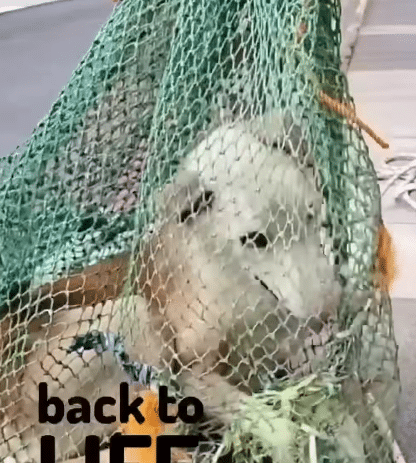
The team placed the dog inside a large rescue net.
The net provided support beneath his body and reduced the risk of him slipping during the lift. It also gave the rescuers above a stable way to raise him through the opening without relying on a collar or an uncertain handhold.
The dog remained inside as the equipment was checked.
Above ground, two rescuers prepared to lift.
They positioned themselves on opposite sides of the opening and began pulling the net upward slowly.
The dog started rising through the concrete shaft.
At first, only the net was visible from the sidewalk.
Then the top of his body appeared.
The darkness surrounding him gave way to daylight as he moved closer to the opening.
The lift had to remain steady.
A sudden movement could cause the net to swing against the concrete walls. Raising it too quickly might also frighten the animal after he had spent so long in the confined passage.
So the rescuers continued one careful pull at a time.
Higher.
Closer.
Until the dog finally reached street level.
His Paws Touched Solid Ground Again
Once the net cleared the opening, rescuers placed it safely on the pavement.
The dog was released.
For the first time since his fall, all four paws rested on open, level ground.
There were no narrow pipes beneath him.
No concrete walls blocking every direction.
No high opening he needed to reach.
The dog stood and shook his body from head to tail.
It was an ordinary movement familiar to anyone who has spent time around dogs. Yet after watching him navigate the trench, the gesture carried a sense of finality.
He was no longer trapped.
The rescuers had brought him back into the open air.
After shaking himself, the dog moved toward a nearby patch of vegetation and disappeared from the camera’s view.
The footage does not establish whether he belonged to someone nearby, whether rescuers later secured him again, or what happened after he left the immediate scene.
It would be easy to invent a final reunion or permanent home.
But the confirmed ending is simpler.
The dog entered the bushes alive and free after nearly an hour beneath the sidewalk.
The Danger Had Been Almost Invisible From Above
The rescue ended successfully, but the exposed opening remained an important part of the story.
Uncovered utility trenches, drains, and maintenance shafts can become serious hazards for animals and people.
From ground level, an opening may look shallow.
Beneath it may be a much deeper structure with hard walls, pipes, water, electrical equipment, or narrow passages that make escape impossible.
Dogs do not recognize warning stones or understand why part of a familiar sidewalk has suddenly become dangerous.
A curious animal may approach the edge.
A frightened dog may run without noticing the gap.
One misplaced paw can be enough.
In this case, the dog survived the fall and remained mobile enough to search for another exit. A smaller, older, or injured animal might not have been able to do the same.
The danger was especially easy to overlook because the dog disappeared completely below street level.
He could not be seen by ordinary pedestrians unless they stopped and looked directly into the opening.
His rescue began because someone did exactly that.
Finding Him Was Only the First Step
Once rescuers knew where the dog was, they still had to solve several problems.
They needed to follow him through the underground space.
They needed to avoid frightening him into a more dangerous section.
They needed to secure his body safely.
And they needed equipment capable of lifting him through the opening without allowing him to fall again.
None of those steps offered a dramatic shortcut.
The team relied on observation, coordination, and patience.
One rescuer moved into position underground.
Others waited above.
The net was prepared only after the dog had been secured.
Each person completed a different part of the operation, and every part was necessary.
The rescue succeeded not because the dog remained conveniently beneath the first opening.
It succeeded even after he moved away from it.
The team adapted to what he did rather than expecting a frightened animal to follow a perfect plan.
He Walked Into the Darkness Looking for a Way Out
One image from the rescue remains especially memorable.
The yellow-and-white dog carefully balancing on a narrow pipe beneath the city.
There was no clear evidence that the route would lead anywhere safer.
He could not know whether another exit existed.
He only knew that remaining beneath the original opening had not brought him back to the surface.
So he continued.
That persistence carried him toward the area where a rescuer was waiting.
But persistence alone could not lift him through the concrete shaft.
The dog needed people above ground who understood how to complete the journey he had started.
They watched where he was going.
They met him there.
Then they placed him inside the net and slowly raised him toward the sky.
The final moments were not marked by celebration.
The dog shook himself and moved away.
The rescuers remained beside the opening they had pulled him from.
For the animal, freedom may have meant nothing more complicated than being able to choose where to walk again.
Minutes earlier, every route had been defined by concrete walls and underground pipes.
Now, the world was open around him.
One exposed hole had taken him beneath the sidewalk.
Several patient strangers brought him back.


