At first, nothing about the sports field seemed unusual.
The grass was quiet beneath the afternoon light. A chain-link fence surrounded the open space, just as it probably had on countless ordinary days.
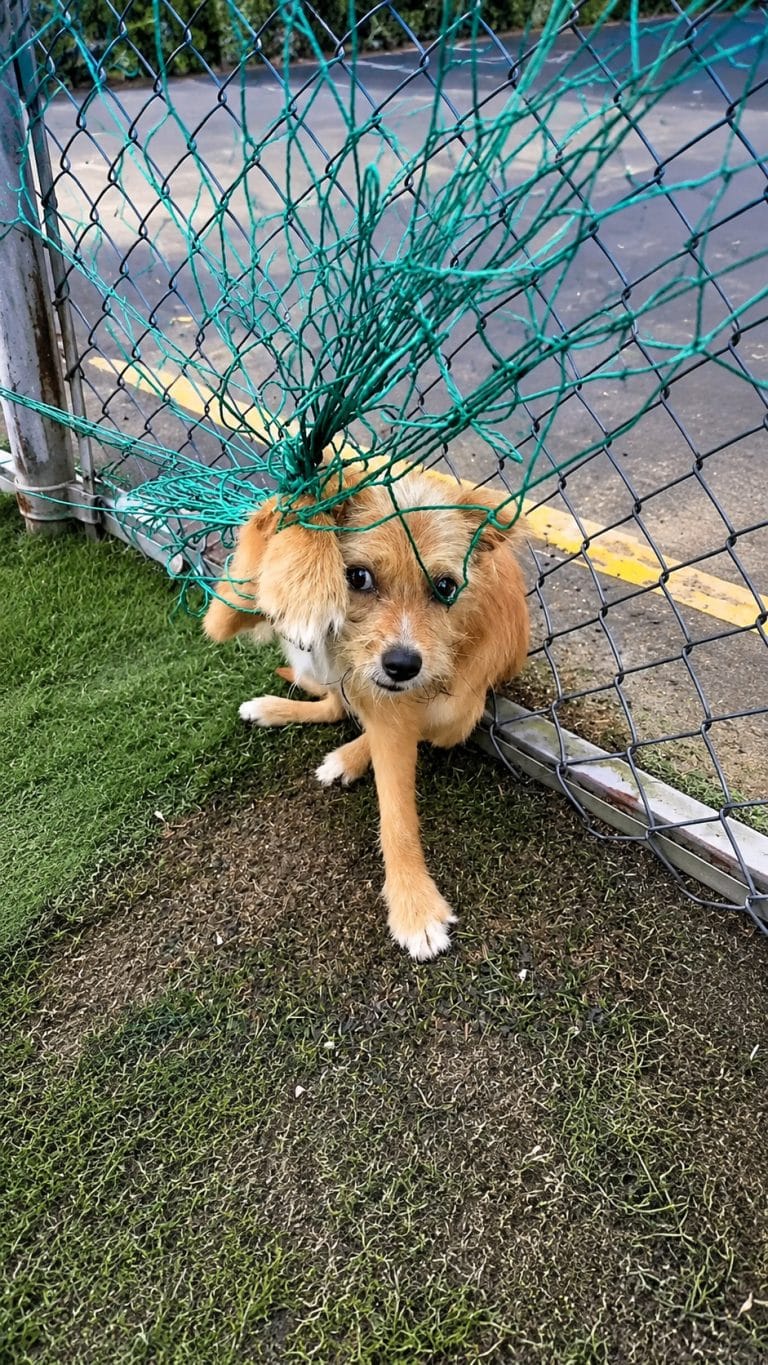
Then someone noticed a small shape pressed against the fence.
A little golden dog had become tangled in the green netting attached to it. His head was caught, one front leg appeared trapped, and every movement risked pulling the material tighter around his body.
By the time help arrived, he was no longer struggling wildly.
He simply remained there.
Waiting beside a field full of open space he could not reach.
Hidden Along the Edge of an Ordinary Field
It is unclear how long the dog had been trapped before someone found him.
He may have tried to squeeze through an opening in the fence. He may have been chasing something across the field or searching for a way out.
Whatever happened, the flexible netting had wrapped around him in a dangerous way.
His head had passed through one section.
One of his front legs had become caught in another.
When he pulled backward, the net appeared to tighten rather than release him.
The dog’s position made the situation especially concerning. His body was pressed close to the fence, leaving him little room to turn or find a better angle.
Any strong movement could have caused the material to press more firmly around his neck or leg.
At first, he likely attempted to free himself.
The ground around him suggested movement, and his posture appeared weary by the time he was discovered.
But repeated struggling had not opened a path to freedom.
The field remained quiet.
People continued with their day.
And the small dog stayed trapped along the edge, almost hidden against the green net.
Then one passerby looked closely enough to see him.
Video: Stranger Carefully Cuts a Tiny Dog Free From Fence Netting
Pulling Him Free Could Have Made Things Worse
The person who found the dog quickly understood that simply tugging on him was not the answer.
Netting can become tighter when pulled from the wrong direction. If the dog panicked while someone tried to drag him backward, the strands could twist further around his neck, ears, or leg.
The rescuer needed a safer approach.
He left briefly and returned with a pair of scissors.
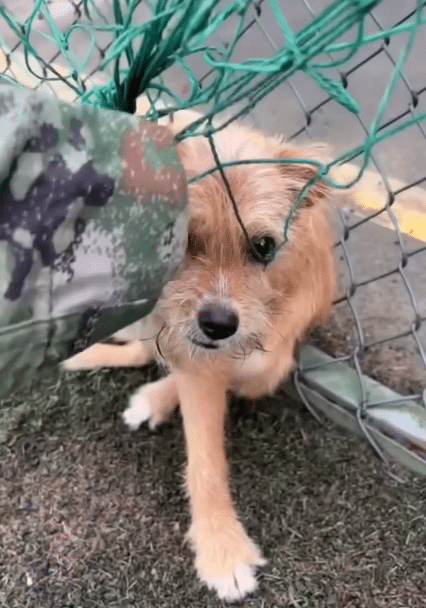
Then he positioned himself beside the dog and began examining where the material had become tangled.
The dog remained close to the ground.
He did not snap or attempt to bite.
He also did not make any sudden effort to escape while the stranger worked near his face.
It is impossible to know whether he understood that the man was trying to help. He may simply have been exhausted after struggling for an unknown length of time.
Either way, his stillness allowed the rescue to proceed more safely.
The man placed one hand near the dog to steady him.
With the other, he carefully lifted a section of netting away from the animal’s body.
Then he made the first cut.
One Careful Cut at a Time
Freeing the dog required patience.
The net was wrapped around more than one part of his body, and cutting too close could have injured his skin.
The rescuer worked slowly.
He separated each strand before bringing the scissors near it.
He checked where the dog’s fur, ear, and leg were positioned.
Then he cut only the section he was certain could be removed safely.
One strand loosened.
Then another.
Small pieces of green netting began falling away from the fence.
The dog stayed remarkably calm as the man continued. He occasionally shifted his weight, but he did not begin thrashing or pulling against the remaining material.
That calmness mattered.
A frightened animal can react unpredictably, especially when restrained by something he cannot understand. Even a friendly dog may struggle when unfamiliar hands come close to a painful or sensitive area.
The rescuer did not rush because the dog appeared cooperative.
Instead, he maintained the same careful pace.
Cut.
Pause.
Check the dog.
Move to the next strand.
Each small action brought the dog closer to freedom without placing him at unnecessary risk.
The Final Strands Fell Away
As more of the netting was removed, the pressure around the dog’s body began to ease.
His front leg became less restricted.
The opening around his head grew wider.
Only a few strands remained between him and the open field.
The rescuer adjusted his position once more.
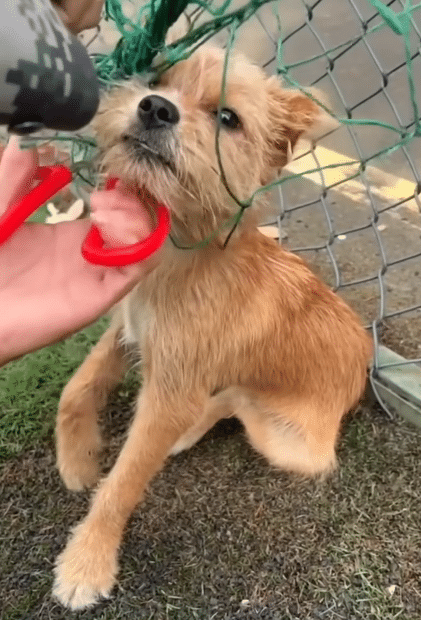
He lifted the final pieces of net away from the dog’s fur and made several last cuts.
Then the dog stepped forward.
For the first time since he had become trapped, nothing pulled him back.
No net tightened around his neck.
No strand held his leg against the fence.
He was free.
For a brief moment, the little dog remained close to the spot where he had been caught. He seemed to pause as the man moved the loose material away from him.
Then his body changed.
The stillness disappeared.
The uncertainty gave way to movement.
He turned toward the field and began to run.
He Raced Across the Grass Without Looking Back
Only moments earlier, the dog had been unable to move more than a few inches.
Now he crossed the grass quickly.
His legs carried him away from the fence and into the open space that had remained just beyond his reach.
The rescuer watched as the small golden figure moved farther across the field.
From what could be seen in the video, the dog appeared able to run normally. He did not seem to favor the leg that had been caught, and he did not collapse after being released.
That was an encouraging sign.
However, being able to run immediately after a rescue does not always guarantee that an animal has avoided every injury. Netting can leave pressure marks, cuts, or soreness that may be difficult to notice beneath fur.
Ideally, a trapped animal should be checked closely after being freed whenever it is safe and possible to do so.
In this case, the dog’s first instinct was clear.
He wanted distance from the fence.
He ran until the tangled net and the frightening confinement were behind him.
The stranger did not chase him or try to turn the moment into something larger.
He had seen an animal in danger.
He had helped.
And now the little dog could move freely again.
Why Fence Netting Can Be Dangerous for Animals
The green material attached to the fence may have seemed harmless when it was installed.
But loose or damaged netting can become a serious hazard for small animals.
Dogs may attempt to crawl beneath it, push their heads through an opening, or follow a scent on the other side. Once part of the body passes through, the flexible strands can tighten when the animal pulls backward.
Legs can become twisted.
Collars may catch.
Material can wrap around the neck or chest.
The more frightened the animal becomes, the more forcefully he may struggle—sometimes making the entanglement worse.
Wild animals face similar risks around discarded rope, garden mesh, sports netting, fishing line, and damaged fencing.
Checking outdoor areas for loose strands can prevent an accident before it happens.
When an animal is already trapped, calmness becomes essential.
Pulling without understanding how the material is wrapped may increase pressure or cause injury. Cutting tools should be used carefully, with a protective space kept between the blade and the animal’s skin.
When the situation is severe, or when the animal is reacting aggressively from fear, contacting local animal control or an experienced rescue group may be the safest choice.
The man in the video appeared to understand the most important part.
The dog needed freedom.
But he also needed that freedom to arrive gently.
One Person Noticed What Others Could Have Missed
There was no rescue vehicle beside the field.
No large team gathered around the fence.
No complicated equipment was needed.
There was only one person who noticed a small dog in trouble and decided that walking away was not acceptable.
He found scissors.
He returned.
He knelt beside an unfamiliar animal.
And he remained there until every dangerous strand had been removed.
The entire rescue may have taken only a few minutes.
For the trapped dog, those minutes changed everything.
Without intervention, he could have remained pressed against the fence as the day grew hotter or darker. Continued struggling might have caused injury, exhaustion, or further entanglement.
Instead, someone paid attention.
That simple decision turned an ordinary passerby into the only help the dog had.
Many meaningful acts of kindness happen this way.
Quietly.
Without preparation.
In places where no one expects a rescue story to begin.
A roadside.
A backyard.
An empty lot.
Or the edge of a neighborhood sports field.
Compassion does not always arrive with flashing lights or dramatic gestures.
Sometimes, it arrives carrying a pair of scissors.
The Open Field Was Finally His Again
After the rescue, the torn pieces of netting remained behind.
The dog did not.
He ran across the field with the quick energy of an animal who had suddenly regained control of his own movement.
There was no way for him to explain what had happened.
He could not tell the man how long he had been waiting or how frightened he had felt while the net held him against the fence.
But he no longer needed to wait.
Someone had seen him.
Someone had stayed calm when the situation could easily have become more dangerous.
And someone had taken the time to cut through every strand standing between him and freedom.
For the rescuer, it may have been one small interruption in an otherwise ordinary day.
For the little dog, it was the moment the fence released him and the entire field opened again.
His story leaves behind a simple reminder.
Not every animal in danger will be able to call for attention.
Some remain quiet.
Some become too tired to struggle.
Some wait in places where they are easy to overlook.
That is why noticing matters.
Because sometimes, saving a life begins with nothing more complicated than looking closely—and choosing to stop.


