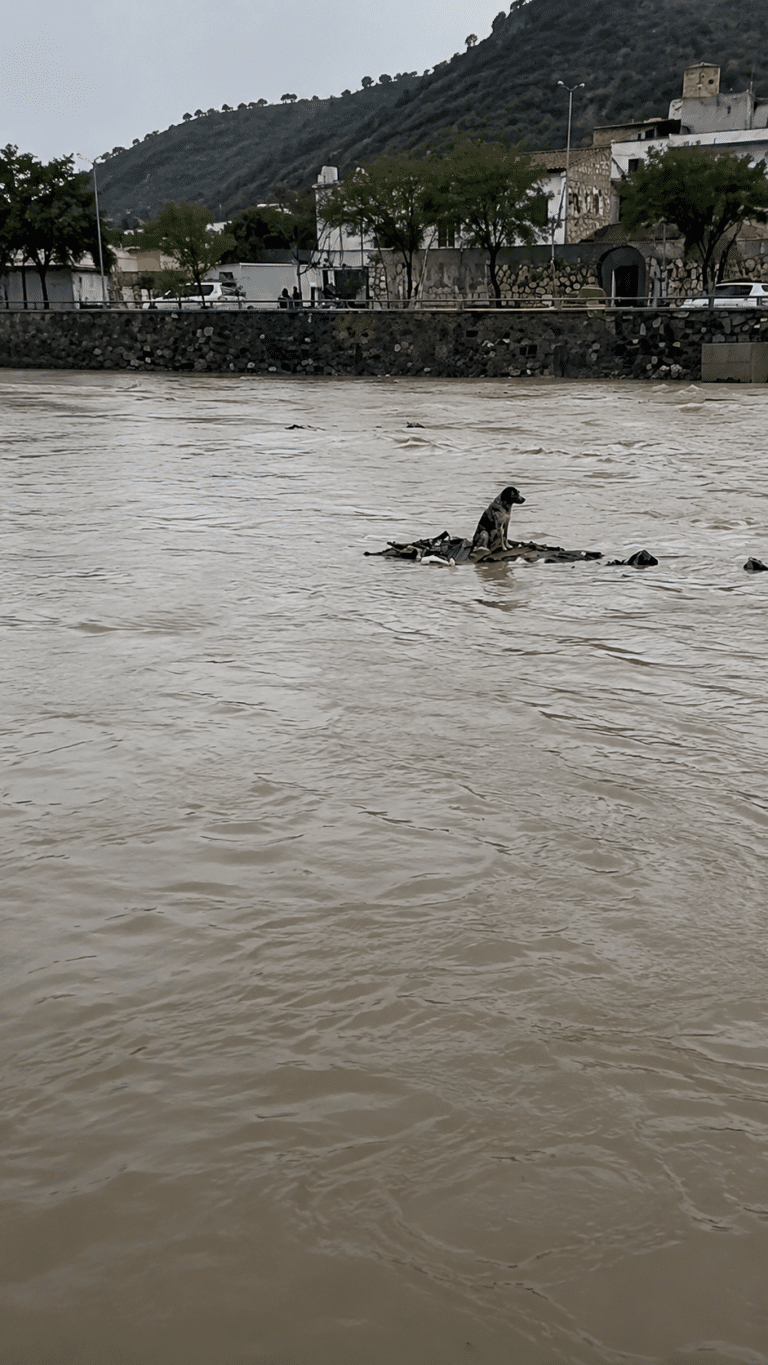
The river no longer resembled the calm channel people nearby may have known.
Brown floodwater rushed between the concrete walls, carrying branches, mud, and scattered debris downstream. Waves struck the sides of the channel before folding back into the current.
In the middle of that water was a dog.
His head appeared briefly above the surface, then disappeared again as another surge rolled over his body.
Each time he managed to rise, the current carried him farther downstream.
Ahead of him, the water narrowed near a dam.
People watching from the bank could see the danger growing—but reaching the frightened animal without becoming another victim would be extraordinarily difficult.
Then one man picked up a long-handled tool and entered the water.
The Dog Was Losing Ground With Every Wave
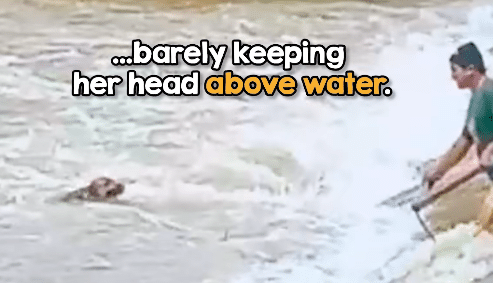
The dog appeared exhausted by the time people noticed him.
He was no longer swimming in a clear direction. Instead, he seemed to be using whatever strength remained simply to keep his nose and mouth above the surface.
The current repeatedly turned his body.
At times, only the top of his head could be seen.
Then he surfaced again several feet farther downstream.
Floodwater behaves differently from ordinary river water. It can move with tremendous force while concealing unstable ground, holes, sharp debris, and sudden changes in depth.
Even a strong swimmer may be overwhelmed.
For a dog already frightened and tired, the danger increases with every minute.
The people gathered nearby appeared unable to reach him safely from the bank. The concrete channel offered few places where the animal could climb out, and the moving water continued carrying him toward the structure ahead.
One man decided to attempt a rescue.
He carried a long-handled hoe or similar tool into the channel, apparently hoping to use it for balance and to test the ground beneath the muddy water.
It was an extremely dangerous decision.
But once he stepped away from the bank, turning back became increasingly difficult.
Video: Man Enters Raging Floodwater to Reach a Dog Being Swept Toward a Dam
The Current Nearly Took the Rescuer Too
The power of the flood became clear as soon as the man moved into deeper water.
The current struck his legs and pushed his body sideways.
He planted the long handle against the riverbed, using it as an additional point of contact while taking another cautious step.
The water continued rising around him.
Each movement had to be deliberate.
If his foot landed on loose debris or slipped into an unseen drop, the same current carrying the dog could also carry him away.
The man leaned forward and tried to close the distance.
But the frightened dog did not understand that someone was attempting to help.
Whenever the rescuer came near, the animal shifted away or was moved by another surge of water.
The gap opened again.
The man followed.
People on the bank watched as both figures moved closer to the dam.
There was little room for error.
The dog was tiring.
The rescuer was struggling to remain upright.
And the muddy water made it difficult to judge exactly where either of them would be carried next.
His First Grip on the Collar Did Not Hold
After several attempts, the man finally moved close enough to reach toward the dog.
He stretched one arm forward while continuing to brace himself with the long tool.
His hand found the collar.
For a moment, the dog’s downstream movement stopped.
The rescuer pulled.
The animal’s body turned against the current, and it appeared that the most dangerous part of the rescue might be over.
Then the collar slipped from his hand.
The water immediately carried the dog away again.
The distance between them widened within seconds.
From the bank, the failed attempt must have been difficult to watch. The rescuer had reached the animal, but the force of the water had taken that opportunity away almost instantly.
The man could have lost his balance while lunging after him.
Instead, he reset his footing and continued.
He used the handle to steady himself.
Then he pushed through the water once more.
The dog surfaced farther downstream.
The man reached again.
This time, his hand closed firmly around the collar.
He did not release it.
Catching the Dog Was Only Half the Rescue
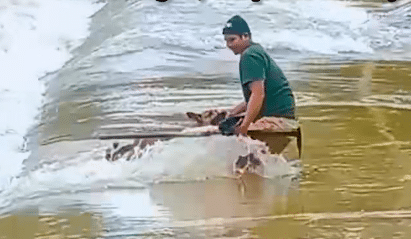
Holding the collar stopped the dog from being carried farther away, but both of them were still standing inside dangerous water.
The man now had to return toward the bank while supporting an exhausted animal against the current.
He turned his body slowly.
One hand remained secured around the dog’s collar.
The other continued using the tool for balance.
The dog struggled briefly as the water pressed against him. A frightened animal may twist, kick, or attempt to climb onto a rescuer, even when those actions make the situation more dangerous.
The man kept the dog beside him rather than allowing the animal to move directly in front of his legs.
Then he began working his way back.
One step.
A pause to regain balance.
Another step.
The current continued pulling at both bodies.
The dog appeared to stop fighting as strongly, though it is impossible to know whether he understood the rescue or had simply become too exhausted to resist.
Either way, the man was now carrying much of the responsibility for keeping them both upright.
The bank remained several difficult steps away.
They Finally Reached Solid Ground
As the water became shallower, the rescuer’s footing appeared more stable.
People nearby moved closer, ready to help once the pair reached the edge.
The man maintained his grip until the dog’s paws found solid ground.
Then both of them moved out of the strongest part of the current.
The dog stood.
Water poured from his coat.
After a moment, he shook his body and began moving around the safer area.
From what could be seen, he was conscious and able to stand after the ordeal. That was encouraging, although animals rescued from floodwater may still require veterinary evaluation.
Exhaustion, contaminated water exposure, hidden injuries, and inhaled water may not always be immediately obvious.
The rescuer also appeared able to leave the channel safely.
The danger that had surrounded both of them only moments earlier continued rushing downstream as though nothing had happened.
But the dog was no longer inside it.
Entering Floodwater Can Create a Second Emergency
The man’s persistence saved the dog in this case, but the rescue also involved serious risk.
Moving floodwater can knock down an adult with surprisingly little depth. Its force increases rapidly, especially in narrow channels and near dams, culverts, or drainage structures.
The muddy surface may hide:
Broken concrete.
Open drains.
Sharp metal.
Electrical hazards.
Sudden drop-offs.
Branches capable of trapping a leg.
Chemical or sewage contamination.
A person who enters without proper equipment can quickly become another life requiring rescue.
Whenever possible, people who see an animal trapped in floodwater should contact firefighters, emergency responders, animal control, or trained rescue organizations.
Useful assistance from a safe location may include keeping the animal in sight, identifying the safest access point, bringing ropes or flotation equipment for trained responders, and preventing crowds from frightening the animal farther into danger.
In some emergencies, help may not arrive as quickly as everyone hopes.
That does not make uncontrolled entry into floodwater safe.
The outcome of this rescue depended not only on determination but also on the man’s ability to maintain his footing in conditions that could easily have overwhelmed him.
Both the dog and rescuer were fortunate to reach shore.
The Dog Had No Way to Escape the Channel Alone
The dog’s struggle also shows how quickly animals can become trapped during flooding.
Water may rise faster than expected.
A familiar path can disappear.
Fences, concrete walls, and drainage channels may prevent an animal from reaching higher ground even when safety appears close.
Dogs separated from their families may try to swim toward familiar scents or structures, only to be pushed in another direction by the current.
Once exhaustion begins, their ability to make purposeful movements declines quickly.
The dog in this video was not simply refusing to swim toward shore.
The water appeared to be controlling where his body went.
Every time he lifted his head, he had to use energy just to breathe.
The dam ahead increased the urgency because water often accelerates near changes in elevation or restricted openings.
Had no one intervened, the dog might have been carried into a section of the channel where reaching him would have become even more difficult.
The man’s second successful grip prevented that.
Compassion Was Followed by Immediate Action
Many rescue stories begin because someone notices an animal in danger.
This one required more than observation.
The people on the bank could see the dog.
They understood what was happening.
But the current created a barrier between concern and action.
One man chose to cross that barrier.
His first attempt did not succeed.
He reached the dog and lost his grip.
The animal was immediately swept farther away.
Still, the man continued.
That second attempt became the turning point.
He secured the collar.
Maintained control.
Then brought the dog back one difficult step at a time.
The rescue was not graceful.
It did not rely on specialized equipment or a carefully controlled environment.
It was wet, unstable, and dangerously unpredictable.
Its success came from persistence—but also from one moment in which the rescuer managed to hold on when the current tried to separate them again.
Heroes Should Not Have to Work Without Proper Equipment
It is understandable that viewers may describe the man as heroic.
He placed himself in danger to save an animal he may not have known.
But stories like this should also prompt communities to consider how emergency rescue can be made safer.
Flood-prone areas benefit from trained response teams with:
Personal flotation devices.
Safety ropes.
Throw bags.
Rescue poles.
Boats designed for swift water.
Protective clothing.
Veterinary or animal-handling support.
With proper equipment, rescuers can reach animals without depending entirely on balance and physical strength.
Preparedness also matters for pet guardians.
When severe weather is forecast, animals should be brought indoors or evacuated early. Leashes, carriers, medication, identification records, and emergency food should be kept ready.
Dogs should never be left chained or enclosed in low-lying areas when flooding is possible.
A disaster may unfold faster than a family expects.
Planning before the water rises can prevent both animal suffering and dangerous rescue attempts.
The Collar Became the Only Connection Between Them
The most memorable part of the footage may be the moment the man reached for the dog a second time.
The current was still pushing both of them downstream.
The dam remained ahead.
The rescuer had already lost his first grip.
Then his hand found the collar again.
That small strip of material became the only connection preventing the dog from being carried away.
The man held it while turning toward shore.
He held it while the water struck his legs.
He held it through each unstable step back.
And he did not release it until the dog had solid ground beneath his paws.
The rescue did not require the dog to understand what was happening.
He did not need to stop being frightened or offer perfect cooperation.
The man simply had to maintain control long enough to move them both out of danger.
This Time, the Current Did Not Win
Minutes earlier, the dog had been almost entirely at the mercy of the flood.
His body disappeared beneath the water.
He surfaced farther downstream.
And the distance between him and the dam continued shrinking.
Then someone entered the channel.
The first attempt failed.
The second held.
That difference was enough.
The dog reached shore alive.
The man walked out behind him.
And the river continued rushing toward the dam without carrying either of them with it.
The story is powerful because it shows what compassion can inspire in an urgent moment.
It is also sobering because the rescue could easily have ended with two lives in danger instead of one.
The best outcome is always prevention, early evacuation, and trained emergency response.
But on that flooded day, none of those protections appeared close enough to reach the dog in time.
One man saw the animal being swept away and made a decision.
He stepped into the water.
He lost his grip.
Then he reached again.
And when the collar returned to his hand, he refused to let the current take the dog a second time.


