The first thing people noticed about Noel was not what he was missing.
It was the sound of his bark.
Small, sharp, and wonderfully confident, it filled the room whenever he sensed that something exciting was about to happen. A walk outside. A visitor at the door. Another dog wandering too close to his favorite spot.
Then Noel would lift his tiny body upright, balancing almost entirely on his two front legs.
For a dog so small, he carried himself with remarkable certainty.
He barked at dogs several times his size.
He challenged Rottweilers from a safe distance as though they were the ones who should be nervous.
And when his closest canine companion, Lily, disagreed with him, Noel responded with the confidence of a dog who believed the entire house belonged to him.
Watching him now, it would be easy to assume that Noel had always been this fearless.
But his life began with injuries so severe that veterinarians could not save either of his back legs.
What happened afterward revealed just how much determination could fit inside one very small dog.
The Puppy Who Arrived With Both Back Legs Shattered
Before Noel became the energetic little dog people know today, he was brought to an animal rescue center in critical condition.
Both of his hind legs had been badly shattered.
The veterinary team examined the injuries and considered every available option. Their first hope was to preserve as much mobility as possible while relieving his pain.
But the damage was too extensive.
Despite efforts to save the injured limbs, the veterinarians eventually faced a difficult decision. Continuing to preserve the legs would likely mean prolonged pain, repeated complications, and little chance of meaningful recovery.
To give Noel the safest path forward, both hind legs had to be amputated.
It was an enormous physical change for such a young and tiny dog.
When he woke from surgery, the way he moved through the world would never be the same.
His body needed time to heal.
The sensitive areas where his legs had been removed required careful monitoring.
Even the simplest movement had to be relearned.
No one could know exactly how Noel would respond once the immediate pain was under control. Some dogs need long periods of assistance after losing a limb. Noel had lost two.
Yet the little puppy soon showed everyone that he had no intention of remaining still for long.
He began studying his new body.
He shifted his weight forward.
He tested his balance.
Then, little by little, he lifted himself.
Video: Tiny Puppy Loses Both Back Legs—Then Teaches Himself How to Stand Again
Laura Planned to Foster Him—Until Noel Made the Decision for Her
Laura entered Noel’s life believing her role would be temporary.
She planned to foster him while he recovered, giving him a quiet home where he could heal away from the noise and stress of a busy rescue environment.
It sounded simple enough.
She would provide medication, soft bedding, regular meals, and the supervision he needed after surgery.
Then, once Noel was ready, another family would adopt him.
But Noel did not behave like a temporary guest.
His personality appeared almost immediately.
He was curious about everything happening around him. He wanted to follow Laura from room to room, even when moving required far more effort than it did for the other dogs.
If someone arrived at the house, Noel announced it.
If Lily received attention, Noel made sure he was noticed too.
And whenever he realized they were preparing to go outside, his entire body seemed to come alive.
He would push himself upright and begin barking excitedly, his front legs working quickly beneath him.
Laura watched him recover physically, but she also watched something else happen.
Noel began making the home his own.
His bed found a permanent place.
His routine became part of the household.
His little voice became a sound Laura expected to hear every day.
The idea of eventually saying goodbye became harder to imagine.
Noel had not simply entered her home to recover.
He had become part of it.
What began as fostering gradually became something permanent.
Laura adopted him.
And Noel, who had already adapted to a completely different way of moving, now had a family willing to adapt with him.
He Learned to Balance Without Being Told How
One of the most remarkable parts of Noel’s recovery was the way he learned to move using only his front legs.
There was no single dramatic moment when everything suddenly became easy.
His progress came through experimentation.
At first, he carefully shifted his weight toward his shoulders.
Then he raised the back of his body slightly.
His front legs trembled as they adjusted to carrying nearly all of him.
Sometimes he lost his balance.
Sometimes he needed to rest.
But Noel kept trying.
He discovered how to keep the sensitive lower part of his body lifted away from the floor. This helped protect the healing areas while allowing him to move more independently.
Day after day, his shoulders became stronger.
His balance improved.
His movements became quicker and more deliberate.
Before long, Noel could hold himself upright with surprising control.
He did not appear to think of the movement as extraordinary.
To him, it was simply how he got where he wanted to go.
If food was being prepared, he found his way toward the kitchen.
If Lily started playing, he joined the activity.
If Laura picked up the leash, Noel made sure no one left without him.
His body had changed dramatically.
His interest in life had not.
That difference mattered.
Noel did not spend his days focused on the movements he could no longer perform. He concentrated on the things still available to him.
Companionship.
Play.
Food.
Attention.
Fresh air.
And the pleasure of making sure every larger dog understood that Noel was not intimidated.
A Tiny Wheelchair Opened the World Around Him
Although Noel could balance and move short distances on his front legs, doing so placed considerable strain on his shoulders and upper body.
Laura wanted him to experience more freedom without forcing his front legs to carry his entire weight during every adventure.
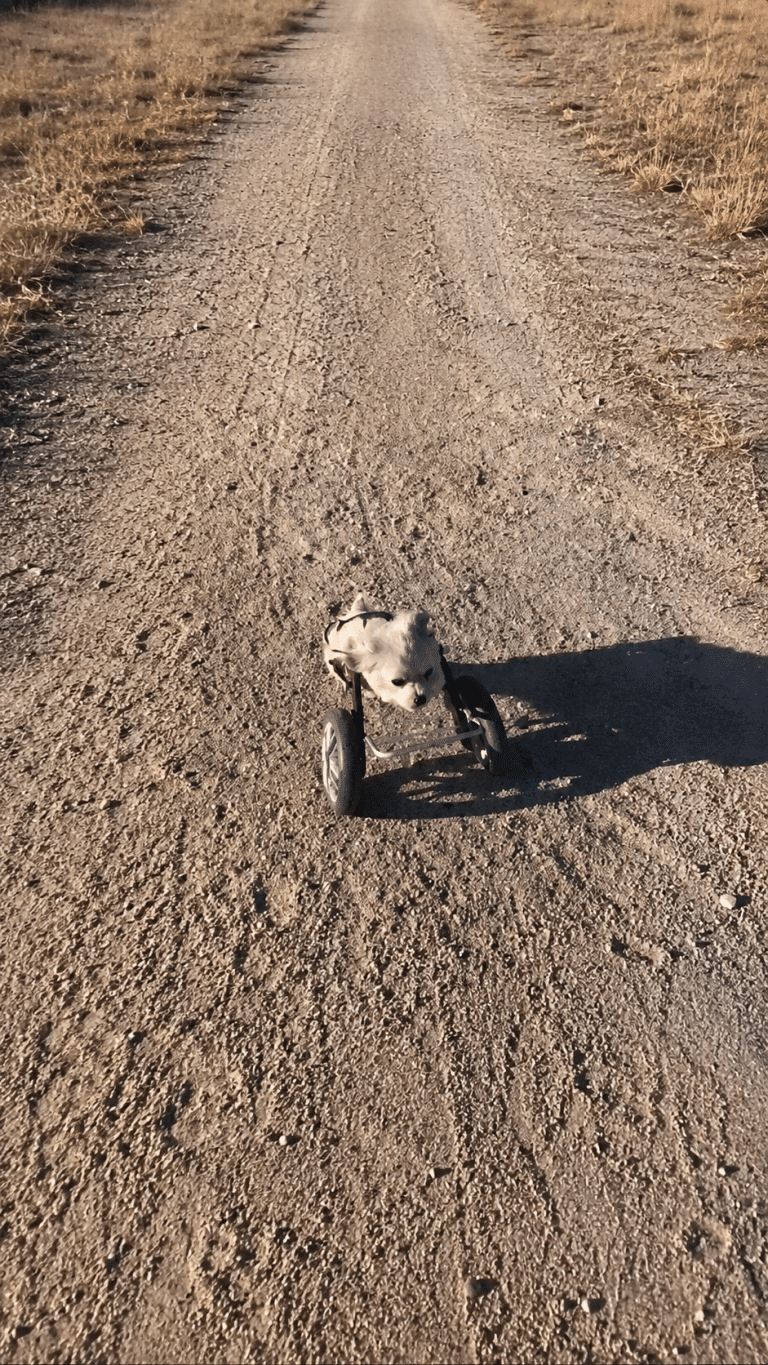
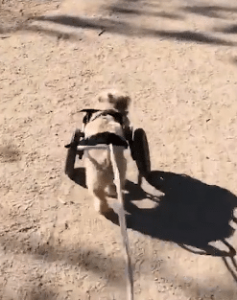
That was when Noel received a wheelchair designed for his small frame.
The device supported the back of his body while allowing his front paws to control his direction and speed.
At first, he needed time to understand how the wheels followed him.
Then the hesitation disappeared.
Noel moved forward.
The wheelchair rolled with him.
He tried again, this time faster.
Soon, the tiny dog who had once been recovering from the loss of both back legs was racing across the ground with remarkable excitement.
The wheelchair did not change Noel’s personality.
It gave that personality more room to express itself.
He could explore sidewalks without becoming tired as quickly.
He could move through parks with greater ease.
He could follow Lily instead of watching her disappear ahead of him.
During walks, Noel sometimes pulled Laura forward with so much enthusiasm that it seemed as though he had been waiting all day for the moment the wheels touched the ground.
His small front legs moved rapidly.
His ears lifted.
Every new scent became a reason to continue.
For Noel, the wheelchair was not a symbol of what had happened to him.
It was a tool that helped him participate in the life already unfolding around him.
Video: Noel Tries His Tiny Wheelchair—Then Takes Off Faster Than Anyone Expected
Lily Never Treated Him Like a Fragile Dog
At home, Noel shared much of his life with Lily.
Their friendship was affectionate, playful, and occasionally filled with noisy disagreements.
Lily did not appear to treat Noel as though he needed constant protection.
She played with him.
She listened when he barked.
And sometimes, like any close companion, she appeared mildly unimpressed by his insistence on being in charge.
Noel seemed to appreciate being treated like every other dog in the house.
He did not want to remain on the sidelines while Lily explored.
He wanted to participate.
When she moved through the room, Noel followed.
When she became excited, he joined the commotion.
When the two competed for attention, Noel made full use of his surprisingly powerful voice.
Their interactions helped create a life that felt ordinary in the best possible way.
Noel was not defined every minute by veterinary appointments, physical limitations, or the surgery that had changed his body.
He was simply a dog living with his friend.
He could be stubborn.
He could be demanding.
He could become dramatically excited about going outside.
And despite his size, he could behave as though he were responsible for protecting the entire household.
Those details revealed more about Noel than any medical description could.
His injuries were part of his history.
They were not the whole of his identity.
His Confidence Often Surprised Much Larger Dogs
Noel’s size never seemed to influence the way he viewed himself.
When he encountered larger dogs, he did not automatically retreat.
He barked directly at them, sometimes standing as tall as he could on his front legs while delivering what appeared to be a very serious warning.
Rottweilers did not impress him.
Dogs many times his weight did not silence him.
From Noel’s perspective, being small and having two legs were apparently unrelated to whether he should express his opinion.
Of course, Laura remained close and made sure his confidence did not place him in an unsafe situation.
But his boldness became one of the qualities people loved most about him.
He did not move through life timidly.
He entered each room as though everyone had been waiting for him.
His excitement affected the people around him too.
A dog balancing on two front legs could have made the room feel sad.
Noel rarely allowed that mood to last.
His barking, determination, and eagerness to participate shifted the attention away from what his body lacked.
People saw what was still there.
Energy.
Curiosity.
Affection.
And a personality far larger than his tiny frame.
His Life Is Not Without Challenges
Noel’s joyful personality does not mean every part of his life is easy.
Dogs who lose both hind legs can require ongoing care.
The skin around the lower body must be checked regularly for irritation or pressure injuries. The front legs and shoulders may carry additional strain. A wheelchair must fit properly and be used in a way that keeps the dog comfortable.
Noel also needs help navigating environments that were designed for four-legged animals.
Stairs can be difficult.
Rough ground may require assistance.
Long periods of movement can become tiring, even when he is eager to continue.
Laura pays attention to those limits.
She makes sure Noel has time outside his wheelchair to rest.
She watches for signs of discomfort.
She supports him when the terrain becomes difficult.
Giving Noel freedom does not mean pretending he has no physical needs.
It means creating a life in which those needs are met without removing the activities he loves.
The wheelchair helps him run.
His home gives him safe places to balance independently.
Laura’s attention ensures that his enthusiasm does not push his body too far.
This combination of support and independence allows Noel to live according to his personality rather than according to assumptions about what a two-legged dog can do.
Every Day, He Chooses the Next Adventure
Today, Noel’s routine is filled with the ordinary pleasures he once might never have experienced.
He wakes in a safe home.
He has Lily nearby.
He receives affection from a person who originally planned to care for him only temporarily and then realized that life without him would feel incomplete.
When it is time to go outside, Noel still becomes intensely excited.
He lifts his body.
His front paws move eagerly.
His bark echoes through the house.
Once secured in his wheelchair, he races forward with the same enthusiasm he brings to nearly everything.
Noel cannot explain how he experienced the loss of his legs.
No one can know exactly what he understood during surgery or recovery.
What people can see is how he responds to the life he has now.
He seeks activity.
He enjoys companionship.
He explores.
He plays.
And when he sees a much larger dog, he frequently makes sure his presence is acknowledged.
His story does not need to suggest that physical challenges are easy or that determination alone solves every difficulty.
Noel’s life works because his courage is supported by practical care.
Veterinary treatment saved him from continued pain.
Laura gave him a permanent home.
His wheelchair gave him access to greater movement.
And daily attention keeps him comfortable enough to enjoy the freedom he fought to regain.
Noel lost both of his back legs when he was still very young.
But he did not lose his curiosity.
He did not lose his confidence.
He certainly did not lose his voice.
Every day, the little dog who once arrived with devastating injuries moves through the world as though another adventure is already waiting for him.
And whenever Noel races forward on his tiny wheels, barking proudly at everything ahead, the people around him are reminded of something simple.
A full life is not always the life someone originally imagined.
Sometimes it is the life rebuilt afterward—with patience, support, and a two-legged dog determined to enjoy every possible moment.


