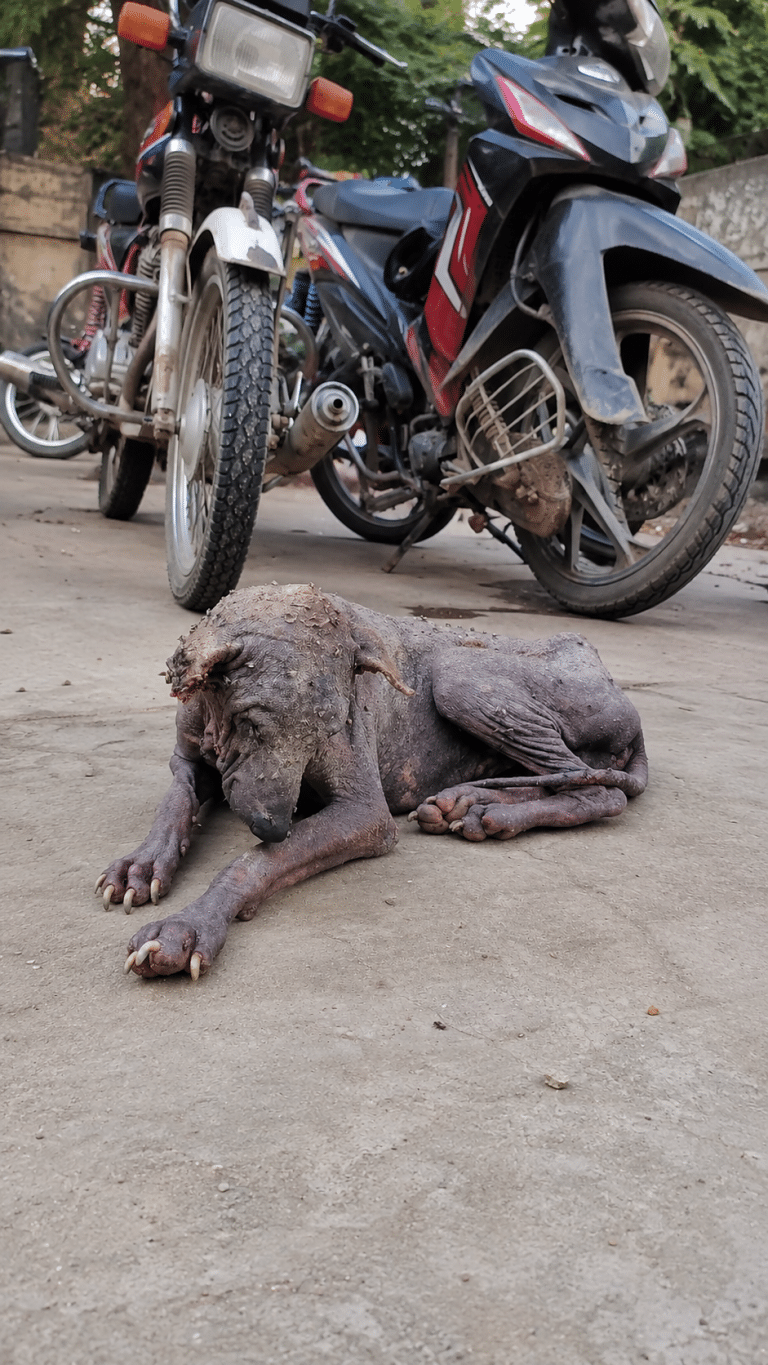
Yogi lay beside the road so quietly that people could have mistaken him for part of the dusty ground.
His body was painfully thin.
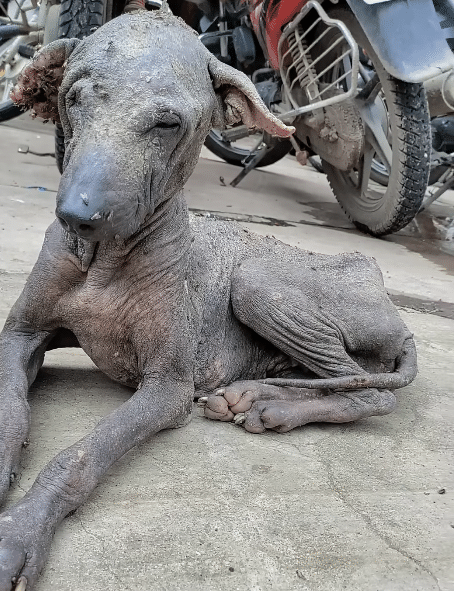
His skin was exposed from head to tail, covered by inflammation, hardened patches, and the visible effects of a severe untreated condition. There was almost no healthy fur left to protect him from the heat, dirt, or insects around him.
He did not bark when rescuers approached.
He did not attempt to run.
He barely lifted his head.
It was impossible to know exactly how long Yogi had been surviving in that condition. But his ribs, fragile posture, and damaged skin revealed that his suffering had not begun recently.
He needed medical help immediately.
More importantly, he needed someone to stop long enough to see that he was still alive.
The Dog Beside the Road Had Almost No Strength Left
When rescuers from RASA India first saw Yogi, they understood that approaching him would require extreme care.
He was physically weak, but fear could still make an injured animal react unpredictably. Even a gentle touch might cause pain when nearly every part of the body is inflamed.
The team kept a safe distance at first.
They watched his breathing.
They studied his movements.
They spoke softly so he would not be startled by sudden voices or footsteps.
Yogi remained on the ground.
His body appeared too exhausted to carry him away, and his eyes followed the rescuers without the energy normally seen in a frightened stray.
There was no way to know what experiences had shaped his response to people.
Perhaps he had been chased away before.
Perhaps human contact had always been followed by discomfort.
Or perhaps his body was simply too depleted to react.
The rescuers did not force him to stand.
Instead, they prepared a large safety net that allowed them to contain and lift him without placing unnecessary pressure on his damaged skin.
The process was slow.
Every movement had to be controlled.
Once Yogi was safely secured, the team carefully transferred him into the rescue vehicle.
Even then, he offered almost no resistance.
That lack of reaction was not reassuring.
It showed just how little energy remained in his body.
But something important had already changed.
Yogi was no longer lying unnoticed beside the road.
He was moving toward medical care.
Video: Hairless and Too Weak to Rise, Yogi Is Carefully Lifted From the Road
Beneath the Damaged Skin Was a Dog Who Needed Immediate Care
At the rescue center, caregivers could finally examine Yogi more closely.
The full condition of his body was difficult to ignore.
Severe mange had caused widespread hair loss. His exposed skin was irritated and uneven, with thickened areas, cracks, and crusted buildup across much of his body.
Without a healthy coat, Yogi had almost no natural protection from the environment.
Dust settled directly against his skin.
Flies and other insects could easily reach irritated areas.
Even lying on a rough surface may have caused additional discomfort.
He was also extremely underweight.
His ribs and hip bones were clearly visible, suggesting that he had not been receiving enough nutrition for a significant period.
The rescue team understood that no single treatment would restore him.
Yogi needed a complete recovery plan.
His skin condition had to be treated.
Secondary infection needed to be addressed.
His body required nutrition, hydration, warmth, and rest.
And because he was so fragile, every part of that care had to be introduced gradually.
The goal was not to create a dramatic transformation for the camera.
The first goal was much simpler.
Help Yogi become comfortable enough to eat, sleep, and begin stabilizing.
His First Medicated Bath Had to Be Done Slowly
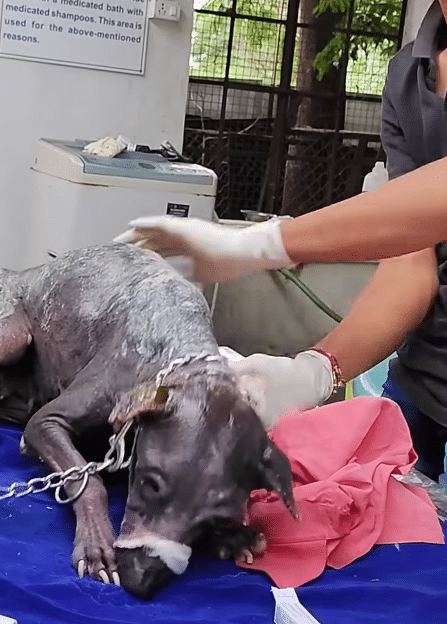
One of Yogi’s earliest treatments was a carefully prepared medicated bath.
For a healthy dog, a bath may be an ordinary part of grooming.
For Yogi, it was a medical procedure.
Warm water helped soften the hardened material covering portions of his skin. It also allowed caregivers to remove dust and debris without scraping or pulling at sensitive areas.
They worked slowly from one part of his body to another.
There was no vigorous scrubbing.
No rushing.
No attempt to remove everything at once.
Yogi’s skin had already endured too much.
Each touch had to be gentle enough to clean without creating more irritation.
As the water moved across his body, layers of dirt began to loosen. Areas that had been hidden beneath the buildup could finally be examined and treated more effectively.
The bath also offered something Yogi had likely been missing for a long time.
Relief.
Warm water surrounded his thin body.
Careful hands supported him when he was too weak to balance comfortably.
No one shouted at him or pushed him away.
Throughout the process, Yogi remained quiet.
His stillness could not be interpreted as complete trust. He was exhausted, unwell, and unfamiliar with the people around him.
But he allowed the caregivers to continue.
That alone made treatment possible.
The bath did not make Yogi suddenly healthy.
His ribs remained visible.
His skin remained inflamed.
He still had a long and uncertain recovery ahead.
Yet when the dirt had been rinsed away and he was carefully dried, he no longer looked like a forgotten shape beside the road.
He looked like a dog receiving care.
And that was the first step toward everything that followed.
Treating Severe Mange Would Take More Than a Few Days
Advanced mange does not disappear after one bath.
The condition is caused by mites that affect the skin, often leading to intense irritation, hair loss, inflammation, and secondary infections. When a dog has been untreated for a long time, recovery may require weeks or months of consistent veterinary supervision.
Yogi began receiving medication selected for his condition, including treatment intended to control the mites.
Antibiotics were also reportedly used to address infection.
His wounds and irritated areas were cleaned regularly, while caregivers monitored his skin for signs of improvement or further complications.
Because Yogi was so underweight, nutrition was another essential part of the plan.
A weak animal cannot rebuild damaged skin or grow a healthy coat without adequate nourishment.
But feeding a severely depleted dog also requires care.
Instead of expecting him to consume large meals immediately, the team could offer manageable portions while observing how his body responded.
Fresh water remained available.
A clean resting space protected his exposed skin from additional dirt.
Soft bedding reduced pressure against sore areas.
Every part of his environment was designed around one purpose: giving his body the conditions it needed to recover.
There was no instant cure.
Some days likely brought more visible progress than others.
Skin treatment can be slow, and early healing may look modest from the outside.
The redness may lessen slightly.
A wound may appear cleaner.
A dog may sleep more peacefully.
To someone expecting a dramatic before-and-after moment, those changes might appear insignificant.
To Yogi’s caregivers, they meant the treatment was beginning to help.
The First Signs of Healing Were Easy to Miss
Yogi’s recovery did not begin with a full coat of fur or a sudden burst of energy.
It began with much smaller changes.
His body became more stable.
The irritated areas of his skin appeared calmer.
He began responding more consistently to the food and care offered to him.
The distant expression in his eyes gradually softened.
These were not dramatic milestones.
But when an animal arrives nearly motionless, even a small response carries meaning.
A lifted head.
A longer glance toward a familiar caregiver.
The willingness to eat.
The ability to rest without constantly shifting from discomfort.
Each was evidence that Yogi’s body was no longer using every bit of its strength simply to endure the day.
The people caring for him continued following the same routine.
Medication.
Nutritious meals.
Skin treatments.
Clean bedding.
Quiet voices.
Gentle handling.
There was no demand that Yogi become affectionate in return.
He did not have to wag his tail to deserve another meal.
He did not need to approach anyone to receive treatment.
Care continued whether or not he knew how to respond to it.
That consistency mattered.
A dog who has lived alone with illness may not immediately understand the difference between being restrained for treatment and being harmed.
Trust can only grow when the experience remains predictable.
The same people return.
The hands stop when discomfort becomes too great.
Food arrives again.
The resting area remains safe through the night.
Through those repeated moments, Yogi could begin learning that the people around him were not another danger he needed to escape.
They were the reason his discomfort was finally beginning to ease.
His Body Needed Treatment—But His Routine Gave Him Security
Medical care addressed Yogi’s skin.
Daily routine helped address something less visible.
Before his rescue, Yogi’s days may have revolved around finding a place to lie down, avoiding danger, and enduring irritation he could not escape.
At the shelter, life became more predictable.
He knew where he would rest.
He began recognizing the people who brought his meals.
Treatment followed a familiar pattern instead of happening through sudden, frightening movements.
This structure may seem ordinary, but it can be deeply important for a traumatized animal.
Safety is not always understood through affection alone.
It is learned through repetition.
The water bowl is still there in the morning.
The bedding remains dry.
The person approaching him uses the same quiet voice as the day before.
Nothing painful happens when he closes his eyes.
Yogi did not need to understand every part of his treatment.
He only needed enough peaceful experiences to begin lowering his guard.
Over time, the dog who had barely reacted beside the road started becoming more aware of the life around him.
His eyes followed movement with greater interest.
His posture appeared less defeated by exhaustion.
He began looking less like an animal disappearing beneath disease and more like an individual returning to the world.
The change was gradual.
That made it more meaningful, not less.
Fur Was Not the First Measure of His Recovery
For many people watching Yogi’s story, the most anticipated moment may be the return of his coat.
Healthy fur would provide visible proof of how far he had come.
But caregivers understood that fur growth was only one part of recovery.
Before a new coat could grow, the mites had to be controlled.
The infection needed to improve.
Damaged skin had to heal.
His body required enough nutrition to devote energy toward rebuilding.
Those processes happened beneath the surface long before a dramatic visual transformation became possible.
For that reason, the earliest measures of success were more practical.
Was Yogi eating?
Was he maintaining hydration?
Were the wounds becoming cleaner?
Could he sleep comfortably?
Was he gaining strength?
Could he tolerate treatment with less distress?
Those questions mattered more than whether he looked completely different after a few days.
Recovery is rarely a straight line.
There may be setbacks.
Some areas of skin may heal faster than others.
Hair may return unevenly.
Medication may need to be adjusted under veterinary supervision.
Yogi’s condition had developed over time, and his body needed time to repair the damage.
The rescue team did not abandon him because the process was slow.
They kept showing up.
And each day of care moved Yogi farther away from the roadside where he had once lain alone.
Someone Stopped—and That Changed the Direction of His Life
Yogi’s story began in a place where his suffering could easily have remained unnoticed.
He was quiet.
He was weak.
He could not chase after someone or call attention to himself.
For an animal in that condition, survival often depends on whether one person chooses to look closely and act.
The RASA India rescuers made that choice.
They did not know how quickly Yogi would recover.
They could not promise that treatment would be simple.
They only knew that leaving him beside the road was not an option.
So they stopped.
They lifted him carefully.
They brought him somewhere clean.
And they began the slow work of helping his body recover from prolonged neglect and disease.
Yogi’s journey was not transformed by one dramatic gesture.
It was transformed by hundreds of smaller ones.
One careful bath.
One measured dose of medication.
One clean blanket.
One bowl of food.
One wound treated again the following day.
Compassion often looks ordinary when viewed moment by moment.
But when those moments are repeated, they can rebuild an entire life.
Yogi No Longer Has to Endure the Hard Days Alone
Yogi still has healing ahead of him.
His coat will need time to return.
His body must regain the weight and strength it lost.
His skin may remain sensitive even as the infection and mange improve.
There is no honest way to turn severe neglect into an instant happy ending.
But Yogi already has something he did not have beside the road.
Support.
When treatment is uncomfortable, someone remains with him.
When he needs food, it is provided.
When his bedding becomes dirty, it is replaced.
When his condition changes, people notice.
He no longer has to rely only on whatever strength remains inside his thin body.
That may be the most important transformation of all.
When rescuers first found Yogi, there was no healthy fur covering him. His body was fragile, and even lifting his head appeared to require effort.
But beneath the damaged skin was still a living animal capable of responding to care.
The early changes were quiet.
A calmer expression.
A steadier body.
A little more interest in the people nearby.
They did not erase what Yogi had endured.
They showed that his story was still moving forward.
Once, he lay beside the road while the world continued around him.
Today, he rests in a place where his condition is treated, his comfort matters, and his life is no longer overlooked.
His recovery may take time.
But this time, Yogi will not have to make that journey alone.


