For most dogs, the world begins with movement.
They follow unfamiliar sounds.
They run toward open doors.
They learn the feeling of grass beneath their paws and sunlight warming their backs.
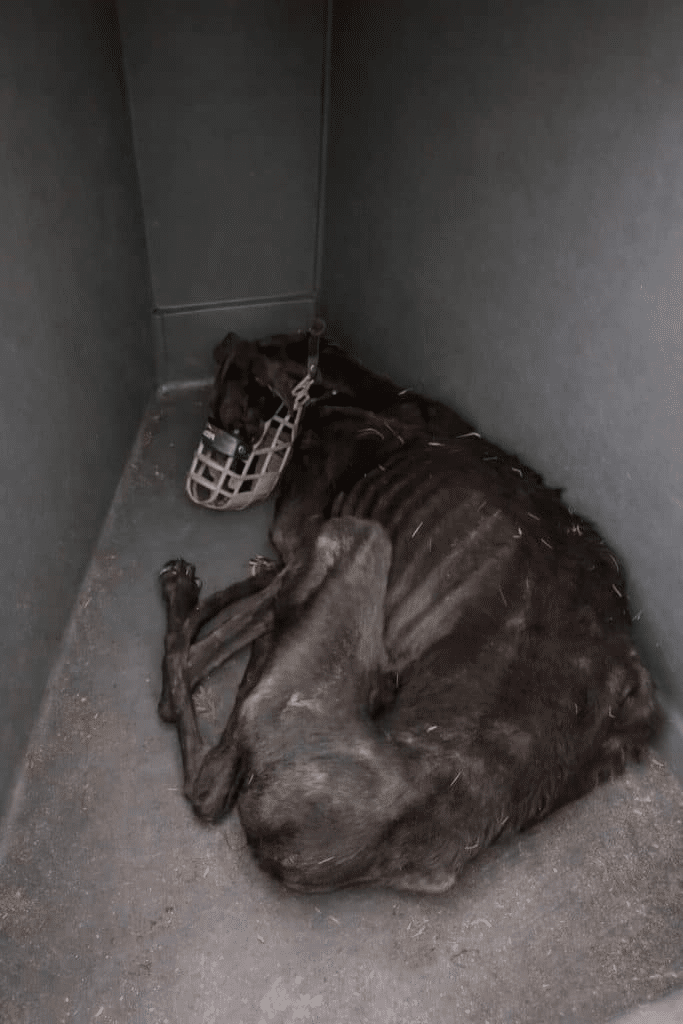
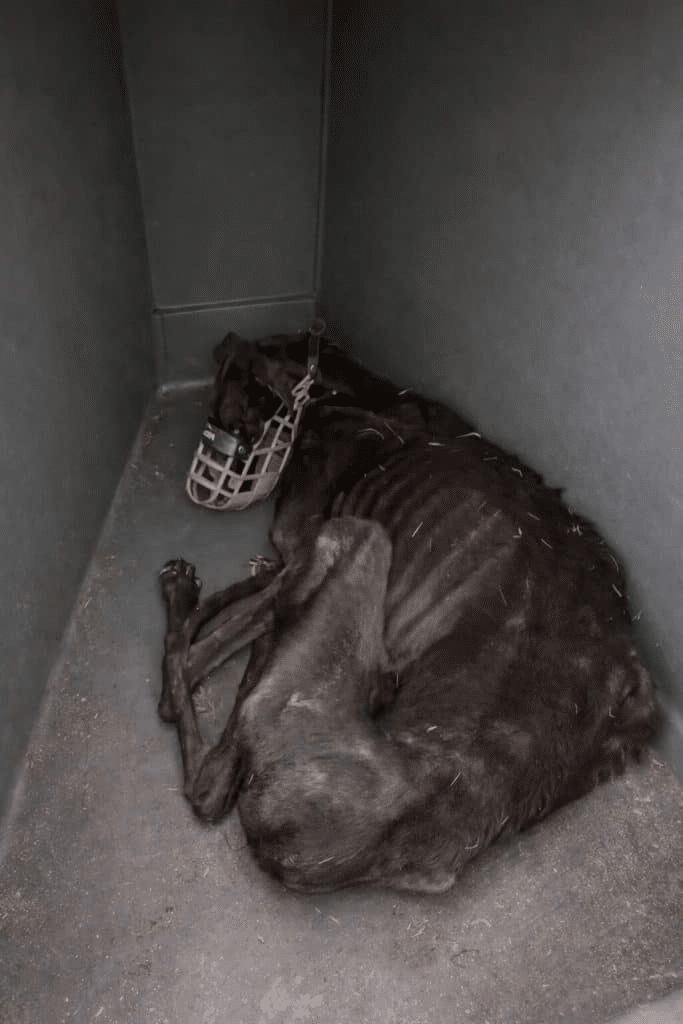
Coco reportedly spent much of his early life knowing none of those things.
His world was defined by metal bars and a space too small for a Greyhound built to stretch, walk, and run. Day after day, life continued beyond the cage while Coco remained inside it.
As the years passed, his body became thinner.
His muscles weakened from limited movement.
Even standing appeared difficult.
Then rescuers finally reached him.
The cage door opened.
Coco attempted to step forward—and collapsed.
The Greyhound Who Could Only Watch Life From Behind Bars
Greyhounds are recognized for their long legs, lean bodies, and remarkable speed.
Everything about their physical structure is designed for movement.
But Coco had reportedly spent years confined inside a cramped enclosure, unable to experience the ordinary freedom most dogs take for granted.
He could hear activity beyond the bars.
He could see people move past.
He may have watched other animals enter spaces he could not reach.
But his own routine rarely changed.
There were no long walks.
No open fields.
No opportunity to strengthen his legs through regular movement.
Over time, the effects of confinement became visible across his entire body.
His frame grew painfully thin.
The muscles that should have supported his long legs began to disappear.
His posture weakened, and the energy expected from a young dog seemed to fade.
Coco did not look like a Greyhound prepared to run.
He looked like an animal conserving every remaining bit of strength.
Exactly how he survived for so long could not be understood from appearance alone. But by the time help arrived, the rescue team knew he needed far more than an open cage door.
Freedom was the first step.
His body would still need to learn how to use it.
Video: Coco Leaves the Cage That Confined Him for Years—Then His Weakened Legs Give Way
Opening the Door Could Not Undo Years of Confinement
The rescuers approached Coco carefully.
An animal who has lived in isolation may react with fear, confusion, or complete withdrawal when unfamiliar people suddenly enter his space.
Coco appeared too weak to offer much resistance.
When the enclosure was finally opened, he tried to move forward.
It should have been a simple action.
One step beyond the bars.
One movement toward open space.
But his legs could not support him.
Coco collapsed almost immediately.
The moment was difficult to watch, yet it revealed something important about long-term neglect: removing an animal from danger does not instantly remove the effects of what happened there.
Coco was free from the cage.
His body was not yet free from the damage confinement had caused.
The rescuers supported him and moved him carefully, avoiding unnecessary pressure on his fragile frame. There would be time later to encourage movement.
For now, the priority was getting him somewhere warm and medically safe.
At the rescue center, Coco was placed on soft bedding.
The hard floor and metal bars were behind him.
He no longer had to remain upright simply because there was nowhere comfortable to lie.
For the first time, he could rest in a place designed around his needs.
But the rescue team understood that his condition remained serious.
A severely underweight dog cannot safely be expected to eat unlimited amounts of food immediately. His body had adapted to scarcity, and every stage of nourishment needed to be managed carefully.
His recovery began with small meals.
Warmth.
Hydration.
Medical observation.
And long periods of uninterrupted rest.
There was no pressure for Coco to stand.
No demand that he show gratitude.
Surviving the first days was enough.
At First, Keeping Him Stable Was the Only Goal
Coco’s early treatment focused on rebuilding the basic strength his body had lost.
Caregivers offered small, nourishing meals rather than overwhelming his weakened system. They monitored how he responded and adjusted his routine according to his needs.
He was kept warm.
His resting area remained clean.
Every movement was supported to reduce the risk of falls or injury.
The team also examined him for problems commonly associated with prolonged confinement and poor physical condition.
His skin needed attention.
His joints and muscles had to be assessed.
His ability to stand, balance, and walk required careful observation.
Greyhounds naturally carry little body fat, but Coco’s appearance went far beyond the breed’s usual lean build. His ribs, hips, and spine were sharply visible, showing how much weight and muscle his body needed to regain.
Still, recovery could not be rushed.
Too much activity could exhaust him.
Too much food too quickly could create additional medical risks.
Even affectionate attention had to be offered gently. Coco had spent so long without normal contact that unfamiliar hands and voices could easily become overwhelming.
So the caregivers kept everything simple.
They sat nearby.
They spoke quietly.
They brought food and water.
They allowed him to sleep.
Many rescue transformations are shown through dramatic before-and-after images. Coco’s earliest progress was far less visible.
He completed a meal.
He rested through the night.
His breathing remained steady.
He lifted his head when someone entered.
Each small success told the team that his body was beginning to respond.
One Brief Stand Became the First Sign of Change
Then, after several days of careful treatment, Coco attempted to rise.
At first, he shifted his weight slowly.
His long front legs moved beneath him.
His body trembled as the muscles tried to support a weight they had not carried properly for a long time.
For a moment, it appeared he might lower himself again.
Instead, Coco stood.
Only briefly.
His legs remained uncertain, and he could not hold the position for long.
But he had lifted himself without immediately collapsing.
To someone unfamiliar with his condition, it may not have looked extraordinary.
To the rescue team, it meant everything.
Standing showed that strength was returning.
It showed that his muscles could begin responding to nourishment and rest.
Most importantly, it gave the caregivers a foundation upon which rehabilitation could continue.
They did not celebrate by asking him to walk farther.
They allowed him to lie down again.
Progress needed to happen at Coco’s pace.
The following attempts remained cautious.
Some days, he stood more confidently.
Other days, fatigue arrived quickly.
Recovery was not a straight path from weakness to strength. His body had endured years of limited movement, and rebuilding it required repetition without pressure.
A few seconds upright became a few careful steps.
Those steps became short, supported walks.
Each movement helped strengthen muscles that had gone unused for too long.
Coco was not running yet.
But he was no longer completely dependent on others to lift him.
The Greyhound who had collapsed outside his cage was beginning to carry himself forward.
Gentle Contact Slowly Became Part of His New Routine
Physical strength was only one part of Coco’s recovery.
He also needed to become comfortable with people.
For much of his life, human presence may not have been associated with affection or safety. He had little reason to understand that a hand could arrive simply to comfort him.
During his first days in care, Coco appeared uncertain when people moved close.
Caregivers did not force interaction.
They allowed him to observe.
A hand might rest nearby before touching him.
A voice would remain soft and familiar.
If Coco appeared uncomfortable, the person stopped rather than continuing to pursue affection.
That respect gave him a sense of control he may never have experienced inside the cage.
Little by little, his posture began to change.
He no longer tensed as quickly when a familiar caregiver approached.
He accepted gentle strokes along his neck and back.
Eventually, he started resting while people remained beside him.
These moments mattered because trust cannot be explained to an animal.
It has to be demonstrated.
Food arrives again.
A blanket is replaced when it becomes dirty.
A person touches gently and then moves away.
No one forces the dog into a corner.
The same safe pattern repeats the following day.
Through consistency, Coco began learning that human contact did not always lead to discomfort or confinement.
Some people opened doors.
Some stayed beside him when his legs gave way.
Some offered care without demanding anything in return.
His First Steps Outside Revealed a Different Dog
As Coco gained weight and strength, the team began introducing him to more open environments.
At first, the outside world appeared enormous.
For a dog accustomed to confinement, even a quiet yard could feel unfamiliar. There were new smells in every direction, uneven ground beneath his paws, and more space than he knew how to use.
Coco moved carefully.
He studied the ground.
He paused frequently.
His legs still lacked the full stability expected from a healthy Greyhound, and caregivers stayed close enough to support him if necessary.
But Coco kept walking.
One cautious step led to another.
Fresh air moved around him.
There were no metal bars blocking the path ahead.
He could stop where he wanted.
He could turn around.
He could decide which scent to investigate.
Those choices may seem ordinary, but they represented an entirely new kind of life.
Inside the cage, Coco’s space had been decided for him.
Outside, he could begin making decisions of his own.
Over time, his walks became longer.
His balance improved.
His muscles continued developing beneath his coat.
The painfully thin outline of his body gradually softened as nutrition and movement restored what years of neglect had taken away.
Caregivers began seeing more than physical improvement.
Coco showed curiosity.
He looked toward sounds.
He explored instead of merely standing still.
He appeared increasingly interested in the world beyond his resting area.
The dog who had once watched life through bars was finally participating in it.
The Day He Began to Run
For a Greyhound, running is more than a way to move.
It is part of what the body was built to do.
But no one wanted to push Coco toward that moment before he was ready.
His legs needed strength.
His joints needed stability.
His body needed enough weight and endurance to move without placing him at unnecessary risk.
Then, during one of his outings, Coco’s pace changed.
A cautious walk became a quicker step.
His stride lengthened.
For a few seconds, he moved across the open ground with a freedom that had once seemed impossible.
Coco ran.
It was not the effortless speed of a fully conditioned Greyhound.
It did not need to be.
The importance of the moment came from what it represented.
The dog who had collapsed when his cage opened was now carrying himself forward because he chose to.
No bars stopped him.
No cramped enclosure defined the distance he could travel.
His legs moved beneath him, and the open space remained available ahead.
Watching Coco run made the long recovery visible all at once.
Every carefully measured meal had contributed to that moment.
Every night on clean bedding.
Every supported attempt to stand.
Every short walk that strengthened his body without exhausting it.
Every patient interaction that helped him feel safe enough to explore.
The run lasted only a short time.
But it proved how far he had come.
Coco was no longer merely being kept alive.
He was discovering how it felt to live.
His Transformation Happened Through Ordinary Care
As weeks became months, Coco continued changing.
His weight increased gradually.
His muscles became more visible.
His coat grew healthier.
His posture no longer reflected the same extreme weakness seen on the day of his rescue.
But his transformation was not created by one extraordinary treatment.
It happened through ordinary acts repeated consistently.
Meals arrived when expected.
Medical needs were addressed.
He had space to rest without being disturbed.
Walks were adjusted to match his strength.
Affection was offered without force.
Those actions gave Coco’s body and behavior time to change naturally.
The sadness people thought they saw in his earliest expression became less prominent as curiosity and awareness returned.
He began greeting familiar people.
He rested more comfortably near them.
He showed interest in the routines around him.
Recovery did not erase the years he had lost.
It gave him experiences that confinement had denied him.
Soft beds.
Open doors.
Human companionship.
The ability to walk away from a place when he wanted.
For most dogs, these things are part of daily life.
For Coco, each one was new.
A Family Offered Him the Life He Had Never Known
Eventually, Coco became ready for the next stage of his journey.
A family learned about him and decided they were willing to welcome a dog whose past required patience and understanding.
Meeting a potential family could not be treated as a simple test of whether Coco behaved perfectly.
He had spent years with little control over his surroundings.
A new home would bring unfamiliar sounds, people, rooms, and routines.
He needed a family who understood that adjustment might take time.
They allowed him to move at his own pace.
They did not surround him or demand immediate affection.
They gave him space to observe and enough consistency to begin feeling secure.
Coco gradually settled into the home.
He discovered places where he could stretch his long body without touching metal bars.
He learned the comfort of sleeping indoors while knowing the door would open again in the morning.
He experienced companionship that did not disappear after a short visit.
The dog who had once possessed almost nothing now had belongings of his own.
A bed.
A bowl.
A familiar walking route.
People who noticed whether he was comfortable.
His new life was not remarkable because it was luxurious.
It was remarkable because it was normal.
Coco was finally being treated like a family dog rather than an animal expected to exist inside a cage.
The Years Behind Bars No Longer Define Every Day Ahead
Coco cannot recover the time he lost.
No rescue can return the early years he might have spent running, playing, and discovering the world.
His body may always carry some effects of prolonged confinement.
New situations may still require patience.
But his story did not end when rescuers found him weak and unable to stand.
That moment became the beginning of something else.
The cage opened.
He collapsed.
People lifted him.
Then they stayed long enough for him to stand again.
Coco’s transformation was not created by asking him to forget what happened.
It was created by giving him a future that no longer repeated it.
He no longer watches life from behind bars.
He walks through open spaces.
He rests beside people he knows.
And when his body carries him into a run, the distance ahead belongs to him.
Once, Coco was a Greyhound who could barely stand outside the cage that had confined him.
Today, he knows the feeling of safe hands, open ground, and a home where no one intends to lock him away again.
His story is a reminder that rescue does more than remove an animal from a terrible place.
It gives that animal time.
Time to heal.
Time to trust.
Time to rediscover the abilities neglect tried to take away.
And sometimes, after years of watching the world from a distance, it gives a dog the chance to finally run into it.


