Christmas Eve is usually associated with warm homes, glowing lights, and families gathering together.
For one heavily pregnant dog, the night looked very different.
Workers at the IAPA shelter found her outside their gates, alone and visibly exhausted. Her body trembled as she tried to remain standing, while her swollen belly showed that she was approaching the final stage of pregnancy.
She watched every movement around her.
When someone stepped closer, her body became tense.
She was not looking for a fight.
She appeared frightened, physically depleted, and uncertain whether the approaching hands would protect her or create another reason to be afraid.
The shelter team brought her inside.
They gave her the name Nata.
And before the holiday night was over, her life had already begun moving in a new direction.
The Pregnant Dog Outside the Gate Could Barely Stand
No one at the shelter knew exactly how long Nata had been waiting outside.
They could not confirm every detail of how she arrived or why the people responsible for her had left her there.
What they could see was concerning enough.
Nata was heavily pregnant.
Her legs appeared weak.
Her body shook from exhaustion and stress.
She was close to giving birth, yet she had been left without the calm, protected environment a mother dog needs during the final days of pregnancy.
The shelter gate may have been chosen because someone believed she would be found there.
But leaving a vulnerable animal outside still exposed her to weather, traffic, fear, and possible medical complications before anyone noticed.
Fortunately, the staff did notice.
They approached slowly, understanding that Nata’s guarded behavior was not something to punish.
A pregnant dog may become especially cautious when she feels threatened or uncertain. Her body is already under enormous physical pressure, and instinct can make her highly aware of anything approaching her vulnerable belly.
The rescuers avoided surrounding her.
They did not reach abruptly over her head.
Instead, they spoke in low voices and gave her enough space to observe them.
Nata remained tense.
But she allowed them to bring her through the gate.
That small act of cooperation gave the team the opportunity to offer what she urgently needed.
Warmth.
Water.
Food.
A quiet place to rest.
And medical attention before labor began.
Video: Pregnant Dog Left Outside a Shelter on Christmas Eve Is Carefully Brought to Safety
Safety Had to Be Shown Through Patience
During her first days at the shelter, Nata remained alert around unfamiliar people.
She watched hands closely.
Sudden sounds caused her to startle.
When someone entered her resting area, she seemed to assess every movement before deciding whether to relax.
The caregivers did not expect her to become trusting immediately.
They understood that a warm blanket could improve her physical comfort without instantly removing her uncertainty.
Trust would need to be built through repetition.
A caregiver entered quietly.
Food was placed nearby.
The same person returned later without forcing contact.
Her bedding was changed gently.
Hands moved slowly around her belly.
Voices stayed soft even when she appeared nervous.
Every peaceful interaction gave Nata new information.
These people were not trying to push her away.
They were not taking her food.
They were not forcing her to move when she needed rest.
They were preparing a safe place for her and the puppies she was carrying.
Little by little, her posture began to soften.
She still remained observant, but she no longer reacted to every movement with the same intensity.
She accepted food.
She allowed caregivers to remain near her.
Eventually, the team could examine her more closely without causing overwhelming distress.
That opened the way for an important next step.
An ultrasound.
The Ultrasound Revealed a Remarkably Large Litter
The veterinary team needed to understand Nata’s condition before labor began.
An ultrasound could help confirm the pregnancy, evaluate the puppies, and give the shelter some idea of how many newborns might soon require care.
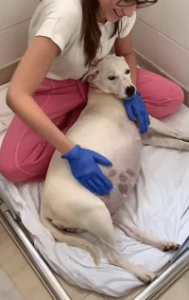
Nata was positioned carefully.
The examination was performed as gently as possible, with caregivers remaining nearby to reassure her.
Then the screen began revealing the lives inside her.
One puppy.
Then another.
And another.
The number continued growing.
The team believed Nata could be carrying thirteen or fourteen puppies—an exceptionally large litter for a mother already arriving weak and exhausted.
The discovery changed the shelter’s preparations immediately.
A large litter creates additional concerns.
Labor may last for many hours.
The mother can become severely fatigued.
Some puppies may need assistance if they are weak, positioned poorly, or unable to nurse effectively after birth.
The shelter needed clean bedding, warming supplies, food for Nata, and people prepared to monitor the family throughout the delivery.
There would also need to be enough room for every puppy to remain close to its mother without becoming chilled or pushed away from the nursing area.
The rescue team began organizing everything they might need.
They could not guarantee that the birth would be easy.
They could only make sure Nata would not face it outside, alone, and unobserved.
Labor Began With the Team Beside Her
When Nata went into labor, shelter workers stayed close.
They kept the environment as quiet as possible.
Too much movement or noise could increase stress, so the team monitored her without crowding the space.
The first puppy arrived.
Small.
Pale.
Completely dependent on its mother.
Then another followed.
And another.
With every birth, caregivers watched both Nata and the newborn carefully.
Was the puppy breathing?
Was the mother cleaning it?
Could it move toward warmth and begin nursing?
Did Nata appear strong enough to continue?
Hours passed as the litter continued growing.
Labor is physically demanding for any mother dog. For Nata, who had entered the shelter already weak, each delivery required strength her caregivers could not take for granted.
Still, she continued.
The small bodies gathered beside her.
Some cried softly.
Some immediately searched for milk.
Others needed help being dried and positioned close to their mother.
The count rose until the team reached fourteen.
Fourteen newborn puppies had entered the world safely inside the shelter.
Only a short time earlier, their mother had been outside the gate with no medical support and no protected place to give birth.
Now Nata rested on clean bedding with every puppy gathered around her.
Fourteen Puppies Created Fourteen New Responsibilities
The delivery was a major milestone.
It was not the end of the risk.
Newborn puppies are fragile during their earliest days. They cannot regulate their body temperature well, and they rely on frequent nursing to maintain energy and continue developing.
With a litter as large as Nata’s, the shelter team needed to make sure that every puppy received enough access to its mother.
The smallest or weakest puppies could easily be pushed away by stronger siblings.
Caregivers watched closely.
They counted the puppies repeatedly.
They checked that each one was warm.
They helped position smaller puppies near Nata when necessary.
They replaced damp bedding and kept the area clean.
The mother also needed careful monitoring.
Producing milk for fourteen puppies placed an enormous nutritional demand on her body. She required appropriate food, fresh water, rest, and veterinary observation as she recovered from the delivery.
Post-birth examinations helped the team check for complications.
Bloodwork and physical assessments could provide important information about her condition after labor.
The caregivers also watched for changes in appetite, energy, body temperature, or behavior that might indicate Nata needed additional treatment.
The first days required constant attention.
There were no long stretches when everyone could simply assume the family was fine.
Someone needed to notice if a puppy stopped nursing.
Someone needed to make sure Nata was comfortable enough to remain with the litter.
Someone needed to keep the space calm while addressing every practical need around them.
Rescue had brought Nata through the shelter gate.
Ongoing care would help carry the entire family through the weeks ahead.
Nata’s Behavior Changed Once Her Puppies Were Safe
During her arrival, Nata had watched every person with uncertainty.
After the birth, her attention remained focused on the puppies.
She cleaned them.
She adjusted her body so they could nurse.
When one cried or moved away from the group, she noticed.
Her caution around people did not disappear immediately.
A mother with newborn puppies may remain highly protective even in a safe environment.
The shelter staff respected that instinct.
They did not handle the puppies more than necessary.
They kept interactions predictable.
When a puppy needed to be checked, the movement was calm and visible rather than sudden.
Nata gradually learned that the caregivers entering her space were helping rather than separating her from the litter.
Her body appeared more relaxed as the days passed.
She accepted their presence.
She rested while they changed bedding nearby.
She allowed health checks to continue.
The shift was not dramatic.
There was no single instant when every fear disappeared.
Instead, trust developed through daily evidence.
The same people brought food.
The same hands returned puppies safely after examinations.
No one removed her from the family she was working so hard to care for.
Her guarded posture softened because the shelter remained consistent.
The frightening uncertainty outside the gate had been replaced by routine.
For Nata, routine meant she could focus on being a mother.
The Shelter Filled With the Sounds of New Life
During the first days, the puppies did little more than nurse, sleep, and move toward warmth.
They remained pressed closely together beside Nata, creating a small, shifting pile of white bodies.
Their eyes were closed.
Their movements were uncoordinated.
Their cries were soft but persistent whenever they became hungry or separated from the group.
As the days passed, their bodies grew stronger.
They began moving with greater purpose.
Tiny paws pushed across the bedding.
Heads lifted toward familiar scents.
The puppies competed more confidently for places beside their mother.
The shelter, which had prepared for an uncertain emergency, was now filled with the ordinary sounds of fourteen newborn dogs developing together.
There were sleepy whimpers.
Rustling blankets.
Caregivers quietly counting the litter again.
Nata shifting her body to find a more comfortable position.
Every sound represented progress.
The puppies were not outside in the cold.
They were not being delivered without help.
They were warm, fed, and watched over by both their mother and the people supporting her.
For the team, the scene carried special weight.
They remembered how weak Nata had looked when she arrived.
Now she was caring for fourteen puppies while recovering from labor herself.
Her body still needed support.
But she no longer had to protect the litter without help.
Growing Puppies Quickly Changed the Rhythm of the Shelter
The newborn stage did not last long.
As the puppies developed, their eyes began opening.
They became more aware of voices, movement, and one another.
Crawling turned into uncertain standing.
Standing became walking.
Soon, fourteen puppies were attempting to explore the same space at once.
The shelter’s quiet maternity area became far more active.
Puppies climbed over their siblings.
They wandered away from Nata, then returned when they became tired or hungry.
They investigated blankets, hands, bowls, and anything else within reach.
Their coordination remained imperfect.
One would take several determined steps and tumble into another.
A group might fall asleep together after only a few minutes of exploration.
Then they would wake and begin again.
Nata remained central to their world.
She continued nursing and cleaning them while also beginning to take brief breaks as the puppies became more independent.
The caregivers supported that transition.
They watched the puppies’ growth.
They introduced age-appropriate nourishment when the time was right.
They kept the environment clean despite fourteen increasingly mobile bodies.
They also began thinking beyond immediate survival.
Each puppy would eventually need veterinary care, vaccination, socialization, and a responsible permanent home.
Saving a large litter requires planning that extends far beyond the emotional birth footage.
The puppies needed futures.
Nata needed one too.
Nata Was More Than the Mother of Fourteen Puppies
Large rescue stories often focus so heavily on the newborns that the mother becomes almost invisible.
Nata deserved attention as an individual.
She had arrived exhausted and frightened.
She had endured a long delivery.
She had provided constant care for a remarkably large litter while her own body recovered.
Once the puppies became more independent, Nata needed opportunities to rest away from them.
She needed individual affection.
She needed exercise appropriate for her condition.
She needed to learn what life could feel like when she was not carrying or feeding fourteen small bodies.
The shelter staff continued working with her gently.
Without the immediate pressure of pregnancy and newborn care, more of her personality could emerge.
She could observe people without feeling that every interaction involved protecting the litter.
She could receive attention for herself.
She could begin building confidence as a dog rather than only as a mother.
That distinction mattered for her long-term future.
Nata’s value was not limited to the puppies she delivered.
She also deserved a safe home, dependable care, and people willing to understand that her cautious behavior had developed during a deeply uncertain period.
The puppies’ survival was part of her story.
It did not need to become the only part.
Their Rescue Began Before the Puppies Were Born
Looking at fourteen growing puppies, it would be easy to think their story began during the delivery.
It began earlier.
It began when someone noticed Nata outside the shelter gate.
Had she remained there longer, labor might have started without medical observation or protection from the weather.
A complicated delivery could have placed both her and the puppies in danger.
A weak mother might have struggled to keep such a large litter warm and nourished without additional support.
Bringing Nata inside created the conditions the family needed.
The ultrasound gave the team time to prepare.
The quiet room gave her somewhere secure to deliver.
The caregivers ensured that weaker puppies were noticed.
Veterinary support allowed her recovery to be monitored after fourteen births.
One decision connected all those later moments.
The shelter staff did not treat Nata’s fear as a reason to keep their distance.
They recognized it as a reason to move more carefully.
They brought her in despite her uncertainty.
They gave her the time needed to understand that the space was safe.
That patience protected more than one life.
It protected fifteen.
Christmas Eve Became the Start of a Different Future
Nata’s arrival did not look like the Christmas Eve most people imagine.
There were no wrapped presents waiting for her.
No decorated room she understood.
No family gathering around a warm table.
Her first gift was much simpler.
A gate opened.
A quiet space was prepared.
Food and water were placed within reach.
People stayed close enough to help without demanding that she trust them immediately.
Those actions changed what happened next.
Instead of giving birth outside, Nata delivered her puppies in safety.
Instead of facing fourteen newborns alone, she had caregivers monitoring the litter.
Instead of remaining frightened by every human movement, she gradually began relaxing around the people who returned each day.
The holiday did not erase the hardship that brought her there.
It created a beginning beyond it.
For the shelter workers, Christmas Eve became associated with a frightened pregnant dog whose future was still uncertain.
The weeks afterward transformed that memory.
They saw Nata resting beside the puppies.
They watched fourteen pairs of eyes open.
They saw the litter begin walking, playing, and filling the shelter with movement.
A night that began with abandonment became the first chapter of fifteen recoveries.
The Family Still Needed Responsible Homes
As the puppies became old enough for adoption, the shelter faced the challenge of finding appropriate families.
Fourteen puppies attract attention.
Their photographs are easy to share.
Their small size and playful behavior can make people want to bring one home immediately.
But responsible adoption requires more than an emotional reaction.
Each puppy would grow.
Each would need training, veterinary care, exercise, patience, and a long-term financial commitment.
Potential adopters needed to understand that a Christmas rescue story did not make the everyday responsibilities of dog ownership disappear.
The shelter could assess applications carefully.
Families could be matched according to the puppy’s temperament and needs.
Adopters could receive guidance about vaccinations, sterilization, socialization, feeding, and helping a young dog adjust to a new environment.
Nata’s placement required equal care.
She needed a home where people would move patiently, respect her boundaries, and give her time to understand a new routine.
A successful rescue does not end when an animal is photographed outside danger.
It continues until safety becomes sustainable.
For Nata and her puppies, that meant moving from emergency shelter care toward permanent homes capable of protecting them for years.
One Open Gate Protected Fifteen Lives
When Nata stood outside the shelter on Christmas Eve, she appeared to have very little strength remaining.
She was close to labor.
She was frightened by human contact.
And she was carrying a litter far larger than anyone initially expected.
The team could not promise an uncomplicated birth.
They could not know whether every puppy would be healthy.
They could not immediately erase Nata’s uncertainty.
They could only begin with what she needed in that moment.
Bring her inside.
Keep her warm.
Feed her.
Examine her.
Stay.
From those simple decisions came everything that followed.
The ultrasound revealing fourteen puppies.
The long hours of labor.
The tiny white bodies gathering beside her.
The days of monitoring, feeding, cleaning, and counting.
The moment the puppies opened their eyes.
Their first uncertain steps.
And the gradual change in a mother who no longer watched every approaching hand with the same fear.
Nata kept her puppies close.
The shelter made sure she did not have to keep them safe alone.
The Night She Was Left Behind Became Their First Night of Safety
Nata’s story carries an emotional contrast.
Someone left a heavily pregnant dog outside on a holiday associated with family and warmth.
But the people inside the shelter chose not to let that abandonment decide what happened next.
They did not see only a frightened dog behaving cautiously.
They saw a mother in urgent need of protection.
They brought her through the gate and gave her enough space to begin settling.
When the ultrasound revealed the size of her litter, they prepared.
When labor started, they stayed.
When fourteen puppies arrived, they continued caring for every one of them.
Nata’s fear did not vanish the moment she was rescued.
Her exhaustion did not disappear after the final puppy was born.
Healing took place slowly, through dependable care repeated across many days.
That makes the outcome more meaningful.
She was not transformed by one dramatic act.
She was supported through an entire process.
Once, Nata stood outside the shelter trembling, unsure whether the people approaching her were safe.
Soon afterward, she lay inside on clean blankets with fourteen newborn puppies pressed against her body.
The weather outside had not changed.
The night was still cold.
But for Nata and the tiny lives depending on her, everything important had.
They had shelter.
They had medical care.
They had people watching over them.
And on the Christmas Eve when Nata appeared to have been left with almost nothing, one open gate gave her entire family the beginning they needed.


