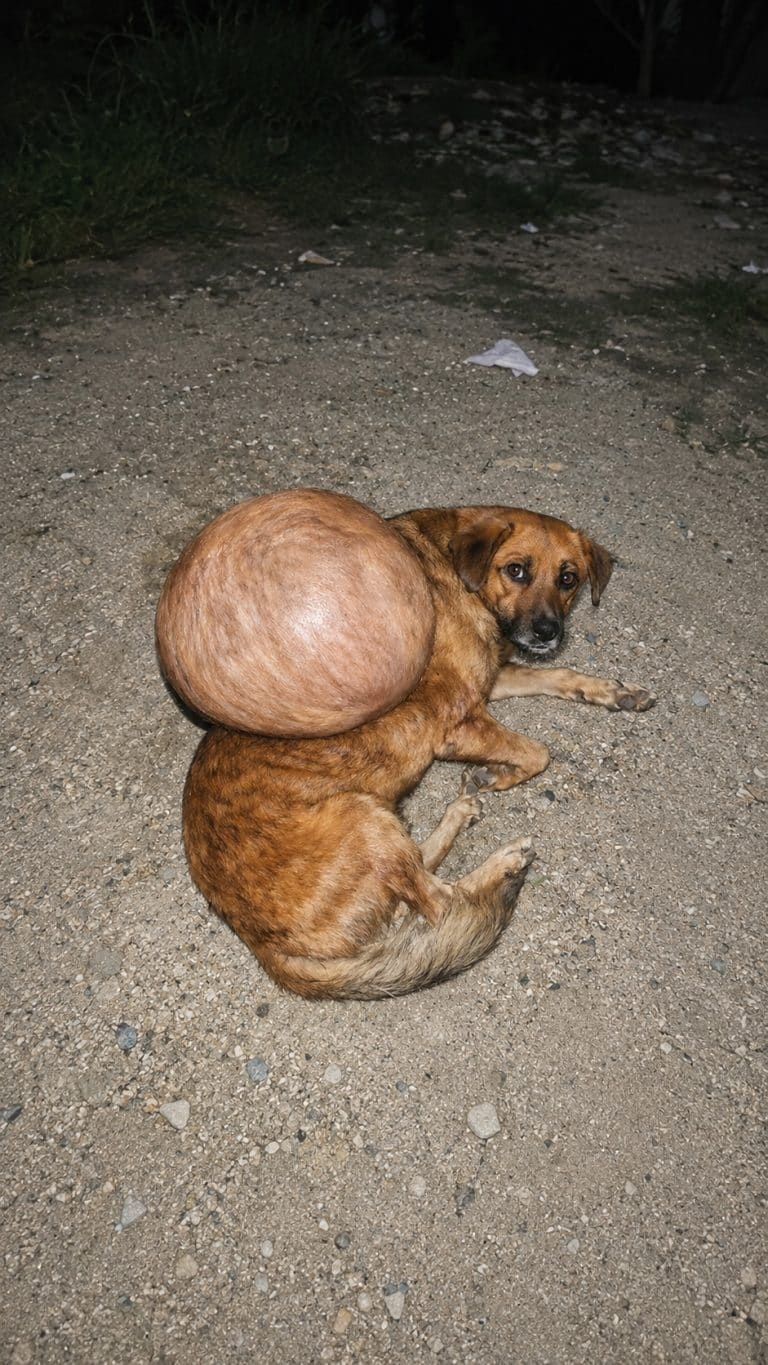
The first thing rescuers noticed was the weight pressing across Fenix’s back.
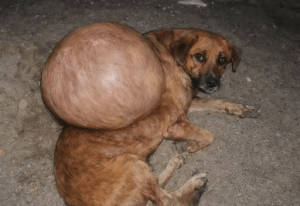
The growth was so large that it altered the shape of his entire body. It hung heavily from one side, pulling against his skin and making even ordinary movement appear exhausting.
Fenix had reportedly lived with the mass for years.
During that time, it continued growing.
Walking became harder.
Finding a comfortable position became nearly impossible.
Yet no veterinary treatment came.
By the time someone finally stepped in, the tumor weighed close to six kilograms—an enormous burden for a dog already weakened by poor care.
Fenix could not ask for an examination.
He could not explain how much the weight affected every step.
He could only continue carrying it.
Then rescuers saw him and made the decision that changed the direction of his life.
The Weight on His Back Had Become Impossible to Ignore
According to those involved in his rescue, Fenix had once belonged to someone.
But living near people had not protected him from prolonged neglect.
As the growth expanded across his back, he continued moving between the house and yard, adjusting his body around a burden that became larger with time.
There was no comfortable way to carry it.
When he walked, the tumor pulled against his back.
When he tried to lie down, he had to position himself carefully so the heavy mass would not press painfully beneath him.
Rest was difficult.
Movement was difficult.
Even turning his body required him to account for the weight attached to it.
Fenix reportedly survived largely on scraps and whatever food was available. His coat became dirty, his skin was irritated, and ticks were found across parts of his body when help finally arrived.
The rescuers could not know every detail of what his days had been like.
They could see the result.
His frame appeared depleted.
His movements were slow.
The tumor had reached a size no one could reasonably overlook.
Despite his condition, Fenix did not react aggressively when rescuers approached.
He appeared cautious and tired, but he allowed them to remain near him.
That gentleness made the sight even more difficult to understand.
The dog had spent years living with a condition that should have received medical attention much earlier, yet he still responded to people without the anger viewers might have expected.
The team did not waste time deciding whether he was worth helping.
They prepared to transport him.
Lifting Fenix required particular care because the tumor could not simply be pulled or allowed to swing freely. His body and the heavy growth both needed support while he was moved into the vehicle.
For the first time in years, Fenix was not being asked to adapt to the tumor alone.
People were adapting their movements around him.
They supported his body.
They kept him steady.
And they carried him toward the veterinary care he had needed for far too long.
Video: Dog Carrying a Massive Tumor Is Finally Taken From Neglect to Veterinary Care
Veterinarians Had to Decide Whether Surgery Was Possible
At the clinic, the medical team began examining Fenix carefully.
The size of the tumor was obvious.
What remained uncertain was how deeply it was connected to the surrounding tissue, how much blood supply it contained, and whether Fenix’s weakened body could safely endure a major operation.
Removing a growth of that size was not a routine procedure.
The team needed to evaluate his overall condition first.
His heart and breathing had to be considered.
Blood tests could help reveal anemia, infection, organ function, and whether his body was stable enough for anesthesia.
The tumor itself needed to be examined through imaging and physical assessment.
Veterinarians also had to consider the condition of the skin covering and surrounding it.
A mass that has grown for years can stretch tissue, restrict movement, and create areas vulnerable to irritation or infection. Removing it might leave a large surgical site requiring careful closure and prolonged aftercare.
Fenix’s ticks and neglected skin also needed attention.
But the most urgent question remained the same:
Could the tumor be removed without placing his life at unacceptable risk?
The answer was not simple.
Surgery would be difficult.
Fenix was already physically depleted.
The operation could involve significant bleeding, and the amount of tissue affected meant recovery would require close observation.
At the same time, leaving the tumor in place offered little chance of a comfortable future.
It had already taken control of the way he moved, rested, and carried himself.
Without treatment, it could continue growing or create further complications.
The veterinary team prepared for surgery.
They did not promise an easy outcome.
They gave Fenix the chance that had been delayed for years.
More Than Two Hours in Surgery Changed His Entire Body
Once Fenix was anesthetized, the veterinary team began the delicate work of separating the tumor from his body.
The operation reportedly lasted more than two hours.
Every stage required precision.
The surgeons had to control bleeding while carefully working through tissue altered by years of growth. Removing too little could leave affected tissue behind. Moving too aggressively could create unnecessary trauma.
Outside the operating room, the people who had rescued Fenix could do little but wait.
The dog had survived for years beneath the tumor’s weight.
Now his future depended on a procedure his weakened body had never been given the opportunity to receive earlier.
Inside, the medical team continued.
Slowly, the mass was separated.
The enormous burden that had shaped Fenix’s daily life was finally lifted away.
When it was weighed, the tumor measured close to six kilograms.
Six kilograms that Fenix had carried while walking.
Six kilograms he had tried to position around whenever he rested.
Six kilograms pulling continuously against a body that was already too thin.
The number helped people understand the scale of what had happened, but the true impact could be seen in Fenix himself.
For the first time in years, his back was no longer dominated by the growth.
The surgical site was cleaned and closed.
His remaining skin problems were addressed, and ticks were carefully removed from his body.
Then Fenix was moved into recovery.
He was still unconscious.
The operation had succeeded, but the most dangerous hours were not necessarily over.
A dog recovering from major surgery needs monitoring for bleeding, changes in breathing, pain, infection, and complications related to anesthesia.
Fenix needed warmth.
Fluids.
Pain control.
A clean place to remain still.
The veterinary team watched him closely as he began waking.
The tumor was gone.
His body now had to learn what it felt like without the weight it had carried for so long.
Recovery Began With Rest, Food, and Careful Steps
Fenix did not stand up from surgery and immediately become a healthy dog.
The operation removed the largest physical burden, but years of poor condition could not be reversed in a single afternoon.
His surgical wound needed time to close.
His weakened body needed nutrition.
His muscles needed to adjust to moving without the tumor pulling his weight to one side.
At first, rest was essential.
Fenix was placed on soft bedding where he could lie without the hard pressure he had known before. Caregivers helped him change position when necessary and monitored the surgical area for swelling, irritation, or other signs that required medical attention.
Meals were provided regularly.
Instead of depending on scraps, he received food selected to support recovery and healthy weight gain.
His body needed protein and energy to repair tissue.
It also needed time to respond.
Fenix’s first movements after surgery were cautious.
His balance had been shaped by years of compensating for the growth. Without it, the distribution of weight across his body felt different.
He stood slowly.
He tested his legs.
Then he began taking careful steps.
The change was immediately visible, but progress remained gradual.
Some days were devoted almost entirely to resting.
On others, he walked a little farther.
The caregivers did not push him to move beyond what his body could safely manage.
Their goal was not to create dramatic footage.
It was to help him heal without damaging the surgical site or exhausting himself.
His skin also required continued care.
Areas irritated by ticks and neglect needed cleaning and treatment. His coat would take time to improve, and healthy weight could return only through consistent feeding.
The people around Fenix followed a routine.
Medication.
Wound checks.
Meals.
Short periods of gentle movement.
Clean blankets.
Quiet companionship.
None of those actions looked as dramatic as the surgery.
Together, they determined whether the surgery could become the beginning of a better life rather than only a temporary medical success.
Four Months Later, Fenix Was Learning How to Enjoy Life
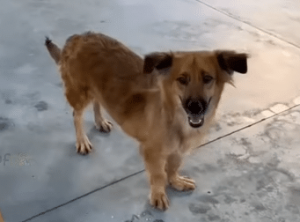
By the fourth month of recovery, the change in Fenix was difficult to miss.
His body looked stronger.
The surgical area had healed.
He could move without the tumor hanging from his back and controlling every step.
But the physical transformation was only part of what people began noticing.
Fenix became more interested in those around him.
The dog who had once spent his days quietly adapting to discomfort began seeking company.
He spent time with other dogs.
He appeared comfortable around children.
He accepted affection and participated in ordinary moments that had been largely absent from his earlier life.
Soft blankets replaced the hard places where he once tried to rest.
Regular meals replaced uncertainty and scraps.
Instead of being left alone with a medical condition no animal could manage independently, he was surrounded by people who noticed when he needed something.
These changes did not erase his history.
Certain movements may have remained cautious.
The years spent carrying the growth had affected his body and his experience of the world.
But Fenix was no longer organizing every part of his day around a six-kilogram burden.
He could lie down without positioning the tumor beside him.
He could walk without its weight pulling against his back.
He could turn toward a person offering attention instead of using all his energy simply to move.
The team also began seeing more of his personality.
Fenix was gentle.
He was social.
He seemed to enjoy quiet companionship as much as playful moments with other animals.
Those qualities had existed beneath the neglect all along.
The rescue did not create a different dog.
It gave the dog who was already there enough comfort to reveal himself.
His tail began moving more often.
His posture appeared relaxed.
The alert, exhausted expression seen at the beginning of his rescue softened as safe experiences replaced the uncertainty of his previous life.
Fenix was not merely alive after surgery.
He was participating in life.
One Final Part of His Rescue Was Still Missing
Fenix had been removed from the place where his condition went untreated.
He had survived a difficult operation.
He had recovered from a surgical wound large enough to reflect the enormous mass removed from his body.
He had learned to move more freely and accept companionship.
But he still needed a permanent home.
Shelter and rescue care had given him safety during the most critical part of his journey.
A family could give him something different.
Consistency extending beyond recovery.
A bed that remained his.
A familiar person beside him each morning.
Walks adjusted to his comfort.
Veterinary care before a small concern ever became another overwhelming medical problem.
Fenix did not need someone attracted only to the shocking photographs of his past.
He needed a person prepared to value the dog he had become.
A calm companion.
A survivor of prolonged neglect.
An animal capable of affection despite how little protection he had once received.
His future family would also need to continue monitoring his health. Follow-up examinations could help veterinarians watch for any recurrence or other complications, while good nutrition and routine care would support the strength he had regained.
Adopting Fenix would not mean rescuing him from the tumor a second time.
The surgeons had already removed it.
It would mean completing the life his rescue had made possible.
Giving him a place where medical needs were noticed early.
Where comfort was ordinary.
Where he would never again spend years carrying a visible burden while waiting for someone to act.
Fenix’s story is often described through the enormous size of the tumor.
But the number alone is not the most important part.
What matters is that the growth had been allowed to remain for years.
What matters is that Fenix continued adapting when he should have been receiving care.
And what matters most is that someone eventually refused to look away.
Rescuers saw the dog beneath the mass.
Veterinarians accepted the difficult surgery.
Caregivers stayed through the months of recovery.
Every person added another step between Fenix and the life he had known before.
Once, his days were shaped by six kilograms of untreated suffering.
Now he can walk without that weight.
He can rest on soft bedding.
He can play with other dogs and remain near people without needing to conserve every bit of strength.
The largest burden has been removed.
Only one thing remains.
A family willing to look at Fenix—not as the dog who once carried a massive tumor, but as the gentle companion waiting to belong somewhere for the rest of his life.


