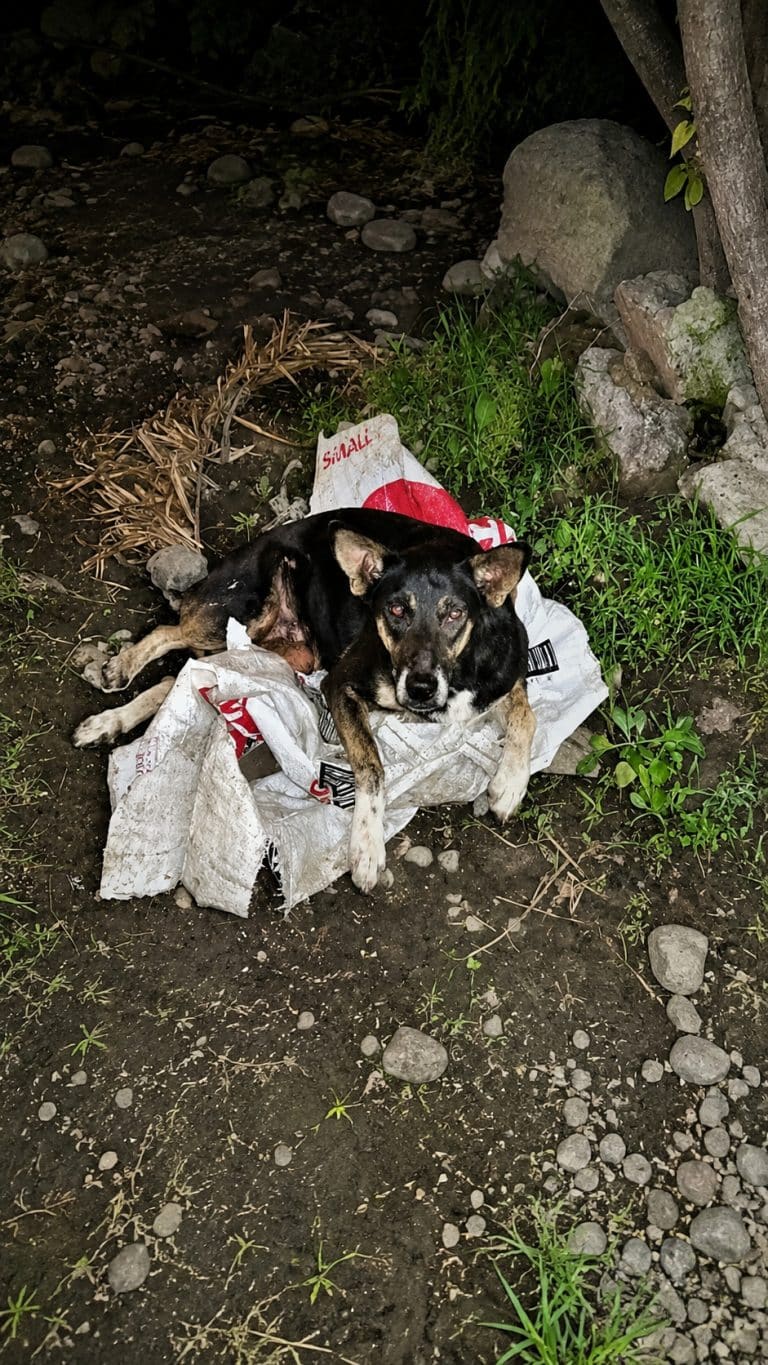
On January 8, rescuers received an urgent call about a dog hidden beneath a roadside drainage canal.
She was pregnant.
She appeared injured.
And she had become trapped deep inside a narrow concrete pipe with no clear way to climb back out.
The rescue team traveled nearly 70 kilometers to reach her.
By the time they arrived, the mother dog was lying against the cold walls of the drain. Her body looked weak, and every attempt to move seemed difficult.
No one knew exactly how long she had been there.
But beneath her exhausted frame were six unborn puppies whose survival depended entirely on hers.
The rescuers would later name her Jasmine.
First, they had to convince her that the people entering the darkness had come to help.
Jasmine Was Too Frightened to Leave the Pipe
The drainage canal was narrow, damp, and difficult to enter.
Jasmine had positioned herself deep inside the concrete pipe, away from the traffic and unfamiliar people gathering outside.
The rescuers initially tried using food to encourage her forward.
They placed it close enough for her to smell while keeping their distance.
But Jasmine did not approach.
Every unfamiliar sound caused her to become more alert.
When someone moved near the opening, she retreated farther into the darkness.
Her response was understandable.
She was injured, physically depleted, and carrying a large litter. A dog in that condition may view any approaching person as another possible threat, even when that person is offering food.
The rescuers did not know what Jasmine had experienced before becoming trapped.
They could not tell whether she had fallen into the drainage system, entered it while searching for shelter, or crawled inside because she was already hurt.
They could only see that she was unable to leave without assistance.
The steep, slippery canal offered little traction.
Her weakened body could not manage the climb.
Waiting much longer might have placed both Jasmine and her puppies at greater risk.
Eventually, one member of the rescue team entered the pipe.
He lowered his body into the confined space and moved toward her slowly.
There was no room for sudden movement.
If Jasmine panicked, she could retreat into an even less accessible section or injure herself further against the concrete.
The rescuer paused frequently.
He spoke quietly.
He allowed her to watch him before moving closer again.
Jasmine appeared frightened, but she did not lunge or attempt to bite.
Little by little, the distance between them closed.
When the rescuer finally reached her, he supported her body carefully and began guiding her toward the opening.
Jasmine no longer had to climb the canal alone.
Human hands carried her through the final distance.
Video: Injured Pregnant Dog Is Reached Deep Inside a Roadside Drainage Pipe
The Examination Revealed How Fragile Her Condition Had Become
Jasmine was transported directly to a veterinary clinic.
Once she was inside, the medical team began assessing both her injuries and the condition of the unborn puppies.
Her body was dangerously weak.
She showed signs of spinal trauma that affected her movement and made standing difficult. Veterinarians also found active bleeding from her reproductive area, adding concern about blood loss and possible complications involving the pregnancy.
The team moved carefully.
Jasmine needed fluids to address dehydration and support circulation.
Her bleeding had to be monitored and controlled.
Her spinal condition required evaluation without placing additional pressure on her body.
At the same time, the medical staff needed to determine whether an infection had developed inside the uterus.
An infection could threaten Jasmine’s life and place every puppy at risk.
Tests reportedly showed no major uterine infection.
That was encouraging.
But it did not answer the most important question.
Were the puppies still alive?
Jasmine had endured injury, exhaustion, bleeding, and an unknown amount of time trapped inside the drainage canal. No one could assume that all six had survived.
The veterinarians prepared an ultrasound.
Jasmine remained still as the equipment moved across her abdomen.
For several tense moments, the team searched the screen.
Then they saw movement.
Tiny heartbeats appeared on the monitor.
One.
Then another.
All six puppies were still alive.
The discovery offered hope, but it also increased the urgency of Jasmine’s treatment.
She was not stable enough to be left without observation.
Her body had to support the puppies while also recovering from its own injuries.
The team began intensive care immediately.
Fluids were administered.
Medication helped address the bleeding and discomfort.
Her vital signs were checked repeatedly.
Caregivers remained nearby, watching for any change that might indicate labor or another emergency.
Video: An Ultrasound Reveals Six Living Puppies Inside the Injured Mother Dog
Only Eighteen Hours Later, Labor Began
Jasmine had been inside the clinic for only about eighteen hours when her behavior began to change.
She became restless.
Her breathing shifted.
The veterinary team recognized the signs.
Labor had started.
There was little time between her rescue and the arrival of the first puppy.
Only the day before, Jasmine had been trapped beneath the road, unable to climb out and too frightened to approach the people trying to reach her.
Now she was giving birth inside a warm, clean room with medical support close by.
The team prepared fresh bedding and warming supplies.
They monitored Jasmine without crowding her.
A frightened mother dog needs enough space to follow her instincts, while caregivers must remain close enough to act if a puppy becomes stuck or shows signs of distress.
The first puppy arrived.
The tiny body was cleaned and placed close to Jasmine.
Then another followed.
One by one, the puppies entered the world.
Each birth brought a new set of questions.
Was the puppy breathing?
Was it warm?
Could it move toward the mother?
Was Jasmine strong enough to continue?
Her body had already endured injury and blood loss. Delivering six puppies placed even greater demands on her remaining energy.
Still, labor continued.
The room gradually filled with soft newborn cries.
By the end of the delivery, six puppies rested beside their mother.
All of them had survived the pregnancy and birth.
The outcome was remarkable, but it did not happen because Jasmine’s condition had suddenly become easy.
She had been reached in time.
Veterinarians had stabilized her.
Caregivers had prepared for complications.
And throughout the delivery, the exhausted mother did what her body was still capable of doing.
When labor finally ended, Jasmine rested with the puppies pressed against her.
She appeared tired beyond measure.
But she was no longer inside a freezing pipe.
Her babies were no longer depending on her in complete isolation.
An entire team was now helping her keep them safe.

Caring for Six Puppies Required More Than Jasmine Could Provide Alone
The successful delivery did not remove every danger.
Jasmine remained weak after giving birth.
Her injuries still needed treatment, and her body now faced the additional challenge of producing enough milk for six rapidly growing puppies.
During the first days, the rescue team monitored the family constantly.
Newborn puppies cannot regulate their body temperature effectively. They must remain warm, nurse frequently, and stay close enough to their mother that she can clean and comfort them.
With six puppies competing for milk, the smallest could easily receive less than the others.
The caregivers checked each one carefully.
They watched for puppies that appeared weaker, cried continuously, or struggled to remain near Jasmine.
When her milk supply was not enough, they provided supplemental bottle feeding.
Each feeding had to be handled slowly.
The puppies were positioned safely and given appropriate formula in controlled amounts.
Too much liquid or feeding too quickly could create serious risks.
Jasmine also received additional nutrition.
Nutritious soups and soft foods helped supply the energy her body needed to recover and continue nursing.
Fresh water remained close.
Her bedding was changed regularly to keep the area clean and reduce the risk of infection.
The rescue team monitored her bleeding, movement, appetite, and overall comfort.
Her spinal injury did not disappear after delivery.
She still needed help adjusting her position and moving safely.
But now she was no longer expected to meet every need alone.
When a puppy needed more food, a caregiver stepped in.
When Jasmine needed rest, someone watched the litter.
When the bedding became damp, it was replaced.
Rescue had changed from an urgent effort inside the pipe into a daily routine built around seven vulnerable animals.
The Frightened Mother Slowly Began Accepting Help
During Jasmine’s earliest hours in care, she watched people with uncertainty.
Her experience inside the drainage pipe had left her physically vulnerable, and the arrival of six newborn puppies gave her another reason to remain alert.
Mother dogs may become especially protective after giving birth.
Even familiar handling can feel threatening when their puppies are nearby.
The rescue team respected that instinct.
They did not remove the puppies unnecessarily.
They allowed Jasmine to see what was happening whenever one needed examination or bottle feeding.
They moved slowly around her resting area.
Over time, Jasmine began learning the routine.
The same people brought her food.
The same hands returned each puppy safely.
No one forced her away from the litter.
No one punished her for watching closely.
Her posture gradually became less tense.
She rested for longer periods while caregivers remained nearby.
She accepted help when the puppies were fed.
The fear visible in her early interactions began giving way to familiarity.
That emotional change happened alongside physical recovery.
Her appetite improved.
Her strength slowly returned.
Her body became better able to support her when she changed position or stood.
The puppies changed quickly too.
At first, they spent almost all their time sleeping and nursing.
Then their bodies began filling out.
Their movements became stronger.
Tiny paws pushed more confidently across the blankets.
The smallest cries grew louder.
Soon, the puppies were no longer six fragile newborns requiring constant positioning beside their mother.
They were beginning to crawl over one another, investigate their surroundings, and respond to movement around the room.
Jasmine remained close.
She cleaned them.
She allowed them to nurse.
She responded when one moved away from the group.
But the rescue team made sure motherhood did not become another burden she had to carry without support.
For perhaps the first time in a long while, Jasmine could rest while other people watched over the lives depending on her.
Seven Lives Were Given a Future Together
The visible journey began with Jasmine trapped inside a drainage pipe.
She could not climb the steep canal.
She was injured.
She was bleeding.
And six puppies were still developing inside her body.
The rescue could have ended differently at many points.
The team might not have reached her in time.
Her fear could have driven her farther into the pipe.
The ultrasound could have revealed that the puppies had not survived.
Her weakened body might have been unable to complete labor safely.
Instead, one careful decision followed another.
The rescue team traveled nearly 70 kilometers.
A man entered the narrow tunnel.
Jasmine allowed herself to be carried out.
Veterinarians stabilized her.
Six heartbeats appeared.
Then, eighteen hours later, six newborn puppies filled the clinic with sound.
The family still needed weeks of care.
Jasmine’s spinal injury required continued attention.
Her body needed nourishment and rest.
The puppies needed supplemental feeding, warmth, medical care, and eventually responsible homes.
But the most immediate uncertainty had passed.
They were together.
They were protected.
And none of them had to remain inside the cold concrete drain.
Jasmine’s story is often described as one of maternal determination.
Her behavior certainly showed that she remained close to the puppies and continued caring for them despite her weakened condition.
But her survival was also made possible by accepting help.
She could not escape the canal alone.
She could not treat her injuries.
She could not produce everything six puppies needed while her own body was depleted.
Rescuers and veterinarians became the support she did not have before.
That is what changed the outcome for the entire family.
Compassion did not replace Jasmine’s effort.
It made sure her effort was no longer the only thing standing between the puppies and danger.
Once, she lay injured beneath a roadside canal with no clear path out.
Only eighteen hours after human hands lifted her into safety, she brought six puppies into the world.
The little family still had healing ahead of them.
But they would face it somewhere warm, surrounded by food, blankets, medical care, and people who noticed when one of them needed help.
Jasmine had spent an unknown amount of time trapped beneath the road.
Her puppies began their lives somewhere entirely different.
Not in darkness.
Not in freezing concrete.
But beside their mother, inside a room where seven lives were finally being protected together.


