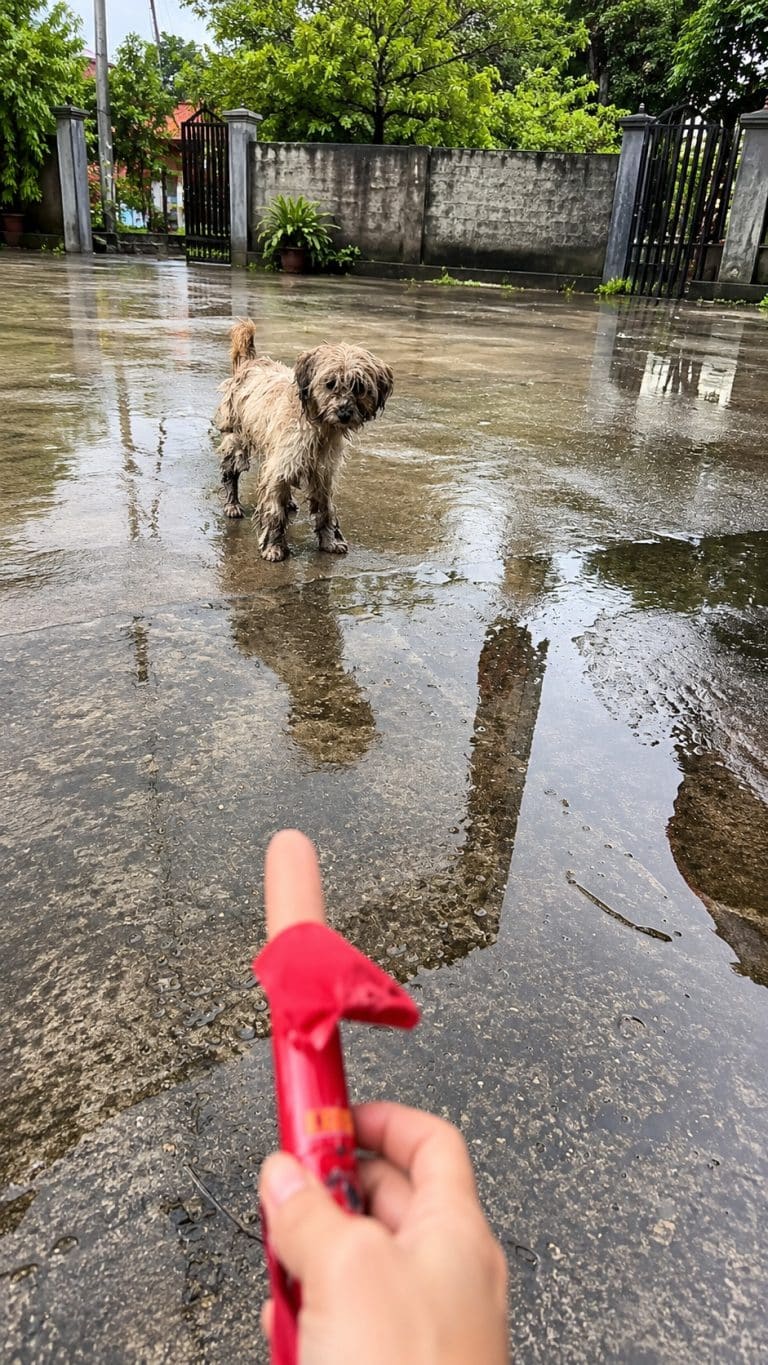
Rain covered the street in a thin layer of cold water.
Small puddles formed beneath the paws of a little stray dog standing alone near the roadside. His long fur was soaked, tangled, and darkened by dirt from life outdoors.
He looked hungry.
But when a person offered him a piece of sausage, he did not immediately come forward.
He watched from a distance.
One step brought him closer to the food.
The slightest movement sent him splashing backward through the rain.
Then hunger drew him forward again.
The dog seemed caught between two powerful instincts: the need to eat and the need to remain far enough away to feel safe.
The person did not chase him.
They simply stayed in the rain and waited.
The Little Dog Wanted the Food but Feared the Hand Holding It
The dog’s physical condition was concerning.
His coat had become tangled and dirty, suggesting that he had spent considerable time without regular grooming or shelter. The wet fur clung to his body and made his frame appear even smaller.
He remained exposed to the rain with no visible dry place nearby.
Yet hunger was not the only thing shaping his behavior.
Whenever the person shifted position, the dog reacted immediately.
His body tightened.
His head moved back.
Then his paws carried him away before the person could come any closer.
He did not bark aggressively.
He did not charge toward the stranger.
His response looked defensive rather than confrontational.
The dog appeared determined to keep enough distance between himself and the person to preserve a sense of control.
No short video could explain exactly why he behaved that way.
Perhaps he had received little positive contact with people.
Perhaps strangers had chased him from doorways or food sources.
He may simply have been an unsocialized stray overwhelmed by the camera, the weather, and an unfamiliar person standing nearby.
Whatever his history, his body language was clear.
He wanted the food.
He did not yet feel safe approaching the hand offering it.
The sausage created an opportunity, but it could not instantly erase his uncertainty.
Trust would have to develop one cautious step at a time.
Video: Hungry Stray Approaches Food in the Rain—Then Runs When the Person Moves
Every Attempt Followed the Same Painful Pattern
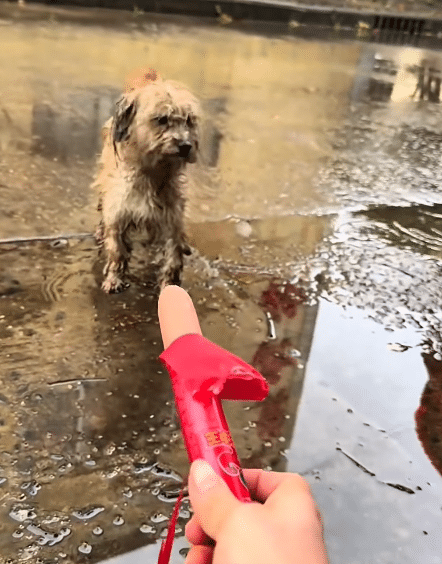
The person lowered the food toward the ground and waited.
The dog remained several feet away, staring at it.
Rain continued falling across his face and coat. His nose lifted slightly as he followed the scent.
Then he moved.
One paw forward.
A pause.
Another small step.
His body remained low, ready to retreat at the first sign of danger.
When the person adjusted their hand, the dog immediately backed away.
Water splashed beneath his feet as he returned to the distance that felt safer.
For a moment, it appeared he might leave completely.
He did not.
Hunger kept him nearby.
The dog turned toward the food again and repeated the process.
Approach.
Pause.
Retreat.
Then return.
Each attempt brought him slightly closer, but none removed his fear completely.
This repeated movement revealed something important about working with frightened animals.
The dog was not being stubborn.
He was trying to manage two conflicting needs.
Food represented relief from hunger.
Proximity to a stranger represented uncertainty.
He could not choose one without accepting the risk created by the other.
A person might become impatient and attempt to close the distance quickly.
That could make the food easier to deliver, but it could also convince the dog that his caution was necessary.
Instead, the person allowed him to leave and return.
The dog remained in control of each step.
That freedom prevented the interaction from turning into a chase.
It also allowed curiosity to continue growing beside the fear.
Patience Made More Progress Than Chasing Ever Could
The person did not follow when the dog backed away.
They did not stand suddenly or attempt to corner him against a wall.
The food remained visible.
The voice behind the camera stayed calm.
For a frightened stray, those choices matter.
Chasing may cause an animal to run into traffic, disappear into an unsafe area, or become too frightened to approach again. Even reaching quickly for a dog who seems close enough can undo the progress created over many patient minutes.
The person in the video allowed silence and stillness to do most of the work.
When the dog retreated, nothing followed him.
When he approached again, the hand remained low.
The dog began learning through repetition.
He could come closer without being grabbed.
He could move away without being pursued.
He could investigate the food while maintaining the distance he needed.
That predictability helped reduce the pressure surrounding the interaction.
Gradually, his movements became less frantic.
He still watched every shift of the person’s body, but he did not flee as far as before.
The pauses between attempts became shorter.
He returned more quickly for another piece of food.
Each successful approach created a new experience for him.
A human remained nearby.
Food appeared.
Nothing painful followed.
Then the same thing happened again.
Trust is often built this way—not through one dramatic gesture, but through many interactions that end safely.
The dog did not need to understand the person’s intentions immediately.
He only needed enough evidence to consider coming closer one more time.
He Finally Took the Food Directly From the Hand
Near the end of the footage, the dog approached again.
His steps remained careful.
His head stayed low.
But this time, he did not stop at the same distance.
The person extended the food without moving toward him.
The dog leaned forward.
For a brief moment, he hesitated.
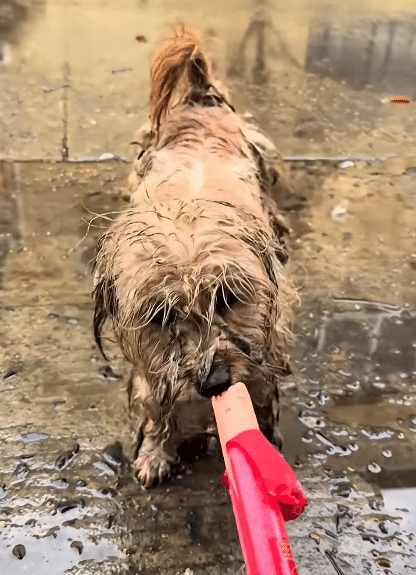
Then he took the sausage directly from the hand.
The interaction lasted only seconds.
To a confident family dog, accepting food from someone might be completely ordinary.
For this little stray, the decision required him to move closer than he had previously allowed.
He placed himself within reach of a person he did not fully trust.
And nothing frightening happened.
The fingers released the food.
The hand did not close around his neck or coat.
The dog was allowed to move away again.
That detail was as important as the feeding itself.
If the person had attempted to grab him immediately, the dog might have learned that approaching food resulted in losing control.
Instead, his first close interaction remained peaceful.
Taking one bite did not mean the dog’s fear had disappeared.
He was still cautious.
He still appeared ready to retreat.
One successful moment cannot undo every negative or unfamiliar experience that shaped his behavior.
But it can become a beginning.
The next approach may feel slightly easier.
A familiar voice may become less threatening.
A hand that repeatedly releases food without reaching farther may begin to represent safety rather than danger.
For the person waiting in the rain, that small act of trust was enough.
There was no need to force a more dramatic response.
The dog had taken the step when he was ready.
Helping a Frightened Stray Requires More Than Food
Food can help create a connection with a hungry dog, but it is only the first part of a safe rescue.
The dog still needed protection from the weather.
His tangled coat required attention.
His physical condition could not be fully understood without an examination.
A stray living outdoors may be dehydrated, underweight, injured, affected by parasites, or carrying an illness that is not visible in a brief video.
Moving him to safety would require planning.
Because he was fearful, simply attempting to pick him up could cause panic.
A leash, humane trap, carrier, fenced area, or help from experienced rescuers might be necessary depending on his behavior and surroundings.
The location also created risk.
Wet roads reduce visibility.
A frightened dog may run unpredictably if startled.
Traffic, deep drains, and flooded areas can turn an attempted rescue into a more dangerous situation.
A careful plan would prioritize keeping the dog close without increasing pressure.
Food could be placed progressively nearer to a safe enclosure.
One person could remain still while another quietly prepared equipment.
A local rescue group or animal-control team could provide experience and tools designed for fearful dogs.
Once contained, the dog would need to be dried and kept warm.
His coat could be examined for mats, skin irritation, wounds, or parasites.
Fresh water and suitable food could be introduced according to his condition.
Most importantly, he would need time.
A dog who finally accepts food from a hand may still hide once brought indoors.
He may become cautious around doorways, sudden noises, or unfamiliar touch.
Safety does not become familiar immediately simply because the environment has changed.
The patient approach shown in the rain would need to continue afterward.
Trust Grows When the Animal Is Allowed to Choose
Fearful dogs often communicate in ways people overlook.
Turning the head away.
Lowering the body.
Freezing.
Licking the lips.
Backing up when someone leans forward.
These behaviors can be requests for more space.
When people respect them, the dog learns that communication works.
When those signals are ignored, the animal may feel forced to run, growl, or defend itself more strongly.
The little dog in the video repeatedly asked for distance through his movements.
The person listened.
They did not interpret his retreat as rejection.
They treated it as information.
That response helped preserve the possibility of trust.
Each time the dog returned, he did so because he had chosen to.
Choice is powerful for an animal whose life may have offered little control.
He decided how close to stand.
He decided when to retreat.
He decided when the need for food felt greater than the uncertainty surrounding the hand.
Eventually, he decided to accept the bite directly.
This does not mean every fearful stray should be left indefinitely without intervention.
There are moments when emergency action is required, particularly if an animal is injured, in traffic, or exposed to dangerous weather.
But even urgent rescue can be carried out with respect for body language.
Movement can remain calm.
Restraint can be prepared before approaching.
Noise and unnecessary people can be kept away.
The goal is not simply to capture an animal.
It is to move that animal toward safety without creating more fear than necessary.
The person in the rain demonstrated the beginning of that process.
They did not demand trust.
They created a reason for the dog to offer a small amount of it.
The Video Ends Before His Full Rescue Is Known
The final moments do not show the dog entering a home.
There is no confirmed veterinary visit.
No bath.
No adoption scene.
The little dog is still outside in the rain when the visible story ends.
That uncertainty should not be replaced with a conclusion the footage does not provide.
What happened on camera was smaller, but still meaningful.
A hungry stray was afraid to approach.
A person waited instead of chasing him.
The dog returned several times.
Eventually, he accepted food directly from the person’s hand.
That single moment did not solve every problem in his life.
He still needed shelter.
He still needed medical care.
He still needed someone to continue helping after the camera stopped.
But something had changed.
At the beginning, every movement sent him running.
Near the end, he came close enough to eat from a human hand.
The distance between those moments was only a few feet.
Emotionally, it may have been much greater.
The dog had no reason to understand that this particular person was different.
He learned through what did not happen.
No one chased him.
No one cornered him.
No one punished his caution.
The hand offered food and allowed him to leave.
Sometimes trust begins not with affection, but with the absence of fear.
A quiet person stays nearby.
A meal is offered without conditions.
The animal approaches and discovers that he remains free to choose what happens next.
The little dog was still wet.
Still cautious.
Still without a confirmed home.
But for one moment in the rain, he no longer had to choose between hunger and complete isolation.
Someone had stopped.
Someone had waited.
And when he finally came close enough, kindness remained exactly where it had been—held gently within reach.


