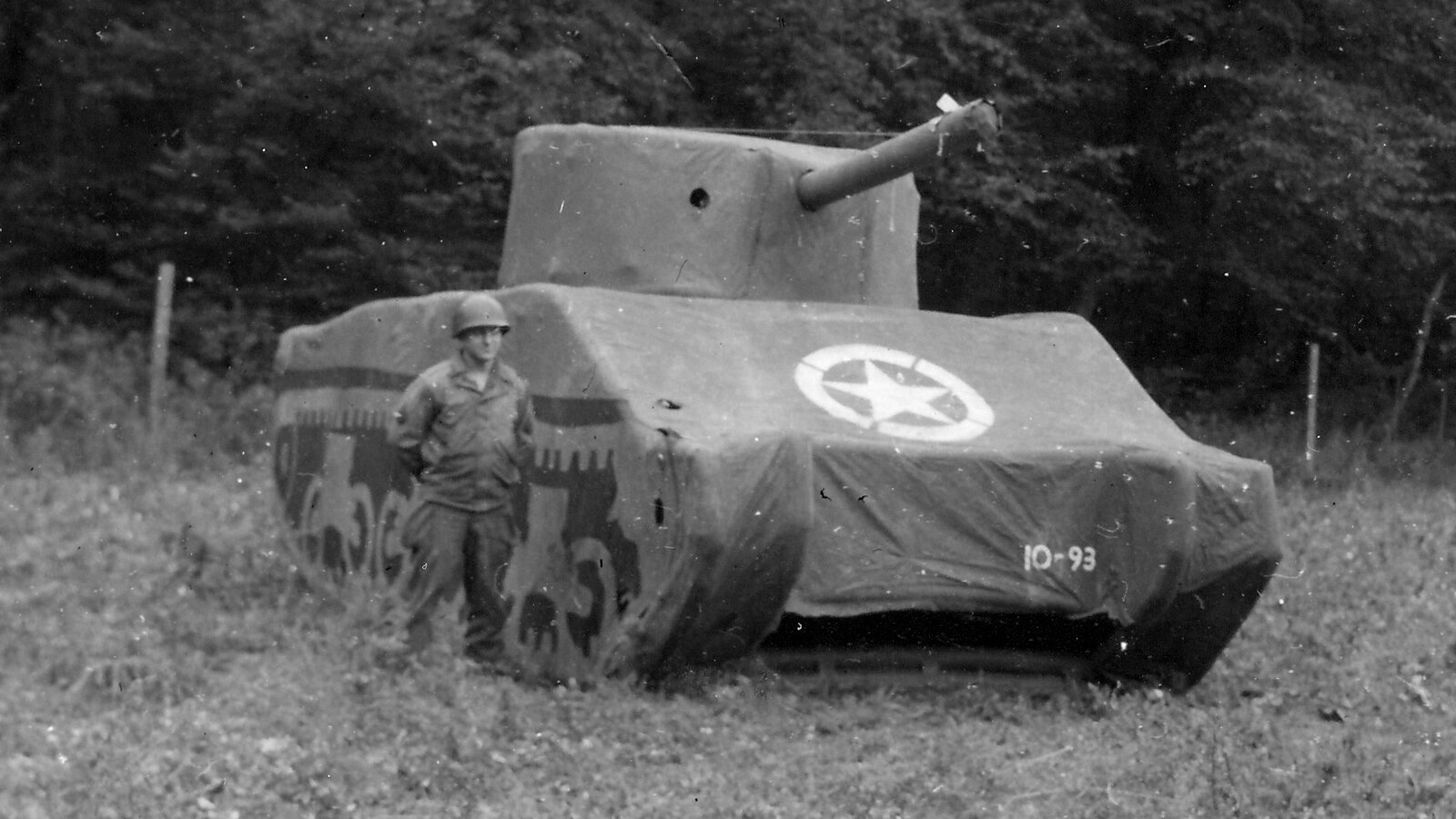
In photographs from World War II Europe, a small group of soldiers appears to be moving a full-size Sherman tank using nothing but their hands. No machinery, no crane, no vehicle. Just a few men casually repositioning what should have been 33 tons of steel.
The explanation was not strength. The tank was rubber, inflated with air, and light enough for two soldiers to carry across a field. The men handling it were part of one of the most unusual units in American military history — a classified deception outfit that spent the war convincing German observers that forces far larger than their own were bearing down on them.
That unit was the 23rd Headquarters Special Troops, better known decades later as the Ghost Army. Their mission was deception, and their tools were inflatable vehicles, powerful sound systems, fabricated radio traffic, and carefully staged behavior designed to manufacture the appearance of entire divisions.
Why the Army Needed a Phantom Force
By 1944, Allied commanders understood that battlefield deception could be as valuable as firepower. The strategic deceptions surrounding D-Day — Operation Bodyguard and its sub-operations — had already demonstrated that convincing the enemy to misread your position and strength could save thousands of lives and shift the outcome of engagements.
What the Army lacked was a mobile, field-level deception unit capable of operating at the tactical scale: something that could fill gaps in the front line, cover unit movements, and tie down enemy forces by making them believe a much larger American presence occupied a given sector.
The 23rd Headquarters Special Troops was activated in January 1944. It was a small formation — approximately 1,100 men — built around four specialized companies. Each company handled a different deception discipline, and the unit was trained to deploy combinations of all four simultaneously. The personnel included artists, radio operators, engineers, and sound specialists, many of them recruited partly for creative skills that would prove directly useful in the field.
The unit arrived in Europe in May 1944 and remained operational through the end of the war. Over roughly eleven months, it conducted approximately twenty distinct deception operations across France, Luxembourg, Belgium, and Germany.
The Inflatable Vehicles That Fooled Distant Observers
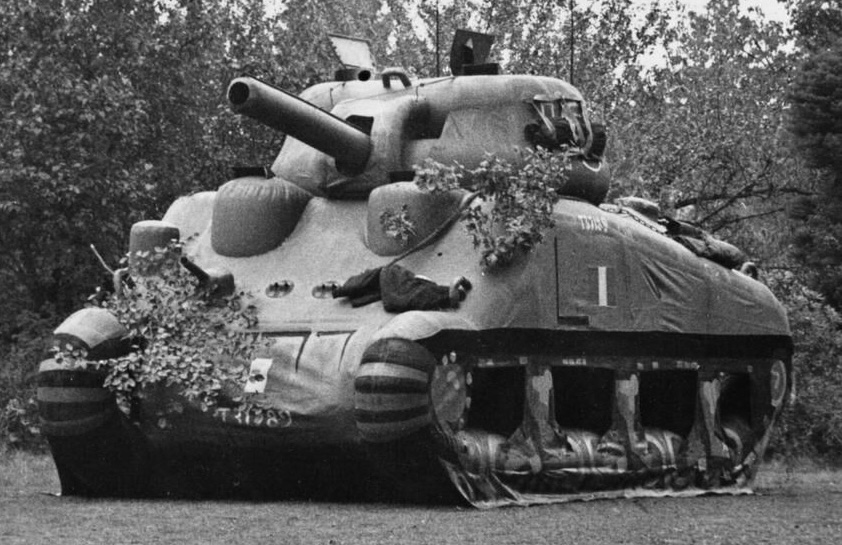
Visual deception was the discipline most associated with the Ghost Army after declassification, and the inflatable equipment was its most striking element. The unit operated rubber replicas of tanks, artillery pieces, trucks, half-tracks, and other vehicles. When properly positioned and dressed with netting, dirt, and wear marks, these inflatables were designed to be convincing to observers at the distances typical of aerial reconnaissance and forward enemy observation posts.
The vehicles were fabricated to approximate the silhouette and scale of their real counterparts. A rubber M4 Sherman replica, for example, matched the tank’s profile well enough that aerial photographs — the primary intelligence tool of the era — could register it as a genuine armored vehicle in a staging area. Ground-level observers at distance, or those working from limited sight lines, could be similarly misled.
Positioning mattered as much as the props themselves. The Ghost Army’s men were trained to deploy vehicles in patterns consistent with real unit behavior: proper spacing, appropriate camouflage, track marks leading into and out of positions. A field of perfectly spaced, pristine inflatables would have raised suspicion. A field that looked lived-in and tactically organized was more credible.
The unit also operated physical props that complemented the inflatables, including dummy command posts, fake supply arrangements, and equipment arranged to suggest a larger headquarters presence. The visual layer was never meant to stand alone — it was one component in a system designed to reinforce itself across multiple channels simultaneously.
How Recorded Sounds Suggested a Moving Division
Visual deception had obvious limits. It worked at distance and in daylight, but it could not produce the noise of a functioning armored division — the engine sounds, track clanking, and radio chatter that experienced soldiers associated with large unit movements. The Ghost Army addressed this with a dedicated sonic deception capability that had no real precedent in any army at the time.
The unit operated powerful sound systems mounted on half-tracks. These systems were capable of projecting recorded sounds — tank movements, vehicle columns, engineering operations, infantry activity — at volumes audible up to fifteen miles away under the right conditions. The recordings were produced with attention to the specific acoustic signatures of different equipment types, and operators could mix and sequence tracks to suggest particular unit activities.
A common operational pattern involved broadcasting the sounds of an armored column moving into a sector, sustaining ambient noise consistent with a large unit settling into position, and then tapering the sound in a way that implied the movement had concluded. Combined with visual props in the same area, and with fabricated radio traffic indicating the same unit, the effect could be convincing to enemy intelligence analysts trying to build a coherent picture from multiple sources.
Timing and coordination between the Ghost Army’s different companies were essential. A sonic broadcast that contradicted what the radio network was transmitting, or that did not correspond to what aerial observers were reporting, would undermine the entire deception.
YOUTUBE EMBED — PRIMARY SEARCH QUERY: “Ghost Army inflatable tanks sound deception documentary”
The Fake Radio Network Behind the Illusion
Radio deception was the Ghost Army’s least visible discipline and arguably its most technically demanding. When the unit impersonated a real formation — and their operations frequently involved pretending to be specific, named American divisions — they had to replicate that unit’s radio behavior completely enough that German signals intelligence would not detect the substitution.
This required operators to study and mimic the transmission patterns, frequencies, message formats, and individual “fists” — the distinctive keying rhythms that trained radio operators develop and that experienced listeners can identify — of the units being impersonated. If the 2nd Armored Division had a recognizable radio signature, the Ghost Army’s operators had to reproduce it closely enough to pass scrutiny.
The radio company ran fake networks that suggested command and logistics traffic appropriate to the size of unit being simulated. They transmitted in ways that implied a division-scale headquarters was operating in a sector, coordinating with adjacent units, and conducting routine administrative business. The volume and pattern of traffic was calibrated to look real rather than to appear either suspiciously quiet or artificially busy.
Before a real unit moved — withdrawing from a line to reposition for an offensive, for example — the Ghost Army would move in, maintain the radio presence of the departing unit, and continue broadcasting in that unit’s name while the actual formation traveled to its new location. The gap between the real unit’s departure and its arrival elsewhere was covered by the Ghost Army’s radio network, keeping German analysts from detecting the movement until it no longer mattered.
A fourth layer of deception involved what the unit called “atmosphere” work — soldiers in the impersonated unit’s markings and insignia moving through nearby towns, visiting service areas, and generally behaving as soldiers from that formation would. Shoulder patches, vehicle markings, and conversation were all managed to reinforce the identity being projected. This was deliberate and required discipline: a single soldier mentioning the wrong unit or displaying the wrong marking could compromise an operation.
YOUTUBE EMBED — SECONDARY SEARCH QUERY: “National WWII Museum Ghost Army combat con artists”
What the Unit’s Operations Achieved
Measuring the effectiveness of deception operations is inherently difficult. Success often meant that nothing happened — an enemy force stayed in place rather than striking, or a gap in the line was not exploited because the enemy believed it was covered. These non-events do not appear in casualty figures or territory maps in the same way that engagements do.
What military historians have documented is that the Ghost Army participated in operations where real American units moved under the cover of the unit’s deceptions, and that those movements were in several cases completed without the German response that might have been expected if the moves had been detected. The crossing of the Rhine in March 1945 included a Ghost Army deception — Operation Viersen — intended to suggest a crossing force at a location other than where American troops were actually crossing. The real crossing by the Ninth Army was accomplished with less opposition than some other Rhine crossings during the same period.
Attributing outcomes directly to the Ghost Army’s specific contributions, as opposed to other factors including air superiority, artillery, and German resource limitations, requires care. Historians have generally treated the unit as a genuine contributor to operational security during its deployments without overstating the certainty of specific cause-and-effect claims.
The unit was deactivated in September 1945. Its records were classified, and the men who served in it returned to civilian life without being able to discuss what they had done. The 23rd Headquarters Special Troops remained classified for decades. Serious public documentation of the unit began accumulating in the 1990s, drawing on declassified records, veteran interviews, and academic research.

Recognition After a Long Silence
For most of the postwar period, the Ghost Army was invisible to the public. Veterans kept their service classified. The unit appeared in no wartime press coverage, no public citations, no widely circulated accounts. It existed in official records but not in the popular understanding of World War II.
Researchers and documentarians began piecing the history together after relevant records were declassified, and by the 2010s the unit had attracted significant historical attention. A documentary aired on PBS in 2013 brought the Ghost Army to wide public awareness for the first time, drawing on archival materials, veteran testimony, and the artwork many of the unit’s members — who included professional artists and designers — had produced during the war.
In 2022, Congress awarded the 23rd Headquarters Special Troops the Congressional Gold Medal, the highest civilian honor Congress can bestow. The award recognized the unit’s documented contributions across its approximately twenty operations in the European theater.
What the historical record confirms is specific and coherent: a unit of roughly 1,100 men used inflatable vehicles, high-powered sound broadcasts, fabricated radio networks, and staged behavior to impersonate formations many times their size. The inflatables were real, the sound systems were real, the radio deceptions were real, and the operations were documented. What the Ghost Army accomplished was not magic or myth — it was a carefully engineered system of illusion, applied under combat conditions, by soldiers trained for a kind of warfare that had no real precedent before them.

