The harvesters were already in the fields when the interruption came.
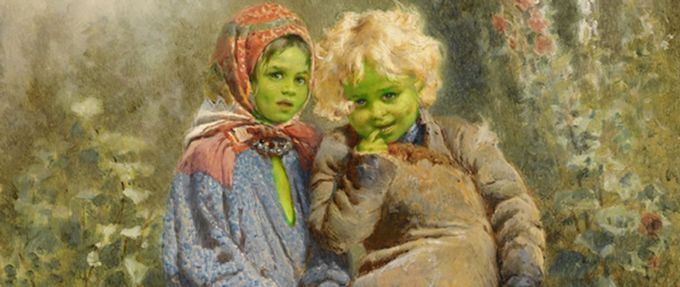
Near Woolpit, a small settlement in Suffolk, two children appeared where no children were expected: a boy and a girl, dressed in unfamiliar clothing, speaking words the workers could not understand. The detail remembered above all others was the color of their skin.
Green.
That single word has carried the story for more than eight centuries. It has invited fairies, underground kingdoms, secret passages and, much later, extraterrestrial visitors into a scene that began with frightened children and a group of puzzled villagers.
But the surviving record is quieter than the legend. This is a medieval account preserved by two chroniclers, not confirmed evidence of a supernatural encounter. William of Newburgh and Ralph of Coggeshall both recorded versions of the story, yet neither text proves that another world existed, that the children were nonhuman or that a gateway opened beneath the Suffolk countryside. What remains is a small historical file with repeated details, meaningful differences and an origin that cannot be recovered with certainty.
The First Surviving Account
The earliest surviving written version appears in William of Newburgh’s Historia Rerum Anglicarum, composed near the end of the twelfth century. William places the event during the reign of King Stephen, which lasted from 1135 to 1154, and begins with an unusual admission: he says he had doubted the story before accepting that it had been supported by numerous people he regarded as credible.
That does not make the episode independently verified. It does tell us that William wanted his readers to understand that he was not repeating the tale casually.
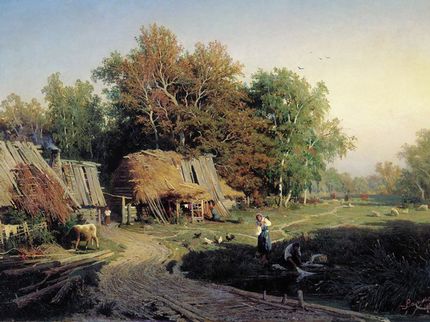
In his account, Woolpit stood several miles from the great religious center at Bury St Edmunds. The village’s name was associated with old pits said to have been used for trapping wolves. During harvest, two children emerged near those excavations. William describes them as green in body, clothed in garments of unfamiliar color and material, and unable to communicate with the people who found them.
They were taken into the village and offered food. They refused it until beans arrived from the fields. The children searched the stalks rather than opening the pods, then wept when they could not find what they expected. Once someone showed them the beans inside the pods, they ate eagerly.
William says they lived on this food for months before accepting bread. Their color gradually changed as their diet changed, and they learned the local language. Both were baptized. The younger boy died not long afterward, while the girl survived, became physically indistinguishable from local women and was reportedly married in Lynn.
Only after learning English could the children describe where they believed they had come from. William calls it the land of St. Martin, a Christian country of churches and bells where direct sunlight was absent, the landscape remained in twilight and a brighter country could be seen beyond a wide river. The chronicler records the explanation but does not identify the place. He closes the file as a marvel he cannot solve, not as a location he has confirmed.
YOUTUBE EMBED 1 — PRIMARY SEARCH QUERY: “Green Children of Woolpit medieval chronicles documentary”
What the Original Record Actually Described
The second version appears in Ralph of Coggeshall’s Chronicon Anglicanum. Ralph’s chronicle was written in the early thirteenth century, and his account preserves the same central sequence: discovery, unknown speech, unusual color, rejection of ordinary food, beans, the boy’s decline and the girl’s adaptation.
Ralph says the children were found near a pit at St. Mary of the Wolf Pits and taken to Sir Richard de Calne’s household at Wikes. There they cried, refused bread and other foods, and finally reacted to fresh beans still attached to their stalks. As in William’s version, they searched the stalks before someone opened the pods for them.
The boy remained weak and died within a short time. The girl recovered, accepted a wider diet and lost what Ralph’s Latin characterizes as a green or leek-green complexion. She was baptized and remained for years in Richard’s service. Ralph also adds an unflattering judgment about her conduct—a detail absent from William and possibly more revealing of the chronicler’s moral framework than of the girl herself.

Ralph’s girl says that the people and things in her homeland were green and that the land had no visible sun, only light resembling the period after sunset. She and her brother had followed livestock into a cavern, heard bells, wandered through it and emerged into overpowering sunlight and unfamiliar warmth. When frightened by approaching people, they could not find the entrance again.
The overlap is substantial, but the differences matter. William supplies St. Martin’s Land, Christian churches, a bright country beyond a river, the baptism of both children and the girl’s marriage at Lynn. Ralph supplies Richard de Calne as the household source, the cavern journey, the shock of sunlight and the claim that the homeland itself was green. Recent scholarship argues that the two chroniclers probably drew from a shared source or story tradition, so they should not be treated as two fully independent confirmations.
The Details Later Versions Changed
Placed side by side, the chronicles reveal how later retellings built a smoother and more dramatic story by merging details that originally belonged to different versions.
St. Martin’s Land appears in William, not Ralph. The cavern and the children’s inability to find its entrance are emphasized by Ralph. William describes them emerging near the wolf pits but has them say they did not know exactly how they arrived. Modern summaries often fuse these details into a literal underground tunnel connecting Woolpit to a named subterranean kingdom.
The color grows brighter too. William’s translation presents the children as completely green, while Ralph describes skin tinged with a green or leek-green color. A strange cast on unhealthy skin is not the same claim as the vivid coloring shown in modern artwork.
The food also changes. The early accounts describe fresh beans, pods and the children’s confusion about where the edible part was found. Later versions reduce this to a magical rule that they could eat only green food. Exact dates such as 1150 or 1160 are similarly convenient; William gives only Stephen’s reign, and both texts were written decades after the alleged discovery.
Even the girl’s later identity has attracted unsupported certainty. A proposed identification with Agnes Barre through financial records has been rejected in recent scholarship. Fairy interpreters later turned the twilight homeland into an Otherworld, while science fiction and UFO culture recast the children as visitors from another planet. The medieval texts mention no spacecraft, technology or nonhuman anatomy. Those belong to the story’s later cultural life.
The Strongest Historical Explanation
The strongest historical explanation begins by treating the strangers as children rather than beings.
They were frightened, hungry, unable to communicate and dependent on each other. They recognized livestock, beans, bells, Christian practice and family relationships. The surviving girl learned English, adapted to local food, entered a household and, in William’s version, married. Nothing in either account requires a nonhuman body or an unknown civilization.
Some form of displacement therefore offers the best broad explanation. The pair may have been lost, orphaned or separated from a migrant community. An unfamiliar language or dialect could have sounded meaningless to rural listeners, while different clothing, poor health and panic would have made the children appear even more foreign.
A more specific theory identifies them as Flemish refugees. East Anglia had connections with Flemish settlers, and later writers linked the story to violence involving Flemish forces near Bury St Edmunds. Some connect St. Martin’s Land to Fornham St Martin and the Battle of Fornham in 1173.
That theory gathers several clues into one picture, but it creates a serious chronological problem. William places the event in Stephen’s reign, which ended in 1154—almost twenty years before the battle. Preserving the Fornham theory requires assuming that William’s dating drifted or that the modern place-name connection is coincidental. Neither chronicle says the children escaped a battle, and their language was never identified.
The most defensible answer is broader: the story may preserve a memory of displaced or culturally unfamiliar children whose speech and condition made them seem otherworldly. Their precise community, route and crisis cannot be recovered. That conclusion explains the human details without filling the gaps with invented certainty.
YOUTUBE EMBED 2 — SECONDARY SEARCH QUERY: “Woolpit green children historical explanation”
The Interpretation That Competes With It
Displacement explains the language and social shock, but not the feature that made the story famous: the green coloration.
The common medical proposal is malnutrition, anemia or the historical condition called chlorosis, once known as “green sickness.” Later medical literature associated chlorosis with pallor, weakness and iron deficiency. That pattern seems to fit parts of the account: the boy was languid, both children were hungry and the girl’s color reportedly faded after she accepted a broader diet.
But resemblance is not diagnosis. Chlorosis was named and debated centuries after the alleged Woolpit event, its historical descriptions were inconsistent, and modern medical reviews note that the supposedly green skin could itself be disputed. No physician’s examination survives, and there is no biological evidence. Recent scholarship on Woolpit specifically warns against confidently diagnosing the children from a few medieval sentences.
A second possibility is that the event was shaped as a medieval marvel. Chroniclers could record unusual episodes because they carried religious, moral or symbolic meaning. William placed the children among prodigies; Ralph’s version emphasizes difference, baptism and entry into Christian society. Caves, bells, twilight countries and sudden passages between landscapes already belonged to a medieval vocabulary of wonder.
That does not require total invention. A real encounter may have been reorganized through familiar narrative patterns. Frightened foreign children could become people from a sunless land. A ditch or wooded hollow could become a cavern. Memories translated through newly learned English, repeated by adults and finally written in Latin could become a crossing between worlds.
The medical and folkloric readings may therefore describe different layers of the same process: a human event, an unusual appearance and a story framework placed around facts no one fully understood.
What Cannot Be Verified
The silence in the record begins where modern curiosity becomes most demanding.
No surviving document gives the children’s names. No exact discovery year is securely established. Their language was not identified. Their clothing was not preserved. No contemporary medical description exists beyond the color terms used by the chroniclers. No excavation has identified a tunnel or cavern connected to a hidden settlement.
The witness chain is also incomplete. William refers to numerous credible informants but does not name them. Ralph presents Richard de Calne and his household as a source, giving his version a more local connection, yet we still do not possess testimony written by Richard, the reapers, the children or the villagers who first encountered them. We have chroniclers reporting what others said.
The girl’s later life is equally uncertain. William reports a marriage at Lynn, but cautiously. Ralph says she remained in Richard’s service for years. Neither provides enough information to trace her securely through surviving records. The attempt to identify her as Agnes Barre is a later proposal, not a confirmed discovery.
Most importantly, the chronicles cannot preserve the children’s original account untouched. Their words would have passed through several stages: an unknown first language, gradually learned English, local repetition, oral transmission and finally Latin composition. At every stage, meaning could shift. “Twilight,” “green,” “St. Martin,” “cavern” and “bells” may reflect what the children meant, what listeners understood or what a chronicler chose as the most meaningful form.
What the documents verify is that a story about green children circulated strongly enough to enter two medieval histories. They do not verify a subterranean nation, extraterrestrial visitors or a literal gate to another world. The evidence stops at the chronicles. Beyond them lies interpretation.
How Culture Rewrote the Story
The tale survived because its core is compact and expandable: two children appear, no one understands them, one food is accepted, one child dies, one adapts and a dim homeland is described only after language becomes possible. Every step invites another question.
By the seventeenth century, the account was already feeding imaginative literature. Later generations carried it into fairy collections, folklore studies, children’s books, poetry, theater, music and science fiction. Modern scholarship traces reworkings from Francis Godwin’s The Man in the Moone in 1638 through plays and proposed operas. The extraterrestrial reading is part of this cultural afterlife, not evidence concealed in the original Latin.
Woolpit itself preserves the legend. The village sign depicts the children, and the local museum includes their story among displays about community history. That does not turn uncertain folklore into verified biography; it shows how a place can acknowledge a story’s importance without proving every element.
The deeper pattern is emotional. The children enter a society where they cannot speak, cannot eat and cannot explain themselves. The boy does not survive the transition. The girl learns the language and loses the feature that marked her as different. Read this way, Woolpit is also a story about how vulnerable strangers are first seen as a spectacle and only later recognized as human.
Why the File Still Matters After Midnight
So what event, if any, lies behind the Green Children of Woolpit accounts?
The best-supported answer is not a confirmed journey from another world. It is the possibility of a real or remembered encounter with two displaced children whose language, clothing, diet and unhealthy appearance made them seem profoundly foreign. Their story was then transmitted through witnesses and shaped by medieval chroniclers who understood unusual events as marvels worth preserving.
The more specific solutions remain uncertain. They may have been Flemish, but the famous 1173 refugee theory does not sit comfortably with William’s earlier dating. They may have suffered from malnutrition or anemia, but no diagnosis can be recovered from the record. Their homeland may encode a misunderstood place, a traumatized memory, a religious image or a narrative otherworld. The surviving evidence cannot choose among those possibilities with confidence.
What can be separated clearly is the record from the legend.
The record gives us Woolpit, two chroniclers, unfamiliar speech, unusual clothing, a green or green-tinged complexion, beans, adaptation, the boy’s death and the girl’s survival. The legend adds a mapped underground kingdom, confirmed nonhuman origins, extraterrestrial identity and a physical portal that can still be found.
Late at night, those additions may be the most tempting part of the story. But the smaller file is more haunting. Somewhere behind the Latin sentences may be two frightened children standing in a harvest field, surrounded by people whose faces and words were as strange to them as theirs were to the villagers.
The chronicles preserved the wonder. They did not preserve enough to give the children their world back.

