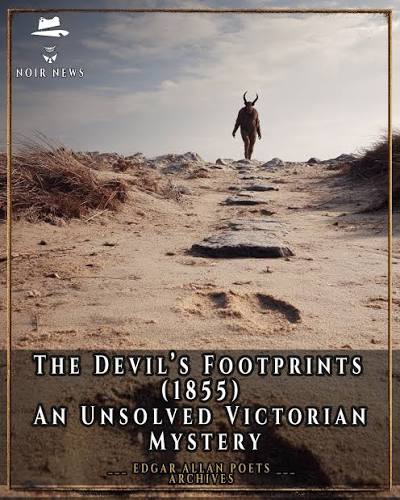
Morning came slowly to the towns around the Exe estuary. Snow covered lanes, gardens and the dark roofs of houses, smoothing familiar places into a quiet white surface.
Then people began noticing the marks.
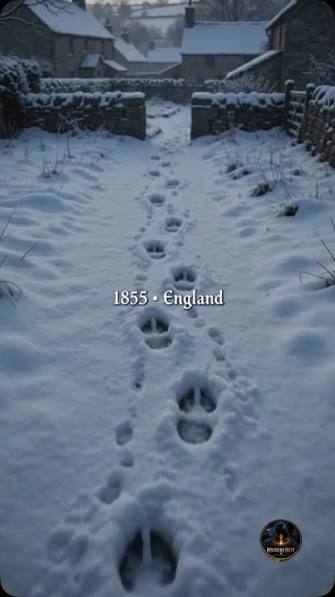
They resembled small hoofprints, but they did not behave like the trail of an ordinary hoofed animal. Reports placed them in single-file lines across fields and courtyards, along narrow walls, over roofs and near obstacles that seemed to interrupt nothing. In some places, the marks appeared to stop and begin again without a visible approach or departure.
The reports are historical; the idea of one continuous supernatural trail is not established. Newspapers, correspondence and tracings show that unusual tracks were widely discussed after the snowfall of February 8–9, 1855. They do not demonstrate that one creature crossed every named town, followed one uninterrupted route or left every mark attributed to the event.
The surviving file points toward something less dramatic but more complicated: several trails, probably created by small animals and altered by unusual snow conditions, were gathered into a single story as reports moved between villages and newspapers. That explanation accounts for much of the evidence, though not every reported obstacle can now be reconstructed.
What Witnesses Reported on the Morning of February 9
The best-known wave of reports followed a heavy fall of snow during the night of Thursday, February 8, into Friday, February 9, 1855. Contemporary weather descriptions indicate that snow fell around midnight, followed by a rise in temperature, some rain and another frost toward dawn. Those changes would later become central to natural explanations because they could enlarge, join or harden animal tracks before residents examined them.
A report printed by The Times on February 16 named Topsham, Lympstone, Exmouth, Teignmouth and Dawlish. It described widespread excitement over tracks found in fields, enclosed gardens, courtyards, on narrow walls and on the tops of houses. The newspaper also noted that some residents connected the marks with Satan, while the subject had already entered local sermons.
The famous description of a single-file trail came from reports that the impressions followed one another rather than alternating clearly to the left and right. Many were compared with a donkey’s shoe, although they were far smaller. Later source collation found reported lengths of roughly three and a half to four inches, widths from about one and a half to two and three-quarter inches, and intervals ranging from eight to sixteen inches. Those measurements overlap, but they are not identical.
Local search parties attempted to follow some trails. One group reportedly traced marks from Dawlish churchyard through nearby districts for approximately five miles without finding an animal. Elsewhere, tracks were described as beginning or ending suddenly. Yet no individual or organized party followed one path across the entire region.
The longest reasonably traceable section in the surviving source collection was measured in miles, not the legendary hundred-mile journey later assigned to a single traveler. That gap between local observation and regional legend is the first important break in the file.
YOUTUBE EMBED 1 — PRIMARY SEARCH QUERY: “Devil’s Footprints Devon 1855 documentary”
The Tracings Show More Than One Kind of Mark
The tracks themselves disappeared with the snow. What survived were descriptions, measurements, sketches and a small group of tracings associated with the Reverend Henry Thomas Ellacombe, vicar of Clyst St George.
Ellacombe gathered letters and observations soon after the event. His papers remained in the parish and were brought to wider attention in 1952, when local historian Major Antony Gibbs showed them to folklorist Theo Brown. The collection included correspondence, a draft communication connected with the Illustrated London News and apparent life-size tracings made while the impressions were still visible.
Those materials do not preserve one perfect, universal hoof. Ellacombe noted that marks could be similar in general form while varying somewhat in size. Some tracings looked like a smooth horseshoe. Others suggested claws or divisions within the impression. Reports also differed over whether the marks were sharply defined, cloven or rounded.
The published illustrations added another layer. The Illustrated London News printed material on the Devon tracks on February 24 and returned to the subject on March 3 with a response attributed to the prominent anatomist Richard Owen. The surviving newspaper image helped establish the neat U-shaped print that later books repeatedly reproduced. Yet the printed outline was only one representation among several, not a photograph of every mark found across Devon.
That distinction changes the question. Instead of asking what single animal made one identical print everywhere, the evidence asks whether several ordinary track types could have been simplified into the same visual symbol.
How Separate Reports Became a Hundred-Mile Trail
The first traceable newspaper report identified in later research appeared on February 13. Three days later, The Times carried the story nationally. The Illustrated London News then published letters, diagrams and proposed explanations over several issues. Each stage added locations and details, but it did not necessarily add a continuous chain of observation.
One influential correspondent used the name “South Devon.” His account listed places beyond the first cluster around the Exe estuary and claimed remarkable uniformity in the size and spacing of the marks. The same version pushed the estimated journey toward one hundred miles and described the track as crossing the River Exe.
Ellacombe’s recovered papers later identified the correspondent as the young William D’Urban, who would eventually become the first curator of Exeter’s Royal Albert Memorial Museum. His account was influential, but its broad conclusions exceeded what any single observer had followed on the ground.
Tracks were reported on both sides of the estuary, but no surviving account shows investigators following one line to one bank, watching it cross the ice or water and locating the same line emerging opposite. Reports from different parishes were treated as segments of one route because the marks appeared during the same period and looked broadly alike.
Even the dates may not belong to one night. Most discoveries were associated with February 9, but some reports referred more generally to recent snowstorms, while another set of marks was reported in Topsham several days later. Once these observations entered the same newspaper conversation, the legendary trail became cleaner and more continuous than the underlying record.

The Leading Explanation: Rodents, Other Animals and Changing Snow
The strongest modern reading is not that one species made every track. It is that multiple small animals crossed unusually receptive snow, after which thawing, rain and refreezing altered their prints into similar hoof-like forms.
A 2021 paper by Brian V. Ridout in the peer-reviewed Transactions of the Devonshire Association reviewed the original accounts and the ways tracks can melt and distort. Ridout argued that small rodents were the most practical source. Rats and mice can move by bounding, placing several feet close together in a compact group. In soft or changing snow, the grouped impressions can merge into a U- or horseshoe-like shape.
The theory also fits the single-file appearance. A hopping animal repeatedly landing its feet in a compact cluster can leave one apparent mark per bound rather than a clear left-right walking pattern. Rodents are nocturnal, numerous and capable climbers. They could enter enclosed gardens, pass through narrow openings and reach walls, sheds or roofs that a donkey or deer could not.
Earlier writers had already proposed rats, mice, cats, birds, badgers and hares, showing that observers did not agree on a single anatomical source. Similar hopping tracks later observed from wood mice were found to match several of the reported Devon measurements.
The weather supplies the second half of the explanation. A shallow layer of snow received tracks, softened as temperatures rose and rain arrived, then froze again before morning. Edges could collapse inward, toes could blur together and separate paw impressions could become a larger continuous outline. Track specialists likewise caution that the surface material can change the apparent shape, depth and detail of an impression.
The theory gains strength from convergence. Small animals explain the size, narrow openings, climbing and repeated local trails. Changing snow explains why different paws might acquire a similar hoof-like appearance.
Its weakness begins with the reported regularity. Some observers measured repeated intervals of eight and a half inches and insisted that ordinary animal tracks nearby remained recognizable. A rodent explanation is persuasive for many marks, but it cannot demonstrate that every reported sequence came from the same gait or underwent exactly the same distortion.
The theory becomes strongest when it is allowed to be plural.
YOUTUBE EMBED 2 — SECONDARY SEARCH QUERY: “Devon mysterious footprints historical explanation”
Why the Escaped Kangaroo Became Part of the Case
One of the strangest natural explanations did not begin as a carefully tested zoological conclusion. It appears to have been offered partly to quiet a more alarming idea.
The Reverend G. M. Musgrave discussed the possibility of an escaped kangaroo after reports circulated that such animals were kept in a private collection near Exmouth. A kangaroo could leap and clear some barriers, making it attractive as a quick answer to tracks found inside enclosed spaces. The suggestion traveled widely because it gave newspapers an exotic creature that was still less frightening than the Devil.
Musgrave’s correspondence, however, shows that he did not regard the theory as established. According to the recovered source material, he used the possibility in a sermon because it offered his listeners a natural alternative to supernatural panic. There was no documented escape, no missing animal publicly identified and no explanation for reports appearing across widely separated communities.
Richard Owen proposed a badger, while another observer favored an otter after noticing possible claw marks and a trail near a narrow pipe. Birds, cats, hares and rats each explained particular details better than others. An airborne balloon with a dragging rope was suggested much later, but it would be expected to leave irregular scraping rather than measured, repeated steps and could not easily account for paths through small openings.
These alternatives expose a faulty assumption. The moment every Devon mark is forced to share one maker, each theory becomes absurd. Once the reports are separated by location and track form, several ordinary animals become possible.
The Obstacles Cannot Be Reconstructed With Confidence
The hardest details are the marks said to have crossed roofs, cleared a fourteen-foot wall, passed through a narrow pipe or stopped at one side of a haystack before continuing beyond it.
Some of these reports appeared in contemporary correspondence, but the descriptions rarely provide enough spatial information to prove continuity. A trail outside a wall and another inside may have been made by different animals. Marks on opposite sides of a house were not necessarily one path across its roof. No measured survey established that every segment aligned or belonged to the same trackway.
The haystack claim is especially resistant, yet it reached print secondhand. The person reporting it had heard of the observation through another acquaintance, and the surviving account does not show how closely the stack’s sides and top were examined.
The same problem affects the supposed estuary crossing: marks existed on both sides, but the connecting route was inferred rather than followed.
A hoax could explain a few conspicuous sequences, especially in places designed to defeat animal explanations. It does not comfortably explain the broad volume of local reports. Some spectacular obstacle stories may preserve genuine tracks, mistaken alignment, rumor or deliberate additions. The record is too thin to assign one answer to all of them.
How a Regional Snow Event Became the Devil’s Walk
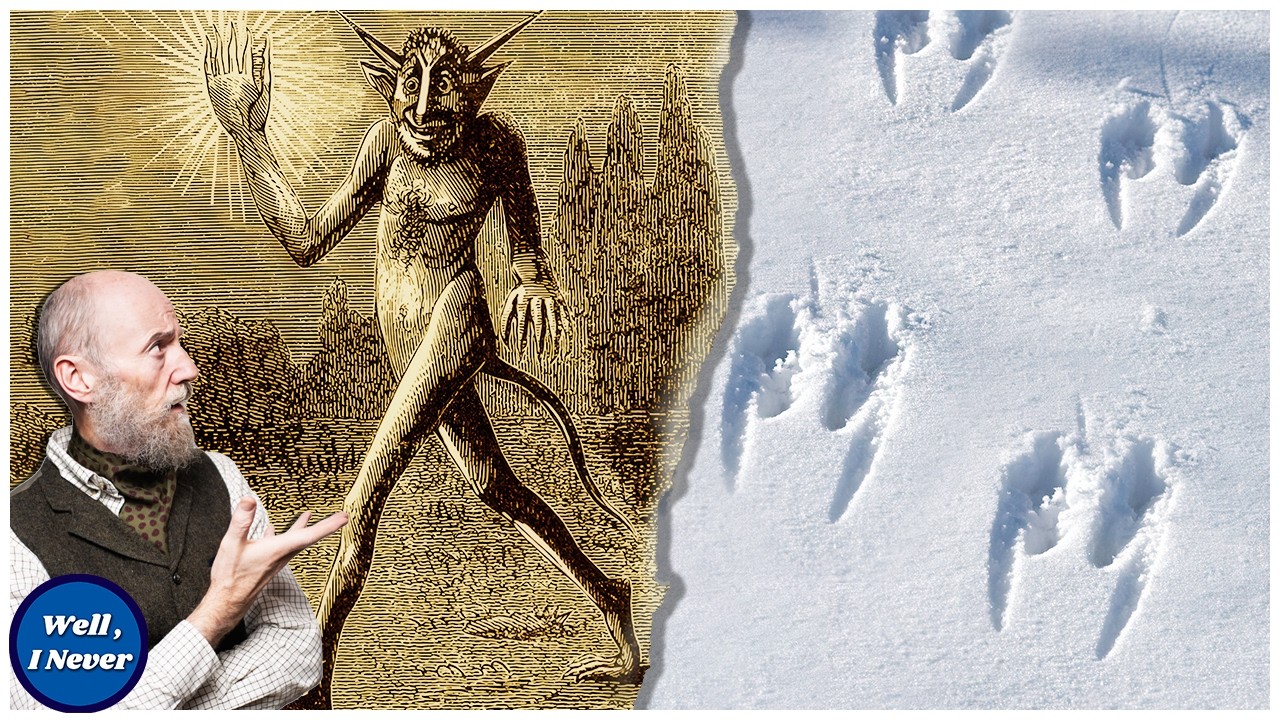
The supernatural label appeared early. The first reports already described frightened residents connecting the marks with Satan, and national newspapers repeated that reaction because it gave a scattered local event a memorable identity.
Later retellings removed much of the uncertainty. Variable measurements became identical prints. Separate towns became points on one route. Marks found on both sides of the Exe became a creature crossing the estuary. A broad region in which sightings were reported became a hundred miles physically walked by one traveler in a single night.
Charles Fort revived the episode for twentieth-century readers in The Book of the Damned, placing it within a larger collection of anomalies that challenged conventional explanation. Later mystery books, television programs and websites inherited the unified version because one impossible traveler is easier to tell than dozens of animals moving during unusual weather. Mike Dash’s 1994 source collection helped return attention to the original papers, inconsistencies and local scale of the evidence.
The Ellacombe tracings are therefore important for more than their shape. They preserve variation at the point where popular memory prefers uniformity.
The archive does not erase the strangeness of that morning. It shows how quickly many small uncertainties can join into one enormous footprint.
What the Evidence Actually Supports
Were the Devil’s Footprints one phenomenon, several animals or a story enlarged by repeated reporting?
The most cautious answer is all three, but not in equal measure. A real regional event occurred: after severe winter weather, residents in numerous Devon communities found unfamiliar tracks and discussed them in letters and newspapers. Some marks were measured and traced. That historical core is stronger than a legend invented decades later.
The evidence does not support one uninterrupted trail. No observer followed it across every town, wall, roof and river. Measurements varied, drawings differed, and some marks appeared on later dates. The celebrated hundred-mile route was built by combining disconnected sightings and estimating how far a hypothetical single traveler would have moved.
Small rodents provide the strongest specific explanation for many of the prints. Their bounding gait can place four feet into one compact impression, their size fits the narrow spacing, and their climbing ability fits gardens and structures. Other animals probably contributed additional trails, while thaw, rain and frost changed outlines before morning. Hoaxes or reporting errors may account for a few of the most theatrical obstacles.
The confidence level is moderate, not absolute. The multi-cause explanation fits the surviving evidence better than any single animal and far better than a supernatural visitor, but the snow vanished before the trackways could be mapped properly.
What remains is a winter landscape reconstructed from paper: separate lines crossing separate gardens, slowly joined by rumor until Devon seemed to hold one set of footprints.

