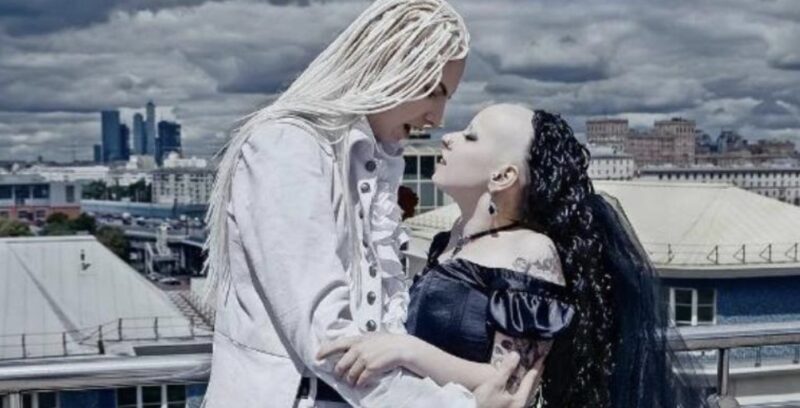
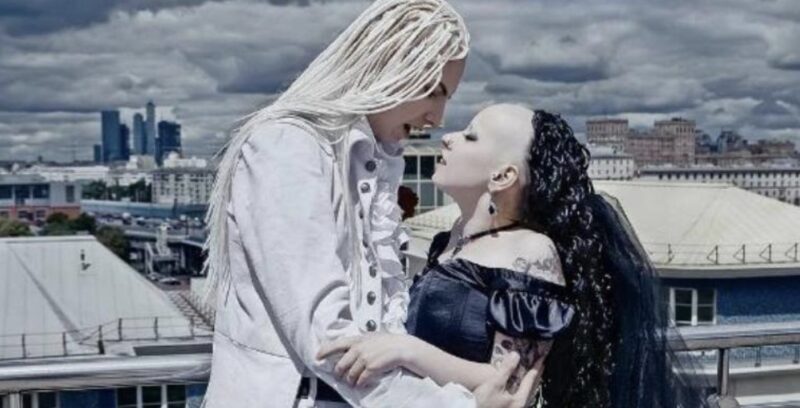
When wedding photographs of Angela and Alexander Tolstov began circulating online, few people could look away.
This was not a ceremony filled with soft pastel flowers, a traditional white bridal gown, or carefully coordinated formalwear. Instead, the couple appeared in dramatically contrasting black-and-white outfits that reflected the gothic subculture they embraced.
Some viewers were fascinated by their confidence. Others mocked their appearance and predicted that the marriage would never last.
But the photographs captured only one day in their lives.
Years later, new family portraits offered a very different picture—one shaped not by internet comments, but by marriage, parenthood, creativity, and a continued refusal to live according to other people’s expectations.
A Wedding Designed Around Their Own Personalities
Angela Tolstova, also known online as Pushba and referred to as Irina in some earlier reports, never wanted an ordinary wedding.
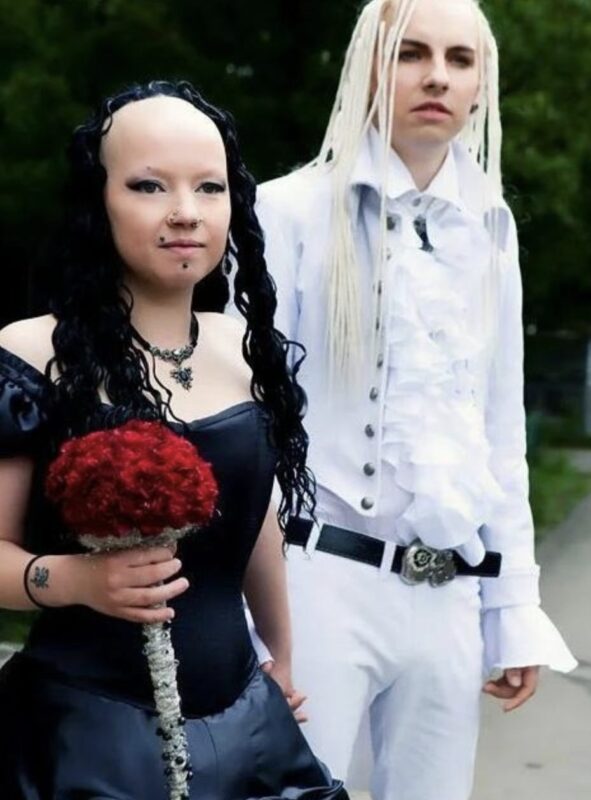
She did not imagine herself wearing a delicate white gown or presenting a conventional bridal image. Instead, she chose a fitted black dress, bold facial piercings, dark curls, and a hairstyle that immediately became one of the most discussed elements of the ceremony.
Alexander created an equally unforgettable look.
He wore a white suit with an old-fashioned silhouette, towering platform footwear, and long white dreadlocks. Standing beside Angela, he created a striking visual contrast: the bride dressed almost entirely in black and the groom dressed almost entirely in white.
The styling was unconventional, but it was not random. Their outfits complemented each other and reflected the shared world they had created together.
An early feature about the wedding praised that black-and-white contrast and noted how happy both the couple and their guests appeared in the photographs.
The Images Quickly Spread Across the Internet
The Tolstovs’ wedding reportedly took place in 2009, during a period when blogs, forums, and LiveJournal communities could transform a personal photograph into an international curiosity almost overnight.
Once their images appeared online, people began sharing them widely.
The couple’s hairstyles, clothing, piercings, and platform shoes became the subject of countless conversations. Some users admired their creativity, while others reacted with ridicule simply because the pair looked so different from the traditional image of a bride and groom.
Many strangers made immediate assumptions about their personalities and relationship.
Some believed their appearance was merely an attempt to attract attention. Others predicted that two people with such unusual styles could not possibly create a stable family life.
Those reactions revealed more about the internet than they did about Angela and Alexander.
Viewers saw a few dramatic photographs and believed they understood the entire relationship. In reality, the couple had simply chosen to celebrate one of the most important days of their lives in a way that felt authentic to them.
Their Celebration Continued Beyond the Ceremony
The wedding itself reportedly followed the same unconventional spirit.
Rather than ending the day with an elegant banquet in a traditional restaurant, later accounts described the couple celebrating with music and a rock-concert atmosphere.
For Angela and Alexander, the goal was not to create a ceremony that would satisfy strangers. They wanted an event that reflected their interests, friendships, and personalities.
That decision helped make the wedding memorable.
Even years after the original photographs first circulated, the images continued reappearing in articles and social-media posts. New audiences repeatedly encountered the black-clad bride and white-clad groom, often without knowing anything about what happened after the cameras were put away.
The question gradually changed from “Why did they dress like that?” to “Where are they now?”
Family Portraits Revealed a New Chapter
Later photographs showed that the viral newlyweds had moved into another stage of life.
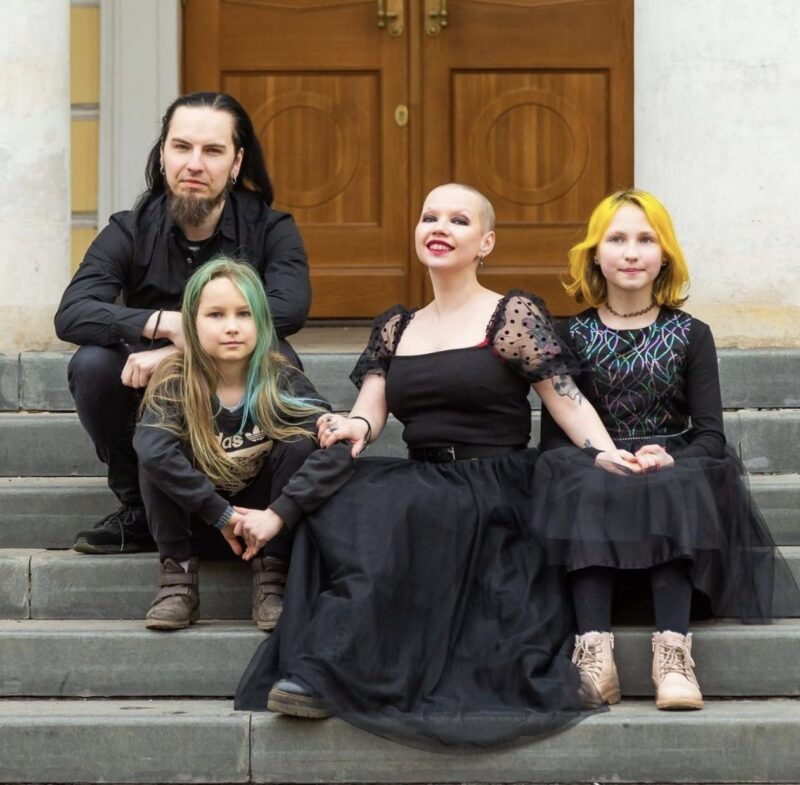
Reports published years after the wedding identified their two older children as a daughter named Lada and a son named Elisey. Family portraits showed the children posing alongside their parents in images that remained creative, expressive, and far removed from the standard studio photograph.
The children were not presented as miniature copies of their parents. Instead, reports suggested that Angela and Alexander encouraged them to explore their own appearances and preferences.
Lada was reportedly allowed to experiment with her hair, while Elisey could choose whether to grow his hair long or keep it short.
That approach reflected one of the central ideas visible in the couple’s wedding photographs: individuality should not disappear simply because other people find it unfamiliar.
Their family images remained unconventional, but they also looked warm, playful, and carefully created.
The dramatic bride and groom who once inspired so many harsh predictions were now being seen as parents.
Angela Turned Her Individuality Into Creative Work
Marriage and motherhood did not erase Angela’s distinctive identity.
On her personal LiveJournal page, she describes herself as Angela Tolstova, or Pushba, and identifies herself as a photographer, model, mother, wife, blogger, and supporter of body positivity. She also explains that her photography often focuses on people who may not fit conventional beauty standards.
Her work challenges the idea that professional portraits should be reserved for young, conventionally attractive, or experienced models.
Instead, she has photographed people of different ages, body types, and backgrounds, approaching each subject with the belief that everyone can be presented creatively and beautifully.
This philosophy connects naturally with the way she presented herself at her wedding.
Angela did not wait for society to approve of her appearance. She built an image that felt honest, accepted the attention it attracted, and continued using photography and modeling as forms of self-expression.
Alexander has also been associated with photography, and earlier profiles described the couple as sharing a creative professional environment.
Their Appearance Changed, but Their Individuality Remained
As later family photographs appeared, viewers noticed that Angela and Alexander no longer looked exactly as they had on their wedding day.
That transformation was hardly surprising.
More than a decade can change anyone’s hairstyle, clothing preferences, responsibilities, and daily routine. Parenthood also introduces practical demands that rarely appear in dramatic wedding portraits.
But changing one’s appearance does not necessarily mean abandoning an identity.
Angela continued to embrace bold fashion, alternative photography, body positivity, and unusual artistic concepts. Her more recent posts still describe a busy creative and family life, including work, photography, handmade accessories, and raising children.
The gothic wedding was never the couple’s entire personality. It was one highly visible expression of who they were at a particular moment.
Their later photographs show evolution rather than contradiction.
The Real Story Was Never About Their Clothes
The wedding photographs became famous because Angela and Alexander looked unusual.
But the reason people continue returning to their story is more complicated.
Their lives challenge the quick judgments that followed the original images. Strangers saw black clothing, shaved hair, dreadlocks, piercings, and platform shoes—and immediately constructed a story about instability.
The years that followed revealed something far more ordinary and meaningful: two creative people building careers, raising children, navigating family responsibilities, and continuing to express themselves in their own way.
Their children did not become interesting because of how they looked.
What mattered was the environment reflected in the family portraits—one in which personal expression was encouraged rather than suppressed.
The Tolstovs’ story is therefore not simply a dramatic “before and after.” It is a reminder that growing older does not have to mean becoming unrecognizable to yourself.
Styles can evolve. Hair can change. Families can grow.
And the people behind a viral photograph will always have lives far more complex than the comments written beneath it.