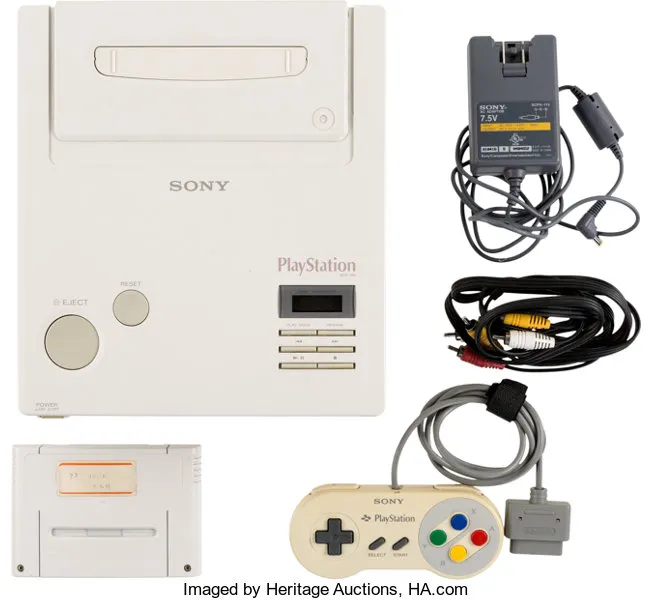
It looked like something pulled from a forgotten storage bin — a gray rectangular console marked with two names that, in the world of gaming, should never appear on the same device: Nintendo and Sony. The unit had no retail box, no instruction manual and no place in any official product catalog. It had simply been sitting in an attic, untouched, for years.
The man who eventually brought it to public attention was Terry Diebold, whose father had received the console through a business connection in the early 1990s. Terry found it while going through his family’s belongings. He had no idea what it was — just that it looked unusual and carried those two unmistakable logos.
What he was holding turned out to be one of the most significant artifacts in video game history.
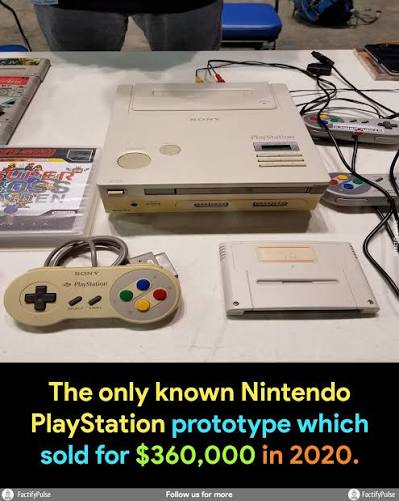
The machine was the only known surviving Nintendo PlayStation prototype — a working hardware unit built during a brief, ambitious and ultimately collapsed partnership between Nintendo and Sony. When it eventually crossed an auction block at Heritage Auctions, it sold for $360,000, a price that reflected both its rarity and its place in the timeline of an industry worth hundreds of billions of dollars today.
The Partnership That Produced the Hybrid Console
In the late 1980s, Nintendo and Sony were not rivals. They were working together. Nintendo wanted a CD-ROM add-on for the Super Nintendo Entertainment System, and Sony had the technology and engineering capacity to help build it. The two companies entered into a development agreement, and Sony began designing a hybrid console capable of playing both SNES cartridges and a new CD-based format that Sony would control.
The planned device was publicly referred to as the “Play Station” — two words, which distinguished it from the Sony PlayStation that would come later. Sony demonstrated a prototype at the Consumer Electronics Show in June 1991, announcing the partnership to the industry. The next morning, Nintendo announced a competing deal with Philips instead. The Sony agreement was effectively dead.
The reasons behind Nintendo’s pivot have been documented and debated for decades. Licensing terms gave Sony significant control over software on the CD format, a concession Nintendo apparently decided was unacceptable. Whatever the internal reasoning, the collaboration ended abruptly, leaving Sony with engineers, experience and intellectual property that it would eventually channel into building its own console — the PlayStation — released in Japan in 1994.
The prototype hardware built during the Nintendo-Sony collaboration was not released and was not supposed to survive. Most units were presumably destroyed or retained internally. The one that ended up in an attic in the American Midwest was a rare exception.
How the Prototype Survived in Private Hands
Terry Diebold’s father, Olga Diebold, had worked at Advanta Corporation, a financial services company that had a connection to Sony during the early 1990s. According to documented accounts, the prototype was given or transferred to the family through that business relationship before the Nintendo-Sony deal fully collapsed and before the industry understood what the device represented.
For roughly two decades, the console sat in storage. It was not displayed, not loaned to museums and not sold. The Diebold family kept it without fully understanding its historical weight. When Terry brought it out and began researching what it actually was, the gaming community took notice quickly.
He first showed the prototype publicly at the Portland Retro Gaming Expo in 2015. Photographs and video footage from that event spread rapidly through gaming forums and tech media, triggering widespread coverage. Enthusiasts and historians recognized immediately that the device matched descriptions of the Nintendo-Sony prototype — and that no other surviving unit had been publicly documented before this one.
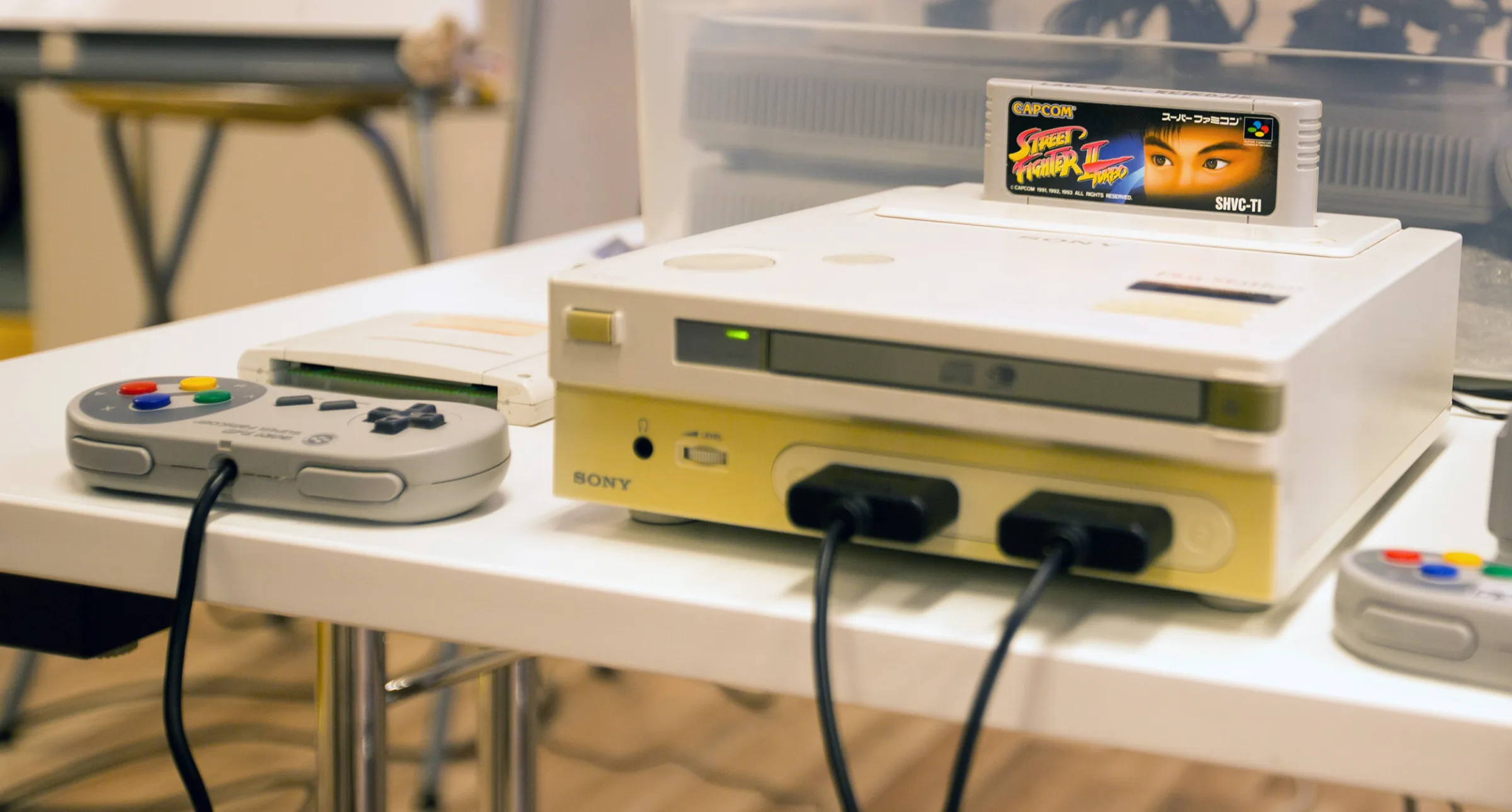
The console’s physical design matched what would be expected from that development period. It featured a cartridge slot on top compatible with SNES game cartridges and a front-loading CD-ROM drive. The Nintendo and Sony logos appeared together on the unit’s face. The hardware reflected the hybrid functionality the two companies had envisioned: a machine that bridged Nintendo’s existing cartridge library with a new disc-based format.
The Tests That Showed It Could Still Work
One of the most striking things about the Diebold prototype was that it was not merely a shell or a mock-up. After more than two decades in storage, the unit was tested and found to be functional — at least in part. Documented demonstrations showed it successfully loading and running SNES game cartridges. The CD-ROM component proved more difficult to assess thoroughly, given the rarity and age of any compatible disc media, but the cartridge functionality confirmed that the core hardware had survived storage in working condition.
These demonstrations were conducted carefully and documented on video, giving gaming historians and potential buyers concrete evidence that the prototype was not simply a decorative artifact. It was a piece of engineering that had been built to function, had functioned during development and had retained enough integrity to function again when tested decades later.
Technical reviewers who examined the unit noted features consistent with pre-release hardware: internal components that reflected the engineering stage the Nintendo-Sony collaboration had reached before the partnership ended. The device was not a fully finished consumer product, but it was far more than a concept rendering.
YOUTUBE EMBED — PRIMARY SEARCH QUERY: “Nintendo PlayStation prototype Heritage Auctions 360000 video”
How Heritage Auctions Presented the Machine
Heritage Auctions, one of the largest auction houses in the United States and a well-established venue for significant video game sales, handled the consignment and authentication process for the prototype. The auction house documented the unit’s provenance, its physical characteristics and its connection to the Nintendo-Sony collaboration.
Heritage presented the prototype in its 2020 auction catalog with detailed description and historical context. The listing emphasized the unit’s status as the only known publicly surfaced example of the Nintendo PlayStation hardware, and it connected the device to the documented history of the failed partnership — including the 1991 CES announcement and Nintendo’s subsequent pivot to Philips.
The auction listing made clear that buyers were bidding on a verified piece of hardware, not a replica or reproduction. Heritage’s involvement added institutional credibility to a provenance story that, while unusual, was supported by documented public demonstrations beginning in 2015 and by the physical evidence of the console itself.
The sale attracted significant attention from collectors, gaming historians and press outlets covering both the auction industry and the video game market.
YOUTUBE EMBED — SECONDARY SEARCH QUERY: “Nintendo PlayStation prototype working demonstration”
The $360,000 Auction Result
When the Heritage Auctions sale concluded in 2020, the Nintendo PlayStation prototype sold for $360,000, a figure that included the buyer’s premium. The result placed it among the highest prices ever paid for video game hardware at public auction at that time.
The final price reflected several converging factors. The prototype’s historical significance as the physical product of the Nintendo-Sony collaboration was primary. Its rarity — no other publicly known surviving unit existed — was equally important. And its documented functionality gave it an edge over a non-working artifact: this was hardware that had been built to operate and could still do so.
The identity of the buyer was not publicly disclosed, which is common in high-value auction transactions. What was documented was the sale price, the auction house and the provenance chain leading back to the Diebold family’s decades of private storage.
The result also drew attention to the broader market for historically significant video game hardware and software, a category that had been gaining serious collector and institutional interest through the late 2010s and into the 2020s.
A Branch of Gaming History That Never Reached Stores
The Nintendo PlayStation prototype is significant not because it represents a product that succeeded, but because it is the physical evidence of one that was abandoned at the threshold. The Nintendo-Sony collaboration, had it continued, would have reshaped the console landscape of the 1990s in ways that are impossible to fully project. Instead, the partnership’s collapse pushed Sony to build its own platform — and the PlayStation became one of the best-selling console lines in history.
The gray unit that sat in a Midwest attic for two decades captures the exact moment before that split. It carries both logos. It runs cartridges designed for one company’s system. It has a disc drive intended for a format the other company would have controlled. It is hardware built for a future that never arrived.
For collectors and gaming historians, the $360,000 sale was not just a transaction. It was a formal acknowledgment that the documented artifacts of gaming’s formative decisions carry real cultural and monetary weight — and that sometimes, the most important objects in an industry’s history are the ones that never made it to a store shelf.

