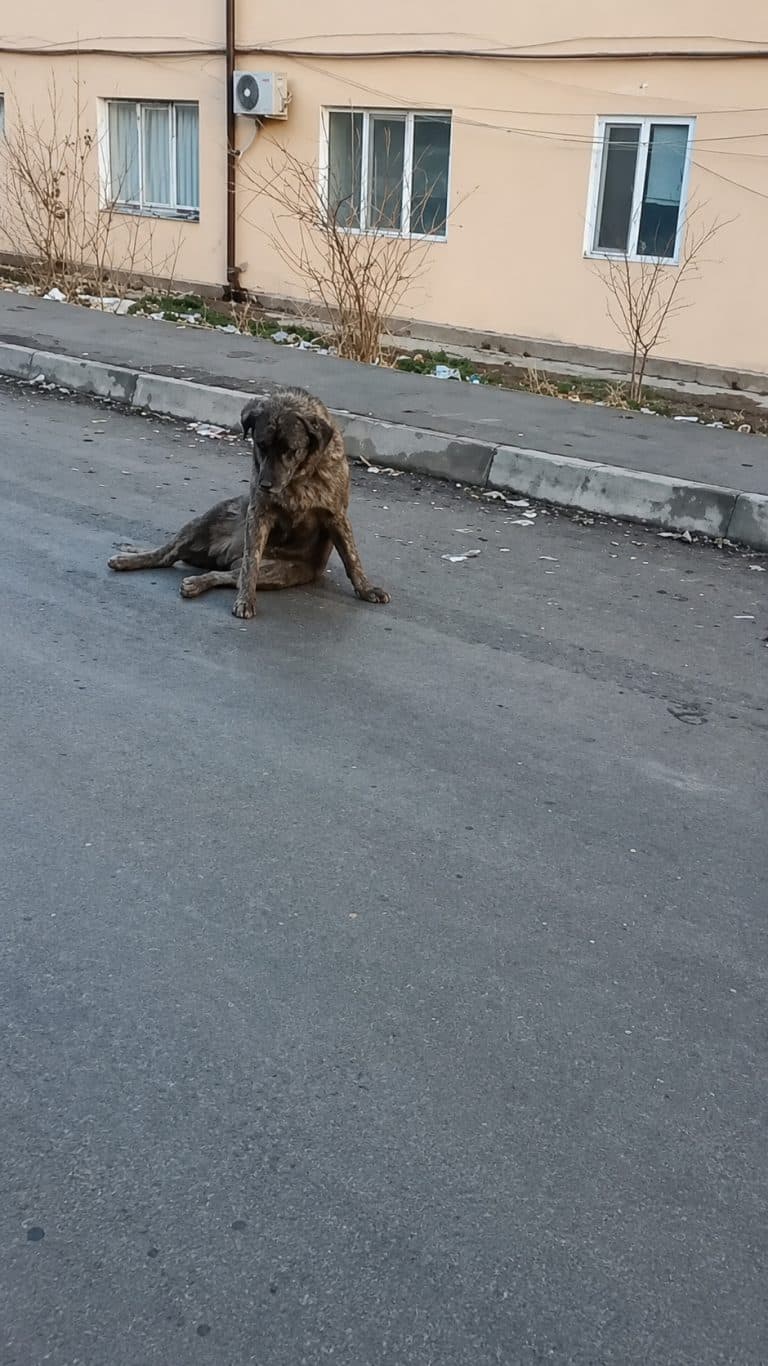
For three days, Gerda remained beside a quiet road in Dagestan, Russia.
Cars passed.
People walked nearby.
But the large stray dog was too weak to stand, and no one appeared willing to move closer.
She lay beneath the open sky with barely enough strength to lift her head. By the time rescuers finally received word about her, Gerda’s body had been pushed dangerously close to its limit.
They did not know whether she would walk again.
They only knew they could not leave her there for another hour.
A Dog Too Weak to Leave the Road
When the rescue team arrived, Gerda remained almost completely motionless.
She was a large dog, but her body looked painfully frail. Exhaustion showed in the way she rested against the ground and struggled to respond to the people gathering around her.
Food was offered.
Gerda showed little interest.
Even raising her head appeared difficult.
The rescuers could not know exactly what had happened before she was found. They could only see that she had been lying beside the road for several days without the care she urgently needed.
Approaching her required caution.
A dog in pain or extreme weakness may react unpredictably, especially when surrounded by unfamiliar people. The team spoke softly and moved slowly, giving Gerda time to recognize that no one intended to harm her.
When they were finally close enough, they lifted her carefully.
Gerda did not resist.
Her body remained heavy and still as she was carried away from the roadside.
Video: Gerda Lay Beside the Road for Three Days Before Someone Finally Came to Help
The Journey to Emergency Veterinary Care
Gerda was first transported to a temporary rescue center, where volunteers could keep her safe while arranging more advanced medical treatment.
She was then taken to Krasnodar for a full veterinary examination.
The trip marked the beginning of a new chapter.
Until that moment, she had been an unnamed dog lying alone as the world passed around her. At the clinic, caregivers gave her a name.
Gerda.
Veterinary staff began working immediately to stabilize her condition.
She received intravenous fluids to address dehydration and support her weakened body. Medication was administered, and doctors performed a series of tests to understand why she could no longer stand or walk normally.
X-rays were especially important.
Because Gerda had been found immobile beside a road, rescuers feared she might have suffered broken bones or another serious injury.
The results brought cautious relief.
No fractures were found.
But Gerda still could not walk, which meant her recovery would require further evaluation, rest, and time.
Her Body Had Survived, but Trust Came Slowly
Although the X-rays ruled out broken bones, Gerda remained extremely weak.
Severe exhaustion, prolonged immobility, pain, or an injury not visible on the initial images may all have contributed to her condition. The rescuers focused on what they could observe rather than trying to force an immediate explanation.
Gerda needed nutrition.
She needed medical supervision.
And she needed a quiet environment where she could begin recovering without pressure.
After the emergency stage of her treatment, arrangements were made for Gerda to travel to a foster home in Moscow.
There, her physical condition was only part of the challenge.
Gerda avoided looking directly at people.
She often positioned herself close to walls and became tense when someone moved nearby. New sounds and unfamiliar gestures appeared to make her uncomfortable.
Her foster family did not demand affection.
They understood that reaching safety did not automatically mean Gerda felt safe.
So they began with simple routines.
Meals at predictable times.
A comfortable place to rest.
Calm voices.
And enough distance for Gerda to observe without feeling trapped.
Kindness Was Offered Without Expectations
Gerda’s foster family allowed her to recover at her own pace.
No one pulled her away from the wall.
No one forced her to interact.
If she turned her head away, they respected the signal. If she remained quiet, someone simply sat nearby.
This steady approach gave Gerda something she may not have experienced for a long time: control over how close people came.
The family continued caring for her each day, even when progress was difficult to see.
Food was placed within reach.
Medication was given gently.
Her bedding stayed clean and soft.
The same people returned every morning and evening.
Over time, Gerda began watching them more closely.
She remained cautious, but she no longer appeared startled by every movement. Familiar voices became part of her routine, and she slowly allowed caregivers to remain nearer.
Trust did not arrive through one dramatic moment.
It grew through hundreds of ordinary interactions in which nothing bad happened.
The Day Gerda Finally Stood
Then came the moment everyone had been hoping for.
Gerda pushed herself upward.
At first, her legs appeared uncertain beneath her large body. She remained standing only briefly before needing to rest again.
But she had done it.
The dog who had been carried away from the roadside had supported her own weight.
Her caregivers continued encouraging movement carefully, never asking her to do more than her body could manage. Strength had to return gradually after such a prolonged period of weakness.
Soon, Gerda attempted a few steps.
They were slow and unsteady.
She paused frequently.
But each step showed that her body was beginning to respond to treatment, nourishment, and rehabilitation.
Then, for the first time since her rescue, Gerda walked across the room.
There was no sudden sprint or dramatic celebration from her.
Only one careful step after another.
For the people who had carried her when she could not stand, the sight meant everything.
Her Confidence Returned With Her Strength
As Gerda’s mobility improved, other changes followed.
She began moving around the foster home more freely instead of remaining pressed against the walls. Her posture relaxed, and she showed increasing curiosity about the spaces around her.
Short walks became possible.
Then longer ones.
Her interactions with people also became easier. Gerda began accepting gentle touch and remaining nearby instead of immediately withdrawing.
She was introduced carefully to other dogs.
At first, she observed them from a distance. As her confidence grew, she began socializing and participating in play.
The transformation did not happen overnight.
There were still moments of hesitation.
Unexpected sounds could make her stop, and unfamiliar situations required patience. But the dog who once appeared unable to engage with the world was now exploring it.
Gerda could walk.
She could run.
And she could experience ordinary moments of companionship without constantly retreating.
The Roadside Was No Longer the End of Her Story
Gerda’s recovery was not miraculous because every difficulty disappeared instantly.
It was remarkable because progress continued when her future had once seemed so uncertain.
She survived the days beside the road.
She endured the journey to veterinary care.
She learned to stand again.
And through the consistency of her foster family, she discovered that people could approach without causing harm.
Her story is a reminder that rescue rarely ends when an animal is lifted into a vehicle.
That is only the first step.
Recovery may require medical treatment, transportation, rehabilitation, nourishing food, and weeks or months of patient care. It may also require people who are willing to remain present even when an animal cannot immediately respond with trust or affection.
Gerda did not need to become cheerful overnight to deserve help.
She did not need to wag her tail before someone cared for her.
Her life mattered while she was still weak, silent, and uncertain.
One Person Stopping Gave Gerda Another Chance
For three days, people passed Gerda without changing her situation.
Then someone stopped.
That decision connected her with rescuers, veterinarians, and a foster family willing to continue what the roadside rescue had begun.
Today, Gerda is no longer the motionless dog beneath the open sky.
She moves with strength.
She explores with curiosity.
She plays with other dogs and accepts care from the people around her.
The road where she was found remains part of her past, but it no longer determines what comes next.
Gerda’s journey was changed by a simple choice:
Someone noticed suffering and decided not to continue walking.
Sometimes compassion begins with emergency treatment.
Sometimes it continues through months of quiet patience.
And sometimes the difference between being forgotten and finding a second chance is one person willing to stop.


