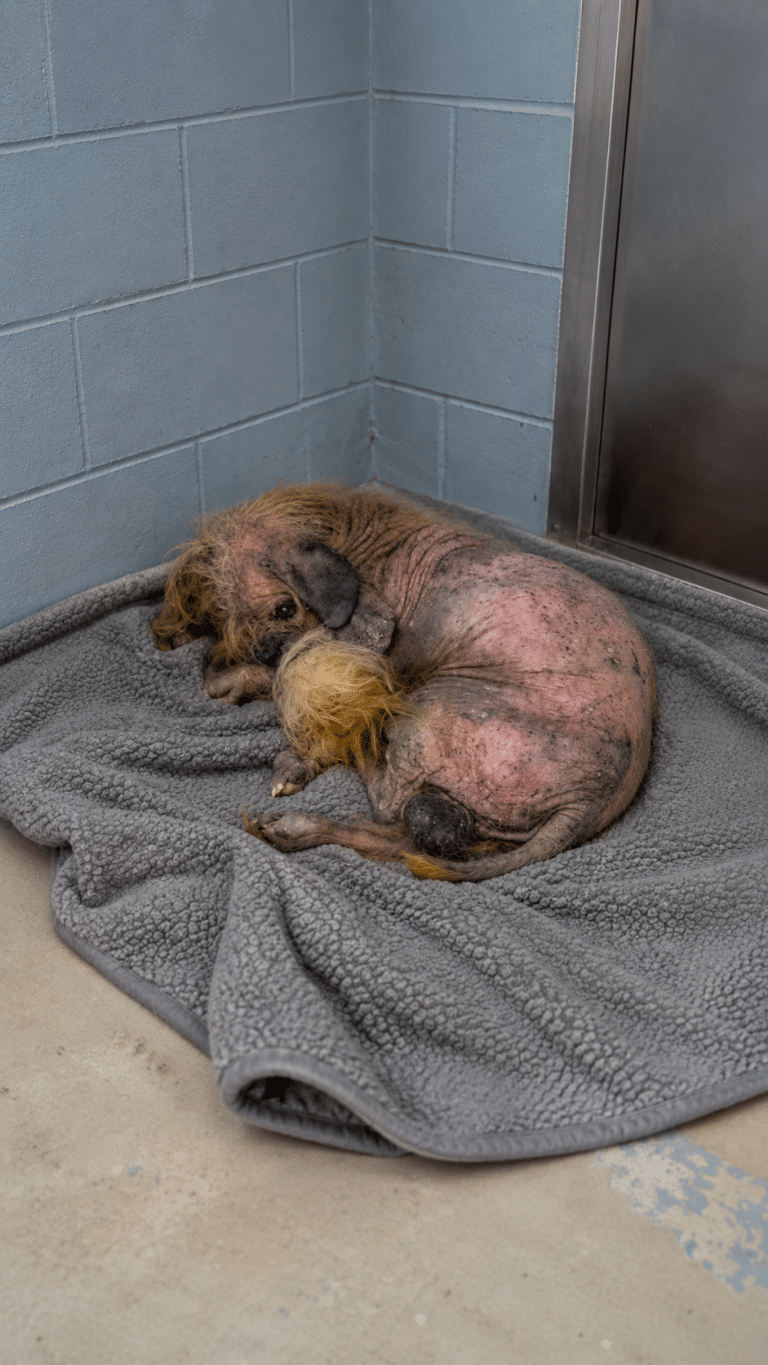
When rescuers first saw Freddy, his condition made it difficult to imagine the lively little dog he would eventually become.
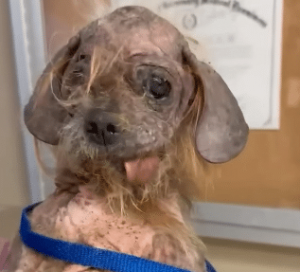
Most of his fur was gone. His exposed skin appeared inflamed, one eye had suffered serious damage, and years without proper care had affected even his teeth.
But the most concerning sign appeared whenever he tried to move.
Freddy’s body remained stiff, and after only a few uncertain steps, his legs sometimes gave way beneath him.
Then a foster mother named Caitie welcomed him into her home—and began showing him that progress did not have to happen all at once.
A Fragile Dog Who Needed Help With Everything
Freddy arrived carrying several visible signs of prolonged neglect.
His nearly hairless body offered little protection, and his sensitive skin required careful handling. He moved slowly, keeping his posture tense as though he expected every step to hurt.
Sometimes, he attempted to cross a short distance and then lowered himself back to the floor.
Other times, he lost his balance completely.
Caitie could see that Freddy wanted to move. His body simply could not cooperate in the way he needed it to.
She did not expect him to behave like a healthy dog immediately.
Instead, she prepared a quiet space where he could rest, monitored his movements, and arranged the veterinary examinations necessary to understand what was happening beneath the visible injuries.
The tests revealed that Freddy’s difficulties were not caused only by weakness.
There was a serious problem affecting his spine.
Video: Freddy Could Barely Walk When Caitie Met Him—Then His Real Personality Emerged
Doctors Found the Reason Every Step Was So Difficult
Veterinary examinations showed that Freddy was suffering from severe spinal disc compression.
The condition placed pressure around his spine and made movement uncomfortable and unstable. It explained why his body appeared stiff and why his legs sometimes failed after only a few steps.
Freddy was also dealing with several other health concerns.
His irritated skin needed treatment.
Infections had to be managed.
His damaged eye and brittle teeth required professional evaluation.
There was no single procedure that would suddenly restore everything his body had lost.
His recovery would require medication, injections, antibiotics, supportive care, and carefully controlled physical rehabilitation.
Even with treatment, progress could not be guaranteed.
Freddy had likely lived with discomfort for a long time, and his muscles had weakened from limited movement. Asking too much from him could cause additional strain.
Caitie understood that his recovery would have to follow his body’s pace.
Some days might bring progress.
Others might bring only rest.
Both would be part of healing.
His Recovery Was Built Around Difficult Daily Routines
Caring for Freddy became part of Caitie’s everyday life.
Medication had to be given on schedule.
His skin needed attention.
Physical therapy exercises were introduced carefully to help his legs regain strength without placing unnecessary pressure on his spine.
The movements were small.
Caitie supported his body while encouraging him to shift his weight. She helped him practice standing and guided him through short attempts at walking.
Sometimes Freddy managed several steps.
Sometimes his legs slipped before he had moved very far.
There were mornings when he appeared stronger, followed by days when his body seemed tired again. His recovery did not follow a smooth, predictable line.
Caitie did not treat a difficult day as failure.
She adjusted the exercises, allowed Freddy to rest, and tried again when he was ready.
Every small achievement mattered.
Standing for a few seconds longer.
Reaching his bowl without falling.
Crossing part of the room before needing help.
These moments might have appeared ordinary to anyone who had not seen Freddy at the beginning.
To Caitie, they showed that he was still responding.
The First New Patches of Fur Brought Hope
While Freddy worked to regain his mobility, his appearance also began changing.
Small patches of fur appeared across his back.
Then more began growing near his tail and along the areas that had once been almost completely bare.
The change happened gradually.
There was no single morning when Freddy suddenly woke with a full coat. His skin needed time to heal before the fur could return, and some areas developed more slowly than others.
But week by week, his body looked healthier.
Soft brown-and-gray fur began covering the irritated skin, giving Freddy the scruffy appearance that would eventually become part of his charm.
His face also became more expressive.
He paid closer attention when Caitie entered the room. He began showing interest in food, movement, and the activities happening around him.
The fragile dog who once seemed focused only on getting through each painful step was becoming curious about his surroundings.
His recovery was no longer visible only through medical progress.
His personality was beginning to emerge.
The Dog Who Struggled to Stand Started Running
As Freddy’s legs became stronger, his movements changed dramatically.
The cautious steps became steadier.
He could remain upright for longer periods and move across the house with less assistance. He still required monitoring, but his body no longer appeared controlled entirely by stiffness and discomfort.
Then Freddy began to run.
At first, it was only a quick burst of movement.
A few excited steps across the room.
But soon, those bursts became the energetic races commonly known as zoomies. Freddy hurried through the house with an enthusiasm that seemed almost impossible compared with his first days in foster care.
He explored.
He played.
He sought attention from the people around him and appeared eager to be included in everything.
Caitie finally saw the dog who had been hidden beneath the illness and exhaustion.
Freddy was playful.
Affectionate.
Curious.
And determined to enjoy every bit of freedom his recovering body allowed.
He did not move perfectly every moment, and his medical history still mattered. But the little dog who once collapsed after short attempts at walking now had enough strength to race toward the people he trusted.
A Neighbor Watched Freddy’s Transformation Unfold
During Freddy’s time with Caitie, one of her neighbors became familiar with him.
The neighbor saw more than the cheerful dog Freddy eventually became. She also understood the work that had brought him there—the medications, difficult exercises, uncertain days, and patient encouragement.
Over time, affection grew into something permanent.
The neighbor decided to adopt Freddy.
For Caitie, foster care had never been about keeping every animal who entered her home. It was about helping each dog become healthy and confident enough to move into the right permanent family.
Still, saying goodbye could have been difficult.
Freddy had depended on her through some of the most vulnerable weeks of his life. She had supported his body when he struggled to stand and celebrated when he finally began moving independently.
Fortunately, Freddy would not be going far.
His new home was close enough that Caitie could continue seeing him.
The adoption gave Freddy a permanent family without completely separating him from the person who had guided him through recovery.
Freddy Finally Received the Ordinary Life He Needed
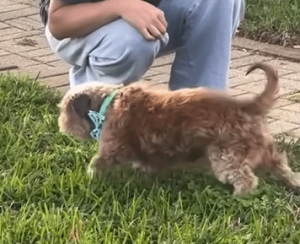
Today, Freddy is almost unrecognizable from the little dog who first entered foster care.
His body is covered in scruffy fur.
He moves through his home with energy.
He plays, runs, seeks affection, and enjoys the safety of a family committed to his continued care.
His past has not been erased.
The effects of spinal compression and prolonged neglect required significant treatment, and his health may always need thoughtful attention. But those challenges no longer represent his entire life.
Freddy is not defined only by the dog who could barely walk.
He is also the dog who kept trying.
The dog who learned to run again.
And the dog whose foster journey led him to someone already waiting nearby.
His transformation did not happen because one person performed a miracle.
It happened because many necessary things were repeated consistently.
Medication.
Physical therapy.
Nutritious meals.
Rest.
Encouragement.
And care that continued even when progress was difficult to see.
His Second Chance Was Created One Small Victory at a Time
Freddy’s story is powerful because his recovery was not immediate or easy.
There were setbacks.
There were days when standing remained difficult.
There were moments when a few steps required every bit of strength he had.
But Caitie continued meeting him where he was.
She did not measure Freddy’s worth by how quickly he healed or whether he could move like other dogs. She cared for him while he was still fragile, stiff, and uncertain.
That patience gave his body time to respond.
It allowed damaged skin to heal.
It helped weakened legs grow stronger.
And it gave the playful dog beneath the exhaustion a chance to appear.
Freddy entered foster care nearly bald and struggling to remain on his feet.
He left with a thick scruffy coat, an energetic personality, and a family of his own.
Better still, the woman who helped him reach that point remains close enough to watch him continue enjoying his new life.
Once, Freddy needed assistance to take only a few steps.
Today, he races through his home toward people who are always happy to see him coming.


