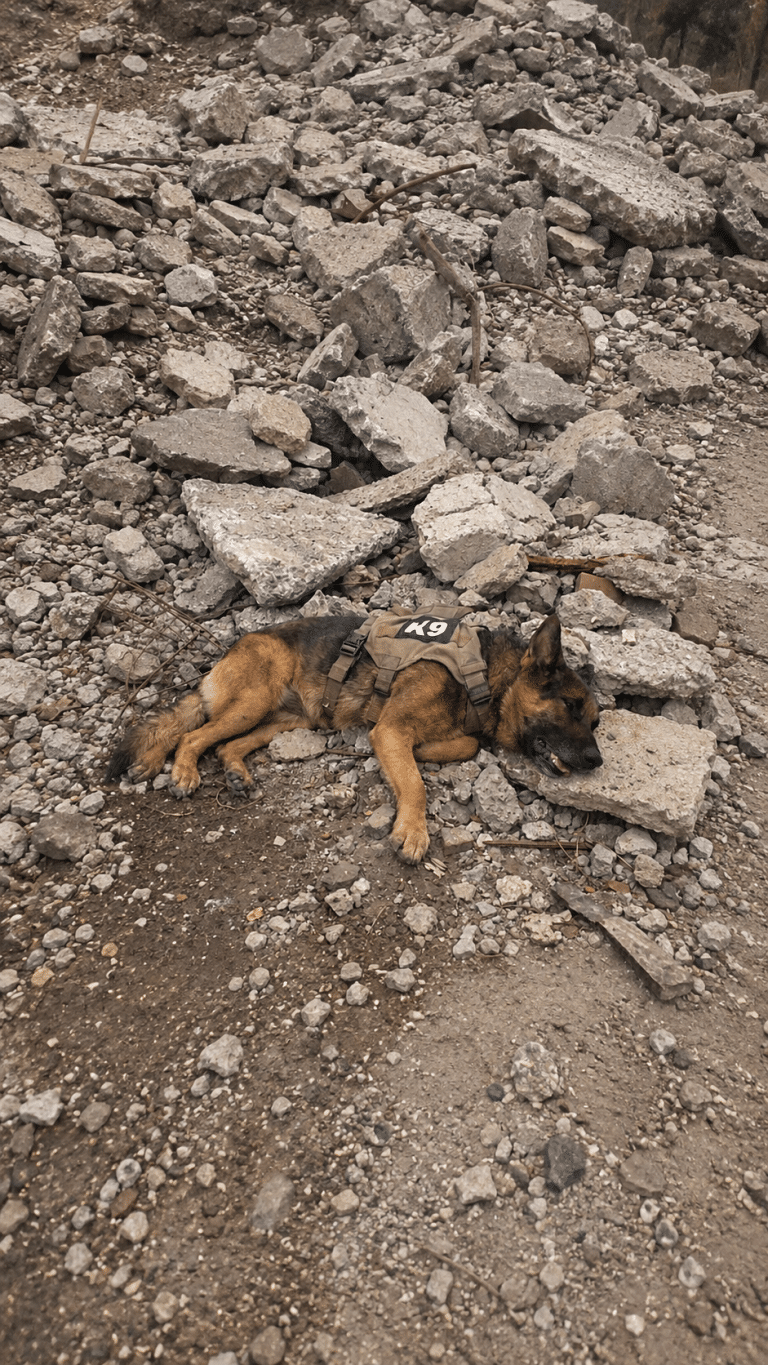
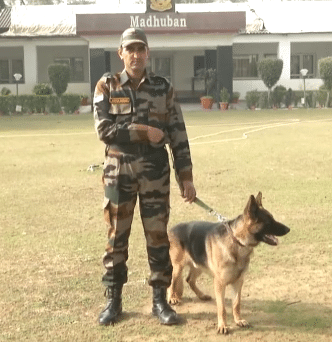
The German Shepherd stood calmly while soldiers secured a specially designed vest around his body.
At first glance, it resembled the protective equipment commonly worn by military working dogs.
Then the camera moved closer.
Attached to the vest was a compact surveillance system capable of transmitting live video and audio back to the dog’s handler.
According to reports surrounding the demonstration, the equipment was developed for the Indian Army’s Military Dog Unit to help soldiers gather information from dangerous locations before personnel move farther inside.
The technology may look futuristic.
But the purpose behind it is immediate: improve situational awareness while offering additional protection to both military dogs and the people working beside them.
A Tactical Vest Designed to Do More Than Protect
Military working dogs have long worn specialized harnesses during patrol, search, and detection assignments.
The equipment shown in the demonstration adds another layer of capability.
Alongside protective material intended to reduce the risk of injury, the vest carries a small camera and audio-transmission system. Footage captured from the dog’s position can reportedly be viewed by soldiers remaining farther behind.
This gives handlers a perspective that would otherwise be impossible to obtain without entering the same space themselves.
A trained dog may be able to move through narrow corridors, tunnels, damaged buildings, or areas where visibility is limited. With a camera attached securely to the vest, the handler can observe obstacles and suspicious activity as the dog advances.
The system does not remove every danger.
But it can provide valuable information before the rest of a team makes its next decision.
Video: Military Dog Tests a Protective Vest With a Live Camera and Audio System
Soldiers Can See What the Dog Encounters
One of the central advantages of the system is real-time communication.
Instead of waiting for the dog to return before interpreting its behavior, handlers may be able to watch the animal’s surroundings as the mission unfolds.
The camera can show the layout of a room.
The audio transmitter may capture nearby movement or voices.
Together, these tools can help soldiers identify hazards, entrances, obstacles, or other details that may not be visible from their position.
Lieutenant Colonel V. Kamal Raj, identified in reports as a leader connected with the unit, described the technology as a force multiplier.
In military terms, that means equipment that helps a team accomplish more effectively without simply adding more personnel.
Even a brief warning can matter in a high-risk environment.
Seeing an obstruction before entering a hallway or identifying movement inside a building may give soldiers time to adjust their approach.
The dog still relies on training and instructions from the handler.
The technology gives the handler a clearer view of what the dog is being asked to investigate.
The Equipment Must Not Prevent the Dog From Moving
A protective vest can only be useful if the dog can still perform comfortably while wearing it.
Military working dogs may need to run, turn quickly, climb, crawl, or pass through confined spaces. Heavy or poorly balanced equipment could restrict those movements and create an additional risk.
The demonstration appears designed to test that concern.
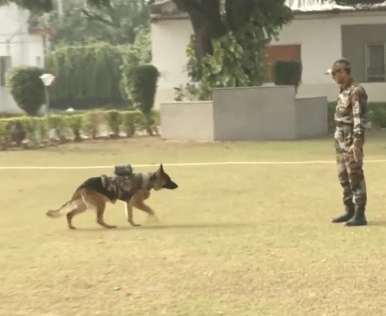
After soldiers secure the vest around the German Shepherd, the dog moves through a field exercise while carrying the camera and protective panels.
He runs across the training area.
He changes direction.
He passes through obstacles without the vest visibly shifting away from its intended position.
The equipment is fitted closely enough to remain stable but not so tightly that it prevents normal breathing or movement.
Handlers also appear to check the straps carefully before allowing the exercise to begin.
Those adjustments are important.
Even advanced technology must be adapted to the individual dog’s size, body shape, training, and role. A vest that works for one animal may require a different fit for another.
The dog’s safety depends not only on the materials used but also on how responsibly the equipment is fitted and monitored.
Military Dogs Still Face Risks Technology Cannot Remove
The camera system may help keep soldiers farther from an uncertain area during the earliest stage of an operation.
However, it also highlights a difficult reality.
The dog is entering the environment first.
Military working dogs may be deployed to detect explosives, locate people, search enclosed spaces, or identify threats that cannot be safely assessed from a distance.
Protective equipment can reduce certain risks, but no vest can make a dangerous mission completely safe.
The term “bulletproof” is also often used broadly in descriptions of tactical armor. In practice, protective equipment usually has specific limits based on its materials, coverage, and testing standards.
A vest may offer resistance against particular threats without protecting every part of the dog’s body or stopping every type of projectile.
That distinction matters.
The technology should not be viewed as permission to expose an animal unnecessarily. Its value lies in providing additional protection during assignments that trained military dogs are already expected to perform.
Responsible use still requires careful planning, veterinary oversight, proper training, and a clear assessment of whether deploying the dog is necessary.
Training Builds Communication Between Dog and Handler
The footage becomes most meaningful during the moments before the dog begins moving.
A soldier checks the vest.
The straps are adjusted.
The handler remains close while the German Shepherd waits for direction.
These actions reveal the amount of communication required before any equipment becomes useful.
A camera cannot tell the dog where to search.
Protective panels cannot replace training.
The success of the mission still depends on the relationship between the dog and the person giving commands.
Military working dogs train extensively to respond in noisy, crowded, and unpredictable environments. They must remain focused despite unfamiliar surfaces, sudden sounds, and the presence of equipment around their bodies.
Handlers, in turn, learn to recognize subtle behavioral signals.
A change in posture may indicate that the dog has detected an unusual scent.
A pause may suggest uncertainty or the presence of an obstacle.
The camera provides additional information, but the handler’s understanding of the individual dog remains essential.
These animals are not remote-controlled machines.
They are trained partners making decisions and responding to commands within complex environments.
Why Dogs Continue to Serve in Specialized Operations
Modern armed forces have access to drones, robots, sensors, and other sophisticated surveillance technology.
Yet working dogs continue to fill roles that machines cannot always perform as effectively.
Their sense of smell allows them to detect substances at concentrations humans would never notice. Their agility lets them move through spaces that may be difficult for larger robotic systems to navigate.
They can adapt quickly to changing terrain.
They can search around obstacles.
And they can communicate findings through behaviors their handlers have been trained to recognize.
Military dogs may assist with explosive detection, patrol work, tracking, search operations, and the identification of hidden people or materials.
The new camera system does not replace those abilities.
It helps soldiers observe them more directly.
Instead of relying only on the dog’s return or behavioral response, handlers can potentially combine the animal’s natural abilities with visual and audio information gathered during the search.
That combination may make operations more informed.
But it also makes the responsibility to protect the dog even more important.
Similar Technology Could Support Rescue Operations
The potential uses of dog-mounted cameras extend beyond military missions.
Search-and-rescue dogs already enter unstable areas after earthquakes, building collapses, landslides, and other disasters. They may reach spaces that are inaccessible to human rescuers during the earliest stages of an emergency.
A lightweight live camera could allow teams to see what the dog encounters.
Rescuers might identify a trapped survivor.
They could examine the condition of a damaged room.
They might also recognize hazards before sending additional personnel into the same area.
Police dogs working in large buildings or difficult terrain could potentially use similar systems, provided the equipment is appropriate for the task and does not interfere with movement.
The technology could also help handlers monitor the dog’s location and physical condition during longer searches.
These possibilities remain dependent on training, cost, reliability, and animal-welfare standards.
Equipment must be durable enough to work in harsh conditions while remaining light, secure, and comfortable for the dog wearing it.
A system designed without those priorities could create more problems than it solves.
The Technology Is Advanced, but the Partnership Remains Essential
The camera and protective vest may be the most visually striking parts of the demonstration.
Yet the system works only because a trained dog is willing and able to operate beside a trusted handler.
Before the exercise begins, the dog waits calmly while soldiers prepare the equipment.
During the exercise, he responds to direction and moves through the course.
Afterward, the handler remains responsible for checking the dog, removing the gear, and monitoring for signs of discomfort or fatigue.
Technology can provide another viewpoint.
Armor can offer an additional layer of protection.
Neither can replace the judgment, care, and communication at the center of a working-dog team.
The footage offers a glimpse of how military operations may continue evolving. Cameras may become smaller. Protective materials may become lighter. Live communication may become faster and more reliable.
But the most important responsibility will remain unchanged.
The people who depend on these dogs must also protect them.
Military working dogs enter difficult environments because of their training, intelligence, and remarkable physical abilities. They deserve equipment designed around their safety—not merely around the information humans hope to obtain.
The German Shepherd in the demonstration may appear to carry technology from the future.
At the center of it, however, is one of the oldest partnerships in human history:
A person giving direction.
A dog placing trust in that person.
And both moving forward together into a place where neither should ever be treated as expendable.


