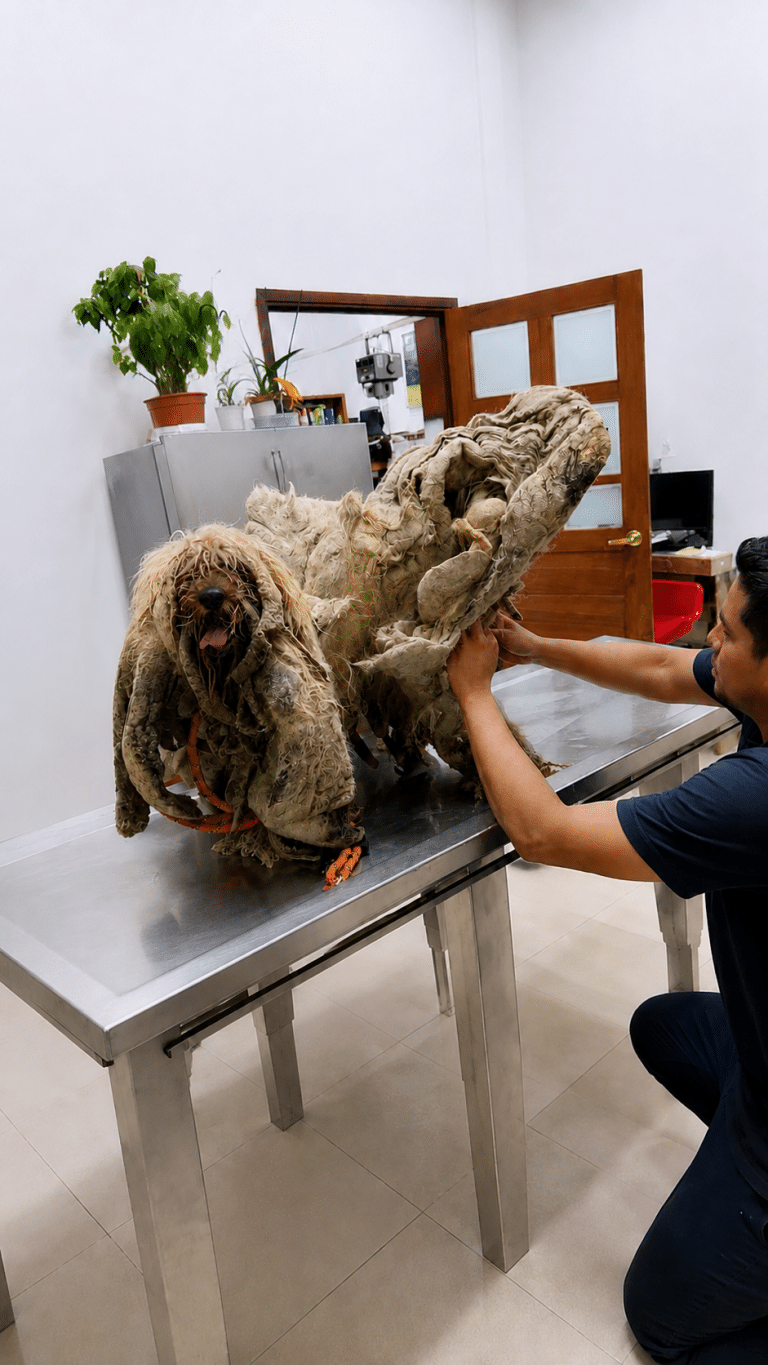
At first, rescuers could not clearly see the dog hidden beneath the enormous mass covering his body.
Thick, hardened fur hung from his sides in heavy sections. Dirt, sand, stones, and other debris had become compressed deep inside the tangled coat, pulling against his skin whenever he tried to move.
The dog could barely walk.
Even turning his body appeared exhausting.
His name would later be Sonador.
But when rescuers first stepped inside the isolated shed where he had been living, they saw an animal whose own fur had become a prison.
A Dog Almost Hidden Beneath Years of Neglect
Sonador had reportedly spent years confined in poor conditions without regular grooming or basic hygiene.
His coat had continued growing, tangling, and collecting debris until it no longer resembled ordinary fur. Dense sections had fused together around his legs, stomach, back, and tail.
The mats restricted nearly every movement.
When Sonador attempted to walk, the heavy coat shifted with him. Some sections pulled tightly against the skin, while others dragged along the ground.
Rescuers approached slowly.
They did not know how he would react to unfamiliar people after so much isolation. Yet Sonador did not snap or attempt to drive them away.
He watched cautiously.
Then, as one volunteer reached toward him, he allowed gentle contact.
The response surprised the team.
Beneath the fear and exhaustion was a dog still willing to accept kindness.
Video: Sonador Could Barely Walk Beneath Years of Matted Fur—Then Rescuers Began Cutting Him Free
The Shed Revealed How Long He Had Been Forgotten
The conditions surrounding Sonador raised immediate concerns.
The shed appeared dirty and isolated, with little evidence that his basic needs had been managed consistently. According to the rescue account, authorities were contacted so the situation could be documented.
While others examined the property, volunteers remained close to Sonador.
They spoke softly and avoided forcing him to move more than necessary. His body was already carrying a tremendous burden, and every unfamiliar sound appeared to make him more alert.
Rescuers also noticed that Sonador behaved differently around other dogs.
Human touch seemed easier for him to accept, while the presence of unfamiliar animals made him nervous. The exact reason could not be known from observation alone, so the team did not force introductions.
His immediate needs were clear.
He required veterinary care.
His skin needed to be examined.
And the hardened coat had to be removed before anyone could understand his true physical condition.
Removing the Fur Required Hours of Careful Work
At the veterinary clinic, the team began cutting through the outer layers of Sonador’s coat.
Ordinary clippers could not move easily through the thickest sections. The fur had become packed with sand, dirt, small stones, and other material collected over a long period of time.
Staff worked piece by piece.
They supported Sonador’s body while separating the mats from his skin. In areas where the coat had tightened closely around his legs or stomach, every cut had to be made with extreme care.
Pulling was not an option.
The skin beneath the mats could be irritated, thin, or hidden completely from view. Moving too quickly risked causing additional injury.
Large sections of compacted fur gradually fell away.
With each piece removed, more of Sonador’s actual body became visible.
His legs were thinner than they had appeared.
His frame was smaller.
And the enormous shape rescuers first encountered had been created partly by years of accumulated material surrounding him.
Sonador remained remarkably patient through the procedure.
He was frightened and tired, but he allowed the veterinary team to continue.
The Scale Revealed the True Weight of His Coat
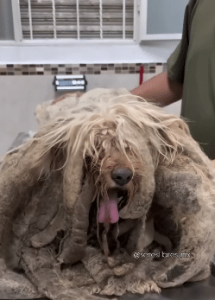
Before the shave, Sonador reportedly weighed approximately 12.1 kilograms.
After the matted coat had been removed, the scale showed about 7 kilograms.
The difference was more than five kilograms.
For a dog of Sonador’s size, that meant a substantial portion of what rescuers had initially seen was not healthy body weight. It was compacted fur, dirt, stones, and debris he had been forced to carry.
The number helped explain why walking had become so difficult.
Every step required him to move not only his weakened body but also the heavy mass attached to it.
Once the final sections were removed, Sonador looked almost unrecognizable.
His body was slim.
His skin was finally visible.
And for the first time, veterinarians could properly inspect the areas that had been hidden beneath the coat.
The shave did not complete his recovery.
It revealed how much recovery he still needed.
His First Free Steps Looked Completely Different
After the procedure, Sonador began testing the way his body moved without the extra weight.
At first, he remained cautious.
Years of restricted movement could not be forgotten immediately. His muscles needed time to adjust, and sensitive skin made gentle handling essential.
But the difference was visible almost at once.
Sonador could turn more easily.
His legs were no longer tied together by thick mats.
His body no longer dragged a heavy coat across the floor.
He took a few steps.
Then several more.
Each movement appeared lighter than the ones rescuers had witnessed inside the shed.
The team allowed him to explore at his own pace. There was no expectation that he would immediately run or play like a fully recovered dog.
Freedom of movement was new.
He needed time to discover what his body could do without the burden that had surrounded it for so long.
The Dog Beneath the Mats Slowly Emerged
As Sonador recovered, his caregivers began seeing more of his personality.
He showed curiosity about his surroundings.
He approached familiar people for attention and appeared increasingly comfortable receiving gentle affection.
Playfulness emerged gradually.
At first, Sonador simply watched movement around him. Later, he began engaging more directly, following caregivers and investigating objects nearby.
His fear around other dogs required patience.
Rather than forcing him into stressful interactions, the rescue team allowed him to observe from a safe distance and introduced new experiences carefully.
Emotional recovery does not follow the same schedule as a haircut.
The mats could be removed in hours.
Trust, confidence, and comfort required repeated safe experiences.
A calm voice.
A meal delivered on time.
A hand that stopped when he became uncomfortable.
Through those ordinary moments, Sonador began learning that his new environment was different from the place he had left behind.
Proper Care Replaced the Burden He Had Carried
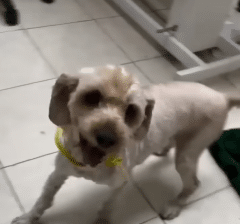
Sonador’s days now included the basic care he had been missing.
Regular meals helped restore strength to his thin body.
Veterinary attention addressed concerns hidden beneath the coat.
Clean bedding gave his sensitive skin a comfortable place to rest.
And caregivers monitored him as his fur began growing back.
This time, his coat would not be allowed to become painful or restrictive.
Grooming became part of his health rather than a cosmetic detail. Brushing, trimming, and skin checks helped prevent the same kind of matting from forming again.
The dog who once struggled beneath five kilograms of tangled debris could now move freely through his surroundings.
He no longer had to remain inside the filthy shed.
He could walk toward people.
Choose a comfortable place to rest.
And begin experiencing a life shaped by care instead of neglect.
Sonador Was Finally Free to Become Himself
Sonador’s transformation is dramatic because the physical evidence of neglect could be removed and weighed.
More than five kilograms separated the dog who entered the clinic from the one who stepped away after grooming.
But the scale told only part of the story.
The coat had restricted his movement.
Isolation had limited his experiences.
And the absence of basic care had allowed a preventable problem to become severe.
His recovery required people willing to look beyond the overwhelming appearance of his fur and recognize the dog still living underneath it.
Rescuers removed him from the shed.
Veterinary staff worked carefully through the hardened layers.
Caregivers remained patient as he learned to move and interact more confidently.
Sonador did not need to appear cheerful before deserving help.
He did not need to trust immediately.
His life mattered while he was still frightened, burdened, and barely able to walk.
Once, every movement pulled against years of accumulated neglect.
Now Sonador can turn, explore, and approach the people around him without carrying a weight his body was never meant to bear.
His fur had become a prison.
Compassion finally opened the door.


