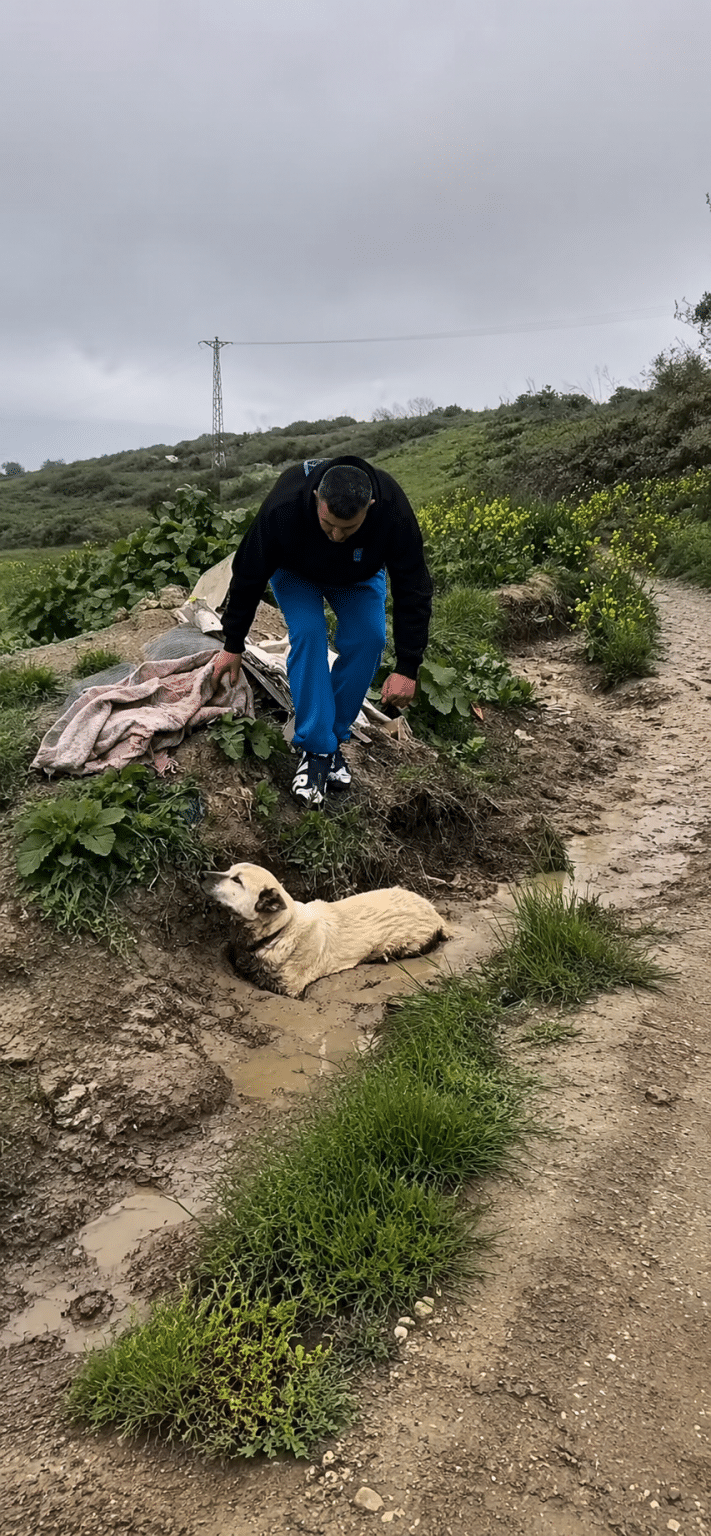
From the edge of the muddy pit, the dog looked impossible to reach.
His large body twisted through the thick mud as he barked and snapped at every movement above him. Whenever a man tried to come closer, the frightened animal lunged forward, then slipped back into the hole he was desperately trying to escape.
The more he struggled, the deeper his paws sank.
There was no safe path out.
And although help had finally arrived, the dog could not yet understand that the person approaching him was there to save his life.
Trapped in Mud With Nowhere to Run
The pit was deep enough that the dog could not climb out on his own.
Its sides were steep and slick, offering almost nothing for his paws to grip. Each attempt to scramble upward ended with his body sliding back into the mud.
By the time the rescuer reached him, the dog was exhausted.
But exhaustion had not made him calm.
He barked continuously, showing his teeth whenever the man moved closer. His body remained tense, and every unfamiliar sound appeared to increase his panic.
From the dog’s perspective, he was cornered.
He could not escape the pit.
He could not create distance from the stranger above him.
And he had no way of knowing whether the hands reaching toward him would bring safety or something else.
The rescuer did not treat the reaction as a challenge.
He did not shout or attempt to overpower the dog immediately.
Instead, he picked up a wooden board and held it carefully between them, creating a barrier that protected both of them while giving the animal time to adjust to his presence.
Video: Terrified Dog Lunges at the Man Pulling Him From a Deep Mud Pit
The Rescuer Refused to Answer Fear With Force
The man remained near the edge of the pit and spoke in a quiet, steady voice.
The dog continued barking.
When the rescuer shifted his position, the animal lunged toward the board. His jaws snapped against the empty space in front of him before he slipped back into the mud.
It would have been easy to label the dog aggressive.
But his behavior appeared defensive rather than calculated.
He was trapped, exhausted, and unable to move away from something that frightened him. With escape no longer possible, barking and snapping were the only tools he had left to create distance.
The rescuer seemed to understand this.
He kept the board in place but did not strike the dog with it. He used it only as a shield, allowing himself to move closer without placing his hands directly in front of the frightened animal.
Each movement was slow.
Each pause gave the dog another moment to breathe.
There was no dramatic breakthrough in which the animal suddenly became trusting.
Fear remained present throughout the rescue.
The difference was that the man did not allow that fear to make him abandon the dog.
Every Movement Became More Difficult
The mud complicated every part of the operation.
It clung to the rescuer’s legs and made it difficult to maintain balance. The dog’s paws repeatedly disappeared beneath the thick surface, limiting his ability to help himself.
Whenever the man tried to guide him toward the shallower side of the pit, the dog resisted.
He twisted away.
He barked.
He tried to lunge again, though each attempt appeared weaker than the last.
The rescuer had to work carefully enough to avoid frightening him further, yet quickly enough to prevent complete exhaustion.
Using the board to redirect the dog, he gradually moved him closer to an area where he could be lifted.
The dog did not cooperate because he suddenly understood the plan.
He was simply running out of strength.
That made the moment more urgent.
His defensive reactions were becoming slower, but not because the fear had disappeared. His body could no longer sustain the same frantic struggle.
After several tense attempts, the rescuer finally secured him.
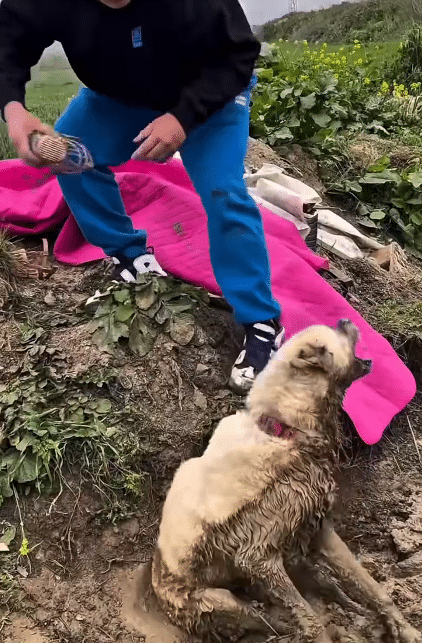
With mud covering them both, the man pulled the large dog upward until his body cleared the edge of the pit.
For the first time, the animal stood on firmer ground.
But being free from the hole did not mean he felt safe.
Outside the Pit, His Body Still Expected Danger
Once above ground, the dog remained rigid and uncertain.
His breathing was heavy.
Mud covered his coat.
His eyes followed every movement the rescuer made, and his posture suggested that another defensive reaction could come without warning.
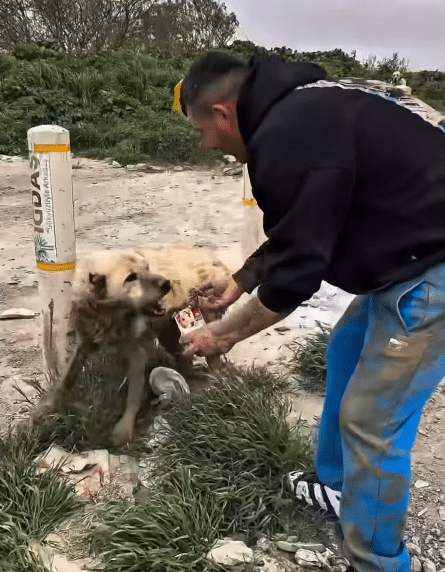
To move him safely, the rescuer placed a muzzle over his mouth.
The muzzle was not used as punishment.
It protected the man while allowing him to lift and transport a frightened dog whose reactions remained unpredictable.
Even then, the rescuer handled him gently.
He did not scold the animal for snapping during the rescue. He did not become angry when the dog struggled.
Instead, he lifted the muddy body into his arms and carried him away from the pit.
The contrast was difficult to ignore.
The dog still appeared prepared to defend himself.
The man holding him remained patient.
Both were covered in mud, yet the rescuer’s movements stayed controlled and careful as he brought the animal toward a safer place.
The physical rescue was complete.
The quieter work of helping the dog settle had only begun.
A Bowl of Food Changed the Atmosphere
Once they reached safety, the rescuer removed the muzzle and placed food nearby.
At first, the dog did not move toward it.
His body remained tense as he watched the man beside him. After everything that had happened, he had little reason to understand the sudden change in his surroundings.
Then he noticed the food.
Hunger slowly drew his attention away from the unfamiliar person.
He leaned forward.
He sniffed the bowl.
And finally, he began to eat.
The change was not magical or complete, but it was visible.
The barking stopped while he focused on the meal.
His posture became less rigid.
The frantic movements seen inside the pit began to settle.
For the first time during the rescue, the dog was able to do something other than fight, flee, or remain prepared for danger.
He ate.
And the man stayed nearby without taking the food away or forcing physical contact.
That quiet experience offered the dog a new piece of information.
The person beside him had pulled him from the mud.
Now that same person was giving him something he desperately needed.
Fearful Behavior Is Often Misunderstood
Stories like this reveal how easily fear can be mistaken for aggression.
A dog who barks, growls, or snaps can appear dangerous. In some situations, those behaviors do create a genuine safety risk and must be handled carefully.
But they do not always reveal the animal’s ordinary temperament.
A trapped dog has few choices.
He cannot explain that he is overwhelmed.
He cannot ask someone to move more slowly.
He cannot understand the tools being used around him or the intentions of the people reaching toward him.
He can only react with the behaviors available to him.
This rescuer protected himself without punishing the dog.
He used a barrier.
He used a muzzle for transportation.
He kept his hands controlled and respected the fact that the animal was frightened.
Most importantly, he did not demand trust before offering help.
The dog did not have to become friendly to deserve rescue.
He did not have to stop barking before the man decided his life was worth saving.
Care came first.
Trust, if it came at all, would need to follow later.
The Dog Beside Him Was No Longer Fighting
By the end of the footage, the dog looked noticeably calmer.
He sat near the man who had pulled him from the pit, no longer lunging with the same frantic intensity. His body still carried signs of exhaustion, and one peaceful meal could not erase whatever had made human contact so frightening.
But the immediate danger had passed.
There was solid ground beneath him.
Food was within reach.
And the person beside him had responded to every defensive reaction with patience rather than anger.
The most powerful part of the rescue was not that the dog became completely trusting within minutes.
It was that the rescuer never required him to.
He understood that the barking was communication.
The snapping was a warning.
The struggle was the reaction of an animal who felt he had nowhere left to go.
So the man protected himself, continued carefully, and brought the dog out anyway.
Inside the pit, the animal appeared ready to fight anyone who came close.
Outside it, with food in front of him and danger behind him, his body finally began to settle.
Beneath the growling was not a cruel dog.
There was a frightened animal whose behavior said, as clearly as it could, that the world did not yet feel safe.
The rescuer listened.
And instead of walking away, he stayed long enough to show the dog that this encounter could end differently.


