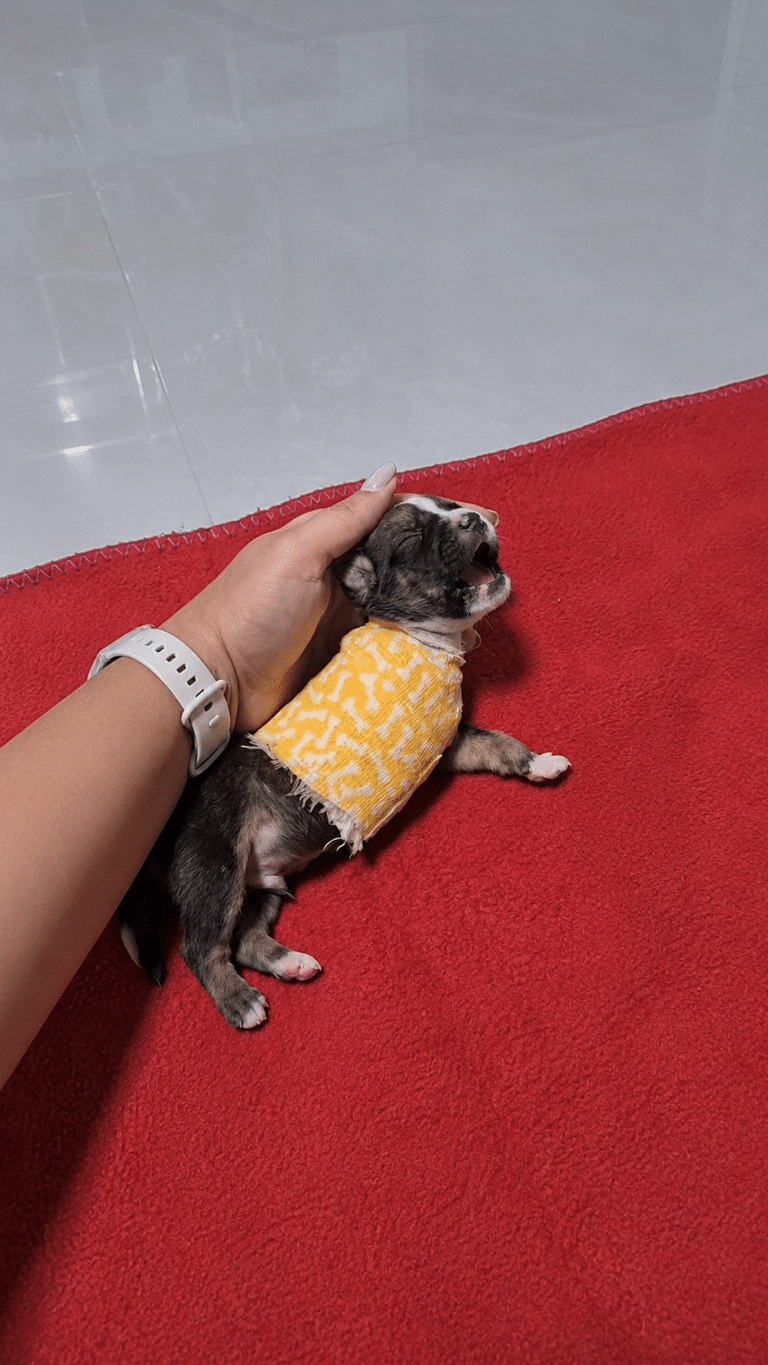
Happy was only 10 days old when rescuers found him.
At an age when a puppy should have been sleeping beside his mother, drinking milk, and discovering the world from somewhere warm, he was lying near a pile of garbage with a severely injured leg.
His body was tiny.
His movements were weak.
Even the soft cries expected from a newborn puppy had become difficult for him to make.
Rescuers lifted him carefully and rushed him to a veterinary clinic, knowing that saving such a young and fragile animal would depend on what happened next.
His Injured Leg Could Not Be Saved
At the clinic, the veterinary team examined Happy immediately.
The damage to one of his legs was too severe for treatment to restore it. Continuing without surgery would have placed the newborn puppy at even greater risk.
The doctors made the difficult decision to remove the damaged part of the limb.
For a puppy only days into life, the procedure was an enormous challenge. His body was extremely small, and he had almost no strength to spare.
Afterward, Happy needed constant attention.
His caregivers cleaned and monitored the surgical area, administered the necessary medication, and watched closely for any change in his condition.
Because he was still too young to eat independently, he also needed milk from a bottle every two hours.
Day and night, someone remained nearby.
Happy had survived the surgery.
Now his tiny body had to find the strength to heal.
Video: Tiny Puppy Loses a Leg at 10 Days Old—Then Learns to Run Again
The First Days Were Filled With Uncertainty
Recovery did not begin smoothly.
Happy developed fevers, and there were nights when he cried despite the warmth and care surrounding him. His caregivers could not know how well such a young puppy would respond after everything his body had endured.
They continued feeding him on schedule.
They kept him clean and warm.
They checked his temperature and monitored the healing limb while giving him a quiet place to rest.
At first, progress was almost too small to notice.
Then Happy began drinking more eagerly from the bottle.
His weight slowly increased.
He became more responsive when familiar caregivers approached.
One day, his tiny tail moved.
It was only a brief wag, but it gave everyone around him a reason to believe his strength was returning.
His recovery was not guaranteed.
But Happy was beginning to participate in it.
He Began Discovering the Life of a Puppy
As the weeks passed, Happy’s world grew beyond medicine and scheduled feedings.
He experienced warm baths.
He rested on soft blankets.
He discovered toys he could mouth and carry.
And he began responding to the gentle hands that had cared for him since the day he arrived.
These ordinary experiences mattered.
Happy’s earliest days had been shaped by injury and emergency treatment. Now he was finally learning the simple routines that should belong to every young dog.
He ate.
He slept.
He explored.
He sought attention from the people nearby.
The missing leg changed the way his body moved, but it did not prevent him from behaving like a curious puppy.
Soon, he began attempting to stand.
His first efforts were unsteady.
Without four legs beneath him, his balance shifted differently. He leaned to one side, stumbled, and sometimes lowered himself back to the floor after only a few seconds.
But he kept trying.
Three Legs Did Not Stop Him for Long
Happy gradually learned how to distribute his weight across his remaining legs.
At first, he moved with small hops.
He tipped sideways when he tried to turn too quickly.
A short trip across the room could end with him sitting down unexpectedly.
His caregivers stayed close but allowed him to practice.
Each attempt helped him understand his changing body a little better.
Before long, Happy could follow people around the room. He moved toward familiar voices, chased after toys, and demanded affection whenever someone sat close enough for him to climb onto their lap.
The puppy who had once struggled to move at all was now difficult to keep still.
His progress did not come from one dramatic breakthrough.
It came through repetition.
Stand.
Stumble.
Rest.
Try again.
With each attempt, Happy became more confident on three legs.
Doctors Preserved a Possibility for His Future
During Happy’s early treatment, veterinarians had preserved part of the affected limb.
That decision left open the possibility that he might someday use a prosthetic leg.
A prosthetic was not required for Happy to enjoy life. He had already shown that he could move, play, and explore using three legs.
But as he grew, an appropriate device might provide additional support and help distribute pressure more evenly across his body.
When a custom prosthetic was eventually prepared, no one knew how Happy would respond.
The new attachment would feel unfamiliar.
It would change his balance again.
And wearing it would not automatically teach him how to walk.
The process would require patience—the same kind of patience that had carried him through bottle feedings, recovery, and his first attempts to stand.
His First Steps With the Prosthetic Were Wobbly
When the prosthetic was fitted, Happy initially appeared unsure of it.
He looked toward the unfamiliar attachment and shifted his body as though trying to understand why his movement suddenly felt different.
His caregivers encouraged him with calm voices and treats.
They did not expect him to begin running immediately.
First, he needed to place the prosthetic against the ground.
Then he needed to trust that it could support him.
Happy took one cautious step.
His body wobbled.
He adjusted and tried again.
Step by step, he began including the prosthetic in his movement instead of holding it away from the floor.
The progress was slow at first, but the pattern was already familiar.
Happy had learned to balance after losing a leg.
Now he was learning balance all over again with additional support.
Before long, the uncertainty gave way to greater confidence.
Once Happy understood how to use the prosthetic, he began moving with the same enthusiasm he brought to everything else.
By Christmas, He Was Almost Unrecognizable
Months after his rescue, Happy no longer resembled the fragile newborn found beside the garbage.
He had grown into a playful and energetic young dog.
He could move confidently.
He followed his caregivers, played with toys, and settled comfortably into the arms of the people who had stayed beside him throughout his recovery.
By Christmas, the difference was striking.
The puppy once dependent on a bottle every two hours was now active and curious. The uncertain first attempts to balance had become eager movement around the room.
His prosthetic was only one part of that transformation.
The greater change had come from the daily care surrounding him.
Regular meals.
Medical attention.
Warmth.
Practice.
And people willing to continue even when progress could only be measured in tiny steps.
Happy’s Recovery Was Built One Day at a Time
Surgery saved Happy from the immediate danger caused by his injured leg.
But surgery alone did not create the dog he later became.
His recovery required caregivers to feed him throughout the night when he was too young to eat alone.
It required close observation during the days when fever made his future uncertain.
It required allowing him to stumble without treating every fall as failure.
And when the prosthetic arrived, it required beginning another patient learning process from the first step.
Happy’s story became widely shared because his transformation was easy to see.
A tiny puppy who could barely move grew into a dog who could run, play, and seek affection.
But the most meaningful part of his journey may have happened between those visible milestones.
Someone prepared another bottle.
Someone cleaned his bedding.
Someone steadied him and then allowed him to try again.
Happy did not recover in one miraculous moment.
He recovered because care continued.
At 10 days old, he lost part of a leg before he had even learned how to walk.
Then, surrounded by people who refused to give up on him, he learned twice—first on three legs, and later with a prosthetic.
His earliest days began beside a pile of garbage.
The life that followed was filled with warm blankets, playful movement, and arms ready to hold him whenever he finally became tired.
Happy’s name could not change what happened to him.
But the people who stayed beside him helped ensure it would describe the life still waiting ahead.


